Quick Answer: Yes. When provisional assessment under Rule 7 of the Central Excise Rules, 2002 is finalised on annual costing, excess excise duty paid in one part of the year must be adjusted against short-payment in another. The Rajasthan High Court set aside a Rs. 1.16 crore demand, but allowed no cash refund or interest on the excess.
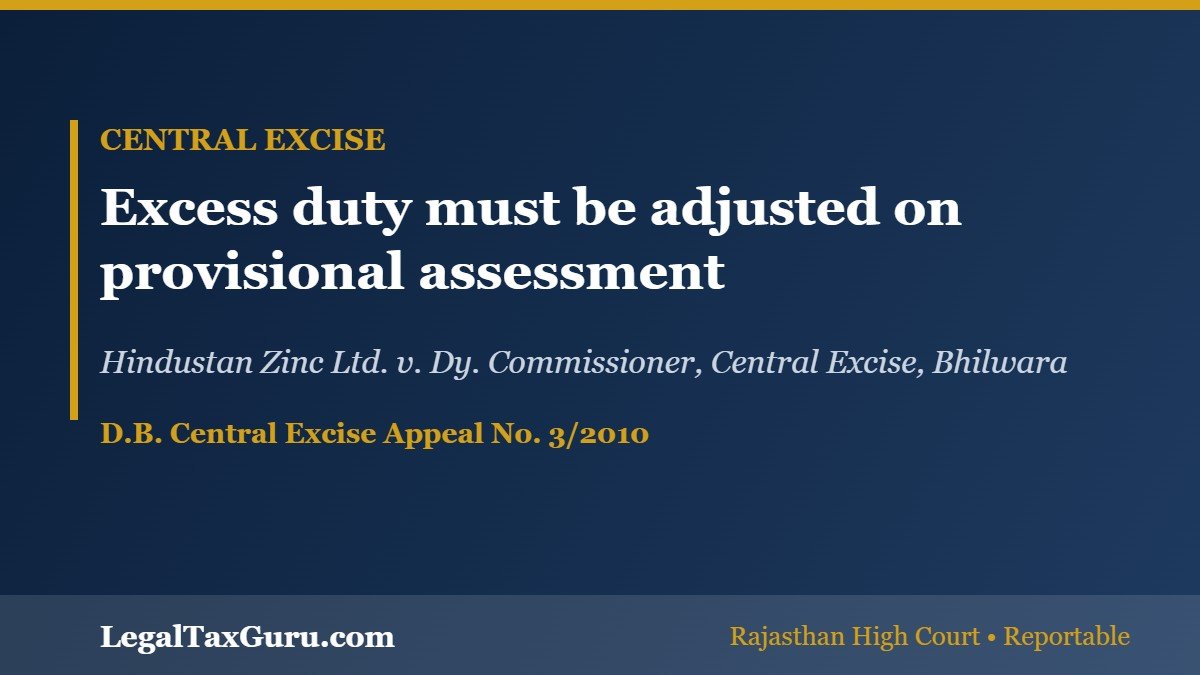
In Hindustan Zinc Limited v. Dy. Commissioner, Central Excise Division, Bhilwara (D.B. Central Excise Appeal No. 3/2010), the Rajasthan High Court held that on finalisation of provisional assessment under Rule 7 of the Central Excise Rules, 2002, the Department cannot split a financial year into two parts and recover a short-payment for one part while ignoring excess duty paid in the other (paras 10–12). The Division Bench allowed the assessee's appeal and set aside the CESTAT order dated 14.05.2009 to the extent it denied adjustment (paras 21–24). It ruled that adjustment of duty already deposited is different from a refund, so the unjust enrichment bar and Rule 7(6) do not block it (paras 13–16). The demand of Rs. 1,16,53,609/- and the interest on it were set aside, subject to adjustment in the duty account. However, the assessee gets no cash refund and no interest on the excess duty (paras 18–20, 23).
Headnote: Provisional Assessment and Excess Duty Adjustment
Central Excise Act, 1944 – Section 11B(2) – Central Excise Rules, 2002 – Rule 7(3), 7(4), 7(5), 7(6) – Central Excise Valuation (Determination of Price of Excisable Goods) Rules, 2000 – Rule 8 – CAS-4 – Provisional assessment – Finalisation – Bifurcation of financial year – Adjustment of excess duty against short-payment – Unjust enrichment – Refund distinguished from adjustment – Interest.
Held: (i) On finalisation of provisional assessment, the method used to fix assessable value must be applied consistently to compute duty liability; where value rests on annual CAS-4 costing, duty paid during the whole year must be counted (paras 9–9.3).
(ii) No provision of the Central Excise Rules, 2002 authorises the Department to bifurcate a financial year and recover a short-payment for one period while ignoring excess payment for the rest; such bifurcation cannot be sustained (paras 10–12).
(iii) Rule 7(6) governs how a refund is dealt with; it does not require the Department to disregard excess duty already deposited while fixing net liability. Adjustment is distinct from a cash refund (paras 13–14.1, 15).
(iv) The passing on of duty incidence to captive smelting units and their availment of CENVAT credit are relevant to a refund claim, not to adjustment in computing net duty (paras 15.1–15.3, 16).
(v) Since only adjustment is allowed and no refund is ordered, the assessee is not entitled to interest on the excess duty under Rule 7(5) (paras 17–18.1).
(vi) The Department cannot demand interest on an alleged short-payment without first giving effect to the adjustment; interest cannot be levied on a shortfall that no longer exists (paras 19–20, 23).
(paras 7–24)
Case Details: Hindustan Zinc v. Dy. Commissioner, Central Excise (D.B. Central Excise Appeal No. 3/2010)
Final Outcome: Appeal allowed; CESTAT order dated 14.05.2009 and the consequential demand set aside to the extent they denied adjustment of excess duty; no cash refund or interest on excess duty.
Case: Hindustan Zinc Limited (Unit: Rampura Agucha Mines, Bhilwara) v. Dy. Commissioner, Central Excise Division, Bhilwara
Neutral Citation: Not printed on the judgment; cited as D.B. Central Excise Appeal No. 3/2010
Case No.: D.B. Central Excise Appeal No. 3/2010 (CNR: RJHC010416872009)
Court: Rajasthan High Court, Jodhpur (Division Bench)
Date of Decision: 16 October 2026 (reserved on 09 October 2026)
Bench: Justice Arun Monga and Justice Sunil Beniwal (authored by Justice Sunil Beniwal)
Relevant Acts & Sections: Central Excise Act, 1944 – Section 11B(2); Central Excise Rules, 2002 – Rule 7(3), 7(4), 7(5), 7(6); Central Excise Valuation (Determination of Price of Excisable Goods) Rules, 2000 – Rule 8; CAS-4
Impugned Order: Order dated 14.05.2009 of the Customs, Excise and Service Tax Appellate Tribunal, New Delhi in Appeal No. E/2622/2006, affirming Order-in-Original No. 57/05-06 (Prov. Ass.) dated 30.11.2005 and the order of the Commissioner (Appeals-II), Jaipur dated 28.04.2006
Source: Rajasthan High Court (official website)
Key Holdings of the Rajasthan High Court
- Splitting a financial year into a "short-paid" and an "excess-paid" period has no statutory basis; the Department could not point to any enabling provision (paras 11–12).
- Adjustment of excess duty against short-payment while computing net liability is not a refund; Rule 7(6) and the unjust enrichment bar do not prevent it (paras 13–15, 16).
- The ruling is fact-specific: it does not hold that duty on every clearance must always be assessed annually (para 10.2).
- No interest on excess duty is payable to the assessee, but no interest can be demanded on a shortfall that disappears on adjustment (paras 18–20).
Brief Facts of the Case
The appellant is the Rampura Agucha mining unit of Hindustan Zinc Limited, which makes lead and zinc concentrate, mostly consumed by the company's own smelting units. As value depended on cost of production and dry metric tonne (DMT) weight, provisional assessment was permitted on 25.04.2000 and finalised yearly (para 2).
For 2004–05, the appellant first adopted a provisional value of Rs. 5,050/- per metric tonne, later raised to Rs. 5,200/-, Rs. 5,875/- and Rs. 6,500/- because of plant expansion costs. The annual costing fixed the value at Rs. 5,333/- per metric tonne, which the Department accepted (para 2.1).
By Order-in-Original No. 57/05-06 (Prov. Ass.) dated 30.11.2005, the Deputy Commissioner fixed total duty for 2004–05 at Rs. 33,65,43,811/- and recorded deposits of Rs. 34,19,68,596/-. Even so, he ordered recovery of Rs. 1,16,53,609/- as short-payment for 01.04.2004 to 19.12.2004, with interest under Rule 7(4) (para 2.2).
The Commissioner (Appeals-II), Jaipur dismissed the appeal on 28.04.2006, holding that duty incidence had been passed on to the buyer. The CESTAT, New Delhi dismissed Appeal No. E/2622/2006 on 14.05.2009, which led to this appeal (paras 2.3–2.4).
Issues Before the High Court
The appeal was admitted on 13.01.2010 on three questions of law (para 6):
- Whether one year can be bifurcated into two parts to hold that the assessee short-paid duty in the first part and paid excess in the other (paras 7–12).
- Whether duty paid in excess under Rule 7 of the Central Excise Rules, 2002 can be adjusted against duty short-paid (paras 13–16).
- Whether the assessee is entitled to claim interest on the excess duty paid (paras 17–20).
Court's Findings and Reasoning
Arguments (paras 3–4.3): Hindustan Zinc argued that it had paid Rs. 54,24,785/- more than the total liability, no law allowed the year to be split, and duty on captive transfers was available as CENVAT credit, so incidence was not passed on under Section 11B(2). It sought only adjustment, not refund. The Department replied that there was a short-payment of Rs. 1,16,53,609/- for the first period and excess of Rs. 1,70,78,391/- for 20.12.2004 to 31.03.2005, the smelting units had availed credit, the appellant had by letter dated 14.09.2005 given up refund, and Rule 7(3) read with Rule 7(6) barred both refund and adjustment (paras 3–4.3).
Issue 1 – Scheme of Rule 7 and consistency (paras 7–9.3): Rule 7 contemplates provisional assessment followed by final assessment, and one method cannot be used to fix value and an inconsistent one to compute duty (paras 8–9). Following the Karnataka High Court in Toyota Kirloskar and the Madhya Pradesh High Court in Godrej Consumer Products, the Bench held that where value rests on annual cost of production, duty paid during the year cannot be ignored because different parts of the year show different results (paras 9.1–9.3).
Issue 1 – Bifurcation not permissible (paras 10–12): On the Department's own figures, the appellant had paid Rs. 54,24,785/- more than the final annual liability. Treating Rs. 1,16,53,609/- as short-paid while separately noting excess of Rs. 1,70,78,391/- "fails to give effect to the overall result of the final assessment" (paras 10–10.1). The Court clarified that it was not laying down that every clearance must be assessed annually; the point was that provisional assessment was permitted and value was fixed through annual costing (para 10.2). When asked, the Department's counsel could not show any provision allowing such bifurcation, so it could not stand (para 11). Issue 1 was answered for the appellant (para 12).
Issue 2 – Adjustment is not refund (paras 13–14.3): Rule 7(6), which sends refundable amounts to the Consumer Welfare Fund unless incidence is not passed on, governs how a refund is dealt with; the real question was whether the deposit must be counted in computing net duty (paras 13–14). Relying on Associated Cement Co. Ltd. v. Commercial Tax Officer, Kota, (1981) 4 SCC 578, on construing machinery provisions to serve the scheme, the Court held that Rules 7(5) and 7(6) cannot be read as requiring the Department to ignore excess duty already deposited (para 14.1).
Issue 2 – Unjust enrichment and CENVAT credit (paras 15–16): The Department's points on CENVAT credit and the letter dated 14.09.2005 were relevant to refund, not to adjustment. Adjustment gives no cash; it only ensures recovery of duty, if any, that remains payable (para 15.1). The Department's reading would let it keep the excess while recovering the shortfall "as though that excess payment had never been made", an anomalous result (paras 15.2–15.3). Issue 2 was answered for the appellant, but limited to adjustment and not cash refund (para 16).
Issue 3 – Interest (paras 17–20): Since the appellant sought only adjustment, it was not entitled to interest on excess duty as though a refund were ordered; Rule 7(5) applies to refunds (paras 17–18.1). Equally, once excess is set off, interest cannot be imposed on a shortfall that no longer exists, and the Department cannot demand interest without first giving effect to the adjustment (paras 19–20).
Final Outcome and Directions
- Appeal allowed; CESTAT order dated 14.05.2009 and the consequential demand under the Order-in-Original dated 30.11.2005 set aside to the extent they deny adjustment (para 21).
- Demand of Rs. 1,16,53,609/- and consequential interest set aside, subject to giving effect to the adjustment in the appellant's duty account (para 23).
- No cash refund and no interest on excess duty directed (paras 23–24).
- The Department to carry out the consequential exercise in accordance with law, considering total annual liability and duty already deposited; if records confirm the final assessment figures, no further duty is recoverable on this demand (para 23).
- Questions of law answered for the appellant, except the claim for interest on excess duty; pending applications disposed of (paras 24–25).
Legal Principle Laid Down
On finalisation of provisional assessment under Rule 7 of the Central Excise Rules, 2002, where assessable value is fixed on the basis of annual cost of production (CAS-4), the Department must compute net duty for the same period on the same basis and give credit for all duty deposited in that period. No provision permits bifurcating the year. Adjustment is distinct from refund, so Rule 7(6) and unjust enrichment do not bar it. No interest is payable on excess duty when only adjustment is allowed, and no interest can be demanded on a shortfall that vanishes on adjustment.
Precedents Relied Upon
- Toyota Kirloskar Auto Parts Pvt. Ltd. v. C.C.E., LTU, Bangalore, C.E.A. No. 103/2010, decided on 13.10.2011 (Karnataka High Court) – Relied upon – overall duty position to be considered on finalisation before levying interest on a shortfall. Discussed at paras 3.3, 9.1, 14.2.
- Principal Commissioner, CGST and Central Excise, Bhopal v. Godrej Consumer Products Ltd., C.E.A. No. 13/2019, decided on 23.04.2019 (Madhya Pradesh High Court) – Relied upon – excess duty in some months adjustable against short-payment in others under annual CAS-4 costing; unjust enrichment no bar where no refund claimed. Discussed at paras 3.3, 9.2, 14.3.
- Associated Cement Co. Ltd. v. Commercial Tax Officer, Kota & Ors., (1981) 4 SCC 578 – Relied upon – machinery provisions to be construed to give effect to the statutory scheme. Discussed at para 14.1.
- Hindustan Zinc Ltd., CESTAT Final Order Nos. 1199/06 (04.08.2006), 447/2008-Excise (10.07.2008) and A/53134/2015-EX (DB) (06.10.2015) – Cited by appellant. Discussed at paras 3, 3.3.
Important Paragraphs of the Judgment
Verbatim extracts from the judgment.
Para 9: "The assessment cannot be finalised by adopting one method for determining the assessable value and another, inconsistent method for calculating the resulting duty liability."
Para 10.1: "Once the assessable value has been determined on the basis of annual costing, the Department cannot disregard the excess payment made during the remainder of the same financial year while enforcing the demand arising from the earlier period."
Para 11: "In the absence of any enabling provision, such bifurcation, particularly when the assessable value was determined on the basis of annual costing, cannot be sustained in law."
Para 14.1: "The question of adjustment of the duty already paid is distinct from the question of entitlement to receive a refund in cash."
Para 15.1: "The fact that the recipient units have availed CENVAT credit cannot, by itself, justify calculating the appellant's duty liability without giving credit for the duty already deposited."
Para 19: "Once the excess duty is taken into account and the net duty liability is determined, interest cannot be imposed on a shortfall that no longer exists."
Practical Impact of the Ruling
- For manufacturers under provisional assessment: Where value is fixed on annual CAS-4 costing, insist that net liability be worked out for the whole period, with credit for every deposit made during the year (paras 9.3, 10.1).
- For captive-consumption units: Availment of CENVAT credit by sister units may defeat a refund, but not the set-off of excess duty against a short-payment in the same assessment (paras 15.1, 16).
- For tax litigation lawyers and excise appeal counsel: Frame relief as adjustment, not refund. Pressing a cash refund invites the unjust enrichment bar under Section 11B(2) and Rule 7(6), while adjustment does not (paras 13–15.1).
- For the Department: Period-wise bifurcation of a financial year needs a statutory basis; none was shown. Interest under Rule 7(4) must be computed only after giving effect to adjustment (paras 11, 19–20).
- Limit on relief: No interest on excess duty where only adjustment is granted, and the ruling is fact-specific (paras 10.2, 18–18.1).
FAQs on Provisional Assessment and Excess Duty Adjustment
1. What did the Rajasthan High Court hold in Hindustan Zinc v. Dy. Commissioner, Central Excise, Bhilwara?
It held that on finalisation of provisional assessment based on annual costing, excess duty paid in one part of the year must be adjusted against short-payment in another. It set aside the demand of Rs. 1,16,53,609/- and the interest on it, subject to adjustment (paras 12, 16, 23).
2. Can the excise department split a financial year into two periods on finalisation of provisional assessment?
Not on these facts. The Department could not point to any provision allowing such bifurcation where value was fixed on annual costing, so the split could not be sustained (paras 10–12).
3. Does unjust enrichment bar adjustment of excess excise duty against short-payment?
No. Rule 7(6) and unjust enrichment concern refunds. Adjustment in computing net liability is different and gives no cash to the assessee (paras 14–15.1).
4. Is the assessee entitled to interest on excess duty in such a case?
No. Interest under Rule 7(5) is linked to refunds; since only adjustment was allowed, no interest on excess duty was granted (paras 18–18.1, 20).
5. Can interest be charged on the short-paid amount for the earlier period?
Only after adjustment. Interest cannot be imposed on a shortfall that no longer exists once the excess duty is set off (paras 19–20, 23).
Keywords: D.B. Central Excise Appeal No. 3/2010, Hindustan Zinc v. Dy. Commissioner Central Excise Bhilwara, finalisation of provisional assessment, Rule 7 Central Excise Rules 2002, adjustment of excess duty, short-payment, bifurcation of financial year, CAS-4 annual costing, unjust enrichment, Section 11B Central Excise Act, CENVAT credit captive consumption, excise appeal Rajasthan High Court, tax litigation lawyer, Justice Arun Monga, Justice Sunil Beniwal
Related on LegalTaxGuru
- More High Court judgments on GST and indirect tax
- CENVAT credit of CVD on imported coal – Union of India v. Hindustan Zinc
- GST Appellate Tribunal (GSTAT): appeal procedure and pre-deposit
Download Judgment PDF – Hindustan Zinc v. Dy. Commissioner, Central Excise
Source: Rajasthan High Court (official website).
Read more: Rajasthan High Court · Central Excise · Indirect Tax