Quick Answer: Dismissal for unauthorised absence can be disproportionate where the employee had long, unblemished service and lesser penalties were never considered. The Rajasthan High Court upheld the misconduct finding against a nurse but converted her dismissal into compulsory retirement with proportionate pension under Rule 14 of the Rajasthan CCA Rules, 1958.
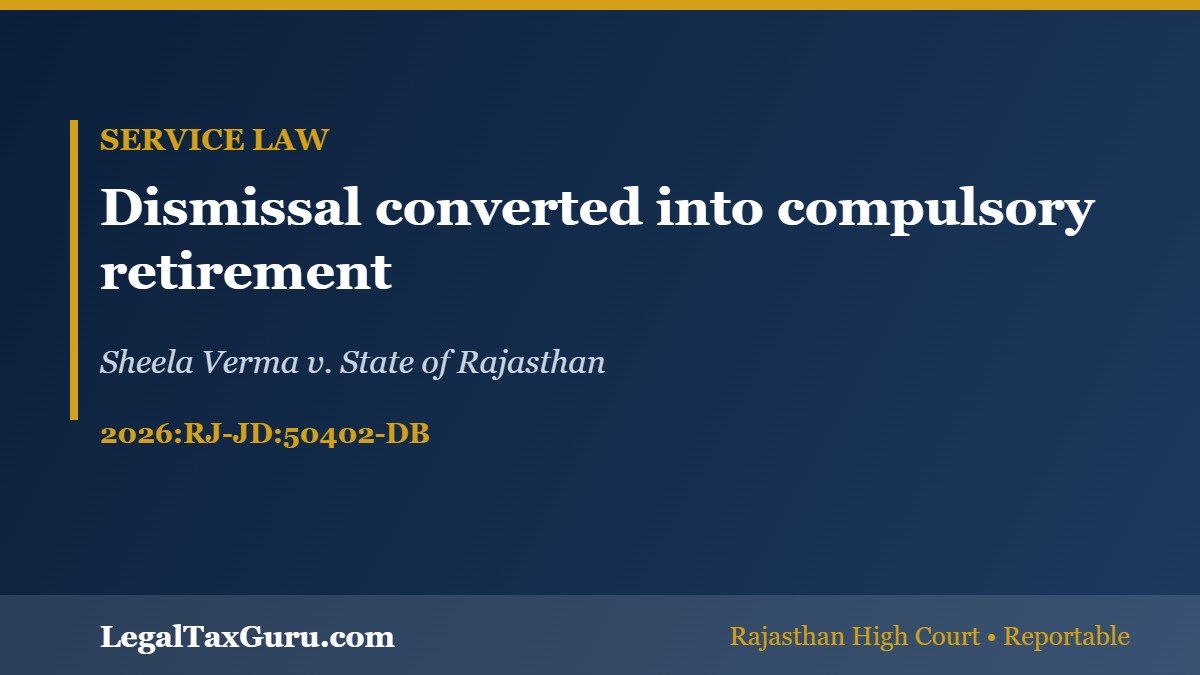
In Sheela Verma v. State of Rajasthan (2026:RJ-JD:50402-DB), the Rajasthan High Court applied the doctrine of proportionality of punishment and held that dismissal from service of a nurse with an unblemished record of about 17 years, for prolonged unauthorised absence, was disproportionate. The Division Bench at Jodhpur accepted the outcome of the disciplinary proceedings and did not re-examine the finding of misconduct (para 7). It found, however, that the authorities had gone straight to the gravest penalty under Rule 14 of the Rajasthan Civil Services (Classification, Control and Appeal) Rules, 1958 without considering any of the lesser penalties (paras 10–11). Relying on Dev Singh v. Punjab Tourism Development Corporation Ltd., the Court modified the Single Judge order and converted the dismissal into compulsory retirement with proportionate pension. It directed the State to extend the consequential benefits with applicable interest within three months (paras 11–13).
Headnote: Dismissal for Unauthorised Absence
Service Law – Rajasthan Civil Services (Classification, Control and Appeal) Rules, 1958 – Rules 14, 16(9), 23, 30 – Unauthorised absence – Dismissal from service – Doctrine of proportionality – Lesser penalties not considered – Compulsory retirement with proportionate pension – Qualifying service for pension – Intra-court special appeal.
Held: (i) Where the Division Bench agrees with the outcome of the disciplinary proceedings, it may confine its scrutiny to the quantum of punishment without re-examining the finding of misconduct (para 7).
(ii) The appellant's long and unblemished service from 1977 to 1994, before her unauthorised absence began, is a relevant factor in deciding the penalty (paras 8–9).
(iii) The disciplinary authorities ought to have taken a view proportionate to the delinquency; imposing the highest punishment of dismissal without even considering the lesser penalties under Rule 14 was not justified (para 10).
(iv) The ordinary rule of service jurisprudence is that the delinquency must be such that no person of common prudence could have imposed any punishment other than the one awarded; the present case was not of that nature (para 11).
(v) Following Dev Singh v. Punjab Tourism Development Corporation Ltd., a court may mould the relief and itself substitute a lesser penalty where the punishment is totally disproportionate to the misconduct (para 11).
(vi) Dismissal converted into compulsory retirement with proportionate pension under Rule 14; consequential benefits with applicable interest to be extended within three months (paras 12–13).
(paras 7–13)
Case Details: Sheela Verma v. State of Rajasthan (2026:RJ-JD:50402-DB)
Final Outcome: Special appeal partly allowed; Single Judge order modified; punishment of dismissal from service converted into compulsory retirement with proportionate pension; consequential benefits with applicable interest to be extended within three months.
Effect on lower order: Single Judge order dated 23.08.2018 (dismissing the writ petition) modified / partly set aside to the extent of the penalty; finding of misconduct left undisturbed.
Case: Sheela Verma v. State of Rajasthan & Anr.
Neutral Citation: 2026:RJ-JD:50402-DB
Case No.: D.B. Special Appeal (Writ) No. 1674/2018
Court: Rajasthan High Court, Jodhpur (Division Bench)
Date of Decision: 13 October 2026
Bench: Justice Arun Monga and Justice Yogendra Kumar Purohit (authored by Justice Arun Monga)
Relevant Acts & Sections: Rajasthan Civil Services (Classification, Control and Appeal) Rules, 1958 – Rules 14, 16(9), 23, 30; Pension rules – Rule 12 (commencement of qualifying service)
Impugned Order: Order dated 23.08.2018 of the learned Single Judge dismissing the writ petition against the dismissal order dated 11.03.2003, appellate order dated 03.01.2007 and the enquiry report communicated with notice dated 02.05.2002
Counsel: Mr. Divik Mathur for the appellant; Ms. Aditi Sharma and Ms. Kanchan Jodha for the respondents
Source: Rajasthan High Court (official website)
Key Holdings of the Rajasthan High Court
- The Division Bench did not re-examine the departmental proceedings and agreed with their outcome; only the penalty was tested (para 7).
- The appellant had an unblemished service career from 1977 to 1994 before she went on leave and did not report back (para 8).
- Qualifying service for pension commences from the date of taking charge of the first post, which made her long service relevant to the choice of penalty (para 9).
- The authorities straightaway imposed dismissal, the highest penalty, without resorting to the lesser penalties under Rule 14 (para 10).
- Penalties under Rule 14 are arranged in ascending order of gravity; dismissal is justified only where no person of common prudence could impose anything less (para 11).
- Following Dev Singh, the Court itself substituted compulsory retirement with proportionate pension and ordered consequential benefits with interest (paras 11–13).
Brief Facts of the Case
The appellant was appointed as Nurse Grade-II in the Medical and Health Department in 1977 and was promoted as Nurse Grade-I in 1991. She proceeded on leave on 09.04.1994 and sought extensions on account of ill health (para 2).
Disciplinary proceedings were initiated for unauthorised absence and a charge-sheet dated 23.12.1995 was issued. She replied and appeared for a personal hearing on 22.03.1996, contending that she had repeatedly sought permission to resume duty but received no response. She then received another charge-sheet alleging unauthorised absence and failure to comply with directions to resume duty, and learnt that two annual grade increments had already been withheld with cumulative effect by an order dated 04.04.1996 (para 2).
She appeared before the Enquiry Officer on 06.06.2000. The enquiry report dated 16.01.2002 was sent to her with a show-cause notice dated 02.05.2002. She objected that no departmental witnesses had been examined and that there was no proof of service of the communications directing her to resume duty. The disciplinary authority dismissed her from service by order dated 11.03.2003 (para 2.1).
Her departmental appeal under Rule 23 of the CCA Rules, 1958 remained pending. On her writ petition (S.B. Civil Writ Petition No. 5030/2006), the High Court on 20.11.2006 directed the appeal to be decided within 45 days, and it was dismissed on 03.01.2007 (para 2.1).
She then challenged the dismissal and appellate orders before the learned Single Judge, alleging breach of natural justice and the service rules. The writ petition was dismissed on 23.08.2018, with the Single Judge observing that she seemed to have abandoned service from 09.04.1994 and that her prolonged voluntary absence till 11.03.2003 was "writ large" (paras 2.2, 6).
Issues Before the High Court
- Whether the Division Bench should re-examine the disciplinary findings of unauthorised absence and insubordination (para 7).
- Whether the punishment of dismissal from service, imposed without considering the lesser penalties under Rule 14, was proportionate to the misconduct (paras 10–11).
- What relief should follow if the penalty was found disproportionate (paras 11–13).
Court's Findings and Reasoning
Arguments (paras 3–4): The appellant argued that the Single Judge had not dealt with her grounds, and that the disciplinary and appellate orders were non-speaking and in breach of Rules 16(9) and 30 of the CCA Rules, 1958. She contended that the enquiry findings were contradictory, since the Enquiry Officer noted no proof of service of the directions to resume duty but still held her guilty. She also said no departmental witnesses were examined, the burden of proof was wrongly shifted to her, and dismissal was grossly disproportionate (paras 3–3.2). The State replied that the enquiry was conducted under the applicable rules, the charges stood established, and no interference was warranted (para 4).
Scope of scrutiny confined to penalty (para 7): The Bench recorded a caveat at the threshold. Having gone through the Single Judge order alongside the departmental proceedings and the nature of the delinquency, it chose not to re-examine them and agreed with the outcome of the disciplinary proceedings. It confined itself to the part of the order upholding dismissal, the highest punishment under Rule 14 (para 7).
Unblemished prior service (paras 8–9): On a query from the Bench, it emerged that the appellant joined service in 1977 and had an unblemished career until 1994, when she went on earned leave and never reported back (para 8). The Court then referred to Rule 12 of the pension rules, under which qualifying service commences from the date the employee takes charge of the post to which he is first appointed (para 9).
No proportionate view taken (para 10): In light of this, the Court held that the administrative authorities ought to have taken a view proportionate to the delinquency. Instead, without considering the lesser penalties in Rule 14, they imposed dismissal outright (para 10).
Test of common prudence and Dev Singh (para 11): The Bench stated that the ordinary rule in service jurisprudence is that the delinquency must be such that no person of common prudence could impose any other punishment. This was not such a case, because no alternative from the ascending scale of Rule 14 penalties was explored. Relying on Dev Singh v. Punjab Tourism Development Corporation Ltd., (2003) 8 SCC 9, the Court noted that where the punishment shocks the conscience of the court or is totally disproportionate, the court may mould the relief and, in rare cases, impose an appropriate punishment itself to cut short litigation (para 11).
Moulding of relief (paras 12–13): Rather than remanding the matter, the Court modified the Single Judge order and converted the dismissal into compulsory retirement with proportionate pension, as envisaged under Rule 14. It directed the respondents to re-process her case and grant consequential benefits with applicable interest under the service rules (paras 12–13).
Final Outcome and Directions
- Special appeal partly allowed; order of the learned Single Judge dated 23.08.2018 modified.
- Punishment of dismissal from service converted into compulsory retirement with proportionate pension under Rule 14 of the CCA Rules, 1958.
- Respondents to re-process the appellant's case and extend consequential benefits with applicable interest under the service rules.
- Compliance within three months from the date the order is uploaded on the High Court website.
- Pending applications disposed of.
Legal Principle Laid Down
Dismissal from service is the gravest penalty under Rule 14 of the Rajasthan Civil Services (Classification, Control and Appeal) Rules, 1958, and the penalties there are arranged in ascending order of gravity. Even where a charge of unauthorised absence is proved, the disciplinary authority must take a view proportionate to the delinquency and consider the lesser penalties first. Dismissal is sustainable only where no person of common prudence could impose any other punishment. Where the authority skips this exercise and the employee has long, unblemished prior service, the High Court may, following Dev Singh v. Punjab Tourism Development Corporation Ltd., uphold the finding of misconduct and substitute a lesser penalty such as compulsory retirement with proportionate pension.
Precedents Relied Upon
- Dev Singh v. Punjab Tourism Development Corporation Ltd., (2003) 8 SCC 9 – Relied upon – a court may interfere with a penalty totally disproportionate to the proved misconduct and, in rare cases, substitute an appropriate punishment itself. Discussed at para 11.
Important Paragraphs of the Judgment
Verbatim extracts from the judgment. For the full text, refer to the judgment PDF below.
Para 7: "...we do not propose to re-examine the same and are in agreement with the outcome of the disciplinary proceedings."
Para 10: "...we are of the view that the administrative authorities ought to have taken a view proportionate to the delinquency of the appellant. However, without even resorting to the lesser penalties prescribed under Rule 14, the authorities straightaway imposed the highest punishment of dismissal from service."
Para 11: "The ordinary rule of service jurisprudence governing punishment is that the delinquency must be of such a nature that no person of common prudence could have imposed any punishment other than the one awarded."
Para 11: "...removal or dismissal from service constitutes the highest and gravest form of punishment, and the administrative authorities straightaway resorted to the same, with which we are not in agreement..."
Para 12: "...converting the punishment of dismissal from service into compulsory retirement, along with proportionate pension, as envisaged under Rule 14, ibid."
Practical Impact of the Ruling
- For government employees facing absence charges: Even if unauthorised absence is proved, long and clean prior service can justify a lesser penalty such as compulsory retirement with pension (paras 8–12).
- For disciplinary and appellate authorities: Record why the lesser penalties under Rule 14 are inadequate before imposing dismissal; jumping to the highest penalty invites judicial interference (paras 10–11).
- For service law advocates: Where challenges to the enquiry itself are weak, a focused plea on proportionality of punishment can secure pensionary benefits for the client (paras 7, 11–12).
- For writ courts: The court need not remand; following Dev Singh, it may mould relief and substitute a penalty to avoid prolonged litigation (paras 11–12).
- For pension claims: Qualifying service counts from the date of first taking charge, so compulsory retirement carries real value for long-serving employees (paras 9, 12–13).
FAQs on Dismissal for Unauthorised Absence
1. What did the Rajasthan High Court hold in Sheela Verma v. State of Rajasthan?
It held that dismissing a nurse with unblemished service from 1977 to 1994 for prolonged unauthorised absence, without considering lesser penalties, was disproportionate. It converted the dismissal into compulsory retirement with proportionate pension (paras 10–12).
2. Did the High Court set aside the finding of misconduct?
No. The Division Bench agreed with the outcome of the disciplinary proceedings and did not re-examine them. Only the quantum of punishment was modified (paras 7, 12).
3. Can a court substitute a lesser punishment in disciplinary cases?
Yes. Relying on Dev Singh v. Punjab Tourism Development Corporation Ltd., the Court held that where a penalty is totally disproportionate, the court may mould the relief and, in rare cases, impose an appropriate punishment itself (para 11).
4. What test applies to the choice of penalty under Rule 14 of the CCA Rules, 1958?
The delinquency must be such that no person of common prudence could have imposed any punishment other than the one awarded. Penalties are arranged in ascending order of gravity and lesser ones must be considered first (paras 10–11).
5. What relief did the appellant finally get?
Compulsory retirement with proportionate pension, with the State directed to re-process her case and grant consequential benefits with applicable interest within three months (paras 12–13).
Keywords: 2026:RJ-JD:50402-DB, Sheela Verma v. State of Rajasthan, proportionality of punishment, dismissal converted to compulsory retirement, unauthorised absence, Rule 14 Rajasthan CCA Rules 1958, proportionate pension, Dev Singh v. Punjab Tourism Development Corporation, departmental enquiry, service law advocate, Rajasthan High Court Jodhpur, Justice Arun Monga, Justice Yogendra Kumar Purohit
Related on LegalTaxGuru
- More Rajasthan High Court reportable judgments
- Transfer of probationer cannot be blocked – Govind v. State of Rajasthan
- Supreme Court reportable judgments
Download Judgment PDF – Sheela Verma v. State of Rajasthan
Judgment PDF: 2026:RJ-JD:50402-DB – Sheela Verma v. State of Rajasthan (D.B. Special Appeal (Writ) No. 1674/2018) – Download Judgment PDF
Source: Rajasthan High Court (official website).
Read more: Rajasthan High Court · Service Law · Disciplinary Proceedings