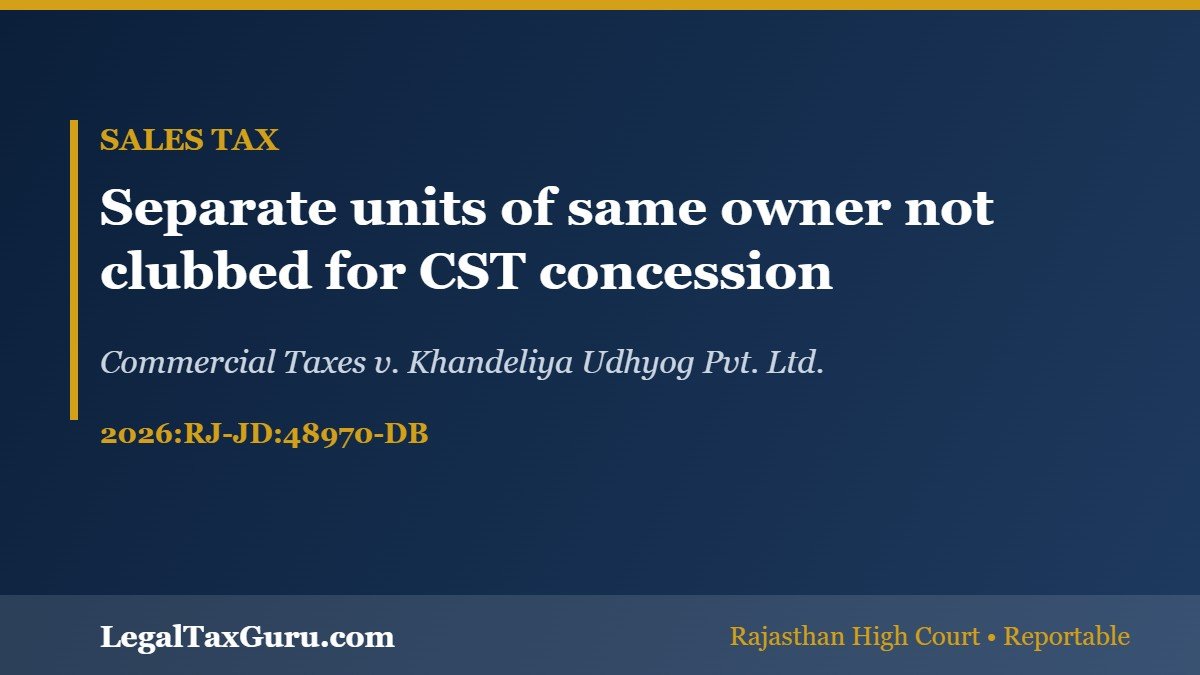
Quick Answer: There can be no clubbing of investment for MSE status where two units of the same owner are separate enterprises. The Rajasthan High Court held that each unit's investment in plant and machinery is counted separately for the concessional CST rate, and dismissed six Revenue revisions against Khandeliya Udhyog.
In Assistant Commissioner (Anti Evasion), Commercial Taxes Department, Sri Ganganagar v. M/s Khandeliya Udhyog Pvt. Ltd. (2026:RJ-JD:48970-DB), the Rajasthan High Court held that clubbing of investment for MSE status is impermissible where two industrial units of the same owner are separate enterprises, and the investment in plant and machinery of each must be counted separately (paras 20–21). A Division Bench of Chief Justice Sanjay K. Agrawal and Justice Baljinder Singh Sandhu dismissed six Sales Tax Revisions filed by the Revenue under Section 84 of the Rajasthan Value Added Tax Act, 2003 against a common order of the Rajasthan Tax Board, Ajmer dated 09.08.2018 (paras 1, 9, 23). The assessee's units at Sri Ganganagar and Alwar, each with investment below Rs. 5 crore, were therefore entitled to the concessional rate of Central Sales Tax on inter-State sales under the State notification dated 14.02.2008 (paras 4–6, 21).
Headnote: Clubbing of Investment for MSE Status
Central Sales Tax Act, 1956 – Section 8(5) – Rajasthan Notification dated 14.02.2008 (No. F.12(99)FD/Tax/07-66), as amended on 21.02.2008 and 08.03.2017 – Micro, Small and Medium Enterprises Development Act, 2006 – Section 7(1)(a)(ii) – Rajasthan Value Added Tax Act, 2003 – Section 84 – Concessional rate of CST for micro and small enterprises – Clubbing of investment in plant and machinery of different enterprises under the same ownership – Explanation – Interpretation of exemption notification – Sales tax revision by Revenue.
Held: (i) The notification dated 14.02.2008 grants a concessional rate of CST of 0.25% on inter-State sales of goods manufactured by a registered dealer while it enjoys micro and small enterprise status under the MSMED Act, 2006 (paras 4, 13).
(ii) The Explanation added by notification dated 08.03.2017 directs that, for ascertaining micro and small enterprise status, the investment in plant and machinery of different enterprises set up under the same ownership shall not be clubbed (paras 14–15).
(iii) The Industries Department clarifications of 08.08.2011 and 31.01.2014 had already stated that the MSMED Act, 2006 does not provide for clubbing the investments of different enterprises of the same person or company (paras 13.1–13.2, 18).
(iv) Unless mutual dependence between two units is established, they cannot be clubbed together; common ownership alone is not enough (paras 18.1, 20).
(v) An exemption notification is construed liberally once the entrepreneur meets the eligibility criteria, and no condition can be read into it when there is none (para 19).
(vi) The Revenue failed to prove common interest, common funding or financial flow-back between the Sri Ganganagar and Alwar units; the Tax Board's order was free of illegality, perversity or jurisdictional error, and all six revisions were dismissed (paras 20–23).
(paras 13–23)
Case Details: Commercial Taxes v. Khandeliya Udhyog Pvt. Ltd. (2026:RJ-JD:48970-DB)
Final Outcome: All six Sales Tax Revisions of the Revenue dismissed; common order of the Rajasthan Tax Board, Ajmer dated 09.08.2018 affirmed; parties to bear their own costs.
Case: Assistant Commissioner (Anti Evasion), Commercial Taxes Department, Sri Ganganagar v. M/s Khandeliya Udhyog Pvt. Ltd., Sri Ganganagar, and connected revisions
Neutral Citation: 2026:RJ-JD:48970-DB
Case No.: D.B. Sales Tax Revision / Reference No. 18 of 2019, with D.B. Sales Tax Revision / Reference Nos. 20, 21, 23, 24 and 25 of 2019
Court: Rajasthan High Court, Jodhpur (Division Bench)
Date of Decision: 7 October 2026
Bench: Chief Justice Sanjay K. Agrawal and Justice Baljinder Singh Sandhu
Relevant Acts & Sections: Rajasthan Value Added Tax Act, 2003 – Section 84; Central Sales Tax Act, 1956 – Section 8(5); Micro, Small and Medium Enterprises Development Act, 2006 – Section 7(1)(a)(ii); Rajasthan Finance Department Notification dated 14.02.2008, as amended on 21.02.2008, 14.07.2014 and 08.03.2017
Impugned Order: Common order of the Rajasthan Tax Board, Ajmer dated 09.08.2018, allowing the assessee's appeals and dismissing the Revenue's appeals against the order of the Appellate Authority, Commercial Taxes, Bikaner dated 16.10.2015
Counsel: Mr. Mahaveer Bishnoi, AAG, with Mr. Harvardhan Singh Chundawat and Mr. Daksh Sharma for the petitioner-Revenue; Mr. Sanjeev Johari, Senior Advocate, with Mr. Shubhankar Johari, Mr. Gaurav Vatwani and Mr. Shekhar Nehra for the respondent-assessee
Source: Rajasthan High Court (official website)
Key Holdings of the Rajasthan High Court
- Micro and small enterprise status for the CST concession under the notification dated 14.02.2008 is tested enterprise by enterprise, not owner by owner (paras 14–15, 21).
- The 08.03.2017 Explanation expressly bars clubbing of investment in plant and machinery of different enterprises set up under the same ownership (paras 14–15).
- Industries Department clarifications of 08.08.2011 and 31.01.2014 said the same (paras 13.1–13.2).
- An explanation takes its meaning from its own terms (paras 17–17.1).
- Clubbing requires proof of mutual dependence, such as common funding and financial flow-back; common ownership is insufficient (paras 18.1, 20).
- Exemption notifications are construed liberally in favour of an eligible entrepreneur, and no extra condition may be read into them (para 19).
Brief Facts of the Case
By a notification dated 14.02.2008 under Section 8(5) of the CST Act, 1956, the Government of Rajasthan fixed a concessional rate of 0.25% on inter-State sales of goods manufactured in the State by a registered dealer having micro or small enterprise status. An amendment of 21.02.2008 confined the benefit to a registered dealer who commences purchase of plant and machinery on or after 14.02.2008 for setting up an enterprise. The concessional rate was raised to 1% on 14.07.2014 (paras 4, 13).
The assessee set up a unit at Sri Ganganagar in February 2009 and a second unit at Alwar in 2012. Each was registered as a small enterprise under Section 7(1)(a)(ii) of the MSMED Act, 2006, with investment in plant and machinery below Rs. 5 crore. The units are more than 500 km apart (paras 5–6).
By an assessment order dated 26.06.2015 for AYs 2012-13 to 2014-15, the assessing authority added up the investment of both units. As the total exceeded Rs. 5 crore, it denied the concession and imposed tax difference, interest and penalty (para 7).
The Appellate Authority, Commercial Taxes, Bikaner (16.10.2015) upheld tax and interest but set aside the penalty. On cross-appeals, the Tax Board by common order dated 09.08.2018 allowed the assessee's appeals, holding that the two enterprises could not be clubbed in view of the 08.03.2017 Explanation, and dismissed the Revenue's appeals (paras 8–9).
The Revenue filed six revisions under Section 84 of the Rajasthan VAT Act, 2003: Nos. 18 and 20 of 2019 (AY 2012-13), Nos. 23 and 24 of 2019 (AY 2013-14), and Nos. 21 and 25 of 2019 (AY 2014-15). They were admitted on 11.01.2021 on a common question of law (paras 2, 9, 9.1).
Issues Before the High Court
- Whether the factory set up by the assessee at Alwar is a different enterprise, so that the investment in its plant and machinery cannot be clubbed with that of the Sri Ganganagar unit for determining micro and small enterprise status (paras 2, 20–21).
- Whether the assessee was entitled to the concessional rate of CST under the notification dated 14.02.2008 for assessment years 2012-13 to 2014-15 (paras 7, 21).
Court's Findings and Reasoning
Revenue's case (paras 10–10.1): The Additional Advocate General called the Tax Board's finding perverse. He argued that the 08.03.2017 amendment did not apply to the assessment years in question, so clubbing was justified, relying on the Orissa High Court in M/s. JSW Steel Ltd. (paras 10–10.1).
Assessee's case (paras 11–11.2): Senior Counsel argued that the MSMED Act, 2006 does not allow clubbing, relied on the clarification of 31.01.2014, and called the 2017 Explanation clarificatory. The units were installed in different years more than 500 km apart, and clubbing would defeat the object of promoting industry in Rajasthan (paras 11–11.2).
Clarifications and the 2017 Explanation (paras 13–16, 18): The Court reproduced the 2008 notification, which ties the concession to micro and small enterprise status under the MSMED Act. The Commissioner of Industries had clarified on 08.08.2011, and again on 31.01.2014 in a letter to the assessee about its Alwar unit, that the MSMED Act does not provide for clubbing investments of different enterprises of the same person or company. The 08.03.2017 Explanation then said so expressly in the notification itself (paras 13.1–15, 18).
Nature of an explanation (paras 17–17.1): Citing Justice G.P. Singh's Principles of Statutory Interpretation and Km. Sonia Bhatia v. State of U.P., the Court noted that an explanation becomes part of the enactment, takes its meaning from its terms, and may widen the scope of the main provision (paras 17–17.1).
Mutual dependence test (para 18.1): Relying on Renu Tandon v. Union of India, the Court held that two units cannot be clubbed unless mutual dependence is established; blood relationship, shared staff or similar products are not enough without common funding and financial flow-back (para 18.1).
Liberal construction (para 19): Following State of Haryana v. Bharti Teletech Ltd., an exemption notification is read liberally once the entrepreneur meets the eligibility criteria (para 19).
Application to facts (paras 20–22): The Revenue did not prove common interest, common funding or financial flow-back between the two units. Common ownership alone could not justify clubbing, and the Tax Board's order suffered from no illegality, perversity or jurisdictional error (paras 20–22).
Final Outcome and Directions
- The question of law is answered in favour of the assessee: the Alwar and Sri Ganganagar units are separate enterprises for the purpose of the notification dated 14.02.2008.
- All assessment orders denying the concessional rate to the assessee held legally unsustainable.
- D.B. Sales Tax Revision Nos. 18, 20, 21, 23, 24 and 25 of 2019 dismissed.
- Common order of the Rajasthan Tax Board, Ajmer dated 09.08.2018 affirmed; parties to bear their own costs.
Legal Principle Laid Down
For the concessional rate of Central Sales Tax under the Rajasthan notification dated 14.02.2008, micro and small enterprise status is determined separately for each enterprise. The investment in plant and machinery of different enterprises set up under the same ownership cannot be clubbed, as the 08.03.2017 Explanation and the earlier Industries Department clarifications make clear. Separate units may be clubbed only where the Revenue proves mutual dependence, such as common funding and financial flow-back; common ownership alone is not enough. An exemption notification is to be construed liberally in favour of an entrepreneur who meets its eligibility criteria.
Precedents Relied Upon
- State of Haryana v. Bharti Teletech Ltd., Civil Appeal No. 6791 of 2004 (decided on 20.01.2014) – Relied upon – exemption notifications to be construed liberally for an eligible entrepreneur; para 22 quoted. Discussed at para 19.
- Renu Tandon v. Union of India, 1993 (66) E.L.T. 375 (Raj.) – Relied upon – units cannot be clubbed without common funding and financial flow-back (itself referring to International Dyestuff Mfg. Co., 1991 (53) E.L.T. 85 (Tribunal)). Discussed at para 18.1.
- Km. Sonia Bhatia v. State of U.P., (1981) 2 SCC 585 – Relied upon – scope of an explanation. Discussed at para 17.1.
- Commissioner of Sales Tax v. Industrial Coal Enterprises, (1999) 2 SCC 607; CIT v. Straw Board Mfg. Co. Ltd., (1989) Supp (2) SCC 523; Bajaj Tempo Ltd. v. CIT, (1992) 3 SCC 78 – Referred (as relied on in Bharti Teletech). Discussed at para 19.
- M/s. JSW Steel Ltd. v. Micro and Small Enterprises Facilitation Council, Cuttack, 2023 (III) ILR-CUT-643 – Cited by the Revenue; not followed. Discussed at para 10.1.
- L.R. Brothers Indo Flora Ltd. v. Commissioner of Central Excise, (2021) 19 SCC 576 – Cited by the assessee. Discussed at para 11.2.
Important Paragraphs of the Judgment
Verbatim extracts from the judgment. For the full text, refer to the judgment PDF below.
Para 2 (question of law): "In the circumstances of the case, whether it can be said that the factory/industry set up by the respondent – assessee at Alwar, would be a different enterprise so as not to club the investment made in the plant & machinery for the purpose of its status as Micro and Small Enterprise?"
Para 14 (Explanation dated 08.03.2017): "For ascertaining the status of Micro and Small Enterprise, under this notification, the investment made in Plant and Machinery in different enterprises set up under the same ownership shall not be clubbed."
Para 19: "In reading an exemption notification, no condition should be read into it when there is none. If an entrepreneur is entitled to the benefit thereof, the same should not be denied."
Para 20: "... we find that the Revenue has failed to establish that both the units of assessee situated at Sri Ganganagar and Alwar have common interest in the business of each other and they have common funding and financial flow-back ..."
Para 21: "This Court is in complete agreement with the conclusion drawn by the Rajasthan Tax Board in the impugned order that the investments made towards the plant and machinery in the two enterprises of the assessee deserve to be treated as separate; since neither enterprise has an investment of more than Rs.5 crores ..."
Para 22: "We do not find any illegality, perversity and jurisdictional error in the impugned order passed by the Rajasthan Tax Board, Ajmer, so as to warrant any interference by this Court in the instant revision petitions."
Practical Impact of the Ruling
- For MSME manufacturers: Each unit's MSE status, and the CST concession, turns on its own investment unless mutual dependence is shown (paras 20–21).
- For legacy VAT/CST assessments: Pre-2017 demands that add up the investment of separate units can be challenged on this ruling and the 2011 and 2014 clarifications (paras 13.1–13.2, 18).
- For the Commercial Taxes Department: Clubbing needs evidence of common funding and financial flow-back, gathered at the assessment stage (paras 18.1, 20).
- For tax litigation lawyers: In a Section 84 revision, a Tax Board finding stands unless illegality, perversity or jurisdictional error is shown (para 22).
- For indirect tax advisers: Liberal construction of exemptions for eligible entrepreneurs is equally useful in GST/excise appeal practice (para 19).
FAQs on Clubbing of Investment for MSE Status
1. What did the Rajasthan High Court hold in Commercial Taxes v. Khandeliya Udhyog?
It held that the assessee's units at Sri Ganganagar and Alwar were separate enterprises, so their investment in plant and machinery could not be clubbed to deny the concessional CST rate. All six Revenue revisions were dismissed (paras 20–23).
2. Can investment in two units of the same company be clubbed for MSE status?
Not under the Rajasthan notification dated 14.02.2008, as clarified by the 08.03.2017 Explanation. Clubbing is possible only if the Revenue proves mutual dependence, such as common funding and financial flow-back (paras 14–15, 18.1, 20).
3. What concession was in dispute?
The 0.25% concessional CST rate (1% from 14.07.2014) on inter-State sales by registered dealers with micro or small enterprise status (paras 4, 13).
4. Did the Court rely on the 2017 Explanation for earlier assessment years?
The Revenue said it did not apply to AYs 2012-13 to 2014-15. The Court upheld the Tax Board on the Explanation read with the 2011 and 2014 clarifications and the mutual dependence test (paras 10.1, 17–20).
5. Which precedents did the High Court follow?
State of Haryana v. Bharti Teletech Ltd. on liberal construction of exemptions, Renu Tandon v. Union of India on clubbing of units, and Km. Sonia Bhatia v. State of U.P. on explanations (paras 17.1–19).
Keywords: 2026:RJ-JD:48970-DB, Commercial Taxes v. Khandeliya Udhyog, clubbing of investment for MSE status, micro and small enterprise, MSMED Act 2006, Section 8(5) CST Act, concessional rate of CST, notification dated 14.02.2008, Explanation 08.03.2017, Rajasthan VAT Act Section 84, sales tax revision, Rajasthan Tax Board, tax litigation lawyer, Rajasthan High Court, Chief Justice Sanjay K. Agrawal
Related on LegalTaxGuru
- More High Court judgments on GST and indirect tax
- GST articles and updates
- Excess excise duty adjustment on provisional assessment – Hindustan Zinc
Download Judgment PDF – Commercial Taxes v. Khandeliya Udhyog Pvt. Ltd.
Source: Rajasthan High Court (official website).
Read more: Rajasthan High Court · Sales Tax · Rajasthan VAT · Indirect Tax