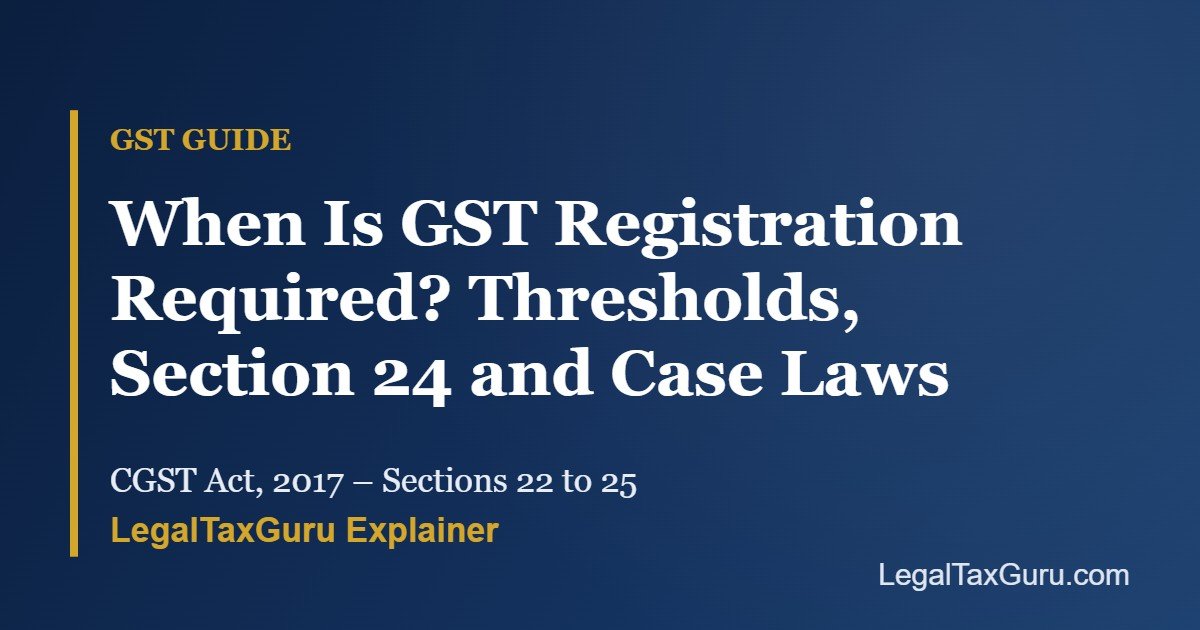
When is GST registration required? Under the Central Goods and Services Tax Act, 2017, a supplier must register in a State when its aggregate turnover crosses the threshold in Section 22, or at once, irrespective of turnover, if it falls in a category listed in Section 24. Every other person may register voluntarily under Section 25(3). This guide explains the threshold limits, the compulsory cases, the exemptions in Section 23, the "one registration per State" rule, and the consequences of not registering, with the case laws that courts and authorities have applied.
Quick Answer
GST registration is required when:
(i) aggregate turnover in a financial year exceeds Rs. 40 lakh for persons exclusively supplying goods (in States that have adopted the higher limit) or Rs. 20 lakh for services or mixed supplies; lower limits of Rs. 10 lakh / Rs. 20 lakh apply in specified special category States (Section 22(1) read with Notification No. 10/2019-Central Tax);
(ii) the person falls in any Section 24 category – for example inter-State supplier of goods, casual or non-resident taxable person, person liable under reverse charge, e-commerce operator, TDS/TCS deductor, Input Service Distributor or OIDAR supplier – irrespective of turnover;
(iii) an existing business is transferred or succeeded, in which case the transferee must register from the date of transfer (Section 22(3)).
1. Threshold Registration Under Section 22
Section 22(1) is the general rule. A supplier becomes liable to register in the State or Union Territory from where it makes taxable supplies once its aggregate turnover in a financial year exceeds the notified limit.
- Services, or goods and services together: Rs. 20 lakh (Rs. 10 lakh in Manipur, Mizoram, Nagaland and Tripura).
- Exclusively goods: Rs. 40 lakh under Notification No. 10/2019-Central Tax, subject to exceptions – the higher limit is not available to suppliers of ice cream, pan masala and tobacco products, to persons required to register under Section 24, and in States that opted out.
- Special category States: Several North-Eastern and hill States have the lower limits. The State-wise position should be checked before applying.
The application must be made within 30 days from the date the person becomes liable (Section 25(1)). A threshold is checked on the turnover for the whole PAN on an all-India basis, not State-wise.
What is "aggregate turnover"?
Section 2(6) defines aggregate turnover as the value of all taxable supplies, exempt supplies, exports and inter-State supplies of persons having the same PAN, computed on an all-India basis. It excludes central tax, State tax, UT tax, integrated tax and cess, and the value of inward supplies on which tax is paid under reverse charge.
- Exempt supplies count. A trader dealing in both exempt and taxable goods must add both for the threshold, even though tax is payable only on taxable supplies.
- Exports count. Zero-rated supplies form part of turnover.
- All-India basis. Turnover of branches in other States under the same PAN is added.
- Agent's supplies: The Explanation to Section 22 treats supplies made by a job worker or agent on behalf of the principal as the principal's turnover in specified cases.
2. Compulsory Registration Under Section 24 – No Threshold
Section 24 overrides the threshold. The following persons must register even if their turnover is below the limit:
- Persons making inter-State taxable supplies (relaxed for service providers below the threshold by Notification No. 10/2017-Integrated Tax, and for handicraft goods by separate notifications).
- Casual taxable persons making taxable supplies, such as exhibition stalls in another State.
- Persons required to pay tax under reverse charge.
- Persons required to pay tax under Section 9(5), i.e. electronic commerce operators for notified services.
- Non-resident taxable persons.
- Persons required to deduct tax at source under Section 51.
- Persons making taxable supplies on behalf of other taxable persons as agents.
- Input Service Distributors.
- Persons supplying goods or services through an e-commerce operator that collects tax at source under Section 52 (subject to relaxations below).
- Every e-commerce operator required to collect TCS.
- Persons supplying online information and database access or retrieval (OIDAR) services from outside India to unregistered persons in India.
- Other notified persons.
E-commerce sellers – relaxation
Small service providers selling through e-commerce platforms, other than those covered by Section 9(5), are exempt from compulsory registration if their turnover is below the threshold (Notification No. 65/2017-Central Tax). Following Notification No. 34/2023-Central Tax, unregistered persons and composition dealers may also make intra-State supplies of goods through e-commerce operators from 01.10.2023, subject to conditions. Inter-State supply of goods through e-commerce still requires registration.
3. Who Is Not Required to Register – Section 23
- A person engaged exclusively in supplying goods or services that are wholly exempt or not liable to tax.
- An agriculturist, to the extent of supply of produce from cultivation of land.
- Persons exclusively making supplies on which the recipient pays the entire tax under reverse charge under Section 9(3) (Notification No. 5/2017-Central Tax).
The exemption is construed strictly. In Commissioner of Customs (Import), Mumbai v. Dilip Kumar & Co., (2018) 9 SCC 1, a Constitution Bench held that an exemption notification must be interpreted strictly and the burden lies on the person claiming it. Applied to GST, a business that claims to be outside registration because its supplies are "wholly exempt" must show that every supply fits squarely within the exemption.
4. One Registration Per State – and Distinct Persons
Registration is State-wise. A person with business places in several States needs a separate registration in each State from which it makes taxable supplies (Section 25(1)). Within one State, multiple registrations for separate places of business are allowed (Section 25(2) read with Rule 11).
Each registration is a "distinct person" under Section 25(4). Supplies between them, even without consideration, are taxable under Schedule I. The Karnataka Appellate Authority for Advance Ruling in In re Columbia Asia Hospitals Pvt. Ltd. (2018) held that services provided by the head office to branches in other States, such as accounting and HR support, are supplies between distinct persons and are taxable. Advance rulings bind only the applicant, but this ruling shows why each registration must account for inter-branch services.
5. Reverse Charge Registration and Importers – Mohit Minerals
Since persons liable under reverse charge must register under Section 24(iii), importers were also treated as liable for IGST on ocean freight under reverse charge by Notification No. 10/2017-Integrated Tax (Rate). In Union of India v. Mohit Minerals Pvt. Ltd., (2022) 10 SCC 700, the Supreme Court held this levy unsustainable, because the ocean freight forms part of the composite supply of goods (CIF imports) on which IGST is already paid at import. The Court also held that GST Council recommendations are persuasive, not binding. The ruling removed one source of compulsory RCM liability, but registration under Section 24(iii) still applies to other notified reverse-charge supplies such as legal services and goods transport agency services received by business entities.
6. Transfer, Succession and Amalgamation – Section 22(2) and (3)
- Every person registered under the earlier laws was migrated to GST from the appointed day (Section 22(2)).
- On transfer of business as a going concern, on account of succession or otherwise, the transferee must register with effect from the date of transfer (Section 22(3)).
- On amalgamation or demerger sanctioned by a court or tribunal, the transferee must register from the date the Registrar of Companies issues the certificate of incorporation giving effect to the order (Section 22(4)).
7. Voluntary Registration
A person below the threshold may register voluntarily (Section 25(3)). Once registered, all provisions of the Act apply as to any registered person. Voluntary registration is useful for claiming input tax credit, dealing with B2B buyers who need tax invoices, and for supplies through e-commerce platforms that insist on GSTIN.
8. Procedure and Timelines
- Apply in Form GST REG-01 within 30 days of becoming liable (Rule 8). Casual and non-resident taxable persons must apply at least five days before starting business.
- Aadhaar authentication is required under Section 25(6B) read with Rule 8(4A); biometric authentication may be required in high-risk cases.
- The proper officer may seek clarification in Form REG-03 and must decide within the time in Rule 9; registration may be granted on physical verification where required.
- Registration takes effect from the date of liability if applied within 30 days; otherwise from the date of grant (Rule 10).
9. Consequences of Not Registering
- Tax demand: The proper officer may assess an unregistered person to the best of judgment under Section 63, with interest.
- Penalty: Section 122(1)(xi) imposes penalty on a person liable to register who fails to do so – Rs. 10,000 or the tax evaded, whichever is higher.
- No input tax credit: Credit cannot be claimed for the period before registration except as allowed under Section 18(1)(a).
- Buyers lose credit: Recipients cannot avail ITC on supplies from an unregistered supplier.
10. Cancellation of Registration – Need for Reasons
Registration can be cancelled under Section 29, including retrospectively, but only after a show cause notice and hearing (Section 29(2) proviso and Rule 22). High Courts have repeatedly set aside cancellation orders that did not give reasons. For example, the Gujarat High Court in Aggarwal Dyeing and Printing Works v. State of Gujarat (2022) quashed cryptic cancellation orders passed without reasons. The principle is consistent with natural justice: an order taking away a GSTIN must show application of mind.
Practical Checklist: Do You Need GST Registration?
- Do you make any inter-State supply of goods? If yes, register.
- Do you sell goods inter-State through an e-commerce platform? If yes, register.
- Are you liable to pay tax under reverse charge on any inward supply? If yes, register.
- Is your all-India aggregate turnover, including exempt supplies and exports, above Rs. 20 lakh (services) or Rs. 40 lakh (goods only)? If yes, register.
- Are all your supplies wholly exempt, or are you only an agriculturist? Registration is not required.
- Do you operate in more than one State? Register separately in each State of supply.
Frequently Asked Questions
1. When is GST registration required for a small business?
When aggregate turnover exceeds Rs. 20 lakh for services or Rs. 40 lakh for goods (lower in special category States), or at once if the business falls under Section 24, such as inter-State supply of goods.
2. Is GST registration required for inter-State supply of services below Rs. 20 lakh?
No. Notification No. 10/2017-Integrated Tax exempts service providers making inter-State supplies from compulsory registration if aggregate turnover is within the threshold.
3. Are exempt supplies included in aggregate turnover?
Yes. Section 2(6) includes exempt supplies and exports, so they count towards the registration threshold even though no tax is payable on them.
4. Can an unregistered person sell goods on Amazon or Flipkart?
Yes, for intra-State supplies of goods from 01.10.2023, subject to conditions in Notification No. 34/2023-Central Tax. Inter-State sales through e-commerce still need registration.
5. What is the penalty for not taking GST registration?
Under Section 122(1)(xi), the penalty is Rs. 10,000 or the tax evaded, whichever is higher, along with tax and interest determined under Section 63.
Keywords: when is GST registration required, GST registration threshold, Section 22 CGST Act, Section 24 compulsory registration, Section 23 exemption, aggregate turnover Section 2(6), voluntary registration, e-commerce seller GST, reverse charge registration, Mohit Minerals, Dilip Kumar exemption, distinct person Section 25(4), GST penalty Section 122
Note: Threshold limits and notifications change from time to time. Verify the current State-wise position before applying.
Read more: GST · GST Case Law · Indirect Tax