Quick Answer: Additional depreciation under Section 32(1)(iia) of the Income Tax Act is available on new captive and wind power plant machinery installed after 31.03.2005 by a manufacturer. The Rajasthan High Court held that electricity is an 'article or thing' and upheld the ITAT order quashing the CIT's Section 263 revision against Hindustan Zinc.
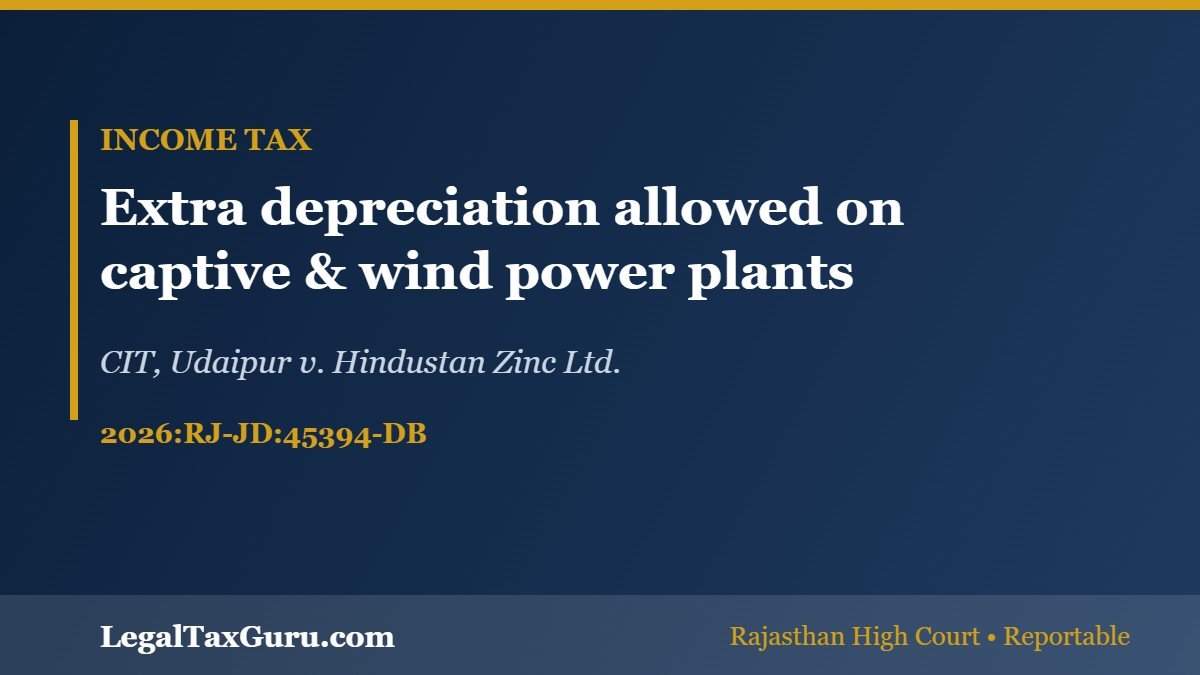
In Commissioner of Income Tax, Udaipur v. M/s Hindustan Zinc Ltd. [2026:RJ-JD:45394-DB], the Rajasthan High Court held that additional depreciation under Section 32(1)(iia) of the Income Tax Act, 1961 is available on new plant and machinery installed at a captive power plant and a wind power plant by an assessee engaged in the manufacture or production of an article or thing. A Division Bench of Chief Justice Sanjay K. Agrawal and Justice Vinit Kumar Mathur dismissed the Revenue's income tax appeal under Section 260A and upheld the ITAT order quashing the Commissioner's revision under Section 263 (paras 18(8)–20). The Court held that electricity is movable property and falls within "article or thing", and that generation of power is "production" (paras 18(2)–18(4)). Since the Assessing Officer's order allowing the claim was neither erroneous nor prejudicial to the interests of the Revenue, the twin conditions laid down in Malabar Industrial Co. Ltd. were not met (paras 12–15, 18(8)).
Headnote: Additional Depreciation under Section 32(1)(iia)
Income Tax Act, 1961 – Sections 32(1)(iia), 143(3), 253, 260A, 263 – Additional depreciation – Captive Power Plant and Wind Power Plant – New plant and machinery acquired after 31.03.2005 – Electricity as "article or thing" – Generation of power as "production" – Revisional jurisdiction – Order "erroneous" and "prejudicial to the interests of the Revenue" – Twin conditions.
Held: (i) Section 263(1) can be invoked only when the assessment order is both erroneous and prejudicial to the interests of the Revenue; if either condition is absent, revision is not permissible (paras 12–14).
(ii) Additional depreciation under Section 32(1)(iia) needs two conditions: new plant and machinery acquired and installed after 31.03.2005, and an assessee engaged in the business of manufacture or production of any article or thing (para 17).
(iii) Electricity is movable property and comes within "article" or "thing"; generation of power is "production", a word wider than "manufacture" (paras 18(2)–18(4)).
(iv) An assessee manufacturing zinc, lead and other minerals, which uses power from its CPP and WPP in its manufacturing units, satisfies the second condition (para 18(5)).
(v) Once the statutory conditions are met, additional depreciation on new power-generation plant cannot be denied, whether or not power generation by itself amounts to production (paras 18(6)–18(7)).
(vi) The Assessing Officer's order allowing the claim was neither erroneous nor prejudicial to the Revenue; the ITAT rightly set aside the Section 263 order, and the appeal was dismissed (paras 18(8)–20).
(paras 11–20)
Case Details: CIT, Udaipur v. Hindustan Zinc Ltd. (2026:RJ-JD:45394-DB)
Final Outcome: Revenue's appeal dismissed; substantial questions of law answered against the Revenue and in favour of the assessee; ITAT order restoring the assessment order affirmed; parties to bear their own costs.
Case: Commissioner of Income Tax, Udaipur v. M/s Hindustan Zinc Ltd.
Neutral Citation: 2026:RJ-JD:45394-DB
Case No.: D.B. Income Tax Appeal No. 183/2014
Court: Rajasthan High Court, Jodhpur (Division Bench)
Date of Decision: 5 October 2026 (reserved on 17 September 2026)
Bench: Chief Justice Sanjay K. Agrawal and Justice Vinit Kumar Mathur
Relevant Acts & Sections: Income Tax Act, 1961 – Sections 32(1)(iia), 143(3), 253, 260A, 263
Impugned Order: Order of the Income Tax Appellate Tribunal dated 28.02.2014 setting aside the CIT's Section 263 order dated 14.03.2011 for Assessment Year 2007-08
Source: Rajasthan High Court (official website)
Key Holdings of the Rajasthan High Court
- Revision under Section 263 needs an order that is both erroneous and prejudicial to the interests of the Revenue; one without the other is not enough (paras 12–14).
- Section 32(1)(iia) has two conditions: new plant and machinery installed after 31.03.2005, and a business of manufacture or production of an article or thing (para 17).
- Electricity is movable property and an "article" or "thing" (paras 18(2)–18(3)).
- Generation of power is "production", which has a wider meaning than "manufacture" (para 18(4)).
- Additional depreciation on new captive and wind power plant cannot be denied once the statutory conditions are fulfilled (paras 18(6)–18(7)).
- The ITAT's finding that the assessment order was neither erroneous nor prejudicial was neither perverse nor contrary to the record (para 18(8)).
Brief Facts of the Case
The assessee, Hindustan Zinc Ltd., is engaged in the business of zinc, lead, silver and other products. For Assessment Year 2007-08, it declared taxable income of Rs. 58,43,88,93,250 and claimed additional depreciation of Rs. 18,87,27,973 under Section 32(1)(iia) on new plant and machinery at its Captive Power Plant, Chanderia (Rs. 9,90,887) and its Wind Power Plant (Rs. 18,77,37,086) (para 2).
In scrutiny, the Assessing Officer passed an order under Section 143(3) on 23.03.2009, determining income at Rs. 61,65,85,62,500 after certain additions and disallowances. According to the assessee, the additional depreciation claim was accepted and allowed (para 3).
On 14.03.2011, the CIT, acting under Section 263, set aside the assessment order and directed a fresh assessment, reasoning that generating power at the CPP and WPP was not manufacture or production of an article or thing (para 4).
On the assessee's appeal under Section 253, the ITAT by order dated 28.02.2014 set aside the CIT's order and restored the assessment order. It held that the twin conditions of Section 263 were not met and that generation of power is "production" of an article or thing, relying on Sesa Goa Ltd., Mysore Minerals Ltd. and Arihant Tiles and Marbles P. Ltd. (paras 5–6).
The Revenue then filed this appeal under Section 260A. Substantial questions of law were framed on 26.04.2016 and 14.09.2026 (paras 1, 7).
Issues Before the High Court
- Whether the ITAT was justified in allowing the assessee's claim for additional depreciation under Section 32(1)(iia) of the Income Tax Act (para 1).
- Whether the ITAT was justified in holding that the CIT was not justified in exercising power under Section 263, and whether that finding was perverse to the record (paras 1, 15).
Court's Findings and Reasoning
Arguments (paras 8–9): Mr. K.K. Bissa, Senior Standing Counsel for the Revenue, argued that the CIT's order was well reasoned and the assessee was not entitled to additional depreciation (para 8). Mr. Ajay Kumar Vohra, Senior Counsel for the assessee, argued that the new plant and machinery was acquired after 31.03.2005 and the assessee was engaged in manufacture or production, so both conditions of Section 32(1)(iia) were met (para 9).
Scope of Section 263 (paras 11–15): The Commissioner must find the assessment order both erroneous and prejudicial to the interests of the Revenue, and may consider all records available at the time of examination (paras 11–12). Following Malabar Industrial Co. Ltd. v. CIT, approved in Paville Projects, if either condition is absent, Section 263(1) cannot be used; where the Assessing Officer takes one of two possible views, the order is not erroneous unless that view is unsustainable in law (paras 13–15).
Conditions under Section 32(1)(iia) (paras 16–17): Reading the provision as amended by the Finance Act, 2007, the Court held that an assessee may claim additional depreciation of 20% of actual cost if (a) the new plant and machinery was acquired and installed after 31.03.2005, and (b) the assessee is engaged in the business of manufacture or production of any article or thing (paras 16–17).
First condition undisputed (para 18(1)): It was undisputed that the CPP and WPP machinery was new and installed after the cut-off date. The ITAT had recorded this in para 14 of its order, and the CIT had not disputed it. The first condition was satisfied (para 18(1)).
Electricity is an "article or thing" (paras 18(2)–18(3)): Relying on State of A.P. v. National Thermal Power Corpn. Ltd., the Court held that power and electricity are movable property and fall within "article" or "thing", since electricity can be transmitted, transferred, delivered and possessed (para 18(2)). It also relied on PCIT v. Damodar Valley Corporation, which held that an assessee generating electricity from thermal power is entitled to additional depreciation under Section 32(1)(iia) (para 18(3)).
Power generation is "production" (paras 18(4)–18(5)): The Court agreed with the ITAT that "production" is wider than "manufacture" and includes generation of power (para 18(4)). It also noted that the assessee manufactures and produces zinc, lead and by-products, and that the power from its CPP and WPP is used in its manufacturing units to make finished products (para 18(5)).
Settled law on power plant depreciation (paras 18(6)–18(7)): An assessee in manufacture or production that installs new power-generation plant after the cut-off date is entitled to additional depreciation, whether or not power generation itself is production (para 18(6)). Mehru Electricals, Damodar Valley Corporation and Hi Tech Arai Ltd. (SLP dismissed) held, for windmills and wind power plants, that the claim cannot be denied once the conditions are met (para 18(7)).
No ground for revision (para 18(8)): As all statutory conditions were met, the assessment order was neither erroneous nor prejudicial to the Revenue. The ITAT rightly found no reason to invoke Section 263(1), and its finding was neither perverse nor contrary to the record (para 18(8)).
Final Outcome and Directions
- Both substantial questions of law answered against the Revenue and in favour of the assessee.
- Income Tax Appeal No. 183/2014 filed by the Revenue dismissed.
- ITAT order dated 28.02.2014 upheld; the assessment order allowing additional depreciation stands restored.
- Parties left to bear their own costs.
Legal Principle Laid Down
An assessee engaged in the business of manufacture or production of an article or thing is entitled to additional depreciation under Section 32(1)(iia) of the Income Tax Act, 1961 on new plant and machinery acquired and installed after 31.03.2005, including captive and wind power plants. Electricity is an "article or thing" and its generation is "production". An assessment order allowing such a claim is neither erroneous nor prejudicial to the Revenue and cannot be revised under Section 263.
Precedents Relied Upon
- Malabar Industrial Co. Ltd. v. CIT, Kerala State, (2000) 2 SCC 718 – Relied upon – twin conditions for Section 263 revision; a possible view taken by the AO is not erroneous. Discussed at paras 13, 15.
- CIT v. Paville Projects Pvt. Ltd., (2023) 453 ITR 447 – Relied upon – Malabar Industrial followed with approval. Discussed at para 14.
- CIT, Bangalore v. Shree Manjunatheaware Packing Products & Camphore Works, AIR 1998 SC 1478 – Relied upon – meaning of "record" under Section 263. Discussed at para 12.
- State of A.P. v. National Thermal Power Corpn. Ltd., (2002) 5 SCC 203 – Relied upon – electricity is goods and movable property. Discussed at para 18(2).
- PCIT v. Damodar Valley Corporation, [2022] 134 taxmann.com 63 (Calcutta) – Relied upon – thermal power generator entitled to additional depreciation. Discussed at paras 18(3), 18(7).
- CIT v. Mehru Electricals & Mechanical Engineers (P) Ltd., [2017] 82 taxmann.com 102 (Rajasthan); CIT v. Hi Tech Arai Ltd., [2010] 321 ITR 477 (Madras) – Relied upon – additional depreciation on windmills and wind power plants. Discussed at para 18(7).
- CIT v. Sesa Goa Ltd., [2004] 271 ITR 331; CIT v. Mysore Minerals Ltd., [2001] 250 ITR 725 (Kar); Arihant Tiles and Marbles P. Ltd. v. ITO, [2007] 211 CTR (Raj) – Referred – relied on by the ITAT; "production" wider than "manufacture". Discussed at paras 6, 18(4).
Important Paragraphs of the Judgment
Verbatim extracts from the judgment. For the full text, refer to the judgment PDF below.
Para 12: "A careful perusal of Section 263(1) of the Act of 1961 would show that it is the essential condition to invoke Section 263 that the Commissioner must find that the order of assessment is erroneous firstly and secondly, that the order of the assessing authority is prejudicial to the interests of the Revenue."
Para 17: "A bare perusal of the aforesaid provisions would mandate that twin conditions required for claiming additional depreciation by the assessee would be; firstly that the new plant and machinery should have been acquired and installed after the cut-off date of 31.03.2005, and secondly, that the assessee should have been engaged in the business of manufacture or production of any article or thing…"
Para 18(2): "So far as second condition is concerned, the power and electricity has been held to be 'movable property' and would come under the purview of 'article' or 'thing', as electricity can be transmitted, transferred, delivered, stored or possessed etc.."
Para 18(6): "It is a settled law that once an assessee acquires and installs new plant and machinery for generation of power after the cut-off date and is in the business of manufacture and production of an article or thing, the assessee is entitled to claim additional depreciation under Section 32(1)(iia) of the Act of 1961, regardless of the fact whether generation of power amounts to production of an article or thing."
Para 18(8): "Upon due consideration, we find that the ITAT has rightly recorded a finding that there was no reason for the CIT to invoke Section 263(1) of the Act of 1961 and it has rightly set aside the order of the CIT, interfering with the order passed by the Assessing Officer, granting additional depreciation under Section 32(1)(iia) of the Act of 1961, which is neither perverse nor contrary to the record."
Practical Impact of the Ruling
- For manufacturing assessees: New captive or wind power plant installed after 31.03.2005 qualifies for additional depreciation under Section 32(1)(iia) where the business is manufacture or production (paras 17, 18(6)).
- For power-generating units: Electricity is an "article or thing" and its generation is "production", which supports the claim even for power generation alone (paras 18(2)–18(4)).
- For the Revenue: Section 263 cannot be used to reopen an allowed additional depreciation claim that is lawful on the facts; both conditions of an erroneous and prejudicial order must be shown (paras 12–13, 18(8)).
- For tax litigation lawyers: In an income tax appeal in the High Court against Section 263 orders, the Malabar Industrial twin test and the record showing that the AO examined the claim remain the main lines of defence (paras 3, 13–15).
FAQs on Additional Depreciation under Section 32(1)(iia)
1. What did the Rajasthan High Court hold in CIT, Udaipur v. Hindustan Zinc Ltd.?
It held that Hindustan Zinc was entitled to additional depreciation under Section 32(1)(iia) on new plant and machinery at its captive and wind power plants, and that the CIT's Section 263 revision was rightly set aside by the ITAT (paras 18(1)–20).
2. Is additional depreciation under Section 32(1)(iia) available on a captive power plant or wind power plant?
Yes, if the plant and machinery is new, was installed after 31.03.2005, and the assessee is engaged in manufacture or production of an article or thing (paras 17, 18(6)–18(7)).
3. Is electricity an "article or thing" for Section 32(1)(iia)?
Yes. Relying on State of A.P. v. NTPC, the Court held that electricity is movable property and falls within "article" or "thing" (paras 18(2)–18(3)).
4. When can the Commissioner revise an assessment under Section 263?
Only when the assessment order is both erroneous and prejudicial to the interests of the Revenue. If either condition is missing, Section 263 cannot be invoked (paras 12–13).
5. Which precedents did the Court rely on?
Malabar Industrial Co. Ltd., Paville Projects, State of A.P. v. NTPC, Damodar Valley Corporation, Mehru Electricals and Hi Tech Arai Ltd. (paras 13–14, 18(2)–18(7)).
Keywords: 2026:RJ-JD:45394-DB, CIT Udaipur v. Hindustan Zinc Ltd., additional depreciation Section 32(1)(iia), captive power plant depreciation, wind power plant depreciation, Section 263 Income Tax Act, erroneous and prejudicial to revenue, Malabar Industrial, income tax appeal High Court, tax litigation lawyer, Chief Justice Sanjay K. Agrawal, Justice Vinit Kumar Mathur
Related on LegalTaxGuru
- More Rajasthan High Court judgments on Income Tax
- Income Tax articles and case laws
- CENVAT credit of CVD on imported coal – Union of India v. Hindustan Zinc
Download Judgment PDF – CIT, Udaipur v. Hindustan Zinc Ltd.
Judgment PDF: 2026:RJ-JD:45394-DB – CIT, Udaipur v. M/s Hindustan Zinc Ltd. (D.B. ITA No. 183/2014) – Download Judgment PDF
Source: Rajasthan High Court (official website).
Read more: Rajasthan High Court · Income Tax · Depreciation