Quick Answer: CENVAT credit of CVD on imported coal, paid at 1%/2% under Customs Notification 12/2012-Cus, is admissible under Rule 3(1)(vii) of the CENVAT Credit Rules, 2004. The Rajasthan High Court held that the proviso to Rule 3(1)(i) cannot be read into Rule 3(1)(vii) and dismissed five Revenue appeals against Hindustan Zinc.
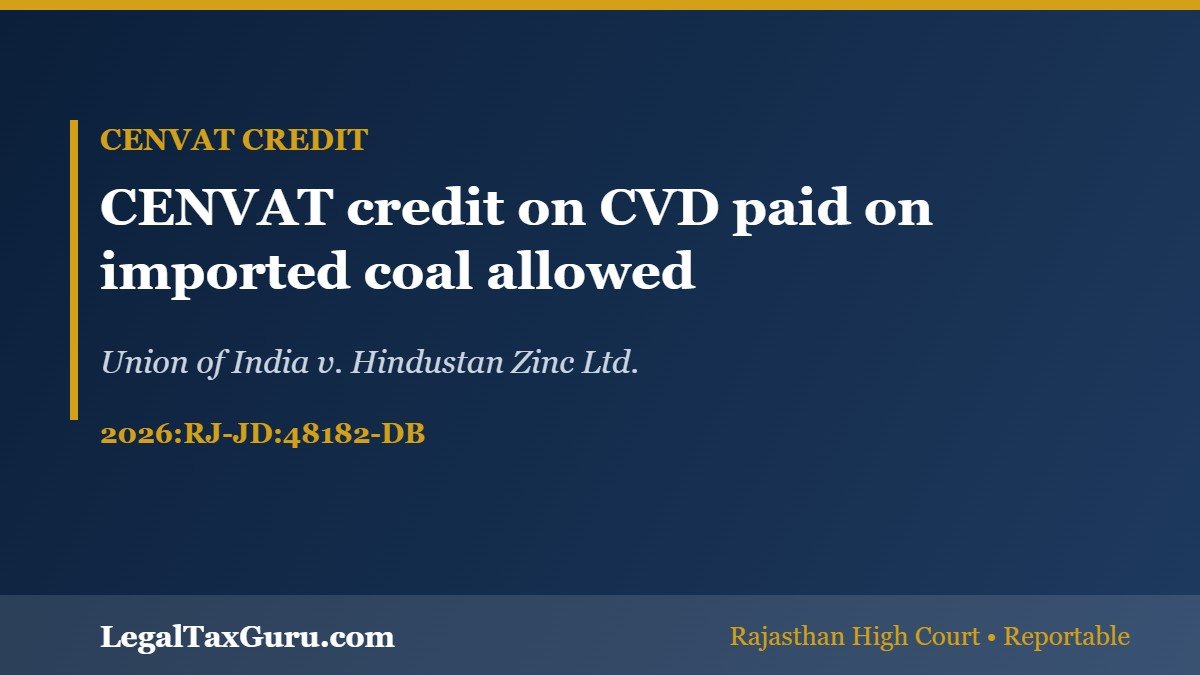
In Union of India v. Hindustan Zinc Ltd. (2026:RJ-JD:48182-DB), the Rajasthan High Court held that CENVAT credit of CVD on imported coal, paid at the concessional rate of 1%/2% under Customs Notification No. 12/2012-Cus, is admissible to a manufacturer under Rule 3(1)(vii) of the CENVAT Credit Rules, 2004 (para 16). A Division Bench of Chief Justice Sanjay K. Agrawal and Justice Baljinder Singh Sandhu dismissed five Central Excise appeals filed by the Revenue against a common CESTAT order of 02.09.2021 (paras 1–2, 17). The Court accepted the Tribunal's finding that the Commissioner had wrongly imported the restrictions in the proviso to Rule 3(1)(i) into Rule 3(1)(vii) (paras 11–13). It drew support from the minutes of the Regional Advisory Committee, Hyderabad Zone, and from the Calcutta High Court's decision in Shyam Steel Industries (paras 13–15). The substantial question of law was answered in favour of the assessee and against the Revenue (para 16).
Headnote: CENVAT Credit of CVD on Imported Coal
CENVAT Credit Rules, 2004 – Rule 3(1)(i), proviso (a) and (b), Rule 3(1)(vii) – Customs Tariff Act, 1975 – Section 3(1) – Customs Notification No. 12/2012-Cus dated 17.03.2012, Serial No. 122A/123 – Central Excise Notification No. 12/2012-CE, Serial Nos. 67 and 128 – Notification No. 1/2011-CE – Additional duty of customs (CVD) on imported steam coal – Admissibility of CENVAT credit – Central Excise appeal by Revenue.
Held: (i) Under Rule 3(1)(i), credit of excise duty specified in the First Schedule to the Central Excise Tariff Act is allowed subject to the twin conditions in proviso (a) and (b) (paras 10–11).
(ii) Rule 3(1)(vii) separately allows credit of the additional duty leviable under Section 3 of the Customs Tariff Act, equivalent to the excise duty specified in clauses (i) to (via) (paras 10–11).
(iii) The assessee paid CVD by availing Serial No. 122A/123 of Customs Notification No. 12/2012-Cus. It neither paid excise duty under the First Schedule nor availed Notification No. 1/2011-CE or Serial Nos. 67/128 of Notification No. 12/2012-CE. The proviso to Rule 3(1)(i) therefore could not be applied to it (para 12).
(iv) The Tribunal's finding that the Commissioner had mixed up Rule 3(1)(i) and Rule 3(1)(vii) was not substantially questioned or contradicted by the Revenue (paras 12–13).
(v) The Regional Advisory Committee, Hyderabad Zone (minutes of 09.02.2015), and the Calcutta High Court in Shyam Steel Industries support the admissibility of such credit (paras 13–15).
(vi) The assessee is entitled to CENVAT credit of 1%/2% CVD on imported coal; the question of law is answered against the Revenue and all five appeals are dismissed without costs (paras 16–17).
(paras 9–17)
Case Details: Union of India v. Hindustan Zinc Ltd. (2026:RJ-JD:48182-DB)
Final Outcome: All five Central Excise appeals of the Revenue dismissed; CESTAT's common final order dated 02.09.2021 allowing CENVAT credit affirmed; parties to bear their own costs.
Case: Union of India (through the Commissioner, CGST and Central Excise Commissionerate, Udaipur) v. Hindustan Zinc Ltd. (Chanderia Lead Zinc Smelter, Putholi, Chittorgarh) and connected appeals
Neutral Citation: 2026:RJ-JD:48182-DB
Case No.: D.B. Central Excise Appeal No. 5 of 2022, with D.B. Central Excise Appeal Nos. 4, 6, 7 and 8 of 2022
Court: Rajasthan High Court, Jodhpur (Division Bench)
Date of Decision: 5 October 2026
Bench: Chief Justice Sanjay K. Agrawal and Justice Baljinder Singh Sandhu
Relevant Acts & Sections: CENVAT Credit Rules, 2004 – Rule 3(1)(i) and 3(1)(vii); Customs Tariff Act, 1975 – Section 3(1); Central Excise Tariff Act, 1985 – First Schedule, Chapter 26; Customs Notification No. 12/2012-Cus (Serial No. 122A/123); Central Excise Notification Nos. 1/2011-CE and 12/2012-CE (Serial Nos. 67 and 128); CBEC Circular No. 41/2013-Cus
Impugned Order: CESTAT, New Delhi, Final Order No. 51785-51789/2021 dated 02.09.2021, setting aside Order-in-Original No. UDZ-EXCUS-000-COM-0076-0080-18-19 dated 26.02.2019 of the Commissioner, CGST, Udaipur
Counsel: Mr. Rajat Arora for the appellant-Revenue; Mr. Vinay Jain and Mr. Aditya Singhi for the respondent-assessee
Source: Rajasthan High Court (official website)
Key Holdings of the Rajasthan High Court
- Rule 3(1)(i) credit of excise duty is subject to the twin conditions in provisos (a) and (b) (para 11).
- Rule 3(1)(vii) independently allows credit of CVD leviable under Section 3 of the Customs Tariff Act, equivalent to the excise duty in clauses (i) to (via) (paras 10–11).
- Where CVD is paid under Serial No. 122A/123 of Customs Notification No. 12/2012-Cus, the excise-side restrictions on Serial Nos. 67 and 128 of Notification No. 12/2012-CE do not apply (para 12).
- The Commissioner erred by reading the conditions of Rule 3(1)(i) into Rule 3(1)(vii); this finding of CESTAT stood unrebutted (paras 12–13).
- The RAC, Hyderabad Zone minutes of 09.02.2015 and Circular No. 41/2013-Cus clarify that credit of 2% CVD on imported coal is eligible (para 13).
- The Calcutta High Court in Shyam Steel Industries decided the identical issue in favour of the assessee (paras 14–15).
Brief Facts of the Case
The assessee, Hindustan Zinc Ltd., is a major producer of zinc and lead concentrates falling under Chapter 26 of the First Schedule to the Central Excise Tariff Act, 1985, with captive mines at various places in Rajasthan (paras 4.1, 9).
For manufacturing its final products, it uses power from captive thermal power plants that run on imported steam coal/steam non-cooking coal falling under Chapter heading 27.01. On import, it paid CVD under Section 3(1) of the Customs Tariff Act at the concessional rate under Serial No. 122A/123 of Customs Notification No. 12/2012-Cus dated 17.03.2012. It availed CENVAT credit of that CVD under Rule 3(1)(vii) (paras 4.2, 9).
The Revenue issued five show cause notices alleging that the credit contravened Rule 3 of the CENVAT Credit Rules. The notices covered Zawar Mines, Chanderia Lead Zinc Smelter (two notices) and Rajpura Dariba Mines (two notices), for periods between April 2012 and June 2017 (para 4.3).
The credit involved in the five notices was Rs. 5,32,24,752, Rs. 23,47,64,043, Rs. 7,83,55,643, Rs. 10,24,52,194 and Rs. 4,59,31,082, which together come to about Rs. 51.47 crore (para 4.3).
By a common Order-in-Original dated 26.02.2019, the Commissioner, CGST, Udaipur confirmed the demands in all five notices (para 4.4). The assessee appealed to CESTAT, New Delhi. By Final Order No. 51785-51789/2021 dated 02.09.2021, the Tribunal set aside the Commissioner's order and allowed all five appeals (paras 4.5–4.7).
The Revenue appealed to the High Court, which admitted the five appeals on 10.08.2023 on a common substantial question of law (paras 3, 5).
Issues Before the High Court
- Whether the 1%/2% additional duty of customs (CVD) paid on imported coal is a duty of excise specified under the Central Excise Tariff Act, 1985, so as to attract the restrictions in the proviso to Rule 3(1)(i) (paras 3, 6).
- Whether CENVAT credit of CVD paid under Customs Notification No. 12/2012-Cus, as amended, is admissible to the assessee under Rule 3(1)(vii) (paras 3, 16).
Court's Findings and Reasoning
Revenue's case (para 6): Counsel for the Revenue argued that the Tribunal had erred in allowing credit of 1%/2% CVD paid on imported coal under Notification No. 12/2012-Cus, as amended on 01.03.2016. He submitted that CVD is not excise duty as such, and credit under Rule 3(1)(vii) is governed by proviso (b) to Rule 3(1)(i). Since buyers of domestic coal cleared at the concessional rate under Serial No. 67 of Notification No. 12/2012-CE cannot take credit, he argued, credit should also be denied on imported coal (para 6).
Assessee's case (para 7): Counsel for the assessee supported the Tribunal's order. He relied on the minutes of the RAC, Hyderabad Zone of 09.02.2015 and on the Calcutta High Court's dismissal of the Revenue's appeal in Commissioner of CGST & CX, Bolpur v. Shyam Steel Industries Ltd. (decided on 05.09.2022) (para 7).
Scheme of Rule 3 (paras 9–11): After reproducing Rule 3(1), the Court explained that Rule 3(1)(i) allows credit of excise duty specified in the First Schedule, subject to the twin conditions in proviso (a) and (b). Credit of additional duty leviable under Section 3 of the Customs Tariff Act, equivalent to the excise duty in clauses (i) to (via), is a separate head (paras 10–11).
Tribunal's finding upheld (paras 12–13): The Court quoted para 16 of the Tribunal's order. The Tribunal had found that the assessee paid CVD under Serial No. 122A/123 of the Customs Notification. It had not paid excise duty under the First Schedule. Nor had it availed Notification No. 1/2011-CE or Serial Nos. 67 and 128 of Notification No. 12/2012-CE. The Commissioner had therefore mixed up Rule 3(1)(i) and Rule 3(1)(vii) (para 12). The High Court recorded that the Revenue could not substantially question or contradict this finding (para 13).
Departmental clarification (para 13): The Court relied on Point No. 1 of the RAC, Hyderabad Zone minutes of 09.02.2015. The RAC noted Board Circular No. 41/2013-Cus dated 21.10.2013, which treats 2% CVD as the general applied rate. It concluded that CENVAT credit of CVD paid on imported coal under Notification No. 12/2012-Cus is eligible, since that notification was not excluded from the purview of Rule 3 (para 13).
Calcutta High Court view (paras 14–15): The Court reproduced paras 7–9 of Shyam Steel Industries, where the Calcutta High Court relied on the meaning of "equivalent" from Chandrakala Trivedi v. State of Rajasthan, Circular No. 41/2013-Cus, the RAC minutes, and a line of Tribunal decisions including Hindalco Industries, to uphold the credit (paras 14–15).
Conclusion (paras 16–17): The Tribunal rightly allowed the credit, and its findings were strictly based on the record (paras 16–17).
Final Outcome and Directions
- The substantial question of law is answered in favour of the assessee and against the Revenue.
- D.B. Central Excise Appeal Nos. 4, 5, 6, 7 and 8 of 2022 are dismissed.
- CESTAT's common Final Order No. 51785-51789/2021 dated 02.09.2021 stands affirmed.
- Parties to bear their own costs; a copy of the order to be placed in all connected files.
Legal Principle Laid Down
Rule 3(1)(vii) of the CENVAT Credit Rules, 2004 is an independent head of credit for the additional duty of customs leviable under Section 3 of the Customs Tariff Act, 1975. The provisos to Rule 3(1)(i), which bar credit of excise duty paid on goods cleared under Notification No. 1/2011-CE or Serial Nos. 67 and 128 of Notification No. 12/2012-CE, cannot be read into Rule 3(1)(vii). Where an importer pays concessional CVD of 1%/2% on steam coal under Serial No. 122A/123 of Customs Notification No. 12/2012-Cus, CENVAT credit of that CVD is admissible.
Precedents Relied Upon
- Commissioner of CGST & CX, Bolpur Commissionerate v. Shyam Steel Industries Ltd., Calcutta High Court, IA No. GA/01/2022 (decided on 05.09.2022) – Relied upon – credit of 1%/2% CVD on imported coal held admissible. Discussed at paras 7, 14–15.
- Hindalco Industries Ltd. v. GST, Bhopal, 2018 (363) E.L.T. 1085 (Tri.-Del.) – Relied upon (by CESTAT, and quoted in Shyam Steel) – no bar on credit under Rule 3(1)(vii) where CVD is paid under Notification No. 12/2012-Cus. Discussed at paras 4.7, 15.
- Chandrakala Trivedi v. State of Rajasthan, (2012) 3 SCC 129 – Referred (within the extract from Shyam Steel) – meaning of the word "equivalent". Discussed at para 15.
- SRF Ltd. v. Commissioner of Customs, Chennai, (2015) 318 ELT 607 (SC) – Referred (within the extract from Shyam Steel). Discussed at para 15.
- Aarti Industries, Asahi Songwon Colors, Shree Cement and Tamil Nadu Newsprint & Papers (CESTAT) – Referred (within the extract from Shyam Steel) – identical view taken by the Tribunal. Discussed at para 15.
Important Paragraphs of the Judgment
Verbatim extracts from the judgment. For the full text, refer to the judgment PDF below.
Para 11: "A careful reading of Rule 3(1)(i) of the Rules would show that a manufacturer shall be allowed to take CENVAT credit of the duty of excise specified in the First Schedule to the Excise Tariff Act leviable under the Excise Act subject to twin conditions incorporated in proviso (a) & (b)."
Para 12 (quoting para 16 of the CESTAT order): "The Commissioner has mixed up rule 3(1)(i) and rule 3(1)(vii) of rule 3 of the Credit Rules. It is for this reason that the conditions specified in rule 3(1)(i) have also been imported into rule 3(1)(vii) of the Credit Rules."
Para 13: "The said finding of the learned Tribunal could not be substantially questioned and contradicted by the learned counsel for the Revenue."
Para 16: "In view of the above, we are of the considered opinion that the learned Tribunal has rightly held that the assessee is entitled to CENVAT credit of 1% / 2% additional duty of customs paid on the imported coal under the Customs Notification No.12/2012-Cus dated 17th March, 2012, as amended by Notification dated 1st March, 2016."
Para 16: "The findings so recorded by the learned Tribunal are strictly based on the material available on record. The question of law is accordingly answered in favour of the assessee and against the Revenue."
Para 17: "The appeals are, accordingly, dismissed, leaving the parties to bear their own costs."
Practical Impact of the Ruling
- For manufacturers importing coal: Industries running captive power plants on imported steam coal can rely on this ruling to support CENVAT credit of concessional CVD paid under Notification No. 12/2012-Cus for the pre-GST period (paras 9, 16).
- For pending legacy disputes: Show cause notices and demands that deny such credit by invoking proviso (b) to Rule 3(1)(i) and Serial No. 67 of Notification No. 12/2012-CE are open to challenge, since that proviso does not govern Rule 3(1)(vii) (paras 11–12).
- For the Revenue: The Department's own RAC minutes and Circular No. 41/2013-Cus weigh against such demands. Revenue appeals that do not rebut the Tribunal's findings on facts are unlikely to succeed (para 13).
- For tax litigation lawyers: In a central excise appeal before the High Court, a consistent line of Tribunal rulings, a supporting High Court decision and departmental clarifications together carry significant weight (paras 13–15).
- For GST/excise appeal practice and adjudicators: Each clause of Rule 3(1) must be read on its own terms; conditions attached to one clause should not be carried into another (para 12).
FAQs on CENVAT Credit of CVD on Imported Coal
1. What did the Rajasthan High Court hold in Union of India v. Hindustan Zinc Ltd.?
It held that Hindustan Zinc was entitled to CENVAT credit of 1%/2% CVD paid on imported coal under Customs Notification No. 12/2012-Cus. It dismissed five Revenue appeals against CESTAT's order of 02.09.2021 (paras 16–17).
2. Is CENVAT credit of CVD on imported coal available under Rule 3(1)(vii)?
Yes. Rule 3(1)(vii) allows credit of additional duty leviable under Section 3 of the Customs Tariff Act. Where CVD is paid under Serial No. 122A/123 of Notification No. 12/2012-Cus, the credit is admissible (paras 10–12, 16).
3. Does the proviso to Rule 3(1)(i) restrict credit of CVD?
No. The Court upheld the Tribunal's finding that the Commissioner wrongly imported the conditions of Rule 3(1)(i) into Rule 3(1)(vii). The assessee had not availed Notification No. 1/2011-CE or Serial Nos. 67/128 of Notification No. 12/2012-CE (paras 11–13).
4. What departmental material supported the assessee?
The minutes of the Regional Advisory Committee, Hyderabad Zone of 09.02.2015 and CBEC Circular No. 41/2013-Cus dated 21.10.2013. Both support eligibility of the credit (para 13).
5. Which decisions did the High Court follow?
It relied on the Calcutta High Court in Shyam Steel Industries Ltd., which in turn followed Hindalco Industries and other CESTAT rulings on the same issue (paras 4.7, 14–15).
Keywords: 2026:RJ-JD:48182-DB, Union of India v. Hindustan Zinc Ltd., CENVAT credit of CVD on imported coal, Rule 3(1)(vii) CENVAT Credit Rules, proviso to Rule 3(1)(i), Notification 12/2012-Cus, additional duty of customs, Circular 41/2013-Cus, Shyam Steel Industries, central excise appeal High Court, Rajasthan High Court, Chief Justice Sanjay K. Agrawal
Related on LegalTaxGuru
- More High Court judgments on GST and indirect tax
- Excess excise duty adjustment on provisional assessment – Hindustan Zinc
- Additional depreciation on power plants – CIT v. Hindustan Zinc
Download Judgment PDF – Union of India v. Hindustan Zinc Ltd.
Source: Rajasthan High Court (official website).
Read more: Rajasthan High Court · Central Excise · CENVAT Credit · Indirect Tax