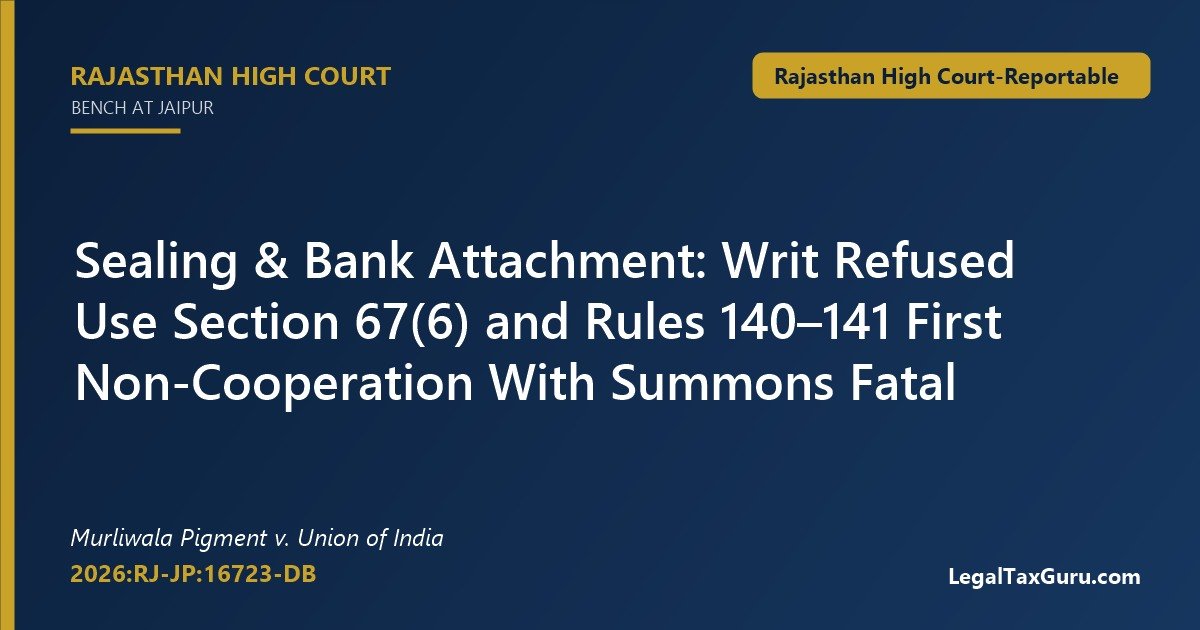
Quick Answer: A writ against Section 67 sealing and bank attachment will fail where the taxpayer has not applied for de-sealing or release under Section 67(4), 67(6) and Rules 140–141. The Rajasthan High Court also found no flaw in the Section 83 attachment and held that disobeying summons disentitles the petitioner to writ relief.
In M/s Murliwala Pigment v. Union of India and Others (2026:RJ-JP:16723-DB), the Rajasthan High Court held that the statutory mechanism for de-sealing and release must be used before the writ court is approached (paras 19–20). A Division Bench of Inderjeet Singh, J and Ashok Kumar Jain, J dismissed the petition against DGGI's sealing of four premises and the DRC-22 attachment, distinguishing Armour Security and Napin Impex (paras 1, 13, 24–25). The petitioner's continued non-appearance on summons weighed decisively against him (paras 21–23).
Headnote: Section 67 Sealing and Bank Attachment
Central Goods and Services Tax Act, 2017 – Sections 6(2)(b), 67, 70 and 83 – CGST Rules, 2017 – Rules 140 and 141 – Search and seizure – Sealing of business premises – Provisional attachment of bank account (DRC-22) – Non-compliance with summons – Alternative remedy – Article 226
Held: (i) Section 67(2) empowers search and seizure, and Section 67(4) authorises the officer to seal premises and also to de-seal them if satisfied under the law (paras 9, 18, 20). (ii) Section 67(6) read with Rules 140 and 141 provides the mechanism for provisional release of seized goods; a taxpayer who has not invoked it cannot rush to the writ court (paras 15, 19–20). (iii) Provisional attachment under Section 83 to the extent of barring debits was not shown to be flawed (paras 10, 19). (iv) Armour Security does not help a petitioner who shows no earlier investigation on the same subject matter (para 13). (v) Napin Impex does not apply on these facts (para 24). (vi) Where efficacious remedies exist, and the petitioner has disobeyed summons, writ jurisdiction will not be exercised (paras 21–23).
(paras 9–10, 13, 18–24)
Case Details: Murliwala Pigment (2026:RJ-JP:16723-DB)
Final Outcome: Writ petition dismissed; pending applications disposed of; no order as to costs (paras 25–26)
Case: M/s Murliwala Pigment v. Union of India and Others
Neutral Citation: 2026:RJ-JP:16723-DB
Case No.: D.B. Civil Writ Petition No. 5848/2026
Court: Rajasthan High Court, Bench at Jaipur (Division Bench)
Date of Decision: 20 April 2026 (Judgment; marked "REPORTABLE")
Bench: Hon'ble Mr. Justice Inderjeet Singh and Hon'ble Mr. Justice Ashok Kumar Jain (authoring judge not indicated in the judgment)
Relevant Acts & Sections: CGST Act, 2017 – Sections 6(2)(b), 67, 70, 83, 130; CGST Rules, 2017 – Rules 140, 141; Constitution of India – Article 226
Impugned Order: Provisional attachment in Form DRC-22 dated 12.03.2026 and sealing of four business premises, issued by the Additional Director, DGGI, Jaipur Zonal Unit, following search on 10.03.2026 (paras 1, 7, 10)
Counsel: Mr. Jaswinder Singh Bedi and Mr. Rudraksh Sharma for the petitioner; Mr. Sandeep Pathak, Mr. Kinshuk Jain, and Ms. Mahi Yadav, AAG, with Mr. Rohan Mittal and Mr. Arun Kumar, for the respondents
Source: Rajasthan High Court (official website)
Key Holdings of the Rajasthan High Court
- "Reason to believe" under Section 67(2) requires an objective determination, as distinguished from a purely subjective consideration (para 9).
- Armour Security is not applicable where the petitioner shows no prior investigation by any authority on similar grounds (para 13).
- Section 67(6) read with Rules 140 and 141 is the route for release of seized goods, as explained in Kay Pan Fragrance (paras 15, 18, 20).
- No application under Section 67(4) and (6) for release of goods or de-sealing was ever filed (para 19).
- The petitioner pointed to no flaw in the Section 83 attachment order dated 12.03.2026 (para 19).
- A petitioner who disobeys summons and bypasses efficacious remedies is not entitled to writ relief (paras 21–24).
Brief Facts of the Case
The petitioner is registered under the Rajasthan GST Act, 2017 (para 7). On 10.03.2026, DGGI officers (respondent nos. 3 and 4) conducted simultaneous searches at five premises associated with the petitioner under Section 67(2) of the CGST Act (para 7).
Goods lying at various premises were seized and four business premises were sealed. Bank accounts of the petitioner's business entities were later attached (para 7).
The petitioner was not present throughout the search (para 10). On 12.03.2026, the bank account was provisionally attached under Section 83, barring debit transactions to safeguard revenue (para 10).
The petitioner was summoned on 14.03.2026 and replied on 18.03.2026, but did not appear (para 7). He was summoned again on 18.03.2026 and filed a detailed reply on 23.03.2026; he also replied to the provisional attachment (para 7).
He then filed the writ under Article 226, seeking quashing of the sealing and the DRC-22, and a direction against coercive steps (paras 2, 7).
Issues Before the High Court
- Whether sealing of business premises and freezing of bank accounts were beyond Section 67 and Section 83 of the CGST Act (paras 3, 19–20).
- Whether Armour Security and Section 6(2)(b) barred the action, since no show cause notice had been issued (paras 3, 12–13).
- Whether the writ petition was maintainable given the statutory release mechanism and the petitioner's non-cooperation (paras 5, 19–23).
Court's Findings and Reasoning
Petitioner's case (paras 3–4): Relying on M/s Armour Security (India) Ltd. v. Commissioner, CGST Delhi East, 2025 INSC 982, counsel argued that premises cannot be sealed as a coercive measure for non-appearance (para 3). Proceedings commence only with a show cause notice under Section 6(2)(b), and Section 67 does not authorise sealing premises or freezing accounts (para 3). Alternatively, he sought to operate from the premises while goods stayed sealed (para 4).
Revenue's case (para 5): The respondents said the action was taken under Section 67 because the petitioner had not cooperated with summons (para 5). Relying on Ankush Jain v. Union of India, DBCWP No. 17040/2022, they argued he must place his explanation before the GST authorities, not the writ court (para 5).
Scope of Section 67 (paras 8–9): The Court explained that "reason to believe" means knowledge of facts that would lead a reasonable person to the same conclusion (para 9). It described it as an "objective determination based on independent care and evaluation as distinguished from the purely subjective consideration" (para 9). Section 67(2) empowers search and seizure, including confiscation under Section 130 (para 9).
Armour Security distinguished (paras 11–13): The Court extracted paras 96–99 of that judgment, including guideline (i) requiring taxpayers to appear on summons (para 11). Relying only on "initiation of any proceedings" under Section 6(2)(b), the petitioner stated no fact showing any earlier investigation on similar grounds, including ITC claims, so Armour Security was inapplicable (para 13).
Napin Impex (paras 14, 24): The petitioner cited M/s Napin Impex, where the Delhi High Court directed de-sealing of premises sealed under Section 67(4), and the Section 83 attachment guidelines (para 14). The Court held Napin Impex inapplicable on the facts (para 24).
Statutory release mechanism (paras 15–20): Relying on State of Uttar Pradesh v. M/s Kay Pan Fragrance Pvt. Ltd., the Court held that the owner of seized goods must use Section 67(6) and Rules 140 and 141 for provisional release (para 15). It noted Calcutta and Delhi High Court decisions on the same lines (paras 16–17).
Respondent no. 3 is authorised to seal premises and also to de-seal them if satisfied under the law (para 20). Yet no material showed that the petitioner ever applied under Section 67(4) and (6) for release or de-sealing; instead, he filed a writ (paras 19–20).
Section 83 attachment (paras 10, 19–20): The attachment was provisional, limited to barring debits, and Section 83 authorises such action to protect revenue (paras 10, 19). The petitioner pointed to no flaw in the order dated 12.03.2026, and nothing showed the respondents acted contrary to law (paras 19–20).
Alternative remedy (paras 21–22): Relying on State of Maharashtra v. Greatship (India) Ltd., 2022 SCC OnLine SC 1262, the Court held that a writ cannot be entertained where efficacious remedies exist (para 21). A coordinate Bench applied this in Tanushree Logistics, and another held that non-compliance with summons is a punishable offence (para 22).
Application to facts (paras 23–24): The petitioner was absent during the search, sought time when summoned, and replied only after his bank account was attached (para 23). He never appeared under Section 70 to give evidence or produce documents (para 23). Having disobeyed summons and filed no supporting documents, he was not entitled to relief (paras 23–24).
Final Outcome and Directions
- Writ petition dismissed (paras 24–25).
- Pending applications, if any, dismissed with the petition (para 25).
- No order as to costs (para 26).
- The judgment notes that the petitioner may apply under the CGST Act and Rules for release and de-sealing (para 20).
- The judgment is silent on any time-bound direction to decide such an application, and on the merits of the underlying investigation.
Legal Principle Laid Down
Sealing of premises and seizure of goods under Section 67, and provisional attachment of bank accounts under Section 83, are subject to a self-contained statutory scheme for release and de-sealing. The officer authorised under Section 67(4) may seal and de-seal premises, and Section 67(6) read with Rules 140 and 141 provides for provisional release of seized goods. A taxpayer who has not invoked this mechanism, shows no flaw in the Section 83 attachment and has disobeyed summons under Section 70 cannot invoke Article 226; Armour Security protects only against parallel proceedings on the same subject matter, which must be shown on facts (paras 13, 18–24).
Precedents Relied Upon
- M/s Armour Security (India) Ltd. v. Commissioner, CGST Delhi East Commissionerate, 2025 INSC 982 – Distinguished – Section 6(2)(b) bar operates only where proceedings on the same subject matter exist; taxpayers must comply with summons. Discussed at paras 3, 11–13, 24.
- M/s Napin Impex Pvt. Ltd. v. Commissioner of DGST Delhi, W.P.(C) No. 10287/2018 (Delhi HC, 28.09.2018) – Distinguished – de-sealing of premises sealed under Section 67(4). Discussed at paras 14, 24.
- State of Uttar Pradesh v. M/s Kay Pan Fragrance Pvt. Ltd., Civil Appeal Nos. 8942/2021 and 8944/2021 (SC) – Relied upon – owner of seized goods must use Section 67(6) and Rules 140–141. Discussed at paras 15, 18.
- M/s Kanak Timber House v. Assistant Commissioner of Sales Tax, 2024 (3) TMI 680 (Calcutta HC) – Referred – followed Kay Pan Fragrance on release of seized goods. Discussed at para 16.
- Genesis Enterprises v. Principal Commissioner CGST Delhi, W.P.(C) No. 13821/2021 (Delhi HC, 15.09.2025) – Referred – writ dismissed after considering ITC Limited v. State of Karnataka, Civil Appeal No. 11798 of 2025, on "reason to believe". Discussed at para 17.
- State of Maharashtra v. Greatship (India) Ltd., 2022 SCC OnLine SC 1262 – Relied upon – following United Bank of India v. Satyawati Tondon, (2010) 8 SCC 110, writ not to be entertained where an efficacious remedy exists. Discussed at para 21.
- Tanushree Logistics Pvt. Ltd. v. State of Rajasthan, DBCWP No. 17550/2022 (Raj HC, 07.12.2022) – Relied upon – petition dismissed on alternative remedy. Discussed at para 22.
- Ankush Jain v. Union of India, DBCWP No. 17040/2022 (Raj HC, 21.12.2022) – Relied upon (cited by Revenue) – summons must be complied with. Discussed at paras 5, 22. The name appears as "Ankur Jain" in para 22.
Important Paragraphs of the Judgment
Verbatim extracts from the judgment. For the full text, refer to the judgment PDF below.
Para 19 (no application, no flaw): "No material is placed on record to show that the petitioner has ever filed any application by invoking the provision under Section 67(4) and (6) for release of goods or de-sealing of premises. Section 83 of CGST Act authorizes the Commissioner to act to protect the interest of the government revenue. The circular dated 21.02.2021 provides for guidelines for attachment of property and the petitioner has failed to point out any flaw in the attachment process initiated by respondents while issuing order of attachment dated 12.03.2026 (Annexure-7)."
Para 20 (statutory route): "There is nothing on record to show that the action of the respondent was contrary to the provisions of law. Respondent no. 3 is authorized under Section 67(4) to seal the premises and also to de-seal the premises, if he is satisfied as per conditions laid under the law. Section 67(6) read with Rule 140 and 141 of CGST Rules, 2017 provides for release of goods and procedure in respect of seized goods. The petitioner may file an application in accordance with the procedure as prescribed under the CGST Act 2017 and CGST Rules 2017, but instead of adopting the procedure prescribed under the law, he filed a writ petition under Article 226 of the Constitution of India."
Para 24 (precedents inapplicable): "Having considered the facts of the case and the material placed on record, the judgments in case of M/s Armor Security (India) Limited (supra) and M/s Napin Impex Private Ltd. Vs. Commissioner of DGST Delhi and Ors. (supra) are not applicable to help the petitioner to succeed in the writ petition, therefore, the writ petition is liable to be dismissed."
Practical Impact of the Ruling
- For taxpayers facing sealing: Apply first to the authorised officer for de-sealing under Section 67(4), and for provisional release under Section 67(6) and Rules 140–141. A writ filed without this step faces dismissal (paras 19–20).
- For taxpayers facing Section 83 attachment: Identify a concrete flaw in the attachment process. A general plea of harassment will not succeed (para 19).
- For summons compliance: Appearing under Section 70 is critical. Non-appearance weighs heavily against the taxpayer in writ proceedings (paras 11, 22–23).
- For Armour Security pleas: The Section 6(2)(b) bar needs pleaded facts of an earlier proceeding on the same subject matter. Citing the judgment alone is not enough (paras 12–13).
FAQs on Section 67 Sealing and Bank Attachment
1. What did the Rajasthan High Court hold in Murliwala Pigment v. Union of India?
The Court dismissed the writ against DGGI's sealing of four premises and the Section 83 attachment. It held that the petitioner never used the release mechanism under Section 67(4), 67(6) and Rules 140–141, and found no flaw in the attachment order (paras 19–20, 24–25).
2. Can a GST officer seal business premises under Section 67(4)?
Yes. The Court held that the officer authorised under Section 67(4) can seal premises and also de-seal them if satisfied under the law. The taxpayer must apply to that officer first (paras 18, 20).
3. Does Armour Security bar a DGGI search before a show cause notice?
No, not on these facts. Armour Security bars parallel proceedings on the same subject matter. The petitioner showed no earlier investigation on similar grounds, so it did not apply (paras 12–13).
4. Is a writ maintainable against Section 83 provisional attachment of a bank account?
Not where an efficacious remedy exists and no flaw is shown. Relying on Greatship (India), the Court refused to entertain the writ. The petitioner's non-compliance with summons also weighed against him (paras 19, 21–23).
5. What relief did Murliwala Pigment get from the High Court?
None; the writ petition was dismissed with no order as to costs. The Court noted that the petitioner may apply under the CGST Act and Rules for release of goods and de-sealing (paras 20, 25–26).
Keywords: 2026:RJ-JP:16723-DB, Murliwala Pigment v. Union of India, Section 67 sealing and bank attachment, Section 67(4) CGST Act, Section 83 provisional attachment, DRC-22, Rules 140 and 141, Armour Security 2025 INSC 982, Greatship India, alternative remedy, DGGI Jaipur, tax litigation lawyer, Rajasthan High Court, Justice Inderjeet Singh
Related on LegalTaxGuru
- More High Court judgments on GST and indirect tax
- GST articles and updates
- No Cash Seizure under Section 67(2) CGST – Bhagwan Tirthani v. Principal Commissioner
Download Judgment PDF – M/s Murliwala Pigment v. Union of India
Source: Rajasthan High Court (official website).
Read more: Rajasthan High Court · GST · Search, Seizure and Attachment · Indirect Tax