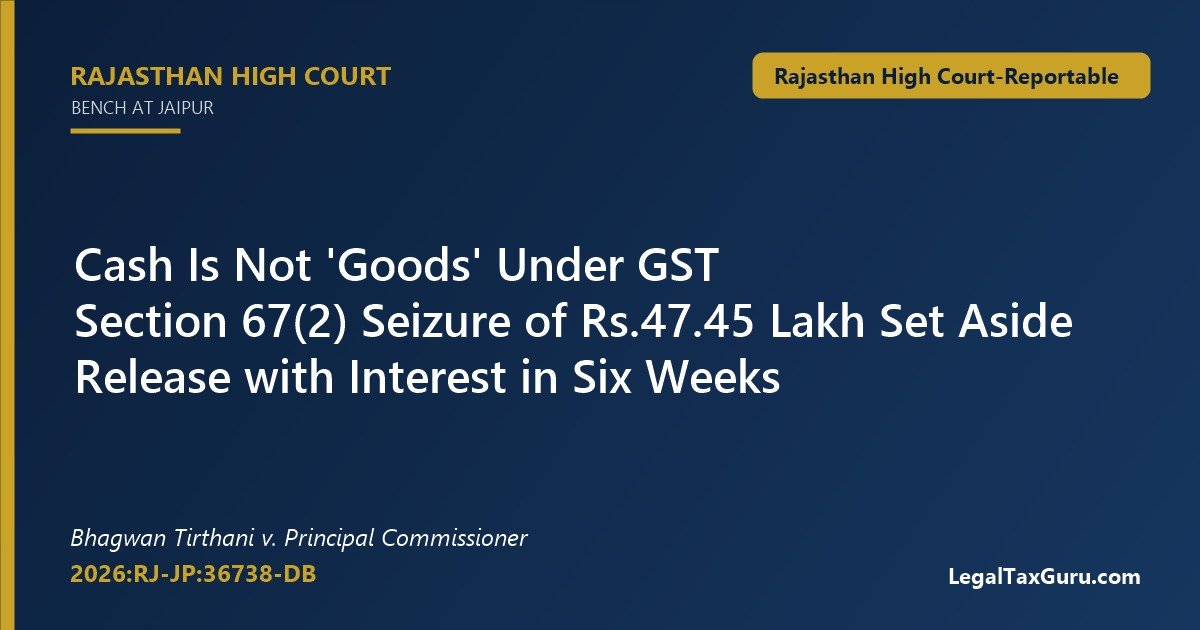
Quick Answer: Cash seizure under Section 67(2) CGST is without authority of law, because money is excluded from "goods" and "things" covers only articles of evidentiary value. The Rajasthan High Court set aside the seizure of Rs.47,45,000 and directed its release with applicable interest within six weeks.
In Bhagwan Tirthani and Others v. Principal Commissioner, CGST Commissionerate, Jaipur and Others (2026:RJ-JP:36738-DB), the Rajasthan High Court held that Section 67(2) confers no power to seize currency as alleged sale proceeds (paras 10–15, 25.10). A Division Bench of Arun Monga, J (author) and Ashutosh Kumar, J allowed the writ, followed the Bombay and Delhi High Courts and declined to follow Kanishka Matta (paras 22–25, 30). The cash must be released within six weeks with interest, while other findings stay with the pending appeal (paras 26–29).
Headnote: Cash Seizure under Section 67(2) CGST
Central Goods and Services Tax Act, 2017 – Sections 2(31), 2(52), 2(75), 67(2), 107, 130 – Search and seizure – Seizure of cash – "Goods" excludes money – "Documents or books or things" – Ejusdem generis – Alternative remedy – Interest on release
Held: (i) Writ jurisdiction is available despite a pending appeal where the challenge goes to the existence of statutory power to seize (para 8). (ii) Money is expressly excluded from "goods" under Section 2(52); cash cannot be "goods liable to confiscation" under the first limb of Section 67(2) (paras 10–11). (iii) "Things" must be read ejusdem generis with "documents" and "books", and covers articles of evidentiary value, not currency as such (paras 13–13.1). (iv) Unlike the Income-tax Act and the Customs Act, the CGST Act confers no express power to seize money, and the omission cannot be judicially supplied (paras 14–15). (v) A later adjudicatory finding that cash is sale proceeds cannot retrospectively cure the absence of power at the time of seizure (para 19). (vi) Kanishka Matta (MP HC) is not followed and is in any case distinguishable on facts (paras 25.1–25.11).
(paras 8, 10–25.11)
Case Details: Bhagwan Tirthani (2026:RJ-JP:36738-DB)
Final Outcome: Writ petition allowed to the extent of the cash; release of Rs.47,45,000 within six weeks with applicable interest; no costs (paras 27–31)
Case: Bhagwan Tirthani and Others v. Principal Commissioner, CGST Commissionerate, Jaipur and Others
Neutral Citation: 2026:RJ-JP:36738-DB
Case No.: D.B. Civil Writ Petition No. 2128/2025 (CNR: RJHC020107092025)
Court: Rajasthan High Court, Bench at Jaipur (Division Bench)
Date of Decision: 14 September 2026 (Order; marked "Reportable")
Bench: Hon'ble Mr. Justice Arun Monga (author) and Hon'ble Mr. Justice Ashutosh Kumar
Relevant Acts & Sections: CGST Act, 2017 – Sections 2(31), 2(52), 2(75), 2(101), 67(2), 107, 112, 130; Income-tax Act, 1961 – Section 132; Customs Act, 1962 – Section 2(22); Constitution of India – Articles 226, 265
Impugned Order: Order-in-Original dated 11.06.2024 passed by the Assistant Commissioner, Anti-Evasion, CGST, Jaipur, insofar as it declines release of confiscated cash of Rs.47,45,000 (para 1)
Counsel: Mr. Rahul Lakhwani with Mr. Mihir Jhanwar, and Mr. Prateek Kedawat (through VC), for the petitioners; Mr. C.S. Sinha with Mr. Dev Yadav, and Ms. Chelsi Agarwal, AAAG, with Mr. Kuldeep Singh Rathore, AAAG, for Ms. Mahi Yadav, AAG, for the respondents
Source: Rajasthan High Court (official website)
Key Holdings of the Rajasthan High Court
- Under Section 2(52), "goods" excludes money, so currency cannot be "goods liable to confiscation" under Section 67(2) (paras 10–11).
- "Things" in Section 67(2) must be read ejusdem generis with "documents" and "books" and is evidentiary in character (paras 13–13.1).
- The validity of a seizure is tested on the power available on the date of seizure; later findings cannot cure it (para 19).
- Cash that merely represents unaccounted wealth cannot be seized; only currency of evidentiary value can (para 25.10).
- Seized cash must be released with applicable interest from the expiry of a reasonable period after seizure (paras 27–29).
Brief Facts of the Case
On 22.11.2022, CGST officers searched the business premises of petitioner No.1 and the residence occupied by petitioner Nos.1 and 2 under Section 67(2) (para 2). Cash of Rs.47,45,000 was seized from the residence. The officers also seized 2,33,300 cigarettes valued at Rs.18,67,690 from the shop and godown (paras 2, 2.1).
The petitioners said the cigarettes belonged to company agents, and that petitioner No.2's first-floor residence was searched without separate authorisation (para 2.1). They claimed the cash belonged to four persons (Rs.1,45,000, Rs.10,00,000, Rs.21,00,000 and Rs.15,00,000), but their affidavits were rejected (para 2.2).
By Order-in-Original dated 11.06.2024, the cigarettes and currency were held liable to confiscation under Section 130, and penalties were imposed (para 2.3). The authority found the cash to be sale proceeds of unaccounted cigarettes sold without invoices (paras 2.3, 6).
Petitioner No.1 filed an appeal in Form GST APL-01 under Section 107, which is pending (para 2.4). The writ was confined to the seizure and retention of cash (para 2.5).
Issues Before the High Court
- Preliminary: whether the writ is maintainable despite the statutory appeal (paras 4, 8).
- Whether Section 67(2) of the CGST Act extends to seizure of currency found during a search, merely because the authorities suspect, or later conclude, that it represents proceeds of unaccounted taxable supplies (para 7).
- Whether "money" is expressly excluded from "goods" under the CGST Act, and whether Section 67(2) authorises seizure of cash (para 7).
Court's Findings and Reasoning
Petitioners' case (paras 3–3.7): Money is excluded from "goods", and "things" means evidentiary articles; they contrasted the Customs and Income-tax Acts and invoked Article 265 (paras 3.1–3.7).
Revenue's case (paras 4–4.4): The Revenue pleaded alternative remedy under Sections 107 and 112, and relied on the cigarettes, statements, WhatsApp messages and an admission that Rs.37,45,000 belonged to petitioner No.1 (paras 4.1–4.2). It cited Smt. Kanishka Matta v. Union of India, 2020 SCC OnLine MP 4564, to read "things" as including cash (para 4.4).
Maintainability (para 8): An appeal lies, but the challenge went "to the root of the jurisdiction" to seize cash, a question of the existence of power; the objection failed (para 8).
First limb – "goods liable to confiscation" (paras 10–11): Section 67(2) covers two distinct categories (para 10). Under Section 2(52), "goods" means movable property "other than money and securities", so seized currency cannot be "goods liable to confiscation" (paras 10, 10.1). Parliament deliberately used the defined term "goods", not "property" or "assets", and no context displaced the definition (para 11).
Second limb – "documents or books or things" (paras 12–13.1): "Documents" and "books" are evidentiary, so "things" must be read ejusdem generis; it is not an unlimited residuary power (paras 12–13). The second proviso permits retention only for "examination" and inquiry, confirming the evidentiary purpose (para 13.1).
Comparative statutes (paras 14–15): Section 67 does not mention money, cash or sale proceeds, while Section 132(1)(iii) of the Income-tax Act and Section 2(22)(d) of the Customs Act expressly cover money (paras 14–14.3). Reading currency into "things" would "add words to the statute", impermissible for a coercive power (para 15).
No power from suspicion or later findings (paras 16–21): GST authorities can assess, recover, summon, attach and adjudicate, but suspected liability cannot enlarge the seizure power (paras 16–17). The character attributed to the cash "cannot, however, create a power of seizure" (para 18). A later finding cannot cure a "foundational absence of jurisdiction" (para 19).
The power to seize "cannot be inferred from the perceived necessity to secure a possible future demand" (para 21).
Bombay and Delhi High Courts followed (paras 22–25): The Court agreed with Smurti Waghdhare v. Joint Director, DGGI, 2026 SCC OnLine Bom 1885, and rested its conclusion independently on six statutory considerations (paras 22–23). It also followed Deepak Khandelwal v. Commissioner of CGST, Delhi West, 2023 SCC OnLine Del 4985, which had declined to follow Kanishka Matta (paras 24–25).
Kanishka Matta not followed and distinguished (paras 25.1–25.9): The Court declined to treat currency as a "thing"; any power to seize cash is for the legislature to enact (paras 25.2–25.3). Kanishka Matta rested on a voluntary statement and a case diary recording reasonable belief (para 25.6). Here, the cigarettes, statements and WhatsApp messages were not linked to the seized cash (para 25.7).
The admission of Rs.37,45,000 was about ownership, not clandestine sale proceeds (para 25.8). Seizure of goods does not justify seizure of cash, and rejecting the explanation cannot supply the missing power (para 25.9).
Application to facts (paras 25.10, 26): The notes were not shown to be required as evidence; the retention was "towards a possible future recovery", which Section 67(2) does not permit (para 25.10). Findings on cigarettes, registration and penalties were left to the appeal (para 26).
Final Outcome and Directions
- Seizure and retention of Rs.47,45,000 held unsustainable (para 27).
- Amount to be released to the persons from whose possession it was seized, subject to any lawful claim, restraint, attachment or order under an independently applicable statute (para 27).
- Petitioners entitled to applicable interest in accordance with law from expiry of a reasonable period after seizure until actual payment (para 28).
- Release within six weeks of the order being uploaded on the Court's website, unless lawfully prevented by a specific order of a competent court or authority (para 29).
- Writ allowed to that extent; no order as to costs; pending applications disposed of (paras 30–31).
- The order is silent on compensation, though it was prayed for (para 1).
Legal Principle Laid Down
Section 67(2) of the CGST Act authorises seizure only of goods liable to confiscation and of documents, books or things useful or relevant to proceedings. Money is excluded from "goods" by Section 2(52), and "things" covers only articles of evidentiary value, so cash that merely represents unaccounted wealth or a possible future demand cannot be seized or retained. Validity is judged on the power available at the time of search, a later finding cannot cure its absence, and such a challenge is maintainable in writ despite a pending appeal (paras 8, 10–25.10).
Precedents Relied Upon
- Smurti Waghdhare v. Joint Director, Directorate General of GST Intelligence, 2026 SCC OnLine Bom 1885 – Relied upon/followed – seizure of cash under Section 67(2) is without authority of law. Discussed at paras 22–23.
- Deepak Khandelwal v. Commissioner of CGST, Delhi West, 2023 SCC OnLine Del 4985 – Relied upon/followed – Section 67(2) does not permit seizure of currency as unaccounted wealth; Kanishka Matta not followed. Discussed at para 25.
- Smt. Kanishka Matta v. Union of India, 2020 SCC OnLine MP 4564 – Cited by Revenue; not followed and distinguished – had read "things" to include money. Discussed at paras 4.4, 24, 25.1–25.11.
Important Paragraphs of the Judgment
Verbatim extracts from the judgment. For the full text, refer to the judgment PDF below.
Para 13 (ejusdem generis): "The words "documents", "books" and "things" in Section 67(2) must be understood with reference to their statutory setting. The associated words "documents" and "books" are inherently evidentiary in character. The expression "things" following those words must therefore be read ejusdem generis, so as to include other articles that may serve as material or evidence in an inquiry under the Act. It cannot be construed as an unlimited residuary expression enabling seizure of every movable article found during search proceedings."
Para 19 (date of seizure): "The validity of a seizure must be tested with reference to the power available on the date when the seizure was effected. A subsequent adjudicatory finding cannot retrospectively cure a foundational absence of jurisdiction. The departmental officers must be able to point to a statutory provision authorising the seizure of the particular subject matter at the time of search. Where such power is absent, the seizure cannot be sustained merely because investigation later furnishes circumstances that may give rise to tax consequences."
Para 25.3 (for the legislature): "The power of search and seizure is a serious invasion upon a person's proprietary and possessory rights. Such power must, therefore, be exercised strictly within the bounds of the statute. It is not open for us to expand its scope on considerations of administrative convenience or on the basis that cash may have some connection with an alleged tax contravention. If the legislature considers it necessary to confer a specific power to seize unaccounted cash or alleged sale proceeds in GST proceedings, it is for the legislature to enact such a provision."
Para 25.10 (evidentiary value): "Suspicion that money represents business receipts must also be tested against the purpose for which it was seized. Currency that has evidentiary value no doubt can be seized. Cash that merely represents unaccounted wealth cannot be seized under Section 67. In the present case, the respondents have not shown that the seized notes are required as an evidence for any proceeding. The impugned order treats the cash as liable to confiscation. It does not rely on the notes as material that yields information. The retention is thus towards a possible future recovery. To reiterate, Section 67(2) does not permit it."
Practical Impact of the Ruling
- For taxpayers: Cash seized in a GST search can be challenged directly in writ, even while an appeal on other findings is pending. Release is to the persons from whose possession it was seized, with interest (paras 8, 26–28).
- For the department: Officers cannot use Section 67(2) to secure future demands by seizing cash. They must use assessment, recovery and attachment provisions instead (paras 16, 21, 25.10).
- For evidence: Currency may be seized only where the department shows it is required as evidence. A bare link to unaccounted business is not enough (paras 25.7, 25.10).
- For litigants: Rajasthan joins the Bombay and Delhi view, against Kanishka Matta (paras 22–25).
FAQs on Cash Seizure under Section 67(2) CGST
1. What did the Rajasthan High Court hold in Bhagwan Tirthani v. Principal Commissioner?
The Court held that Section 67(2) does not authorise seizure of cash as such. Money is excluded from "goods" under Section 2(52), and "things" covers only evidentiary articles. The seizure of Rs.47,45,000 was set aside (paras 10–13, 27).
2. Can GST officers seize cash as sale proceeds of unaccounted goods?
No, not under Section 67(2). The alleged character of the cash may matter for assessment or recovery, but it cannot create a seizure power. A later adjudicatory finding cannot cure the lack of power on the date of seizure (paras 18–19, 25.10).
3. Is a writ maintainable against cash seizure when a GST appeal is pending?
Yes, where the challenge is to the existence of power to seize. The Court held that alternative remedy does not bar a writ against action without jurisdiction. It did not decide the other findings pending in appeal (paras 8, 26).
4. What did the Rajasthan High Court say about Kanishka Matta?
The Court declined to follow Kanishka Matta on the meaning of "things". It also distinguished it because that case had a voluntary statement and a case diary linking the cash to illicit supply. No such link existed here (paras 25.2, 25.6–25.7, 25.11).
5. Will the seized cash be refunded with interest?
Yes, the Court directed release within six weeks of uploading of the order. The petitioners get applicable interest in accordance with law from the expiry of a reasonable period after seizure. Release is subject to any lawful order under another statute (paras 27–29).
Keywords: 2026:RJ-JP:36738-DB, Bhagwan Tirthani v. Principal Commissioner, cash seizure under Section 67(2) CGST, Section 2(52) goods excludes money, Section 130 confiscation, ejusdem generis, Kanishka Matta, Smurti Waghdhare, Deepak Khandelwal, Section 132 Income-tax Act, tax litigation lawyer, Rajasthan High Court, Justice Arun Monga
Related on LegalTaxGuru
- More High Court judgments on GST and indirect tax
- GST articles and updates
- Use Statutory Release Route Before Writ on Section 67 Sealing and Bank Attachment – Murliwala Pigment v. Union of India
Download Judgment PDF – Bhagwan Tirthani v. Principal Commissioner, CGST, Jaipur
Source: Rajasthan High Court (official website).
Read more: Rajasthan High Court · GST · Search, Seizure and Attachment · Indirect Tax