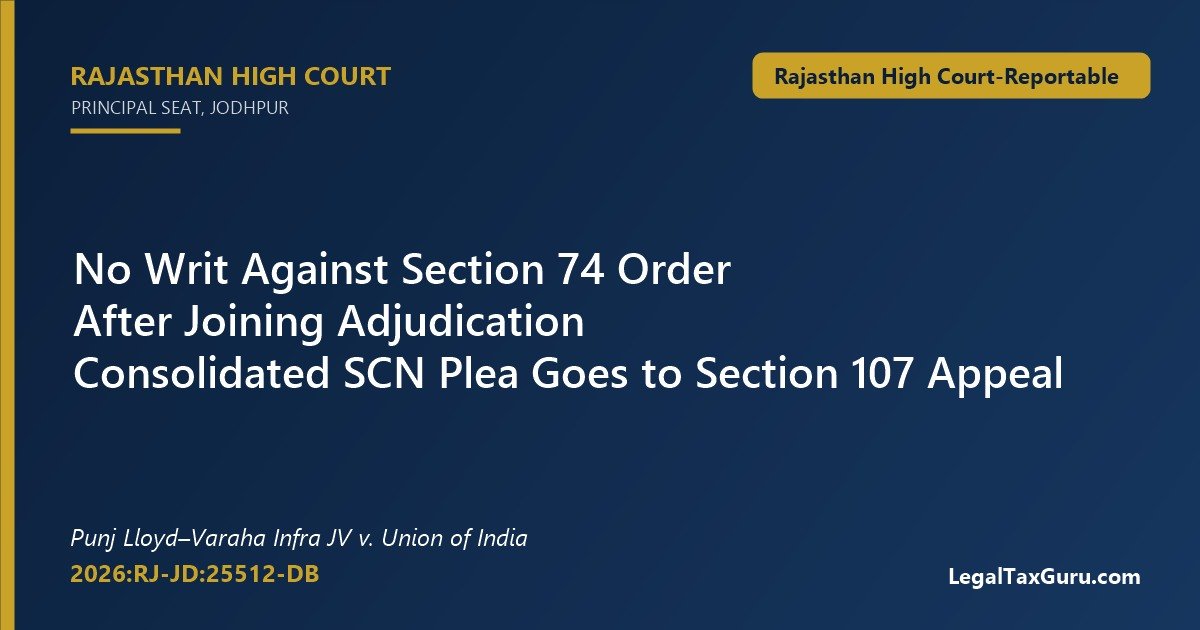
Quick Answer: A writ against Section 74 order will not ordinarily be entertained where the assessee joined adjudication and received a speaking order, because an efficacious appeal lies under Section 107. The objection that a single consolidated SCN for multiple years is impermissible must be raised in that appeal.
In M/s Punj Lloyd Ltd.–Varaha Infra Ltd. (JV) v. Union of India & Ors. (2026:RJ-JD:25512-DB), the Rajasthan High Court held that no Commercial Steel exception was made out against the SCN dated 12.03.2025 and the Order-in-Original dated 27.03.2026 (paras 1, 5, 9). A Division Bench of Justice Inderjeet Singh and Justice Sandeep Taneja dismissed the writ petition (para 10). The JV may challenge the order in appeal under Section 107 (para 9).
Headnote: Writ Against Section 74 Order
CGST Act, 2017 – Section 74 – Section 107 – Article 226, Constitution of India – Consolidated show cause notice for multiple years – Alternative remedy – Writ against show cause notice – Participation in adjudication – Natural justice
Held: (i) An alternative remedy is not an absolute bar to a writ, but a writ is entertained only for breach of fundamental rights, violation of natural justice, excess of jurisdiction or a challenge to vires (para 5). (ii) A consolidated SCN grievance was relegated to appeal in Super Service Point, and the Supreme Court permitted withdrawal of the SLP with liberty to appeal (paras 6–6.2). (iii) A writ petition does not ordinarily lie against the issuance of a show cause notice (para 7). (iv) Where the assessee was served, did not challenge the notice at the outset, participated and received a speaking order after hearing, there is no breach of natural justice (para 9). (v) The consolidated multi-year SCN objection can be raised in a Section 107 appeal (para 9). (vi) The writ was dismissed, leaving the petitioner to the statutory appeal (paras 9–10).
(paras 5–10)
Case Details: Punj Lloyd–Varaha Infra JV v. Union of India (2026:RJ-JD:25512-DB)
Final Outcome: Writ petition dismissed; petitioner left free to file an appeal under Section 107 against the Order-in-Original dated 27.03.2026
Case: M/s Punj Lloyd Ltd.–Varaha Infra Ltd. (JV) v. Union of India & Ors.
Neutral Citation: 2026:RJ-JD:25512-DB
Case No.: D.B. Civil Writ Petition No. 10695/2026
Court: Rajasthan High Court, Jodhpur (Division Bench)
Date of Decision: 25 May 2026
Bench: Justice Inderjeet Singh and Justice Sandeep Taneja [author not indicated in the order text; to be verified from certified copy]
Relevant Acts & Sections: CGST Act, 2017 – Sections 74, 107; Constitution of India – Article 226
Impugned Order: Show Cause Notice dated 12.03.2025 (Annexure-2) and Order-in-Original dated 27.03.2026 (Annexure-3)
Counsel: For the petitioner: Mr. Sharad Kothari and Mr. Chirag Soni. For the respondents: Mr. Mahaveer Bishnoi, AAG, with Mr. HVS Chandrawat; Mr. Rishabh Dadhich, Associate to Mr. Rajvendra Saraswat.
Source: Rajasthan High Court (official website)
Key Holdings of the Rajasthan High Court
- Section 107 provides a statutory appeal against any decision or order of an adjudicating authority under the CGST Act (para 5).
- An alternative remedy is not an absolute bar, but the writ court intervenes only on the four exceptions recognised in Commercial Steel (para 5).
- A consolidated SCN grievance was relegated to appeal in Super Service Point, with the SLP withdrawn with liberty to appeal (paras 6–6.2).
- A writ petition does not lie against the issuance of a show cause notice (para 7).
- A party who was served, did not challenge the SCN at the outset, participated and received a reasoned order after hearing cannot claim breach of natural justice (para 9).
- Where an efficacious Section 107 appeal exists, the High Court will not entertain a writ against a Section 74 order (paras 9–10).
Brief Facts of the Case
The petitioner is a joint venture of Punj Lloyd Ltd. and Varaha Infra Ltd., based at Jodhpur (cause title). It sought quashing of a show cause notice dated 12.03.2025 and consequential proceedings (para 1). It also sought a declaration that the Order-in-Original dated 27.03.2026 was illegal (para 1).
Its core grievance was jurisdictional. It contended that the authority could not issue a consolidated single show cause notice for multiple years under the scheme of Section 74 (para 2).
The petitioner did not challenge the notice when issued. It participated in adjudication and raised all its objections there (para 9). After hearing, the authority passed the Order-in-Original dated 27.03.2026, and the writ followed (para 9). The judgment does not record the demand amount or the years covered.
Issues Before the High Court
The judgment does not formally frame issues. From the arguments and discussion, the questions were:
- Whether a writ under Article 226 lies against the SCN and Order-in-Original when a Section 107 appeal is available (paras 3, 5).
- Whether any exception to the alternative-remedy rule, such as violation of natural justice or excess of jurisdiction, was made out (paras 5, 9).
- Whether the petitioner, having participated in adjudication, could still challenge in writ the jurisdiction to issue a consolidated SCN (paras 3, 9).
Court's Findings and Reasoning
Petitioner's case (paras 2–2.2): A consolidated single SCN for multiple years is outside the scheme of Section 74 and liable to be quashed in judicial review (para 2). The petitioner relied on the Supreme Court rulings in Godrej Sara Lee and J. Sri Nisha (para 2.1). It also cited orders of this Court and other High Courts, including Uno Minda, Ashok Jain & Co., Rathi Bars and Gyankeer Tobacco Products (para 2.2).
Revenue's case (paras 3–3.2): The AAG submitted that the SCN was within limitation and that the petitioner was estopped from raising jurisdiction after participating (para 3). Once the Order-in-Original was passed, the Section 107 appeal was the remedy (para 3). Section 74 uses "period", not "Financial Year", and the objection was dealt with in the order itself (para 3.1). The Revenue relied on Trillion Lead Factory, Tanushree Logistics and the Delhi High Court in Mathur Polymers (para 3.2).
Section 107 and Commercial Steel (para 5): Section 107 allows any person aggrieved by an adjudicating authority's order to appeal (para 5). The Court quoted paras 11 and 12 of Commercial Steel, which recognise four exceptions to the alternative-remedy rule (para 5). Where none is established, the writ should not be entertained, and facts are for the appellate authority (para 5).
Commercial Steel on its facts (para 5): There, service of notice on the person in charge of the conveyance was enough to rule out a breach of natural justice (para 5). The Supreme Court relegated that respondent to the Section 107 remedy without observations on merits (para 5).
Super Service Point on consolidated orders (paras 6–6.2): The Gujarat High Court had dismissed a writ claiming that separate orders ought to have been passed against a consolidated SCN (paras 6–6.1). The SLP was dismissed as withdrawn on 07.01.2026, with liberty to appeal under Section 107 (para 6.2).
No writ against SCN (para 7): The Court quoted the Supreme Court's observation in Trillion Lead Factory that no writ lies against issuance of a show cause notice (para 7). That observation draws on Prabhash Chandra Mirdha and an earlier Supreme Court order (para 7).
Tanushree Logistics (para 8): A co-ordinate Bench had held writs against assessment orders not maintainable save in limited circumstances (para 8). It relegated the petitioner to appeal and excluded the writ period for limitation (para 8).
Application to facts (para 9): The SCN was duly served, and the petitioner chose to participate rather than challenge it, raising all objections (para 9). The authority heard the petitioner and passed a speaking and reasoned order, so there was no breach of natural justice (para 9). Given the efficacious Section 107 remedy, the Court declined to entertain the writ (para 9).
Consolidated SCN question left open (paras 2–9): The Court did not decide whether a consolidated multi-year SCN is valid under Section 74. Nor did it discuss the petitioner's cited rulings individually, so the objection remains available in appeal (paras 2.1–2.2, 9).
Final Outcome and Directions
- Court not inclined to entertain the writ in view of the efficacious Section 107 appeal (para 9).
- Petitioner may appeal, if so advised, against the Order-in-Original dated 27.03.2026 (para 9).
- Writ petition dismissed; pending applications disposed of (paras 10–11).
- Unlike the quoted Tanushree Logistics direction, the order is silent on excluding the writ period for limitation. It is also silent on costs, stay and pre-deposit (paras 8–11).
Legal Principle Laid Down
Where an assessee was served with a Section 74 notice, did not challenge it at the outset, participated in adjudication and received a speaking order after hearing, no violation of natural justice arises. The High Court will then not exercise writ jurisdiction, since an efficacious appeal lies under Section 107. A jurisdictional objection to a consolidated multi-year notice does not, by itself, bring the case within the Commercial Steel exceptions after the assessee has joined adjudication; it must be raised in appeal (paras 5–9).
Precedents Relied Upon
- Assistant Commissioner of State Tax v. M/s Commercial Steel Ltd., (2022) 16 SCC 447 – Relied upon – four exceptions to the alternative-remedy rule. Discussed at paras 5, 9.
- M/s Super Service Point v. Union of India, R/Special Civil Application No. 9382/2025 (Gujarat High Court, decided 04.09.2025); SLP (Civil) No. 38643/2025 dismissed as withdrawn on 07.01.2026 – Relied upon – consolidated SCN grievance relegated to appeal. Discussed at paras 6–6.2.
- M/s Trillion Lead Factory Pvt. Ltd. v. Superintendent of Central Tax, SLP (Civil) No. 7101/2026, decided 27.02.2026 – Relied upon – no writ lies against issuance of a show cause notice. Discussed at para 7.
- Tanushree Logistics Pvt. Ltd. v. State of Rajasthan, D.B. Civil Writ Petition No. 17550/2022, decided 07.12.2022 – Relied upon – writs against assessment orders not maintainable save in limited circumstances. Discussed at para 8.
- Secretary, Ministry of Defence v. Prabhash Chandra Mirdha, (2012) 11 SCC 565 – Referred – cited within the Trillion Lead Factory extract. Discussed at para 7.
- Godrej Sara Lee, J. Sri Nisha, Uno Minda, Ashok Jain & Co., Rathi Bars, Gyankeer Tobacco Products – Cited by petitioner; not discussed – consolidated SCN impermissible. Noted at paras 2.1–2.2.
Important Paragraphs of the Judgment
Verbatim extracts from the judgment. For the full text, refer to the judgment PDF below.
Para 5 (Commercial Steel, as quoted): "The existence of an alternate remedy is not an absolute bar to the maintainability of a writ petition Under Article 226 of the Constitution. But a writ petition can be entertained in exceptional circumstances where there is: (i) a breach of fundamental rights; (ii) a violation of the principles of natural justice; (iii) an excess of jurisdiction; or (iv) a challenge to the vires of the statute or delegated legislation."
Para 6.2 (Super Service Point SLP): "It is pertinent to mention here that the Special Leave to Appeal (Civil) No.38643/2025 decided on 07.01.2026, filed against the dismissal of the writ petition by the Gujarat High Court, was also dismissed as withdrawn, by the Hon'ble Supreme Court, with liberty to the petitioner to file an appeal under Section 107 of the Act of 2017."
Para 7 (Trillion Lead Factory, as quoted): "It is trite law that no writ lies against an issuance of show cause notice and such writ petition would not be maintainable."
Para 8 (Tanushree Logistics, as quoted): "In the result, the objection of maintainability of the writ petitions is sustained and the writ petitions are held to be not maintainable, as the petitioner has an efficacious alternative statutory remedy of filing of an appeal."
Para 9 (participation in adjudication): "In the instant case, the show cause notice dated 12.03.2025 was duly served upon the petitioner. Undisputedly, the petitioner did not lay any challenge to the show cause notice at the initial stage and rather chose to participate in the adjudication process and raised all the objections therein. The adjudicating authority, after giving opportunity of hearing to the petitioner, passed a speaking and reasoned Order-in-Original dated 27.03.2026, therefore, in our opinion, there is no violation of principles of natural justice."
Para 9 (liberty to appeal): "The petitioner may avail the remedy of appeal, if so advised, to challenge the Order-in-Original dated 27.03.2026."
Practical Impact of the Ruling
- For taxpayers: Challenge a consolidated multi-year SCN at the threshold, if at all. Participation followed by a reasoned order sharply narrows the writ route (para 9).
- For appeal planning: The order does not exclude the writ period from limitation. Section 107(1) allows three months from communication, with a further month condonable under Section 107(4); file promptly (paras 9–11).
- For the department: The Revenue's argument that Section 74 speaks of a "period" and not a "Financial Year" remains open before the appellate authority (paras 3.1, 9).
- For practitioners: The consolidated-SCN issue is undecided, and the petitioner's cited writ orders were not discussed (paras 2.2, 9).
- For drafting writs: Pleadings should show a clear Commercial Steel exception, such as total lack of jurisdiction or denial of hearing, apart from the merits (para 5).
FAQs on Writ Against Section 74 Order
1. What did the Rajasthan High Court hold in Punj Lloyd–Varaha Infra JV v. Union of India?
The Court refused to entertain a writ against Section 74 order because the JV had participated in adjudication and received a reasoned order. No Commercial Steel exception was made out, so the JV was relegated to a Section 107 appeal (paras 5, 9–10).
2. Is a consolidated GST show cause notice for multiple years valid under Section 74?
The Court did not decide this question. It noted the Revenue's argument that Section 74 uses "period" and not "Financial Year", and left the objection to be raised in appeal (paras 3.1, 9).
3. When will the High Court entertain a GST writ despite an alternative remedy?
Only in exceptional cases. These are breach of fundamental rights, violation of natural justice, excess of jurisdiction, or a challenge to the vires of a statute or delegated legislation (para 5).
4. Does participating in GST adjudication affect the right to file a writ?
Yes, significantly. The petitioner was served, did not challenge the SCN at the outset, raised all objections and received a reasoned order after hearing, so no breach of natural justice was found (para 9).
5. Was the writ period excluded for limitation in this case?
No such direction appears in the operative order. The JV was left free to appeal under Section 107, but the order is silent on excluding the writ period (paras 9–11).
Keywords: 2026:RJ-JD:25512-DB, Punj Lloyd–Varaha Infra JV v. Union of India, writ against Section 74 order, Section 107 CGST Act appeal, consolidated show cause notice multiple years, alternative remedy GST writ, Commercial Steel, Trillion Lead Factory, Super Service Point, Tanushree Logistics, natural justice, tax litigation lawyer, Rajasthan High Court, Justice Inderjeet Singh
Related on LegalTaxGuru
- More High Court judgments on GST and indirect tax
- GST articles and updates
- GST Order Without DIN Valid if RFN Is Verifiable – Mahesh Trivedi v. Union of India
Download Judgment PDF – Punj Lloyd–Varaha Infra JV v. Union of India
Judgment PDF: 2026:RJ-JD:25512-DB – M/s Punj Lloyd Ltd.–Varaha Infra Ltd. (JV) v. Union of India & Ors. (D.B. Civil Writ Petition No. 10695/2026) – The judgment PDF will be uploaded here shortly.
Source: Rajasthan High Court (official website).
Read more: Rajasthan High Court · GST · Writ Jurisdiction · Indirect Tax