Quick Answer: The Rajasthan High Court held Molana Construction per incuriam, ruling that it cannot, as a matter of course, condone delay beyond the Section 107 limit under Article 226 when the writ itself is filed after limitation. Interference is reserved for exceptional cases such as gross breach of natural justice or inherent lack of jurisdiction, and the writ petition was dismissed.
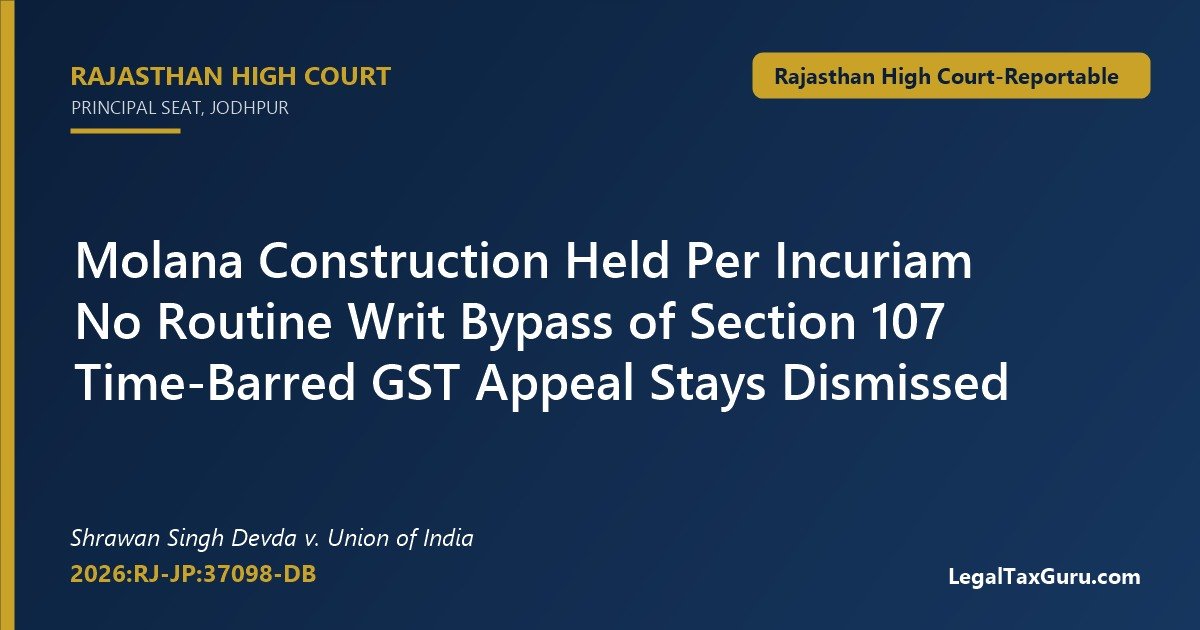
In Shrawan Singh Devda v. The Union of India & Ors. (2026:RJ-JP:37098-DB), the Rajasthan High Court held Molana Construction per incuriam, and with it the later decisions that condoned GST appeal delays under Article 226 (para 27). A Division Bench of Justice Munnuri Laxman and Justice Anuroop Singhi held that writ jurisdiction cannot disregard the statutory scheme of limitation, save in exceptional cases (paras 25, 28). The writ petition against cancellation of GST registration and dismissal of the time-barred appeal was dismissed (paras 30–31).
Headnote: Molana Construction Per Incuriam
RGST Act, 2017 / CGST Act, 2017 – Sections 29(2)(c), 39 and 107 – Cancellation of registration for non-filing of returns – Retrospective effect – Show cause notice – Appeal beyond condonable period – Article 226 – Per incuriam – Articles 14, 19(1)(g) and 21
Held: (i) Cancellation effective from a date within the period of default is not "retrospective" in the strict sense; specific reasons are needed only for a date anterior to the default (paras 17–18).
(ii) No separate show cause notice is needed merely because cancellation is to operate retrospectively (para 19).
(iii) Where the writ petition is filed after expiry of the statutory appeal period, the High Court cannot, as a matter of course, condone delay and remand the appeal (paras 25, 28).
(iv) Molana Construction and the decisions founded on it ignored Ashok Verandani and binding Supreme Court rulings, and are per incuriam (para 27).
(v) Interference is justified only in exceptional cases, such as a gross breach of natural justice or inherent lack of jurisdiction; none was shown (para 28).
(vi) No breach of Articles 14, 19(1)(g) or 21, as fresh registration remains available; petition dismissed (paras 30–31).
(paras 13–31)
Case Details: Shrawan Singh Devda v. Union of India (2026:RJ-JP:37098-DB)
Final Outcome: Writ petition dismissed; cancellation order and appellate order dismissing the appeal as time-barred left undisturbed (paras 29–31).
Case: Shrawan Singh Devda, Proprietor of Ashapura Construction v. The Union of India & Ors.
Neutral Citation: 2026:RJ-JP:37098-DB
Case No.: D.B. Civil Writ Petition No. 15910/2026
Court: Rajasthan High Court, Jodhpur (Division Bench)
Date of Decision: 18 August 2026 (reserved on 24.07.2026)
Bench: Justice Munnuri Laxman (author) and Justice Anuroop Singhi
Relevant Acts & Sections: Rajasthan GST Act, 2017 and CGST Act, 2017 – Sections 29, 39 and 107; CGST Rules, 2017 – Rules 22(1) and 22(3); Limitation Act, 1963 – Section 29(2); Constitution of India – Articles 14, 19(1)(g), 21, 226 and 227
Impugned Order: Order dated 03.08.2023 of the Assistant Commissioner, Ward-III, Circle Sumerpur, cancelling registration w.e.f. 31.03.2023; order dated 10.06.2026 of the Appellate Authority, State Tax Department, Jodhpur, dismissing the appeal as time-barred (paras 1, 3–4)
Counsel: Mr. Paras Mal Chopra with Ms. Prerna Chopra (through VC), Mr. Gaurang Deora, and Ms. Shashi Vaishnav for Mr. Dinesh Kumar Joshi for the petitioner; Mr. Rajendra Prasad, Senior Advocate-cum-Advocate General, assisted by Mr. A.S. Shekhawat; Mr. Shyam Sunder Paliwal, Deputy Solicitor General of India; and Mr. Harshvardhan Singh with Mr. Abhishek Bishnoi for Mr. Mahaveer Bishnoi, AAG, for the respondents.
Source: Rajasthan High Court (official website)
Key Holdings of the Rajasthan High Court
- Section 29(2)(c) permits cancellation, including from a retrospective date, where returns are not filed for six continuous months (paras 14, 16).
- Cancellation from a date within the default period is not retrospective in the strict sense (paras 17–18).
- A show cause notice need only state the non-compliances, not the precise extent of the action proposed (para 19).
- Where a writ is filed after the appeal period has expired, the High Court cannot make the limitation "otiose" by condoning delay (para 25).
- Molana Construction overlooked Ashok Verandani and Supreme Court rulings; it and the decisions following it are per incuriam (para 27).
- Writ interference after limitation is reserved for exceptional cases, such as gross breach of natural justice or inherent lack of jurisdiction (para 28).
- Cancellation does not leave the taxpayer remediless, since fresh registration can be sought (para 30).
Brief Facts of the Case
The petitioner, sole proprietor of "Ashapura Construction", was registered under the CGST and RGST Acts from 01.07.2017 (para 2). On 09.05.2023, a show cause notice proposed cancellation for failure to file returns for six consecutive months, and registration was suspended (para 2).
No reply was filed (para 3). On 03.08.2023, the registration was cancelled with effect from 31.03.2023 (para 3).
The petitioner appealed under Section 107 of the RGST Act, but beyond both the original and the extended period (para 4). On 10.06.2026, the Appellate Authority dismissed the appeal as time-barred for want of sufficient cause (para 4). The writ petition sought quashing of both orders and restoration of registration (paras 1, 4).
Issues Before the High Court
The issues arising for decision were (paras 18–20, 25):
- Whether the cancellation with effect from 31.03.2023 was an unreasoned retrospective cancellation contrary to Section 29.
- Whether a separate show cause notice was required before giving the cancellation retrospective effect.
- Whether the High Court, under Article 226, should condone delay beyond the Section 107 limit and remand the appeal on merits.
- Whether Molana Construction and the decisions following it lay down the correct law.
Court's Findings and Reasoning
Petitioner's case (paras 5–7): The cancellation was unreasoned and retrospective without a hearing, contrary to Section 29 (para 5). The High Court could condone delay under Article 226, as in Molana Construction and later rulings (para 6). The delay arose from taking legal advice and collecting documents, and the returns had since been filed (paras 6–7).
Revenue's case (paras 8–12): The returns were not filed for six months, the SCN went unanswered and cancellation followed under Rule 22(3) (para 8). Cancellation from the date of first default is not truly retrospective, and no second notice was needed (para 9). Beyond the condonable period, the Appellate Authority was functus officio, and later compliance did not erase the default (paras 10–11).
Retrospective cancellation (paras 14–18): Section 29(2)(c) permits cancellation for six months' non-filing, including from a retrospective date (paras 14, 16). Retrospective effect cannot be given mechanically and needs objective reasons (para 18). Here, the effective date fell within the default period, so it was not retrospective in the strict sense (paras 17–18).
No separate notice (para 19): Section 29 requires only one show cause notice before cancellation. It must state the alleged non-compliances, not the precise extent of the consequential action (para 19).
The rival lines of authority (paras 20–23): The petitioner relied on Molana Construction and later decisions founded on it (para 20). The respondents relied on Ashok Verandani, Rudraksh Collection, Bharti Marbles and Mateshwari Construction, and on Multi Trading Agencies and Singh Enterprises (paras 21–22). They argued Molana was per incuriam (para 23).
Reading Glaxo Smith Kline (paras 24–25): A writ filed within the appeal period may be entertained for jurisdictional error or breach of natural justice (para 25). But where the writ itself is filed after limitation, the High Court cannot "as a matter of course" condone delay (para 25). Doing so would run contrary to ONGC v. Gujarat Energy Transmission Corporation (para 25).
Molana Construction per incuriam (paras 26–27): Ashok Verandani was the earliest Division Bench view that such delay cannot be condoned (para 27). Molana took a different view without considering it, and without the binding Supreme Court rulings (para 27). It and the later decisions founded on it were held per incuriam (para 27).
Exceptional cases only (paras 28–29): There is no absolute bar to a writ after the appeal period, but not as a matter of course (para 28). Interference is limited to cases such as complete disregard of natural justice or inherent lack of jurisdiction (para 28). None was shown, so the reasons for delay were not examined (paras 28–29).
Articles 14, 19(1)(g) and 21 (para 30): The petitioner is not remediless, as fresh registration may be sought (para 30). Fiscal statutes are construed strictly, and routine writ bypass of limitation would defeat legislative intent (para 30).
Final Outcome and Directions
- The writ petition was dismissed (para 31).
- The Court declined to examine the reasons offered for the delay (para 29).
- The cancellation order dated 03.08.2023 and the appellate order dated 10.06.2026 stand (paras 28–31).
- Pending applications were disposed of (para 32). The judgment is silent on costs.
Legal Principle Laid Down
Where a writ petition is filed after the statutory appeal period under Section 107 has expired, the High Court will not, as a matter of course, condone the delay and remand the appeal. Article 226 may be invoked only in exceptional cases, such as gross breach of natural justice or inherent lack of jurisdiction. Molana Construction and decisions founded on it were held per incuriam on this point (paras 25, 27–28).
Precedents Relied Upon
- Assistant Commissioner (CT) LTU, Kakinada v. Glaxo Smith Kline Consumer Health Care Ltd., (2020) 19 SCC 681 – Relied upon – High Court should not, as a matter of course, bypass statutory limitation. Discussed at paras 24–25.
- Oil and Natural Gas Corporation Limited v. Gujarat Energy Transmission Corporation Limited, (2017) 5 SCC 42 – Relied upon – Statutory limitation cannot be circumvented. Discussed at para 25.
- M/s Multi Trading Agencies, Drangbal v. Union Territory of Jammu and Kashmir, SLP (C) Diary No. 58716/2024 (17.02.2025) – Relied upon – Delay beyond the statutory bar not condoned. Discussed at paras 22, 26.
- M/s Singh Enterprises v. Commissioner of Central Excise, Jamshedpur, Civil Appeal No. 5949/2007 (14.12.2007) – Relied upon – No condonation beyond the statutory outer limit. Discussed at paras 22, 26.
- Ashok Verandani v. Central Board of Indirect Taxes & Customs, D.B. CWP No. 2430/2024 (Jaipur Bench, 01.03.2024) – Followed – Delay beyond the condonable period cannot be condoned. Discussed at paras 21, 27.
- M/s Molana Construction Company v. Central Goods & Service Tax Department, D.B. CWP No. 12076/2024 (26.07.2024) – Held per incuriam. Discussed at paras 6, 20, 23, 27.
- RPC PSIPL JV, Govind Traders, M/s M R Traders, Mehtab Singh, M/s Infinite EV Solutions, M/s Saini Construction Company and Ritik Acharya (Rajasthan High Court) – Relied on by the petitioner; treated as founded on Molana and per incuriam. Discussed at paras 6, 20, 27.
- M/s Rudraksh Collection, Bharti Marbles & Granites and M/s Mateshwari Construction & Traders (Rajasthan High Court) – Relied on by the respondents. Discussed at paras 12, 21.
Important Paragraphs of the Judgment
Verbatim extracts from the judgment. For the full text, refer to the judgment PDF below.
Para 18: "In the present case, the order of cancellation was not given effect from the date anterior to the period of default; rather, it was made effective from a date falling within the period of default itself and it is not retrospective in strict sense."
Para 25: "However, such a power cannot be exercised where the writ petition itself is filed after the expiry of the statutory period of limitation prescribed for filing the appeal. In such cases, the High Court cannot, as a matter of course, disregard the legislative mandate and make the provision of limitation otiose and entertain the writ petition so as to circumvent the statutory scheme."
Para 27: "The subsequent judgments relied upon by the learned counsel for the petitioner are founded upon the decision in M/s Molana Construction Company (cited supra) which was rendered without considering the earlier Division Bench decision in Ashok Verandani (cited supra) as it was not brought to the notice of the bench and the binding precedents of the Apex Court referred to hereinabove and all such decisions are per incuriam and, therefore, cannot be treated as laying down the correct proposition of law."
Para 28: "However, interference can be justified only in exceptional circumstances such as where an order has been passed by completely disregarding the principles of natural justice or inherent lack of jurisdiction is clearly established. In the absence of such circumstances, a writ petition cannot ordinarily be entertained so as to defeat the legislative intendment."
Para 30: "The reason is that petitioner is not rendered remediless, as the statutory scheme permits the petitioner to seek fresh registration in accordance with law and continue carrying on the business. It is well settled that fiscal statutes are required to be construed strictly."
Practical Impact of the Ruling
- For taxpayers with cancelled registrations: Do not count on the High Court to rescue a time-barred appeal. File within three months, or at most four, from communication (paras 25, 28).
- For practitioners: A writ is more likely to succeed if filed within the appeal period, or if it shows gross breach of natural justice or lack of jurisdiction (paras 25, 28).
- For the department: Cancellation from a date within the default period needs no special reasons and no second notice (paras 18–19).
- For businesses unable to restore registration: Fresh registration remains a lawful route to resume business (para 30).
- For the law of precedent: This ruling departs from Molana Construction and later Division Bench orders such as M R Traders (2026:RJ-JD:485-DB), which condoned delay under Article 226 (paras 6, 20, 27). Coordinate Benches now differ; M R Traders (2026:RJ-JD:485-DB) followed Molana, while this ruling holds that line per incuriam. A larger Bench reference may follow [to be verified] (paras 6, 27).
FAQs on Molana Construction Per Incuriam
1. What did the Rajasthan High Court hold in Shrawan Singh Devda v. Union of India?
It held that the High Court cannot, as a matter of course, condone delay beyond the Section 107 limit under Article 226. Molana Construction and the decisions founded on it were declared per incuriam, and the writ petition was dismissed (paras 25, 27, 31).
2. Why was Molana Construction held per incuriam?
The Court found that Molana was decided without considering the earlier Division Bench decision in Ashok Verandani. It also did not consider binding Supreme Court rulings such as Glaxo Smith Kline, Multi Trading Agencies and Singh Enterprises (para 27).
3. Can the High Court ever entertain a writ after the GST appeal period expires?
Yes, but only in exceptional circumstances, such as complete disregard of natural justice or inherent lack of jurisdiction. It cannot be done as a matter of course to defeat the statutory limitation (para 28).
4. Is cancellation of GST registration from the date of default "retrospective"?
Not in the strict sense, said the Court. Specific reasons are required only where cancellation takes effect from a date before the default period began. Here, 31.03.2023 fell within the default period (paras 17–18).
5. What remedy is left for a taxpayer whose registration stays cancelled?
The Court noted the petitioner is not remediless. The statutory scheme allows an application for fresh registration in accordance with law, so business can continue (para 30).
Keywords: Molana Construction per incuriam, Shrawan Singh Devda v. Union of India, 2026:RJ-JP:37098-DB, D.B. Civil Writ Petition No. 15910/2026, Section 107 RGST Act, Article 226 condonation of delay, retrospective cancellation of GST registration, Section 29(2)(c), Ashok Verandani, Glaxo Smith Kline, Singh Enterprises, Rajasthan High Court, Justice Munnuri Laxman
Related on LegalTaxGuru
- More High Court judgments on GST and indirect tax
- GST articles and updates
- Article 226 Power Survives Section 107(4) Cap on GST Appeal Delay – M R Traders v. Union of India
Download Judgment PDF – Shrawan Singh Devda v. Union of India
Judgment PDF: 2026:RJ-JP:37098-DB – Shrawan Singh Devda, Proprietor of Ashapura Construction v. The Union of India & Ors. (D.B. Civil Writ Petition No. 15910/2026) – The judgment PDF will be uploaded here shortly.
Source: Rajasthan High Court (official website).
Read more: Rajasthan High Court · GST · GST Appeals · Indirect Tax