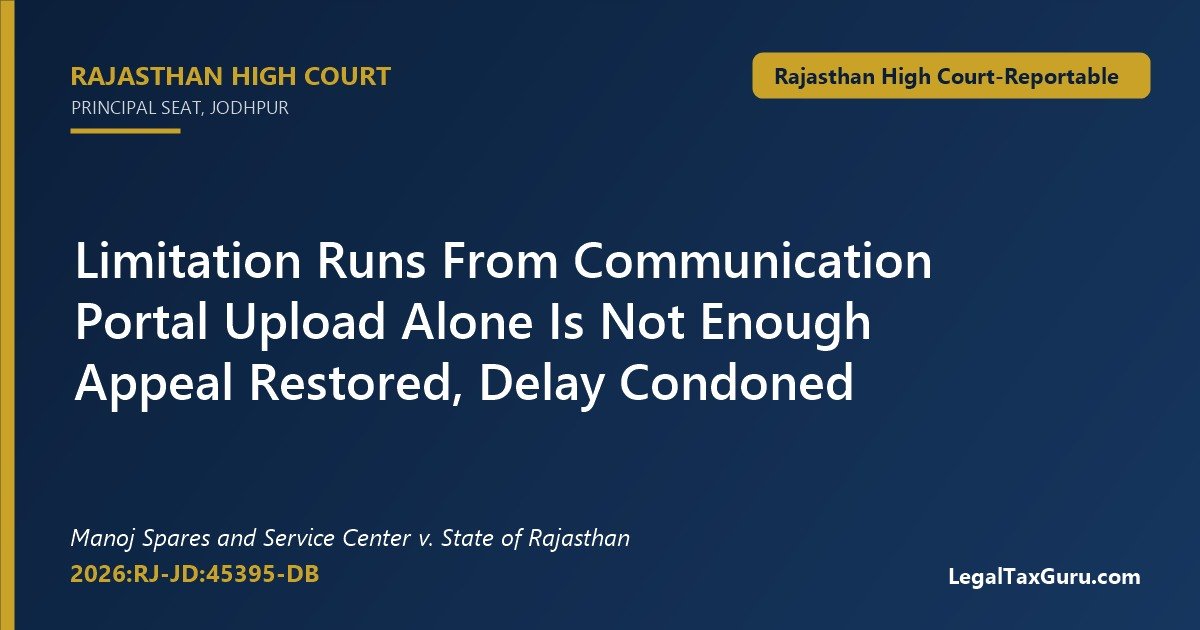
Quick Answer: On GST appeal limitation portal upload, the Rajasthan High Court held that the three-month period under Section 107(1) runs only from communication of the order, and mere upload on the portal is not communication. It set aside the appellate order dismissing the appeal as time-barred, condoned the delay and remanded the appeal for decision on merits.
In M/s Manoj Spares and Service Center v. State of Rajasthan & Ors. (2026:RJ-JD:45395-DB), the Rajasthan High Court held that GST appeal limitation does not start on portal upload, because Section 107(1) requires the order to be communicated (paras 13, 18–21). A Division Bench of Chief Justice Sanjay K. Agrawal and Justice Vinit Kumar Mathur read Section 107(1) with Section 169 and treated communication as mandatory (paras 17–21). The Order-in-Appeal dated 12.05.2026 was set aside, the delay condoned and the appeal remanded for decision on merits (para 22).
Headnote: GST Appeal Limitation Portal Upload
CGST Act, 2017 – Sections 107(1), 107(4) and 169 – RGST Act, 2017 – Appeal against cancellation of GST registration – Limitation – "Communicated" – Upload on common portal – Limitation Act, 1963 – Section 5 – Article 226
Held: (i) The three-month period under Section 107(1) runs from the date the order is communicated to the person aggrieved (paras 7, 13).
(ii) "Communication" is undefined in the Act and must be read contextually; it means effective imparting of the order, actual or constructive (paras 7–13).
(iii) Section 5 of the Limitation Act is excluded; the Appellate Authority may condone only one further month (paras 13, 17–18).
(iv) The adjudicating authority had to comply strictly with Section 107(1) read with Section 169(1); mere upload on the portal is not communication (para 18).
(v) Rules cannot circumscribe the statutory mode; until the order is communicated, limitation does not start (paras 19–21).
(vi) Appellate order set aside; delay condoned and appeal remanded on merits (para 22).
(paras 6–24)
Case Details: Manoj Spares and Service Center v. State of Rajasthan (2026:RJ-JD:45395-DB)
Final Outcome: Writ petition allowed; Order-in-Appeal dated 12.05.2026 set aside; delay condoned; appeal remanded to the Appellate Authority for decision on merits (paras 22–23).
Case: M/s Manoj Spares and Service Center, through its Proprietor Shri Manoj Kumar Gupta v. State of Rajasthan & Ors.
Neutral Citation: 2026:RJ-JD:45395-DB
Case No.: D.B. Civil Writ Petition No. 18521/2026
Court: Rajasthan High Court, Jodhpur (Division Bench)
Date of Decision: 5 October 2026 (reserved on 16.09.2026)
Bench: Chief Justice Sanjay K. Agrawal (author) and Justice Vinit Kumar Mathur
Relevant Acts & Sections: CGST Act, 2017 – Sections 107(1), 107(4) and 169; Rajasthan GST Act, 2017; Limitation Act, 1963 – Section 5; Constitution of India – Articles 226 and 227
Impugned Order: Order-in-Appeal dated 12.05.2026 of the Appellate Authority, State Tax, Bikaner, dismissing the appeal as time-barred; Order-in-Original dated 26.03.2025 in Form GST REG-19 cancelling registration w.e.f. 06.11.2024 (paras 1, 2)
Counsel: Mr. Sharad Kothari, Mr. Kalpit Shishodiya and Mr. Chirag Soni for the petitioner; Mr. Mahaveer Bishnoi, AAG, with Mr. Harshvardhan Singh, and Mr. Rajvendra Saraswat with Mr. Rishabh Dadhich and Mr. Jitesh Kumar Suthar for the respondents.
Source: Rajasthan High Court (official website)
Key Holdings of the Rajasthan High Court
- Under Section 107(1), the appeal period of three months starts from the date the order is "communicated" to the person aggrieved (paras 6–7).
- "Communicate" is a strong word; the party affected must know the order, actually or constructively (paras 9, 12–13).
- Where a provision protects the aggrieved person's remedy, limitation runs from communication, not from the date of the order (para 10).
- Section 5 of the Limitation Act is excluded; the Appellate Authority's power ends at three months plus one month (paras 13, 17–18).
- The adjudicating authority was bound to communicate the order under Section 107(1) read with Section 169(1); upload alone did not suffice (para 18).
- Rules cannot cut down the statutory mode, and limitation does not run until the order is communicated (paras 20–21).
- The Court expressed no opinion on the merits of the cancellation (para 24).
Brief Facts of the Case
The petitioner ran an automobile spare parts and service centre at Suratgarh and held GST registration (para 2(i)). On 06.11.2024, a show cause notice in Form GST REG-17/31 proposed cancellation for non-filing of returns for six continuous months (para 2(i)).
On 26.03.2025, an Order-in-Original in Form GST REG-19 cancelled the registration with retrospective effect from 06.11.2024 (para 2(ii)). On 10/14.04.2026, on learning of the cancellation, the petitioner filed all pending returns and paid the tax and other dues (para 2(ii)).
On 19.04.2026, the petitioner filed an appeal in Form GST APL-01, with an explanation for the delay (para 2(iii)). On 12.05.2026, the Appellate Authority dismissed it as filed after a delay of 8 months and 23 days, beyond the 90-day period (para 2(iii)). The writ petition followed (paras 1, 2(iii)).
Issues Before the High Court
The issues arising for decision were (paras 5–7, 13):
- When does the three-month period under Section 107(1) begin to run for an appeal against a GST order?
- Does upload of the order on the GST common portal amount to "communication" of the order under Section 107(1)?
- Was the Appellate Authority justified in dismissing the appeal as barred by 8 months and 23 days?
Court's Findings and Reasoning
Petitioner's case (para 3): The Order-in-Original had to be communicated under Section 107(1), and limitation would run only from communication. Since it was never communicated, the appeal filed immediately on knowledge could not be dismissed as delayed (para 3).
Revenue's case (para 4): The order was uploaded on the GST portal, so the petitioner was deemed to know of it. Upload under Section 169 was itself sufficient compliance, and the appeal was rightly dismissed (para 4).
Meaning of "communication" (paras 6–8): Section 107(1) allows an appeal within three months from the date the order is "communicated" (paras 6–7). The term is not defined, so it must be read contextually (para 7). Its ordinary meaning is to impart, confer or transmit information (para 8).
Supreme Court guidance (paras 9–12): In Kubic Darusz, "communicate" was described as a strong word requiring effective imparting of knowledge (para 9). M.M. Rubber held that where a remedy protects the affected person, limitation runs from communication (para 10). D. Saibaba read the limitation as running from communication or knowledge, actual or constructive (para 12).
Application to Section 107 (para 13): The purpose of communication is to enable the person aggrieved to appeal. The Appellate Authority can condone only one further month, making four months in all. The order "has to be mandatorily communicated", and time runs only from such communication (para 13).
Section 169 and Saral Wire Craft (paras 14–17): Section 169 lists modes of service in clauses (a) to (f) (paras 14–15). In Saral Wire Craft, the Supreme Court required meaningful and realistic service so the affected party can act (para 16). Since the authority's power ends after three months plus one month, communication is vital (para 17).
Upload is not communication (para 18): Section 5 of the Limitation Act is wholly excluded, following Singh Enterprises (para 18). The adjudicating authority was obliged to comply strictly with Section 107(1) read with Section 169(1). Upload on the portal alone did not amount to communication (para 18).
Mandatory nature and rules (paras 19–21): The provision on communication must be construed strictly, and the petitioner was never communicated the order (para 19). Rules cannot circumscribe the mode provided by the statute (para 20). Until the order is communicated, the period of limitation does not start (para 21).
Application to facts (paras 21–22): The Appellate Authority was "absolutely unjustified" in holding the appeal barred by 8 months and 23 days (para 21). The petitioner had paid the dues on 10.04.2026 and appealed on 19.04.2026, immediately after learning of the order (para 22).
Final Outcome and Directions
- The Order-in-Appeal dated 12.05.2026 was set aside (para 22).
- The delay in filing the appeal was condoned (para 22).
- The matter was remanded to the Appellate Authority for hearing and deciding the appeal on merits (para 22).
- The writ petition was allowed and pending applications disposed of (para 23).
- No opinion was expressed on the merits of the cancellation (para 24). The order is silent on costs.
Legal Principle Laid Down
Under Section 107(1) of the CGST Act, the three-month limitation for a GST appeal starts only when the order is communicated to the person aggrieved. The adjudicating authority must comply strictly with Section 107(1) read with Section 169(1). Mere upload of the order on the common portal, without more, is not communication and does not set limitation running (paras 13, 18–21).
Precedents Relied Upon
- Chhattisgarh State Electricity Board v. Central Electricity Regulatory Commission, (2010) 5 SCC 23 – Relied upon – Undefined words to be read contextually. Discussed at para 7.
- Union of India v. S.P. Singh, (2008) 5 SCC 438 – Relied upon – Ordinary meaning of "communicate". Discussed at para 8.
- Kubic Darusz v. Union of India, (1990) 1 SCC 568 – Relied upon – "Communicate" is a strong word requiring effective knowledge. Discussed at para 9.
- Collector of Central Excise, Madras v. M/s M.M. Rubber and Co., 1992 Supp (1) SCC 471 – Relied upon – Limitation for a remedy runs from communication. Discussed at para 10.
- Municipal Corporation of Delhi v. Qimat Rai Gupta, (2007) 7 SCC 309 – Referred – When communication of an order is necessary. Discussed at para 11.
- D. Saibaba v. Bar Council of India, (2003) 6 SCC 186 – Relied upon – Limitation from communication or knowledge, actual or constructive. Discussed at para 12.
- Saral Wire Craft Private Limited v. Commissioner of Customs, Central Excise and Service Tax, (2015) 14 SCC 523 – Relied upon – Service must be meaningful and realistic. Discussed at para 16.
- Singh Enterprises v. Commissioner of Central Excise, Jamshedpur, (2008) 3 SCC 70 – Relied upon – Section 5 of the Limitation Act excluded. Discussed at para 18.
Important Paragraphs of the Judgment
Verbatim extracts from the judgment. For the full text, refer to the judgment PDF below.
Para 13: "Therefore, the order has to be mandatorily communicated and the person aggrieved must be communicated with the decision or order. In other words, the party affected by the order or decision must know it, actually or constructively, and the period of three months would start running from the date of communication to the person affected of order by the authority concerned."
Para 18: "Therefore, the Adjudicating Authority was obliged to strictly comply with the provisions contained in Section 107(1) of the Act of 2017 read with Section 169(1) of the Act of 2017 and communicate the order to the person aggrieved, which, in the present case, has not been done and only the order has been uploaded on the GST Portal, as submitted by the learned counsel for the Revenue, which, in our considered opinion, would not amount to the communication of order in terms of Section 107(1) of the Act of 2017."
Para 20: "It is to be noted that the Rules are creature of a Statute and the Rules cannot circumscribe the mode that had been provided under the Statute. The Statute under Section 107 mandates communication of the order to the person aggrieved by registered post/ e-mail, etc."
Para 21: "The provision contained in Section 107(1) of the Act of 2017 qua communication to the affected party is mandatory in nature and unless the order is communicated to affected person, the period of limitation would not start running. As such, the Appellate Authority is absolutely unjustified in holding that the appeal is barred by 8 months and 23 days."
Para 22: "Accordingly, the impugned order dated 12.05.2026 is set aside, and as according to the learned counsel for the appellant, the appellant immediately after coming to know about the order, deposited the entire dues on 10.04.2026 and filed the appeal on 19.04.2026, the delay in filing the appeal is condoned and the matter is remanded back to the Appellate Authority for hearing and deciding the appeal on merits."
Practical Impact of the Ruling
- For taxpayers with cancelled registrations: Where an order was only uploaded on the portal, limitation may not have started. Appeal promptly after actual knowledge and record that date (paras 18–22).
- For adjudicating authorities: Upload alone is risky. Orders should also be communicated by a mode that brings them to the taxpayer's notice, such as e-mail or post (paras 18, 20).
- For appellate authorities: Before dismissing an appeal as time-barred, check when and how the order was communicated, not merely uploaded (paras 13, 21).
- For practitioners: Plead the date of actual knowledge and the absence of communication. Show prompt compliance, such as filing returns and paying dues (paras 2(ii), 22).
- For the department: The ruling sits alongside the exclusion of Section 5 of the Limitation Act. The four-month outer limit stays, but its starting point is communication (paras 13, 17–18).
FAQs on GST Appeal Limitation Portal Upload
1. What did the Rajasthan High Court hold in Manoj Spares and Service Center v. State of Rajasthan?
It held that the three-month period for a GST appeal under Section 107(1) runs from communication of the order. Mere upload on the GST portal was not communication. The appellate order was set aside and the appeal remanded (paras 18, 21–22).
2. Does uploading a GST order on the portal start the appeal limitation?
Not by itself, according to this ruling. The Court held that the adjudicating authority must comply strictly with Section 107(1) read with Section 169(1). Upload alone, as argued by the Revenue, did not amount to communication (paras 4, 18).
3. Can the Appellate Authority condone delay beyond one month under Section 107(4)?
No. The Court held that Section 5 of the Limitation Act is excluded and the Appellate Authority can condone only one further month. The total outer period is three months plus one month from communication (paras 13, 17–18).
4. What does "communicated" mean under Section 107(1) of the CGST Act?
The term is undefined, so the Court read it contextually. It means the affected party must know of the order, actually or constructively, so that an appeal can be filed (paras 7–13).
5. What relief did Manoj Spares and Service Center get?
The Order-in-Appeal dated 12.05.2026 was set aside and the delay condoned. The appeal was remanded to the Appellate Authority for decision on merits, with no opinion on the merits (paras 22, 24).
Keywords: GST appeal limitation portal upload, Manoj Spares and Service Center v. State of Rajasthan, 2026:RJ-JD:45395-DB, D.B. Civil Writ Petition No. 18521/2026, Section 107(1) CGST Act, Section 169 CGST Act, communication of order, GST registration cancellation, Saral Wire Craft, Singh Enterprises, limitation, Rajasthan High Court, Chief Justice Sanjay K. Agrawal
Related on LegalTaxGuru
- More High Court judgments on GST and indirect tax
- GST articles and updates
- AAAR's 90-Day Limit Under Section 101(2) Is Directory – Giri Transport v. AAAR Rajasthan
Download Judgment PDF – Manoj Spares and Service Center v. State of Rajasthan
Judgment PDF: 2026:RJ-JD:45395-DB – M/s Manoj Spares and Service Center, through its Proprietor Shri Manoj Kumar Gupta v. State of Rajasthan & Ors. (D.B. Civil Writ Petition No. 18521/2026) – The judgment PDF will be uploaded here shortly.
Source: Rajasthan High Court (official website).
Read more: Rajasthan High Court · GST · GST Appeals · Indirect Tax