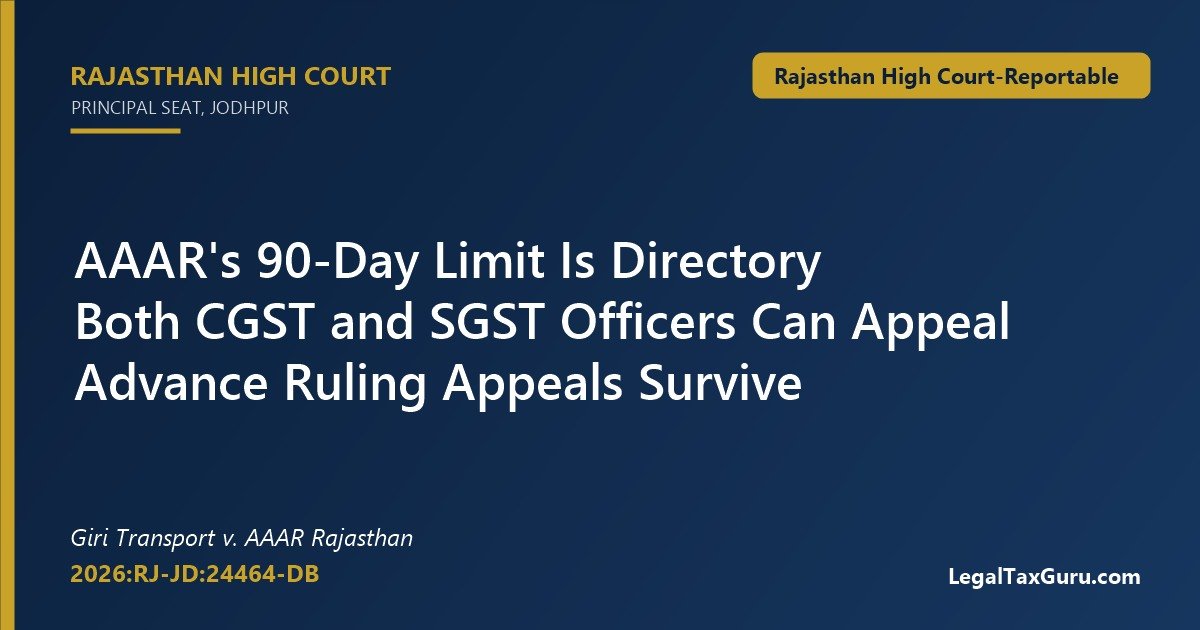
Quick Answer: The advance ruling appeal 90-day limit in Section 101(2) of the CGST/RGST Act is directory, so an appeal does not lapse when the AAAR takes longer. The Rajasthan High Court also upheld limitation from actual receipt, the CGST officer's locus and manual filing under Rule 107A.
In M/s Giri Transport Company v. The Appellate Authority for Advance Ruling, Rajasthan & Ors. (2026:RJ-JD:24464-DB), the Rajasthan High Court upheld the AAAR order dated 01.07.2024 rejecting the petitioner's preliminary objections (paras 1, 7–15). A Division Bench of Justice Arun Monga (author) and Justice Sunil Beniwal dismissed the writ against two departmental appeals from a favourable ruling on free-of-cost diesel (paras 2.4–2.5, 16–17). The petitioner must now join the appellate proceedings on merits (para 16).
Headnote: Advance Ruling Appeal 90-Day Limit
CGST/RGST Act, 2017 – Sections 97, 98, 100, 101(2), 103, 169 – CGST Rules, 2017 – Rules 106, 107A – Advance ruling – Appellate Authority for Advance Ruling – 90-day time limit – Directory provision – Limitation – Concerned officer – Jurisdictional officer – Estoppel against State – Manual filing
Held: (i) The 90-day period in Section 101(2) is directory, an outer limit for expeditious disposal and not a jurisdictional condition; no consequence is prescribed for breach (paras 8–8.3). (ii) Limitation under Section 100(2) runs from actual receipt of the ruling where that date is specifically established; Section 169 does not automatically override it (paras 9–9.1). (iii) "Concerned officer" and "jurisdictional officer" are distinct authorities, both entitled to appeal under Section 100(1), regardless of participation before the AAR (paras 10–11). (iv) There is no estoppel against the State in taxation; an unauthorised stand of a subordinate officer does not bind the department (para 13). (v) Rule 107A saves manual filing of appeals (paras 14–14.1). (vi) Writ jurisdiction cannot be used as an instrument of delay (para 15).
(paras 8–15)
Case Details: Giri Transport v. AAAR Rajasthan (2026:RJ-JD:24464-DB)
Final Outcome: Writ petition dismissed; petitioner to join appellate proceedings before the AAAR
Case: M/s Giri Transport Company v. The Appellate Authority for Advance Ruling, Rajasthan & Ors.
Neutral Citation: 2026:RJ-JD:24464-DB
Case No.: D.B. Civil Writ Petition No. 13071/2024
Court: Rajasthan High Court, Jodhpur (Division Bench)
Date of Decision: 20 May 2026 (reserved on 7 April 2026)
Bench: Justice Arun Monga (author) and Justice Sunil Beniwal
Relevant Acts & Sections: CGST/RGST Act, 2017 – Sections 2(31), 15(2)(b), 97, 98, 100, 101, 103, 169; CGST Rules, 2017 – Rules 106, 107, 107A
Impugned Order: Order dated 01.07.2024 of the Appellate Authority for Advance Ruling, Rajasthan (Chief Commissioner (SGST), Jaipur), rejecting preliminary objections in departmental appeals against Advance Ruling dated 16.06.2022
Counsel: For the petitioner: Mr. Sanjay Jhanwar, Senior Advocate, assisted by Mr. Wilson Joy. For the respondents: Mr. Mahaveer Bishnoi, AAG, assisted by Mr. Harshvardhan Singh Chundawat; Mr. Kuldeep Vaishnav with Mr. Arpit Yoganandi; Mr. Nilesh Choudhary.
Source: Rajasthan High Court (official website)
Key Holdings of the Rajasthan High Court
- Section 101(2) is directory; no provision lapses an appeal on expiry of 90 days (paras 8, 8.2).
- The word "shall" is not conclusive; context, object, scheme and consequences decide (para 8.3).
- Limitation for appeal runs from the date of actual receipt, where specifically established (para 9.1).
- Condonation within the proviso to Section 100(2) was a valid exercise of discretion (paras 9.3–9.5).
- Both the CGST and the SGST officer can appeal an advance ruling under Section 100(1) (paras 10–11).
- There is no estoppel against the State; an unapproved stand of a subordinate officer does not bind the department (para 13).
- Rule 107A permits manual filing; procedure cannot become a jurisdictional bar (paras 14–14.1).
Brief Facts of the Case
The petitioner, a Goods Transport Agency at Suratgarh, sought an advance ruling under Section 97 of the RGST Act. The question was whether diesel supplied free of cost by the service recipient forms part of the taxable value of transport services (para 2.1). Respondent No. 3, the State officer, supported the petitioner before the AAR (paras 2.2–2.3).
By ruling dated 16.06.2022, the AAR held that the value of such diesel is not includable (para 2.4). Two appeals followed: one by respondent No. 6, the Principal Commissioner, CGST Jodhpur, and one by respondent No. 3 itself (para 2.5). The petitioner said the ruling was dispatched and delivered in June 2022 and uploaded on the portal on 17.06.2022 (para 2.6).
The petitioner raised preliminary objections on limitation, procedure, jurisdiction, timelines and contradictory stands (para 2.8). In CWP No. 14009/2022, the High Court on 22.09.2022 directed that these be decided before the merits (para 2.9).
The matter lay dormant for over a year, and the petitioner believed the proceedings had been dropped (para 2.10). The appeals were revived in March 2024, and the AAAR rejected all five objections on 01.07.2024 (paras 2.10, 6–6.5).
The AAAR found that the CGST officer received the ruling on 29.06.2022 and appealed on 12.08.2022, with delay condoned (para 6.2). The SGST officer received it on 15.09.2022 and appealed on 14.10.2022, within 30 days (para 6.2). [Filing dates and delay figures in paras 2.7, 4.5, 6.2, 9.4 and 9.5 vary; to be verified from certified copy.]
Issues Before the High Court
- Whether the 90-day limit in Section 101(2) is mandatory, so that the appeals stood extinguished (para 8).
- Whether the departmental appeals were barred by limitation under Section 100(2) (para 9).
- Whether the CGST officer had locus to appeal under Section 100(1) (paras 10–11).
- Whether reliance on internal correspondence violated natural justice (para 12).
- Whether the department was estopped by the State officer's earlier stand (para 13).
- Whether hard-copy filing of the appeals was fatal (para 14).
Court's Findings and Reasoning
Petitioner's case (paras 3.1–3.20): The petitioner called the impugned order perverse and contrary to natural justice (para 3.1). Advance ruling provisions, it argued, are special, time-bound and to be strictly construed (para 3.16). A ruling binds in personam under Section 103, so parallel appeals defeat the scheme (para 3.17).
Revenue's case (paras 4.1–4.10): The respondents called the petition hyper-technical and sought dismissal in limine (para 4.1). On merits, FOC diesel is "consideration" under Section 2(31) and includable under Section 15(2)(b) (para 4.1). They said the petitioner itself caused delay, not filing objections before the AAAR until 07.03.2024 (para 4.4).
Approach of the Court (para 7): The Bench agreed with the logic and reasoning of the Appellate Authority. It found no ground for interference in extraordinary jurisdiction but recorded its own reasons (para 7).
90-day limit is directory (paras 8–8.1): The petitioner relied on "shall" and the absence of "as far as possible" (paras 3.2–3.3). Delay by a quasi-judicial authority does not annul proceedings or give finality to the order under challenge (para 8). No provision lapses an appeal, and the absence of a penal consequence strongly indicates a directory provision (para 8).
Textual argument rejected (paras 8.2–8.3): The contrast with Sections 101C and 107 was a "purely textual argument"; intent must be gathered from the statute as a whole (para 8.2). A mandatory reading would extinguish the departmental right of appeal by passage of time (para 8.2). Whether "shall" is mandatory depends on context, object, scheme and consequences (para 8.3).
Limitation runs from actual receipt (paras 9–9.2): The petitioner relied on India Post tracking and the portal upload date under Section 169 (paras 3.6–3.7). Communication for limitation runs from actual receipt where specifically established (para 9.1). Disputes about the date of receipt are factual and do not warrant writ interference (para 9.2).
Condonation not mechanical (paras 9.3–9.5): The Authority applied its mind under the proviso to Section 100(2) (para 9.3). The outer limit is 60 days, and the CGST appeal was within it (para 9.4). Elaborate reasons were not needed for a short delay on a question of statewide significance (para 9.5).
Both officers may appeal (paras 10–11): The two terms denote distinct authorities, one Central and one State (para 10). The AAR's own letter identified the SGST officer as jurisdictional and the CGST officer as concerned officer (para 11). Right of appeal is statutory and does not depend on prior participation (para 10).
Natural justice (para 12): The letters of 31.05.2024, 05.06.2024 and 12.06.2024 were internal inquiries to verify dates of receipt (para 12). Their substance was disclosed in the impugned order, so no prejudice arose (para 12).
No estoppel against the State (para 13): The State officer's supportive stand was taken without approval of higher authorities (para 13). There is no estoppel against the State in taxation, and the department may correct such an error by appeal (para 13).
Manual filing saved by Rule 107A (paras 14–14.1): The petitioner said appeals had to be filed electronically under Section 100(3) and Rule 106 (para 3.14). Rule 107A expressly saves manual filing, and procedure cannot become a jurisdictional bar (paras 14–14.1).
Application to facts (para 15): The impugned order only rejected objections and called the petitioner to argue merits (para 15). A second approach to the Court on the same technical grounds revealed an attempt to delay final adjudication (para 15).
Final Outcome and Directions
- Writ petition dismissed as bereft of merit (paras 16–17).
- Petitioner to join the appellate proceedings before the Appellate Authority (para 16).
- Pending applications disposed of (para 18). The order is silent on costs.
- The FOC diesel valuation question was not decided and remains for the AAAR (paras 4.1, 16).
Legal Principle Laid Down
The 90-day period in Section 101(2) of the CGST/RGST Act for the AAAR to pass its order is directory: an outer limit for expeditious disposal, not a jurisdictional condition precedent, so an appeal does not lapse on its expiry. Limitation under Section 100(2) runs from actual receipt where that date is specifically established. The "concerned officer" and the "jurisdictional officer" each have an independent right of appeal under Section 100(1), and an unauthorised stand of a subordinate officer creates no estoppel against the State (paras 8.2, 9.1, 10–11, 13).
Precedents Relied Upon
- Mohan Singh v. International Airport Authority of India, (1997) 9 SCC 132 – Relied upon – whether "shall" is mandatory depends on context and consequences. Discussed at para 8.3.
- Bachahan Devi v. Nagar Nigam Gorakhpur, (2008) 12 SCC 372 – Relied upon – same proposition on mandatory and directory provisions. Discussed at para 8.3.
- Dinesh Chandra Pandey v. High Court of Madhya Pradesh, (2010) 11 SCC 500 – Relied upon – same proposition. Discussed at para 8.3.
- Municipal Committee, Charkhi Dadri v. Ramji Lal Bagla, (1995) 5 SCC 272 – Cited by respondents – "shall" read as directory where no consequence is prescribed. Noted at para 4.3.
- M/s Shree Jeet Transport v. Union of India, 2023 SCC OnLine Chh 5982 – Cited by respondents on merits; not decided – FOC diesel includable in GTA value. Noted at para 4.2.
Important Paragraphs of the Judgment
Verbatim extracts from the judgment. For the full text, refer to the judgment PDF below.
Para 8 (no lapsing of appeal): "There is no provision in the CGST or RGST Act that provides for automatic lapsing of an appeal upon expiry of the 90-day period, nor does the Act prescribe any consequence for non-compliance with this timeline. The absence of a penal consequence for delay is itself a strong indicator that the provision is directory."
Para 8.2 (directory outer limit): "A provision whose strict construction destroys the very right it was designed to protect cannot be read as mandatory. The 90-day period is therefore directory, being an outer limit to ensure expeditious disposal and not a jurisdictional condition precedent to the exercise of appellate power."
Para 9.1 (actual receipt): "Section 169 prescribes modes of service, but communication for the purpose of limitation must be reckoned from the date of actual receipt where such date is specifically established."
Para 10 (right of appeal): "The Act does not restrict the right of appeal to whichever of the two happened to participate in the advance ruling proceedings. ... Jurisdiction and right of appeal are statutory, they do not depend upon prior participation in the proceedings below."
Para 14.1 (manual filing): "A procedural prescription cannot be elevated into a jurisdictional bar, and the appeals cannot be thrown out on this purely technical ground."
Practical Impact of the Ruling
- For taxpayers holding favourable rulings: Delay by the AAAR beyond 90 days will not, by itself, make the advance ruling final (para 8).
- For the department: Both the Central and State officer may appeal independently, even if only one appeared before the AAR (paras 10–11).
- On limitation: Proof of actual receipt by the officer's office governs; portal upload or postal tracking may not override it (paras 9–9.1).
- On estoppel and procedure: A field officer's supportive stand before the AAR does not bind the department, and manual AAAR appeals are valid under Rule 107A (paras 13–14.1).
- For GTA operators: The FOC diesel question remains open before the AAAR, where the department relies on Sections 2(31) and 15(2)(b) (paras 4.1–4.2, 16).
FAQs on Advance Ruling Appeal 90-Day Limit
1. What did the Rajasthan High Court hold in Giri Transport v. AAAR Rajasthan?
It dismissed the writ petition and upheld the AAAR's rejection of the preliminary objections. The petitioner was directed to join the appellate proceedings on merits (paras 16–17).
2. Is the advance ruling appeal 90-day limit under Section 101(2) mandatory?
No. The Court held it directory, an outer limit for expeditious disposal, because the Act prescribes no consequence for non-compliance (paras 8, 8.2).
3. Can both the CGST and SGST officer appeal against an advance ruling?
Yes. The "concerned officer" and the "jurisdictional officer" are distinct authorities, each entitled to appeal under Section 100(1) (paras 10–11).
4. When does limitation for an appeal against an advance ruling start?
It runs from the date of actual receipt of the ruling, where that date is specifically established. Section 169 does not automatically override evidence of receipt (paras 9–9.1).
5. Is a manually filed appeal before the AAAR valid?
Yes. Rule 107A expressly saves manual filing, and a procedural prescription cannot be a jurisdictional bar (paras 14–14.1).
Keywords: 2026:RJ-JD:24464-DB, Giri Transport Company v. AAAR Rajasthan, advance ruling appeal 90-day limit, Section 101(2) directory, Section 100 CGST Act, concerned officer, jurisdictional officer, limitation from actual receipt, Section 169, Rule 107A manual filing, estoppel against State, FOC diesel GTA, tax litigation lawyer, Rajasthan High Court, Justice Arun Monga
Related on LegalTaxGuru
- More High Court judgments on GST and indirect tax
- GST articles and updates
- TRAN-1 Time Limit Is Mandatory, Not Directory – Dharnia Motors v. Union of India
Download Judgment PDF – Giri Transport Company v. AAAR Rajasthan
Judgment PDF: 2026:RJ-JD:24464-DB – M/s Giri Transport Company v. The Appellate Authority for Advance Ruling, Rajasthan & Ors. (D.B. Civil Writ Petition No. 13071/2024) – The judgment PDF will be uploaded here shortly.
Source: Rajasthan High Court (official website).
Read more: Rajasthan High Court · GST · Advance Ruling · Indirect Tax