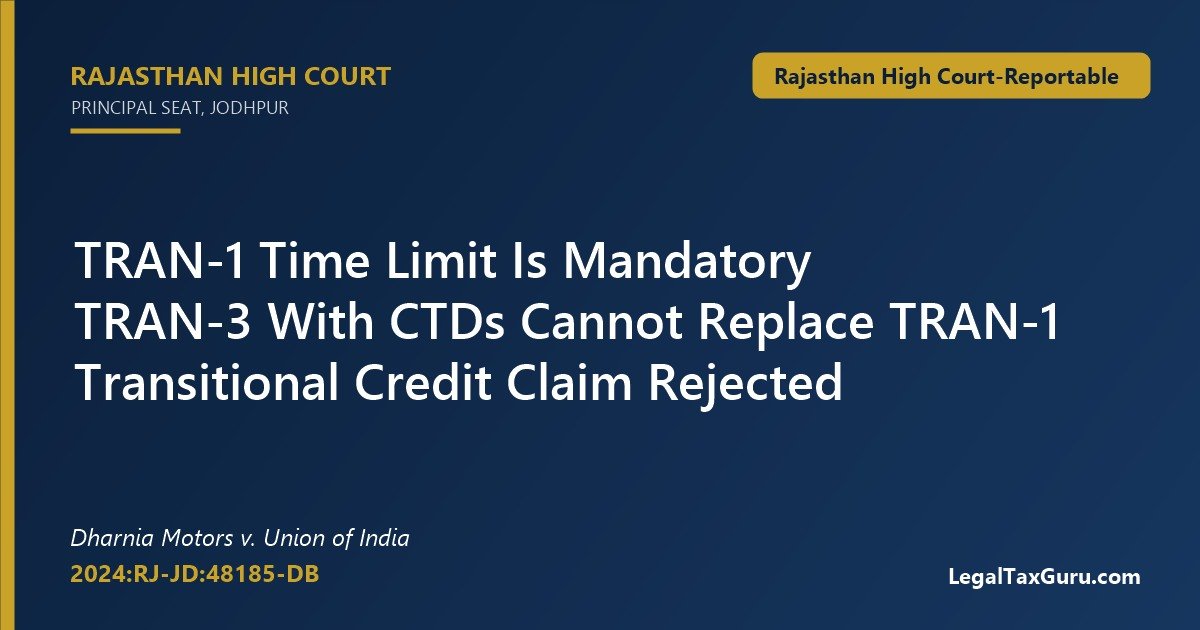
Quick Answer: The Rajasthan High Court held that the TRAN-1 time limit under Rule 117 of the CGST Rules is mandatory, because Section 140(3) itself requires credit to be taken "within such time and in such manner as may be prescribed". A dealer who filed only TRAN-3 with Credit Transfer Documents, without a timely TRAN-1, cannot claim transitional credit.
In Dharnia Motors, through its Proprietor Jitendra Bishnoi v. Union of India & Ors. (2024:RJ-JD:48185-DB), the Rajasthan High Court held that the TRAN-1 declaration is a statutory pre-condition, not an empty formality (paras 18, 32). A Division Bench of Chief Justice Manindra Mohan Shrivastava and Justice Munnuri Laxman dismissed the writ petition of a Hero MotoCorp sub-dealer at Nokha, Bikaner (paras 2, 39). Filing CTD particulars in TRAN-3 could not substitute a timely TRAN-1, and the Court differed from the Gujarat High Court's Siddharth Enterprises view (paras 37–38).
Headnote: TRAN-1 Time Limit
CGST Act, 2017 – Section 140(3) – CGST Rules, 2017 – Rule 117 – Transitional credit – TRAN-1 – TRAN-3 – Credit Transfer Document – Notification Nos. 21/2017 and 34/2017 – Mandatory vs directory – Input tax credit as concession
Held: (i) The TRAN-1 time limit flows from Section 140(3) itself; Rule 117 is within the rule-making power (paras 17–20).
(ii) The TRAN-1 declaration is a statutory pre-condition, not an empty formality (para 32).
(iii) The time limit is substantive and mandatory, not directory (paras 33, 35–36).
(iv) Input tax credit is a concession that can be availed only in accordance with law (paras 27–31).
(v) Uploading CTD particulars in TRAN-3 does not dispense with TRAN-1 (para 37).
(vi) The Court differed from Siddharth Enterprises (Gujarat) and agreed with JCB India (Bombay) (para 38).
(paras 17–39)
Case Details: Dharnia Motors v. Union of India (2024:RJ-JD:48185-DB)
Final Outcome: Writ petition dismissed; pending applications dismissed (para 39).
Case: Dharnia Motors, through its Proprietor Jitendra Bishnoi v. Union of India & Ors.
Neutral Citation: 2024:RJ-JD:48185-DB
Case No.: D.B. Civil Writ Petition No. 9717/2018
Court: Rajasthan High Court, Jodhpur (Division Bench)
Date of Decision: 29 November 2024 (judgment reserved and pronounced)
Bench: Chief Justice Manindra Mohan Shrivastava (author) and Justice Munnuri Laxman
Relevant Acts & Sections: CGST Act, 2017 – Section 140(3); CGST Rules, 2017 – Rule 117 (including sub-rule (1A)); Forms GST TRAN-1 and TRAN-3; Notification No. 21/2017 dated 30.06.2017; Notification No. 34/2017 dated 15.09.2017; Constitution of India – Article 226
Impugned Order: No adjudication order challenged; petition sought a declaration of entitlement to transitional credit claimed through TRAN-3; complaint closed by Memo dated 20.05.2018 (para 6)
Counsel: Mr. Sharad Kothari for the petitioner; Mr. Rajvendra Saraswat for the respondents.
Source: Rajasthan High Court (official website)
Key Holdings of the Rajasthan High Court
- Section 140(3) requires credit to be taken "within such time and in such manner as may be prescribed"; fixing a time limit was obligatory (paras 17–18, 33).
- The TRAN-1 declaration is a statutory pre-condition, not a mere procedural aspect (para 32).
- The time limit is mandatory, as shown by the word "shall" and the object of avoiding stale claims (paras 35–36).
- Input tax credit is a concession availed strictly as per law, following Jayam & Co. and ALD Automotive (paras 27–31).
- Filing CTD details in TRAN-3 under Notification No. 21/2017 does not dispense with TRAN-1 (para 37).
- The Court differed from Siddharth Enterprises and agreed with JCB India (para 38).
Brief Facts of the Case
The petitioner trades in automobiles and motorbikes and obtained GST registration on 22.09.2017. As a sub-dealer of Hero MotoCorp Ltd., it bought from the primary dealer and held no duty-paying invoices (para 2).
It claimed excise duty credit on stock held on 30.06.2017, the day before the CGST Act came into force (para 3). It was not registered under the Central Excise Act, 1944 and claimed eligibility under Section 140(3) (para 3).
Notification No. 21/2017 dated 30.06.2017 introduced Credit Transfer Documents (CTDs) issued by manufacturers, with credit claimed through TRAN-3 (para 5). The petitioner received three CTDs from Hero MotoCorp on 03.09.2017 and filed TRAN-3 (para 6).
Its separate TRAN-1 claim for carried-forward VAT was processed, but the TRAN-3 claim was not; a complaint was closed by Memo dated 20.05.2018 (para 6). Notification No. 34/2017 dated 15.09.2017 had required simultaneous TRAN-1 and TRAN-3 filing for CTD credit (para 6). No TRAN-1 for excise credit was filed within the Rule 117 period (para 1).
Issues Before the High Court
No provision or notification was challenged as unconstitutional. The questions were (paras 12, 37):
- Whether, once eligibility under Section 140(3) is shown, non-filing of TRAN-1 within the Rule 117 period can defeat transitional credit.
- Whether the TRAN-1 requirement is substantive and mandatory, or merely processual and directory.
- Whether filing CTD particulars in TRAN-3 dispenses with the TRAN-1 declaration.
Court's Findings and Reasoning
Petitioner's case (paras 7–8): The petitioner argued that the rule-maker exceeded its powers by imposing a time-bound TRAN-1 not found in Section 140 (para 7). Entitlement vests on meeting the Section 140(3) conditions; the TRAN-1 requirement is directory (para 7). It relied on nine authorities, including Siddharth Enterprises (para 8).
Revenue's case (paras 9–10): The Revenue argued that credit depends on eligibility and a timely TRAN-1 (para 9). Rule 117 allowed 90 days, a further 90 days and a Council-backed window for technical glitches, none of which was used (para 10). Even TRAN-3 was filed late; it relied on Indian Oil Corporation and JCB India (para 10).
Time limit flows from the statute (paras 15–18): Section 140(3) itself makes credit available "within such time and in such manner, as may be prescribed" (para 17). That obliged the rule-maker to lay down the procedure through Rule 117 (para 17.1). The time limit is therefore a statutory mandate, and failing to prescribe one would itself have breached Section 140(3) (para 18).
Rule 117 not ultra vires (paras 19–21): The petitioner's authorities on subordinate legislation, such as Naresh Chandra Agrawal and Ispat Industries, were distinguishable (paras 19–20). Where the statute requires a time limit, prescribing one cannot exceed the rule-making power (para 20). There was no warrant even for reading down the Rule (para 21).
No vested right dehors the law (paras 22–26): Eicher Motors concerned retrospective lapsing of credit (para 24). In Dai Ichi Karkaria, credit was indefeasible only once "validly taken" (para 25). None of the cited cases dealt with a dealer who failed to file a timely TRAN-1 (paras 25.1–26).
ITC is a concession (paras 27–31): Under Jayam & Co., conditions of a statutory concession must be strictly complied with (para 28). ALD Automotive upheld a 90-day time limit for ITC under the Tamil Nadu VAT Act as mandatory (paras 29–29.4, 34). TVS Motor Company reiterated the principle (para 30).
Mandatory, not directory (paras 32–36): The TRAN-1 declaration is a solemn statutory declaration of eligibility on the portal (para 32). Prescribing the time limit was "absolutely mandatory" (para 33). The object is to prevent stale claims that are hard to verify, and the word "shall" signals mandatory intent (paras 35–35.1). Fiscal laws require strict construction (para 36).
Application to facts (paras 37–38): Rule 117 offered a liberal scheme of 90 days, a further 90 days and a Council-backed extension, yet the petitioner used none (para 37). Nothing in the notifications of 30.06.2017 and 15.09.2017 permits credit without TRAN-1, and TRAN-3 serves a different purpose (para 37). The petitioner was silent on the plea that TRAN-3 was itself late (para 37). The Court differed from Siddharth Enterprises and agreed with JCB India (para 38).
Final Outcome and Directions
- The writ petition was dismissed as devoid of merit (para 39).
- Pending applications, if any, were dismissed (para 39).
- No direction was issued to permit a fresh TRAN-1 (para 39).
- The judgment is silent on costs.
Legal Principle Laid Down
Where a statute confers transitional credit "within such time and in such manner as may be prescribed", the time limit is part of the substantive entitlement. A rule fixing it is within the rule-making power, and the TRAN-1 declaration under Rule 117 is a mandatory pre-condition. Furnishing CTD particulars in TRAN-3 does not substitute a timely TRAN-1 (paras 18, 20, 32–33, 35–37).
Precedents Relied Upon
- Jayam & Co. v. Assistant Commissioner & Anr., AIR 2016 SC 4443 : (2016) 15 SCC 125 – Relied upon – ITC is a concession; its conditions must be strictly complied with. Discussed at paras 28, 31.
- ALD Automotive Pvt. Ltd. v. Commercial Tax Officer & Ors., AIR 2018 SC 5235 – Relied upon – Time limit for ITC under Section 19(11), TNVAT Act is mandatory. Discussed at paras 29–29.4, 34.
- M/s TVS Motor Company Ltd. v. State of Tamil Nadu & Ors., AIR 2018 SC 5624 – Relied upon – Reiterates Jayam & Co. Discussed at para 30.
- JCB India Limited v. Union of India & Ors., (2018-TIDL-23-HC-Mum-GST) (Bombay High Court) – Followed – Credit is a concession, not claimable dehors the law. Discussed at paras 10, 38.
- Siddharth Enterprises v. The Nodal Officer, 2019 (29) GSTL 664 (Gujarat High Court) – Cited by petitioner; not followed – Rested on transitional credit being a vested right. Discussed at paras 25.1, 38.
- Eicher Motors Ltd. & Ors. v. Union of India, (1999) 2 SCC 361 – Distinguished – Retrospective lapsing of credit. Discussed at para 24.
- Collector of Central Excise, Pune v. Dai Ichi Karkaria Ltd., (1999) 7 SCC 448 – Distinguished – Credit indefeasible only once validly taken. Discussed at para 25.
- Global Ceramics Pvt. Ltd. v. Principal Commissioner of Central Excise, Delhi-I, W.P. (C) No. 6706/2016; Dipak Vegetable Oil Industries Ltd. v. Union of India, 1991 (52) ELT 222 (Guj) – Distinguished. Discussed at para 25.1.
- State of T.N. v. P. Krishnamurthy, (2006) 4 SCC 517; Ispat Industries Ltd. v. Commissioner of Customs, (2006) 12 SCC 583; Additional District Magistrate v. Siri Ram, (2000) 5 SCC 451; Naresh Chandra Agrawal v. ICAI (C.A. No. 4672/2021) – Distinguished – Ultra vires rules. Discussed at paras 19–20.
Important Paragraphs of the Judgment
Verbatim extracts from the judgment. For the full text, refer to the judgment PDF below.
Para 18 (statutory mandate): "Therefore, the prescription of time limit is not merely a provision of Rule framed by the Rule Making Authority in exercise of rule making power conferred on it under the CGST Act, 2017, but is also a statutory mandate, as contained in sub-section (3) of Section 140 of the CGST Act, 2017, that such claim has to be made within the prescribed time and in such manner, as may be prescribed. Therefore, the Rule Making Authority had no option but to prescribe the time limit for making appropriate declaration consistent with the eligibility conditions contained in the law itself."
Para 32 (pre-condition): "The requirement of statutory declaration in the prescribed proforma TRAN-1 is not an empty formality or mere procedural aspect, as has been contended before us. It constitutes a statutory pre-condition because eligibility to claim transitional credit under sub-section (3) of Section 140 of the CGST Act, 2017, is based on certain conditions, which are statutorily prescribed. The law requires appropriate solemn declaration to be made by the claimant by submitting electronically the details in TRAN-1 on GST portal."
Para 35.1 (mandatory language): "In addition, we also find that the language deployed mandates period by using the word "shall". Normally, the use of word "shall", as construed, is mandatory requirement. The use of expression "within such time", as contained in sub-section (3) of Section 140 of the CGST Act, 2017, reflects legislative intention of prescription of time, within which statutory declaration has to be made, as mandatory and not directory."
Para 38 (conflict of views): "The view which we have taken for the reasons stated hereinabove, we humbly beg to differ with the view taken by the Gujarat High Court in the case of Siddharth Enterprises Vs. The Nodal Officer (supra) and agree with the view taken by the Bombay High Court in the case of JCB India Limited Vs. Union of India & Ors. (supra)."
Practical Impact of the Ruling
- For taxpayers and dealers: In Rajasthan, transitional credit without a timely TRAN-1 is unlikely to succeed, whatever the Section 140(3) eligibility (paras 33, 35).
- For sub-dealers holding CTDs: TRAN-3 alone is insufficient; the CTD route had to be paired with TRAN-1 (para 37).
- For the department: The ruling supports rejecting late or missing TRAN-1 claims and treats the Rule 117 window as adequate (para 37).
- For litigants: "Vested right" and "procedural, hence directory" arguments face this reasoning, especially where the extension route was not used (paras 26, 37).
- For advisers: The ruling openly differs from Siddharth Enterprises (Gujarat); flag this conflict in pleadings (para 38).
FAQs on TRAN-1 Time Limit
1. What did the Rajasthan High Court hold in Dharnia Motors v. Union of India?
It held that filing TRAN-1 within the Rule 117 period is mandatory and substantive. The time limit flows from Section 140(3) itself, so credit claimed without a timely TRAN-1 was rightly not allowed (paras 18, 33, 35, 39).
2. Is the TRAN-1 declaration a mere procedural formality?
No. The Court held it is a statutory pre-condition requiring a solemn declaration of eligibility. It is not an empty formality or a mere procedural aspect (paras 32, 36).
3. Can transitional credit be claimed by filing only TRAN-3 with Credit Transfer Documents?
No. Uploading CTD particulars in TRAN-3 serves a different purpose. Nothing in the notifications of 30.06.2017 and 15.09.2017 dispenses with TRAN-1 (para 37).
4. Is Rule 117 of the CGST Rules beyond the rule-making power?
No. Section 140(3) requires credit to be taken "within such time and in such manner as may be prescribed". The rule-maker was bound to fix a time limit, so Rule 117 is not ultra vires (paras 17–20).
5. Does the Rajasthan High Court follow the Gujarat High Court's Siddharth Enterprises ruling?
No. The Court respectfully differed from Siddharth Enterprises. It agreed with the Bombay High Court in JCB India that credit is a concession claimable only as per law (paras 10, 38).
Keywords: TRAN-1 time limit, Dharnia Motors v. Union of India, 2024:RJ-JD:48185-DB, D.B. Civil Writ Petition No. 9717/2018, Section 140(3) CGST Act, Rule 117 CGST Rules, TRAN-3, Credit Transfer Document, transitional credit, mandatory vs directory, Siddharth Enterprises, JCB India, tax litigation lawyer, Rajasthan High Court, Chief Justice Manindra Mohan Shrivastava
Related on LegalTaxGuru
- More High Court judgments on GST and indirect tax
- GST articles and updates
- AAAR's 90-Day Limit Under Section 101(2) Is Directory – Giri Transport v. AAAR Rajasthan
Download Judgment PDF – Dharnia Motors v. Union of India
Judgment PDF: 2024:RJ-JD:48185-DB – Dharnia Motors, through its Proprietor Jitendra Bishnoi v. Union of India & Ors. (D.B. Civil Writ Petition No. 9717/2018) – The judgment PDF will be uploaded here shortly.
Source: Rajasthan High Court (official website).
Read more: Rajasthan High Court · GST · Transitional Credit · Indirect Tax