Quick Answer: A GST order without DIN is not void if it bears a verifiable RFN generated on the common portal and is served under Section 169 of the CGST Act. The Rajasthan High Court relied on the CBIC circular dated 09.06.2025, which modifies the 2019 DIN circulars for portal communications.
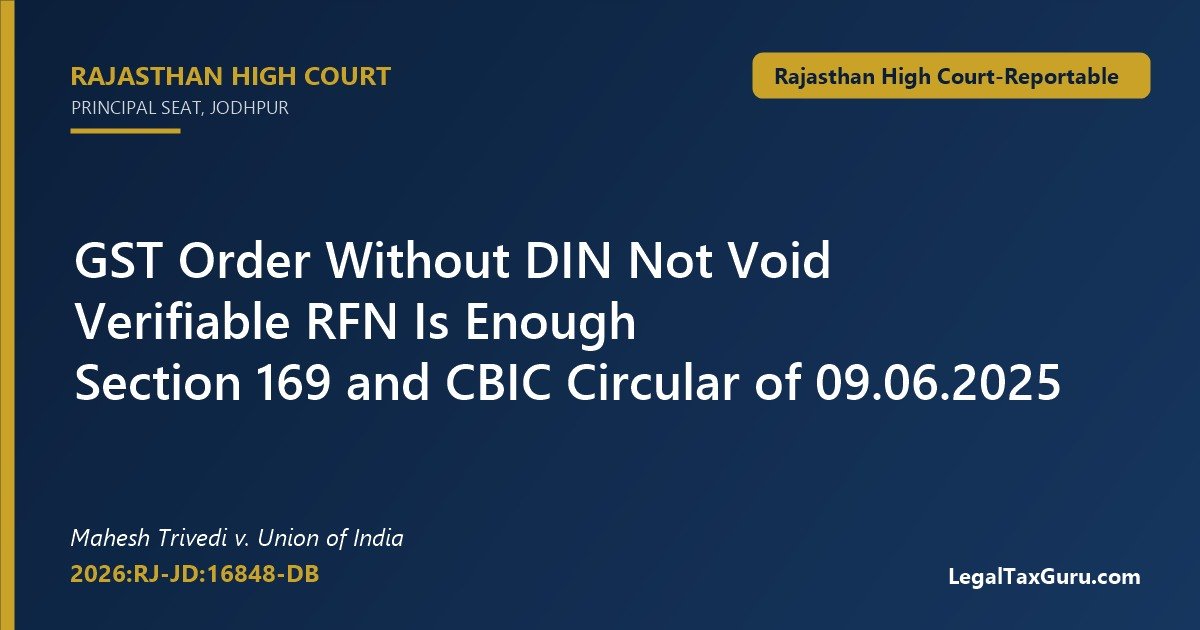
In Shri Mahesh Trivedi v. Union of India & Ors. (2026:RJ-JD:16848-DB), the Rajasthan High Court held that an order bearing a unique RFN on every page is not a communication without a verifiable identification number (paras 7–8, 15). A Division Bench of Justice Arun Monga and Justice Sunil Beniwal dismissed the writ against a penalty order alleging wrongful ITC of ₹32.29 crore (paras 1, 17). The petitioner may still file a statutory appeal, with the writ period excluded for limitation (para 18).
Headnote: GST Order Without DIN
CGST Act, 2017 – Section 169 – Section 107 – Document Identification Number (DIN) – Reference Number (RFN) – Circular No. 122/41/2019-GST – Circular No. 128/47/2019-GST – CBIC circular dated 09.06.2025 – Validity of order – Writ jurisdiction – Limitation
Held: (i) An order that does not carry the label "DIN" but bears a unique RFN on every page, retrievable on the portal, is not a communication without any verifiable identification number (paras 7–8). (ii) Section 169 recognises service through the common portal, registered post and e-mail; an order so served cannot be invalidated on a technical objection about the nomenclature of the identification number (paras 9–11). (iii) Where receipt of postal and e-mail communication is not specifically denied, the requirement of lawful communication stands satisfied (para 12). (iv) The CBIC circular dated 09.06.2025 modifies the 2019 DIN circulars; portal communications bearing a verifiable RFN need no DIN and are valid (paras 13–15). (v) A nullity plea on this ground does not justify bypassing the statutory appeal (paras 6, 16). (vi) The writ was dismissed, but the time spent in it is excluded for limitation in a statutory appeal (paras 17–18).
(paras 6–18)
Case Details: Mahesh Trivedi v. Union of India (2026:RJ-JD:16848-DB)
Final Outcome: Writ petition dismissed; period spent in the writ petition excluded for limitation if a statutory appeal is filed
Case: Shri Mahesh Trivedi v. Union of India & Ors.
Neutral Citation: 2026:RJ-JD:16848-DB
Case No.: D.B. Civil Writ Petition No. 5271/2026
Court: Rajasthan High Court, Jodhpur (Division Bench)
Date of Decision: 10 April 2026 (Order (Oral))
Bench: Justice Arun Monga (author) and Justice Sunil Beniwal
Relevant Acts & Sections: CGST Act, 2017 and RGST Act, 2017 – Sections 61, 67, 169; Circular No. 122/41/2019-GST dated 05.11.2019; Circular No. 128/47/2019-GST dated 23.12.2019; CBIC circular dated 09.06.2025; Instruction No. 4/2023-GST dated 23.11.2023; Rule 142, CGST Rules, 2017; Article 226, Constitution of India
Impugned Order: Order dated 09.12.2025 passed by the Joint Commissioner, Central Goods and Services Tax, Udaipur, bearing RFN I/3740446/2025 [penalty amount and penal provision to be verified from the impugned order]
Counsel: For the petitioner: Mr. Vikas Balia, Senior Advocate, assisted by Mr. Prateek Gattani. For the respondents: Mr. Mahaveer Bishnoi, AAG; Mr. Nilesh Choudhary for Mr. Kuldeep Vaishnav.
Source: Rajasthan High Court (official website)
Key Holdings of the Rajasthan High Court
- The ratio of G. Bhaskar Reddy applies where a communication carries no verifiable identification number at all; it does not govern an order bearing an RFN on each page (para 7).
- An RFN that retrieves the order on the CBIC/GST portal is a unique and verifiable electronic identifier linked to that communication (para 8).
- Section 169 deems an order duly served when sent by any prescribed mode, including registered post, e-mail or the common portal (paras 9–10).
- Even if neither DIN nor RFN had been mentioned, due service under Section 169 would prevent invalidation on a mere technical objection about nomenclature (para 11).
- Absent a specific denial of receipt, the requirement of lawful communication is satisfied (para 12).
- The CBIC circular dated 09.06.2025 modifies the 2019 DIN circulars; RFN serves the same function as DIN for portal communications (paras 13–15).
- The writ was dismissed, but the period spent prosecuting it stands excluded for limitation in a statutory appeal (paras 17–18).
Brief Facts of the Case
CGST officials inquired into M/s Shree Vallabh Industries, a proprietary concern. They found it to be a dummy concern controlled by the petitioner (para 2). Search and seizure under Section 67 followed at his residence and at the premises of M/s Rajlaxmi Exim, another proprietary entity (para 2).
A show cause notice dated 30.06.2025 was issued to the petitioner, who replied on 16.08.2025 (para 2.1). A separate notice dated 27.06.2025 under Section 61 was dropped by order dated 29.09.2025 after considering his response (para 2.1).
The impugned order dated 09.12.2025 then imposed penalty on the petitioner (para 2.2). It held that he had wrongly availed ITC of ₹32,29,10,192 without actual receipt of goods or services (para 1). It further held that he had passed on fraudulent ITC of ₹30,97,96,899 through 32 fictitious entities created and operated by him (para 1).
The petitioner approached the High Court directly to set aside the order (para 2.3). He did not first avail the statutory appeal (paras 4, 6).
Issues Before the High Court
The judgment does not formally frame issues. From the arguments and the discussion, the questions were:
- Whether the impugned order, which did not carry a "DIN", was non est under Circular Nos. 122/41/2019-GST and 128/47/2019-GST (paras 3–3.1).
- Whether the alleged nullity justified bypassing the alternative statutory appellate remedy (paras 4, 6).
- Whether the order was validly communicated under Section 169 of the CGST Act (paras 9–12).
- What is the effect of the CBIC circular dated 09.06.2025 on the requirement of DIN (paras 13–15).
Court's Findings and Reasoning
Petitioner's case (paras 3–3.1): Senior counsel argued that DIN is mandatory under Circular No. 122/41/2019-GST dated 05.11.2019 and Circular No. 128/47/2019-GST dated 23.12.2019. A communication without DIN, he contended, is non est and deemed never issued (para 3). The circulars permit exceptions only with recorded reasons and an express declaration, neither of which appeared in the order (para 3.1).
Revenue's case (para 4): The respondents, appearing on advance service, opposed the petition as devoid of merit. They submitted that it was filed without availing the alternative appellate remedy (para 4).
Nullity plea used to bypass appeal (para 6): The Court noted that the "no DIN, hence non est" plea was the principal contention. It was also the justification for not invoking the statutory appeal (para 6). The Court declined to subscribe to that view (para 6).
G. Bhaskar Reddy and Pradeep Goyal distinguished (para 7): The Court respectfully agreed with the principle in the cited judgments but held that they did not govern these facts (para 7). In G. Bhaskar Reddy, the communication had no verifiable identification number whatsoever (para 7). Here, each page bore the number "I/3740446/2025" at the top right corner (para 7).
RFN verified in court (para 8): On the Court's query, counsel for respondents 1 to 4 stated that the number was an RFN. Entering it on the CBIC/GST portal on the hearing date retrieved the impugned order without further input (para 8). The Court held the RFN to be a unique and verifiable electronic identifier, so the purpose of access and service was achieved (para 8).
Section 169 governs service (paras 9–10): The Court reproduced Section 169 in full (para 9). It deems an order duly served if sent by any prescribed mode, including registered post, e-mail or the common portal (para 9). The impugned order itself recorded upload on the portal and dispatch by registered post and e-mail (para 10).
Nomenclature cannot invalidate service (para 11): Even arguendo if no DIN or RFN had been mentioned, the suggested consequence would not automatically follow (para 11). Service duly effected through the statutory modes cannot be invalidated on a technical objection about nomenclature (para 11).
No denial of receipt (para 12): The petition contained no specific averment denying receipt of the postal or e-mail communication (para 12). Once service is effected in a recognised mode, lawful communication stands satisfied (para 12).
CBIC circular dated 09.06.2025 (paras 13–14): Counsel for the respondents tendered this circular, and the Court took it on record (para 13). It records that portal documents always bear an RFN verifiable on the portal, and refers to Section 169(1)(d) and Instruction No. 4/2023-GST (para 13). It clarifies that such communications need not quote DIN, modifying the 2019 circulars to that extent (paras 13–14).
RFN serves the purpose of DIN (para 15): For portal communications, the RFN serves the same functional purpose of traceability, authenticity and verification as a DIN (para 15). Absence of the label "DIN" does not invalidate such a communication (para 15).
Application to facts (paras 16–17): The order bore a verifiable RFN and was served by additional statutory modes. The challenge based solely on the absence of "DIN" was therefore devoid of substance (para 16). The Court recorded no finding on the merits of the ITC allegations (paras 16–18).
Final Outcome and Directions
- Writ petition dismissed as bereft of merit; pending applications disposed of (para 17).
- The writ was filed within the limitation period for a statutory appeal (para 18).
- If the petitioner files an appeal, the period spent in the writ shall stand excluded for limitation, in accordance with law (para 18).
- The order is silent on costs and on any stay or pre-deposit (paras 17–18).
Legal Principle Laid Down
A GST order generated through the common portal that bears a unique RFN, verifiable online, is a valid communication even without the label "DIN". The CBIC circular dated 09.06.2025 modifies Circular Nos. 122/41/2019-GST and 128/47/2019-GST to that extent. Independently, an order served by any mode under Section 169 cannot be invalidated on a technical objection about nomenclature, particularly where receipt is not denied; such a plea does not justify bypassing the statutory appeal (paras 7–16).
Precedents Relied Upon
- G. Bhaskar Reddy v. Assistant Commissioner, WP No. 7871/2025 (Andhra Pradesh High Court) – Distinguished – the communication there bore no verifiable identification number whatsoever. Discussed at paras 6–7.
- Pradeep Goyal v. Union of India & Ors., 2022 SCC OnLine SC 949 – Distinguished – principle accepted but held not to govern the facts. Discussed at paras 6–7.
Important Paragraphs of the Judgment
Verbatim extracts from the judgment. For the full text, refer to the judgment PDF below.
Para 7 (distinguishing G. Bhaskar Reddy): "In G. Bhaskar Reddy (supra), the communication under challenge did not contain any verifiable identification number, whatsoever. The present case stands on a different footing. Here, although the expression "DIN" is not specifically printed on the impugned order, each page of the order prominently bears the number "I/3740446/2025" at the top right corner."
Para 11 (service under Section 169): "Taking a step further, arguendo, that no DIN and / or RFN had been mentioned, the consequence suggested by the petitioner does not automatically follow. Section 169 accords statutory recognition to service through electronic upload, registered post and e-mail. Therefore, where the order has been duly communicated through these prescribed modes, service of the order cannot be invalidated merely on a technical objection relating to nomenclature of the identification number."
Para 13 (CBIC circular dated 09.06.2025, as quoted): "It is therefore clarified that for communications via common portal (in compliance with Section 169 of the CGST Act, 2017) having verifiable Reference Number (RFN), quoting of Document Identification Number (DIN) is not required and such communication bearing RFN is to be treated as a valid communication."
Para 15 (RFN equals DIN in function): "The effect of the aforesaid circular is clear and unambiguous. In respect of communications generated through the GST portal, the RFN serves the same functional purpose of traceability, authenticity and verification as a DIN. Therefore, absence of the label "DIN" does not render such communication invalid where a verifiable RFN is already available."
Para 18 (limitation): "However, before parting, we deem it appropriate to observe that the writ petition was instituted within the period of limitation prescribed for filing a statutory appeal. Therefore, in the event the petitioner is so advised to avail the appellate remedy, the period spent in prosecuting the present writ petition shall stand excluded for the purposes of limitation in accordance with law."
Practical Impact of the Ruling
- For taxpayers: A "no DIN" objection will not succeed in Rajasthan against portal orders bearing a verifiable RFN. Verify the RFN on the GST portal before pleading it (paras 8, 15–16).
- For writ petitioners: A nullity plea based only on DIN will not bypass the appeal under the Act. Merits challenges belong before the appellate authority (paras 6, 16–17).
- For pleadings: Silence on receipt is costly. The absence of a specific denial of postal and e-mail receipt was fatal to the service objection (para 12).
- For the department: Upload orders on the portal and also send them by post or e-mail; the Court relied on these additional modes (paras 10, 16).
- For appeal timelines: File any writ within the appeal limitation period. The Court excluded the writ period because it was instituted within that period (para 18).
FAQs on GST Order Without DIN
1. What did the Rajasthan High Court hold in Mahesh Trivedi v. Union of India?
The Court held that a GST order without DIN is valid if it bears a verifiable RFN generated on the common portal. The RFN serves the same function of traceability, authenticity and verification as a DIN, so the writ was dismissed (paras 15–17).
2. Is a GST order without DIN void under Circular No. 128/47/2019-GST?
Not when the order is a portal communication bearing a verifiable RFN. The CBIC circular dated 09.06.2025 modifies Circular Nos. 122/41/2019-GST and 128/47/2019-GST to that extent (paras 13–14).
3. How did the Court distinguish G. Bhaskar Reddy?
In G. Bhaskar Reddy, the communication had no verifiable identification number at all. Here, every page of the order bore RFN "I/3740446/2025", which retrieved the order on the portal (paras 7–8).
4. Can service of a GST order be challenged if it lacks DIN but is sent by e-mail and post?
Generally not. Section 169 recognises service through the portal, registered post and e-mail, and such service cannot be invalidated on a technical objection about nomenclature. The petitioner here also did not specifically deny receipt (paras 9–12).
5. Can the petitioner still file an appeal after the writ was dismissed?
Yes. The writ was filed within the appeal limitation period. The time spent in the writ will be excluded for limitation if the petitioner files a statutory appeal (para 18).
Keywords: 2026:RJ-JD:16848-DB, Mahesh Trivedi v. Union of India, GST order without DIN, Reference Number RFN, Section 169 CGST Act, service of GST order, Circular 122/41/2019-GST, Circular 128/47/2019-GST, CBIC circular 09.06.2025, G. Bhaskar Reddy distinguished, alternative remedy, tax litigation lawyer, Rajasthan High Court, Justice Arun Monga
Related on LegalTaxGuru
- More High Court judgments on GST and indirect tax
- GST articles and updates
- No Writ Against Section 74 Order After Joining Adjudication – Punj Lloyd–Varaha Infra JV v. Union of India
Download Judgment PDF – Mahesh Trivedi v. Union of India
Judgment PDF: 2026:RJ-JD:16848-DB – Shri Mahesh Trivedi v. Union of India & Ors. (D.B. Civil Writ Petition No. 5271/2026) – The judgment PDF will be uploaded here shortly.
Source: Rajasthan High Court (official website).
Read more: Rajasthan High Court · GST · GST Procedure · Indirect Tax