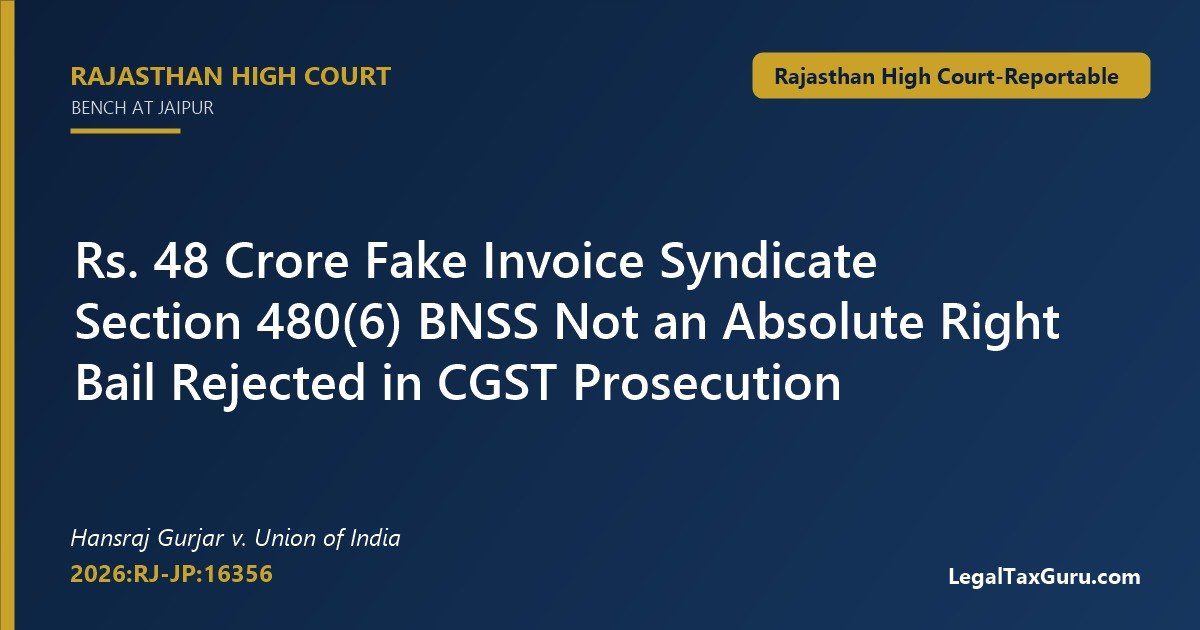
Quick Answer: On GST fake invoice bail, the Rajasthan High Court held that Section 480(6) of the BNSS confers no absolute or indefeasible right to bail, and custody length alone is not decisive. Treating alleged evasion of about Rs. 48.41 crore through fake firms as a serious economic offence, it dismissed the bail application.
In Hansraj Gurjar v. Union of India (2026:RJ-JP:16356), the Rajasthan High Court refused GST fake invoice bail to an accused alleged to have run fake firms for marble and granite supplies (paras 17–18, 29–30). Justice Praveer Bhatnagar held that Section 480(6) of the BNSS confers no absolute or indefeasible right to bail (paras 21, 23–24). Treating the case as a serious economic offence involving alleged evasion of about Rs. 48.41 crore, the Court dismissed the bail application (paras 18, 20, 28–30).
Headnote: GST Fake Invoice Bail
CGST Act, 2017 – Sections 67(2), 70, 132(1)(a), (f), (h), (l) and 132(5) – Bharatiya Nagarik Suraksha Sanhita, 2023 – Sections 479, 480(6) and 483 – Code of Criminal Procedure, 1973 – Section 437(6) – Regular bail – Fake firms, invoices and e-way bills – Economic offence – Article 21
Held: (i) Statements of co-accused under Section 70 and documentary evidence prima facie showed active involvement in a fake-invoice syndicate (para 17).
(ii) The petitioner was prima facie the "mastermind" of sham documents; evasion of about Rs. 48.41 crore on a taxable value of about Rs. 268.80 crore was alleged (para 18).
(iii) Economic offences with deep-rooted conspiracies are a class apart, following Y.S. Jagan Mohan Reddy (para 20).
(iv) Section 480(6) BNSS (Section 437(6) CrPC) is not mandatory and confers no indefeasible right, following Subhelal (paras 21, 23–24).
(v) Section 479 BNSS shows the right to bail is subject to the Court's just discretion (paras 25–27).
(vi) Length of custody alone, without mitigating circumstances, does not entitle the accused to bail; application dismissed (paras 28–30).
(paras 16–30)
Case Details: Hansraj Gurjar v. Union of India (2026:RJ-JP:16356)
Final Outcome: Bail application dismissed (paras 29–30).
Case: Hansraj Gurjar s/o Sh. Ramgopal v. Union of India, through Intelligence Officer, Directorate General of GST Intelligence, Jaipur Zonal Unit
Neutral Citation: 2026:RJ-JP:16356
Case No.: S.B. Criminal Miscellaneous Bail Application No. 16428/2025
Court: Rajasthan High Court, Bench at Jaipur (Single Bench)
Date of Decision: 18 April 2026 (reserved and pronounced after arguments concluded on 15 April 2026)
Bench: Justice Praveer Bhatnagar
Relevant Acts & Sections: CGST Act, 2017 – Sections 67(2), 70, 132(1)(a), (f), (h), (l) and 132(5); Bharatiya Nagarik Suraksha Sanhita, 2023 – Sections 479, 480(6) and 483; Code of Criminal Procedure, 1973 – Section 437(6); Constitution of India – Article 21
Impugned Order: Bail rejected by the trial court on 19.09.2025 and by the Additional Sessions Judge No. 9, Jaipur Metropolitan-II, on 14.10.2025 (para 13); DGGI Case No. F. No. DGGI/INT/INTL/755/2025-Gr-N (para 1)
Counsel: Mr. Madhav Mitra, Sr. Adv., assisted by Mr. Arjun Singh, Mr. Daksh Pareek and Ms. Jaya Mitra for the petitioner; Mr. Kinshuk Jain, Sr. Adv., Standing Counsel for DGGI, with Mr. Sourabh Jain, and Mr. Akshay Bhardwaj with Mr. Mohit Kumar Soni for the respondent.
Source: Rajasthan High Court (official website)
Key Holdings of the Rajasthan High Court
- Section 132 offences of fraudulent availment and passing on of ITC through fake invoices and e-way bills were prima facie made out (para 17).
- The petitioner allegedly operated more than two firms and had a financial interest in fictitious transporters (paras 17–18).
- Economic offences "constitute a class apart" and need a different approach to bail (para 20).
- Section 480(6) BNSS does not confer any absolute or indefeasible right to bail (para 21).
- Section 437(6) CrPC and Section 480(6) BNSS empower but do not compel release; the Magistrate may refuse with reasons (paras 23–24).
- Section 479 BNSS confirms that bail depends on the Court's just discretion (paras 25–27).
- Mere length of incarceration is not determinative in a serious economic offence (para 28).
Brief Facts of the Case
The Directorate General of GST Intelligence, Jaipur Zonal Unit, arrested the petitioner for offences under Sections 132(1)(a), (f), (h) and (l) of the CGST Act (para 1). He has been in judicial custody since 13.08.2025 (para 4).
The department alleged a syndicate that created fake firms, misused identities and issued bogus invoices and e-way bills without supply of goods (para 8). The alleged evasion was Rs. 48,41,21,094, well above the Section 132(5) threshold, making the offence cognisable and non-bailable (para 9).
Searches were conducted under Section 67(2), and statements were recorded under Section 70 (para 10). Goods movement was shown through allegedly non-existent transporters, M/s Shri Mahadev Transport Company and M/s Har Har Mahadev Logistics (para 11).
Earlier bail applications were rejected by the trial court on 19.09.2025 and by the Additional Sessions Judge on 14.10.2025 (para 13). A complaint had been filed and investigation was said to be concluded (para 4).
Issues Before the High Court
- Whether the material prima facie connected the petitioner with the alleged GST fake-invoice syndicate (paras 17–19).
- Whether Section 480(6) BNSS entitled the petitioner to bail as the trial had not concluded (paras 5, 12, 21–24).
- Whether the period of custody undergone, by itself, justified release on bail (paras 4, 6, 28).
Court's Findings and Reasoning
Petitioner's case (paras 2–7): The petitioner claimed false implication resting only on co-accused Narendra Chaudhary's Section 70 statement (para 2). He claimed to satisfy the triple test, with no antecedents, documentary evidence already seized and a maximum sentence of five years (para 3). He relied on custody since 13.08.2025, slow trial progress, Section 480(6) BNSS and Article 21 (paras 4–6).
Revenue's case (paras 8–15): The Union said the petitioner was an active member of a large syndicate, not a mere facilitator (paras 8, 11). Section 480(6) BNSS did not apply as the CGST Act is a special statute (para 12). Co-accused bail had been rejected, and economic offences called for a stricter approach (para 14).
Prima facie involvement (para 17): Documentary evidence and co-accused statements under Section 70 prima facie showed that the petitioner was "actively involved". He was operating more than two firms as part of the syndicate (para 17).
Scale of the alleged fraud (para 18): The petitioner, "acting as the mastermind behind these sham documents", allegedly showed transport where none occurred (para 18). WhatsApp chats allegedly showed goods worth Rs. 63 crore moved without GST between January and July 2025 (para 18). The Court found "no evidence to suggest wrongful implications" at this stage (para 18).
Parity (para 19): A Co-ordinate Bench had rejected co-accused Narender Choudhary's bail on 28.11.2025, and the petitioner's role was "not distinguishable" (para 19).
Economic offence a class apart (para 20): The Court found a "structured and deep-rooted conspiracy" causing significant loss to the exchequer (para 20). It applied Y.S. Jagan Mohan Reddy on the different approach to bail in economic offences (para 20).
Section 480(6) BNSS (paras 21–24): The provision confers no absolute or indefeasible right to bail (para 21). It empowers the Court to grant bail where a trial is not concluded within 60 days, but the Magistrate may still refuse (para 23). The Court followed Subhelal that Section 437(6) is not mandatory (para 24).
Section 479 BNSS (paras 25–27): The Court noted that a first-time offender may lawfully be detained up to one-third of the maximum sentence (para 26). These safeguards, flowing from Article 21, confirm that bail rests on the Court's just discretion (para 27).
Application to facts (paras 28–29): Custody length, "in absence of any other mitigating circumstances", was not a determinative factor (para 28). Given the gravity, magnitude of evasion and record, the Court declined bail without commenting on merits (para 29).
Final Outcome and Directions
- The bail application was dismissed (para 30).
- The Court expressly made no comment on the merits of the case (para 29).
- No directions were issued on the pace of trial.
- The order is silent on costs.
Legal Principle Laid Down
In a prosecution under Section 132 of the CGST Act for large-scale fake invoicing, bail is governed by the gravity of the economic offence, the material collected and the accused's role. Section 480(6) BNSS (Section 437(6) CrPC) gives no indefeasible right to bail on non-conclusion of trial. Length of custody alone, without other mitigating circumstances, does not justify release (paras 20–28).
Precedents Relied Upon
- Y.S. Jagan Mohan Reddy v. CBI, (2013) 7 SCC 439 – Relied upon – Economic offences are a class apart and need a different approach in bail. Discussed at paras 15, 20.
- Subhelal v. State of Chhattisgarh, (2025) 5 SCC 140 – Relied upon – Section 437(6) CrPC is not mandatory and confers no absolute right to bail. Discussed at para 24.
- Narender Choudhary (co-accused), S.B. Criminal Miscellaneous Bail Application No. 14559/2025, decided 28.11.2025 (Rajasthan High Court) – Relied upon – Co-accused bail rejected; parity against the petitioner. Discussed at para 19.
- Nimmagadda Prasad v. CBI, (2013) 7 SCC 466 – Cited by both sides. Discussed at paras 7, 15.
- Ram Narain Poply v. CBI, (2003) 3 SCC 641; Kalyan Chandra Sarkar v. Rajesh Ranjan, (2004) 7 SCC 528 – Cited by the respondent. Discussed at para 15.
- State of Gujarat v. Mohanlal Jitamalji Porwal, (1987) 2 SCC 364; SFIO v. Nittin Johari, (2019) 9 SCC 165; Ratnambar Kaushik v. Union of India and Vineet Jain v. Union of India (SLPs); Naveen Yadav and Mohit Vijay v. Union of India (Rajasthan High Court) – Cited by the petitioner; not discussed. Referred at para 7.
Important Paragraphs of the Judgment
Verbatim extracts from the judgment. For the full text, refer to the judgment PDF below.
Para 17: "The material collected during the course of investigation, including documentary evidence as well as the statements of co-accused persons recorded under Section 70 of the CGST Act, prima facie indicates that the petitioner was actively involved in the alleged offence and was operating more than two firms as part of the alleged syndicate engaged in such activities."
Para 21: "So far as the contention with regard to adopting a liberal approach in view of the mandate of Section 480(6) of the BNSS is concerned, this Court is of the view that the said provision does not confer any absolute or indefeasible right upon the petitioner to be released on bail."
Para 23: "It is also to be noted that Section 480(6) of BNSS or 437(6) of Cr.P.C does not impose mandatory requirements but instead empowers the court to grant bail if a trial is not concluded within 60 days. Nevertheless, the Magistrate retains the authority to deny bail taking into consideration the peculiar facts and circumstance of the case."
Para 28: "Furthermore, the contention with regard to the period of custody undergone by the petitioner, in the facts and circumstances of the present case, by itself cannot be treated as a determinative or sole factor for grant of bail, as mere length of incarceration, in absence of any other mitigating circumstances, does not entitle the petitioner to be enlarged on bail, more particularly when the allegations pertain to a serious economic offence involving substantial loss to the public exchequer."
Para 30: "Accordingly, the instant bail application preferred by the accused petitioner is hereby dismissed."
Practical Impact of the Ruling
- For accused in GST prosecutions: Section 480(6) BNSS is not an automatic route to bail; the Court weighs gravity and role (paras 21–24).
- For defence counsel: Custody length must be paired with mitigating circumstances; alone it is not enough (para 28).
- For DGGI and the department: Section 70 statements, WhatsApp chats and links to fictitious transporters carried prima facie weight (paras 17–18).
- For co-accused: Rejection of a co-accused's bail with an indistinguishable role weighs against parity claims (para 19).
- For businesses: Operating or lending identity to fake firms and transport entities can lead to prolonged custody under Section 132 (paras 8, 11, 18).
FAQs on GST Fake Invoice Bail
1. What did the Rajasthan High Court hold in Hansraj Gurjar v. Union of India?
It refused bail to an accused alleged to have masterminded fake firms, invoices and e-way bills with evasion of about Rs. 48.41 crore. Section 480(6) BNSS was held to confer no absolute right to bail (paras 18, 21, 30).
2. Is bail automatic under Section 480(6) BNSS if the trial is not concluded in 60 days?
No. The provision empowers but does not compel the Court to grant bail. The Magistrate may refuse it for reasons, following Subhelal (paras 23–24).
3. Can long custody alone justify bail in a GST offence?
Not by itself. Without other mitigating circumstances, length of incarceration is not determinative in a serious economic offence (para 28).
4. How are GST fake invoice cases treated for bail?
As economic offences that are a class apart, needing a stricter approach. The Court applied Y.S. Jagan Mohan Reddy (para 20).
5. What evidence did the Court rely on?
Documentary evidence, co-accused statements under Section 70, links to fictitious transporters and WhatsApp chats. These prima facie showed active involvement (paras 17–18).
Keywords: GST fake invoice bail, Hansraj Gurjar v. Union of India, 2026:RJ-JP:16356, S.B. Criminal Misc. Bail Application No. 16428/2025, Section 132 CGST Act, Section 480(6) BNSS, Section 437(6) CrPC, Section 479 BNSS, economic offence bail, DGGI Jaipur, Section 70 statement, GST prosecution lawyer, Rajasthan High Court, Justice Praveer Bhatnagar
Related on LegalTaxGuru
- More High Court judgments on GST and indirect tax
- GST articles and updates
- No Straight-Jacket Bail Formula in Rs. 1,032 Crore Fake ITC Case – Ashutosh Garg v. Union of India
Download Judgment PDF – Hansraj Gurjar v. Union of India
Judgment PDF: 2026:RJ-JP:16356 – Hansraj Gurjar v. Union of India (S.B. Criminal Miscellaneous Bail Application No. 16428/2025) – The judgment PDF will be uploaded here shortly.
Source: Rajasthan High Court (official website).
Read more: Rajasthan High Court · GST · GST Prosecution and Bail · Indirect Tax