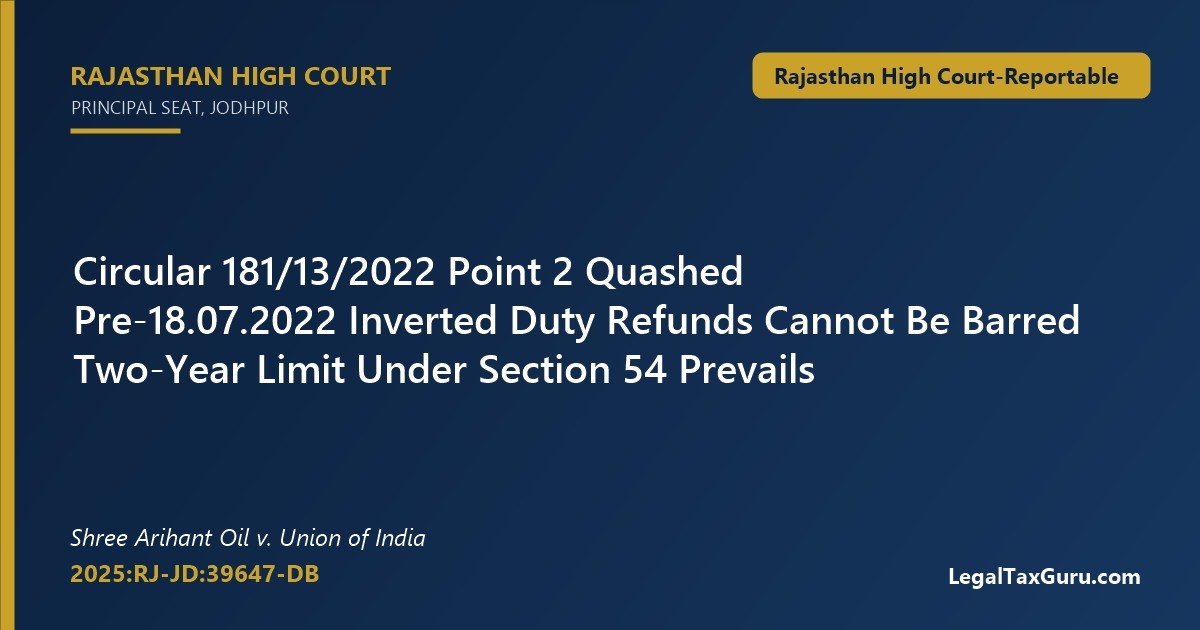
Quick Answer: The Rajasthan High Court quashed the Circular 181/13/2022 inverted duty refund restriction to the extent it confined refunds to applications filed up to 18.07.2022. Refund of ITC on tax paid before that date can be claimed within the two-year limit under Section 54 of the CGST Act.
In Shree Arihant Oil and General Mills, through its Partner Harsh Kumar Jain v. Union of India & Ors. (2025:RJ-JD:39647-DB), the Rajasthan High Court held that Notification No. 09/2022-Central Tax (Rate) applies only from 18.07.2022 and has no filing-date embargo (paras 13, 15). A Division Bench of Justice Dinesh Mehta and Justice Sangeeta Sharma allowed the writ petition and declared Point No. 2 of the Circular violative of Article 14 (paras 20–21). The authorities must decide the edible oil manufacturer's refund applications dated 04.01.2023 within three months, without relying on the quashed part (para 22).
Headnote: Circular 181/13/2022 Inverted Duty Refund
CGST Act, 2017 – Section 54(3) – Notification No. 09/2022-Central Tax (Rate) dated 13.07.2022 – CBIC Circular No. 181/13/2022-GST dated 10.11.2022, Point No. 2 – Refund of unutilised ITC – Inverted duty structure – Edible oil (HSN 1514) – Two-year limitation – Articles 14, 19(1)(g) and 300A
Held: (i) Notification No. 09/2022 operates prospectively from 18.07.2022; manufacturers remain entitled to inverted duty refund for tax paid up to that date (paras 12–13).
(ii) Point No. 2 of the Circular adds a filing-date restriction absent in the Notification and is contrary to Section 54 (para 15).
(iii) The restriction is unreasonable and creates an irrational classification, violating Article 14 (paras 16–17).
(iv) The accrued right to ITC refund up to 18.07.2022 cannot be denied; denial impinges on Articles 19(1)(g) and 300A (para 18).
(v) Point No. 2 quashed to that extent; refund applications to be decided within three months (paras 21–22).
(paras 12–22)
Case Details: Shree Arihant Oil v. Union of India (2025:RJ-JD:39647-DB)
Final Outcome: Writ petition allowed; Point No. 2 of Circular No. 181/13/2022-GST quashed to the extent it confines refund to applications filed up to 18.07.2022; refund applications to be decided within three months (paras 20–22).
Case: Shree Arihant Oil and General Mills, through its Partner Harsh Kumar Jain v. Union of India & Ors.
Neutral Citation: 2025:RJ-JD:39647-DB
Case No.: D.B. Civil Writ Petition No. 2932/2023
Court: Rajasthan High Court, Jodhpur (Division Bench)
Date of Decision: 8 September 2025 (oral order)
Bench: Justice Dinesh Mehta (author) and Justice Sangeeta Sharma
Relevant Acts & Sections: CGST Act, 2017 – Section 54 (including Section 54(3)); Notification No. 09/2022-Central Tax (Rate) dated 13.07.2022; CBIC Circular No. 181/13/2022-GST dated 10.11.2022, Point No. 2; Constitution of India – Articles 14, 19(1)(g), 226 and 300A
Impugned Order: No refund order passed; challenge to inaction on refund applications dated 04.01.2023 (Annexure-P/2 to P/4) and to Point No. 2 of Circular No. 181/13/2022-GST (paras 1, 5, 7, 22)
Counsel: Mr. Sanjeev Johari, Senior Counsel, assisted by Mr. Shubhankar Johari, for the petitioner; Mr. Rajat Arora for the respondent-CGST Department; Mr. Mahaveer Bishnoi, AAG, for the State.
Source: Rajasthan High Court (official website)
Key Holdings of the Rajasthan High Court
- Notification No. 09/2022 is enforceable from 18.07.2022, so ITC refund on tax paid up to that date is not barred (paras 12–13).
- Point No. 2 restricts refund by filing date, though the Notification contains no such stipulation (para 15).
- With a two-year limitation under Section 54, refund can be claimed at least within that period (paras 15–16).
- Classifying applications as filed before or after 18.07.2022 lacks rationale and amounts to apparent discrimination (para 17).
- ITC is an indefeasible right accruing when goods are bought; denial impinges on Articles 19(1)(g) and 300A (para 18).
- The view accords with the Gujarat and Andhra Pradesh High Courts; the SLP against the Andhra Pradesh ruling was rejected on 09.05.2025 (para 19).
Brief Facts of the Case
The petitioner is a partnership firm at Agro Food Park, Udyog Vihar, Sri Ganganagar, manufacturing edible oil. It bought mustard oil and similar inputs under HSN Code 1514 on payment of GST (paras 1–2).
On 13.07.2022, Notification No. 09/2022-Central Tax (Rate) barred accumulated ITC refund for items including HSN 1514, with effect from 18.07.2022 (para 3).
The petitioner's products fell under an inverted duty structure. It filed refund applications under Section 54 on 04.01.2023 for periods prior to 18.07.2022 (paras 4–5, 22).
The respondents neither accepted nor rejected them, apparently because of Circular No. 181/13/2022-GST dated 10.11.2022 (para 7). Point No. 2 applied the restriction to all applications filed on or after 18.07.2022 (para 14). The refund amount is not stated in the judgment. [Amount to be verified from the refund applications/certified copy]
Issues Before the High Court
No issues were framed separately; the questions were (paras 1, 14):
- Whether Point No. 2 of the Circular could deny refund for periods before 18.07.2022 merely because the application was filed on or after that date.
- Whether the restriction is consistent with Notification No. 09/2022 and Section 54.
- Whether it is arbitrary under Article 14 and infringes Articles 19(1)(g) and 300A.
Court's Findings and Reasoning
Petitioner's case (paras 5–7): Senior Counsel argued that, as the Notification was effective only from 18.07.2022, refund of ITC on earlier purchases remained available (para 5). Applications filed later, within two years under Section 54, deserved consideration (para 6). The respondents were "sitting tight", perhaps because of the Circular, which the Andhra Pradesh High Court had held illegal (para 7).
Revenue's case (paras 8–9): Counsel for the CGST Department argued that, under the clarificatory Circular, the petitioner was not entitled to the refund (para 8). The Additional Advocate General for the State adopted this argument (para 9).
Prospective notification (paras 11–13): The Court explained the inverted duty structure, where ITC is refunded because output tax is lower than input tax (para 11). The judgment refers to "Section 5(3)" and the "electronic cash ledger" here. As the Notification took effect from 18.07.2022, refund of ITC on tax paid up to that date cannot be denied (paras 12–13).
Circular goes beyond Notification and Section 54 (paras 14–15): Point No. 2 restricts refunds to applications filed up to 18.07.2022, though the Notification has no such stipulation (para 15). With a two-year limitation, an assessee can claim refund at least within that period (para 15).
Unreasonable and arbitrary (para 16): Tested for reasonableness, the Circular falls foul of Article 14. No assessee can be expected to claim refund for tax paid up to 18.07.2022 on that very day (para 16).
Discriminatory classification (para 17): The restriction creates two classes of applications based only on filing date. The classification has no rationale or intelligible criteria and takes away a substantial statutory right (para 17).
Accrued right to ITC (para 18): Relying on Dai Ichi Karkaria, the Court held that ITC accrues on the date the goods were bought (para 18). The right accrued up to 18.07.2022 cannot be denied, and the respondents' stand impinges on Articles 19(1)(g) and 300A (para 18).
Application to facts (paras 19–22): The Court noted similar views in Patanjali Foods (Gujarat) and Priyanka Refineries and Gemini Edibles (Andhra Pradesh) (para 19). The SLP against the Andhra Pradesh ruling was rejected on 09.05.2025 (para 19). The Revenue's reliance on the Circular therefore failed, and the petitioner's applications had to be decided on merits (paras 20–22).
Final Outcome and Directions
- The writ petition was allowed (para 20).
- Point No. 2 of Circular No. 181/13/2022-GST was declared illegal, arbitrary, violative of Article 14 and contrary to the Notification dated 13.07.2022 (para 21).
- It was quashed to the extent of confining refund to applications filed up to 18.07.2022 (para 21).
- The refund applications dated 04.01.2023 must be decided in accordance with law within three months, without relying on the quashed part (para 22).
- The order does not itself grant the refund, and is silent on interest and costs (para 22).
Legal Principle Laid Down
A notification restricting inverted duty refund for specified goods operates only from its effective date and cannot defeat ITC refund accrued on earlier purchases. A circular cannot add a filing-date cut-off absent from the notification or curtail the two-year limitation under Section 54. Classifying refund claims solely by filing date is arbitrary under Article 14 and impinges on Articles 19(1)(g) and 300A (paras 13, 15–18, 21).
Precedents Relied Upon
- Collector of Central Excise, Pune & Ors. v. Dai Ichi Karkaria Ltd. & Ors., 1999 (112) ELT 353 (SC) : (1999) 7 SCC 448 – Relied upon – ITC is an indefeasible right accruing when goods are bought. Discussed at para 18.
- Patanjali Foods Ltd. v. Union of India & Ors., R/Special Civil Application No. 17298/2024, decided on 12.02.2025 (Gujarat High Court) – Relied upon – Somewhat similar view on the Circular. Discussed at para 19.
- Priyanka Refineries Pvt. Ltd. v. Deputy Commissioner ST & Ors. and Gemini Edibles and Fats India Ltd. v. Assistant Commissioner of Central Taxes & Ors., (2025) 143 GSTR 636 : 2025 SCC OnLine AP 1435 (Andhra Pradesh High Court) – Relied upon – Similar view on the Circular. Discussed at paras 7, 19.
- SLP against the Andhra Pradesh ruling, judgment dated 09.05.2025, (2025) 143 GSTR 644 : 2025 SCC OnLine SC 1580 – Referred – SLP rejected by the Supreme Court. Discussed at para 19.
Important Paragraphs of the Judgment
Verbatim extracts from the judgment. For the full text, refer to the judgment PDF below.
Para 15 (contrary to Section 54): "If above clarification issued by the CBITC is taken into consideration, it is apparent that it restricts the right of claiming refund for the applications filed up to 18.07.2022, though the Notification dated 13.07.2022 does not contain such stipulation. That apart, when the limitation for claiming refund under section 54 of the Act of 2017 is 2 years, an assessee can claim refund at least up to such period."
Para 16 (Article 14): "No assessee can be expected to file claim of refund of the tax for the period paid upto 18.07.2022 on 18.07.2022 itself, more particularly when he can apply for refund of tax within the permissible time limit of two years. Hence, curtailment of an assessee's right to claim refund upto 18.07.2022 - the date of enforceability of the notification is illegal and contrary to section 54 of the Act of 2017."
Para 18 (accrued right): "Input Tax Credit is an indefeasible right of an assessee, which accrues to it on the date when the goods were bought. … Said goods have been placed in the negative list with effect from 18.07.2022. As such, the right which has accrued to the petitioner up to the date, when the notification came into force cannot be denied."
Para 21 (Circular quashed): "The Point No. 2 of the Circular No. 181/13/2022-GST dated 10.11.2022 issued by the CBITC is declared illegal and arbitrary being violative of Article 14 of the Constitution of India and also contrary to the purport and import of the Notification dated 13.07.2022. The same is, therefore, quashed to the extent of confining the refund of Input Tax to the application(s) filed upto 18.07.2022."
Para 22 (directions): "The respondents are directed to consider and decide petitioner's application(s) dated 04.01.2023 (Annexure-P/2 to Annexure-P/4) for refund in accordance with law, however, within a period of three months from today. While deciding the applications, the respondents shall not rely upon the part of the Circular dated 10.11.2022, which has been quashed."
Practical Impact of the Ruling
- For edible oil and Chapter 15 manufacturers: Inverted duty refunds for periods up to 18.07.2022 can be pursued even if filed later, within the Section 54 limitation (paras 13, 15–16).
- For taxpayers with pending or rejected claims: Claims stalled on the strength of Point No. 2 may now be pressed; in Rajasthan, the quashed part cannot be relied upon (paras 21–22).
- For the department: A circular cannot add a cut-off absent from the notification; applications must be decided on merits within the time fixed (paras 15, 22).
- For litigants facing inaction: A writ lies against an authority "sitting tight" over refund applications (paras 7, 22).
- For practitioners: The ruling aligns Rajasthan with Gujarat and Andhra Pradesh, strengthening challenges to Point No. 2 elsewhere (para 19).
FAQs on Circular 181/13/2022 Inverted Duty Refund
1. What did the Rajasthan High Court hold in Shree Arihant Oil and General Mills v. Union of India?
It quashed Point No. 2 of Circular 181/13/2022 to the extent it confined refund to applications filed up to 18.07.2022. The restriction was held arbitrary, violative of Article 14 and contrary to Notification No. 09/2022 and Section 54 (paras 15–16, 21).
2. Can inverted duty refund for periods before 18.07.2022 be claimed after that date?
Yes. The Notification applies only from 18.07.2022 and has no filing-date cut-off. Refund for tax paid up to that date may be claimed within the two-year limit under Section 54 (paras 13, 15–16).
3. Why was Point No. 2 of Circular 181/13/2022 held arbitrary?
No assessee could be expected to claim refund for tax paid up to 18.07.2022 on that very day. Classifying claims by filing date lacked rationale and amounted to apparent discrimination (paras 16–17).
4. Is input tax credit an accrued right for refund purposes?
Yes. Relying on Dai Ichi Karkaria, the Court held that ITC is an indefeasible right that accrues when goods are bought. Its denial impinges on Articles 19(1)(g) and 300A (para 18).
5. What relief did the petitioner get in Shree Arihant Oil and General Mills?
The writ petition was allowed. The authorities must decide the refund applications dated 04.01.2023 within three months, without relying on the quashed part of the Circular (paras 20, 22).
Keywords: Circular 181/13/2022 inverted duty refund, Shree Arihant Oil and General Mills v. Union of India, 2025:RJ-JD:39647-DB, D.B. Civil Writ Petition No. 2932/2023, Notification No. 09/2022-Central Tax (Rate), Section 54 CGST Act, inverted duty structure, edible oil HSN 1514, Article 14, Patanjali Foods, tax litigation lawyer, Rajasthan High Court, Justice Dinesh Mehta
Related on LegalTaxGuru
- More High Court judgments on GST and indirect tax
- GST articles and updates
- Inverted Duty Refund Applies to Multiple Inputs and Outputs – Nahar Industrial v. Union of India
Download Judgment PDF – Shree Arihant Oil and General Mills v. Union of India
Judgment PDF: 2025:RJ-JD:39647-DB – Shree Arihant Oil and General Mills, through its Partner Harsh Kumar Jain v. Union of India & Ors. (D.B. Civil Writ Petition No. 2932/2023) – The judgment PDF will be uploaded here shortly.
Source: Rajasthan High Court (official website).
Read more: Rajasthan High Court · GST · GST Refund · Indirect Tax