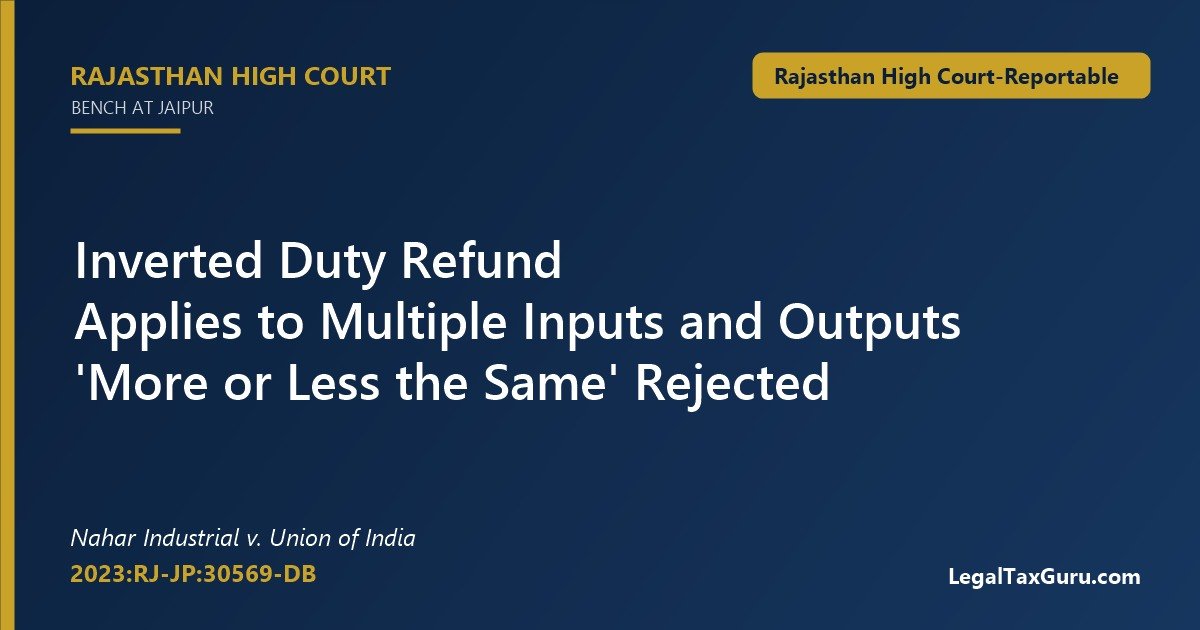
Quick Answer: An inverted duty structure refund under Section 54(3) of the CGST Act is available even where there are multiple inputs and multiple output supplies at different rates. The Rajasthan High Court set aside the rejections based on "more or less the same" rates and stock, and remanded the claims for computation under Rule 89(5).
In M/s Nahar Industrial Enterprises Limited v. Union of India & Ors. (2023:RJ-JP:30569-DB), the Rajasthan High Court held that the inverted duty refund scheme applies irrespective of the number of inputs and output supplies (paras 7.5, 7.7). A Division Bench of Manindra Mohan Shrivastava, J and Anil Kumar Upman, J allowed seven writ petitions and set aside the rejection orders (paras 1, 7.13–7.14). The Adjudicating Authority must now decide the claims afresh under the Rule 89(5) formula (paras 7.12–7.13).
Headnote: Inverted Duty Structure Refund
CGST Act, 2017 – Section 54(3), first proviso, clause (ii) – CGST Rules, 2017 – Rule 89(5) – Refund of unutilised input tax credit – Inverted duty structure – Multiple inputs and multiple output supplies – "Inputs" and "output supplies" in plural – Strict construction of taxing statute – Stock accumulation – Circulars No. 79/53/2018-GST and 125/44/2019-GST
Held: (i) Clause (ii) of the first proviso to Section 54(3) uses the plural "inputs" and "output supplies"; the refund scheme applies irrespective of the number of inputs and outputs (paras 7.4–7.7). (ii) Refund cannot be denied on the view that input and output rates are "more or less the same"; that substitutes the statutory test (para 7.9). (iii) Even a marginally higher overall rate of inputs, causing accumulation, attracts inverted duty refund (para 7.9). (iv) A stock-based approach violates Rule 89(5), which turns on rate of tax and ITC, not stock (para 7.10). (v) Refund must be computed only under the Rule 89(5) formula (para 7.12). (vi) Where there is no accumulation of unutilised ITC, no refund arises (para 7.13).
(paras 7.4–7.13)
Case Details: Nahar Industrial (2023:RJ-JP:30569-DB)
Final Outcome: Writ petitions allowed; orders of the Adjudicating Authority and Appellate Authority set aside; claims remanded for fresh consideration on a case-to-case basis; no costs (paras 7.13–7.16)
Case: M/s Nahar Industrial Enterprises Limited v. Union of India & Ors.
Neutral Citation: 2023:RJ-JP:30569-DB
Case No.: D.B. Civil Writ Petition No. 8476/2021, with D.B. CWP Nos. 7664/2021, 8487/2021, 8489/2021, 8490/2021, 8491/2021 and 8492/2021
Court: Rajasthan High Court, Bench at Jaipur (Division Bench)
Date of Decision: 31 October 2023
Bench: Manindra Mohan Shrivastava, J (author) and Anil Kumar Upman, J
Relevant Acts & Sections: Sections 2(59), 16, 49, 54(1), 54(3) and 112, CGST Act, 2017; Rule 89(5), CGST Rules, 2017; Circular No. 79/53/2018-GST dated 31.12.2018; Circular No. 125/44/2019-GST
Impugned Order: Orders dated 06.10.2020 and 11.05.2021 of the Additional Commissioner (Appeals), CGST, Jaipur, affirming refund rejection (lead petition: order dated 24.08.2020 of the Adjudicating Authority) (paras 3.3–3.4)
Counsel: Mr. M.P. Devnath, Advocate (through video conferencing), assisted by Mr. Pranav Malik, Advocate, for the petitioners; Mr. Kinshuk Jain, Advocate, assisted by Mr. Jay Updhayay and Mr. Saurabh Jain, Advocates, for the respondents
Source: Rajasthan High Court (official website)
Key Holdings of the Rajasthan High Court
- Section 54(3) proviso (ii) uses the plural "inputs" and "output supplies", which must be given full effect (paras 7.4–7.5).
- The inverted duty refund scheme applies irrespective of the number of inputs and output supplies (para 7.7).
- Refund is available where accumulation is due to the rate on inputs exceeding the rate on output supplies (paras 7.7–7.8).
- The "rate is more or less the same" approach alters the legislative scheme and borders perversity (para 7.9).
- A stock-based reason for rejection violates the statutory scheme of Rule 89(5) (para 7.10).
- Refund must be determined only by the Rule 89(5) formula; no accumulation means no refund (paras 7.12–7.13).
Brief Facts of the Case
The petitioner manufactures textiles, from spinning and weaving to processing, and is registered under the CGST Act (para 3.1). Its inputs, including cotton, manmade fibre, packing material and stores, attract GST from 5% to 28% (para 3.1). Its outputs, cotton yarn, blended yarns and polyester/viscose yarns, attract 0.1% to 12% (para 3.1).
For January to March 2020, the petitioner sought refund of Rs. 1,31,39,059 under Section 54(3) on the GSTN portal under Rule 89 (para 3.2). A show cause notice proposed rejection on the ground that the case was not one of inverted duty structure (para 3.3). The claim was rejected by order dated 24.08.2020 (para 3.3).
Appeals for different tax periods were disposed of by common orders dated 06.10.2020 and 11.05.2021, affirming the rejection (para 3.4). With no GST Appellate Tribunal functioning under Section 112, the petitioner filed writ petitions (para 3.5). Seven petitions for different tax periods were decided by a common order, with facts drawn from CWP No. 8476/2021 (para 1).
Issues Before the High Court
The Court noted that a "common issue of law" arose, without framing it separately [issue framing to be verified from certified copy]. As discussed, the questions were:
- Whether refund under Section 54(3), proviso (ii), is available where there are multiple inputs and multiple output supplies at different rates (paras 1, 7.4–7.8).
- Whether refund can be denied because input and output rates are "more or less the same", or because accumulation is due to stock (paras 7.9–7.10).
- How refund is to be computed when the conditions of Section 54(3) are met (para 7.12).
Court's Findings and Reasoning
Petitioner's case (paras 4.1–4.7): The petitioner argued that Section 54(3) and Rule 89(5) require no one-to-one correlation between inputs and outputs (para 4.2). It said refund is computed GSTIN-wise, not product-wise, and the portal permits only one application per period (paras 4.3–4.4). The law does not recognise "more or less", and the Rule 89(5) formula does not consider stock (paras 4.4–4.5).
It added that Circular No. 125/44/2019-GST, relied on in appeal, was never a ground before the Adjudicating Authority (para 4.6).
Revenue's case (paras 5.1–5.3): The department said inputs and outputs both largely attracted 5%, 12% and 18%, with negligible 28% inputs (paras 5.1–5.2). Cotton and manmade fibre formed 75% to 85% of inputs, and over 75% of outputs were cotton or cotton blended yarn at 5% (para 5.3). It argued accumulation arose from higher procurement and lower supplies, not rate inversion (para 5.3).
It read the Circular dated 31.12.2018 as covering only single-rate outputs, and cited VKC Footsteps (para 5.3).
Statutory scheme and VKC Footsteps (paras 6.1–6.4): After extracting Section 54(3) and Rule 89(5), the Court relied on VKC Footsteps for the concept of inverted duty structure (paras 6.1–6.4).
Comparative analysis of rates (paras 7.1–7.3): For 5% cotton yarn, every input other than cotton bore 12%, 18% or 28% (para 7.2). For 0.1% supplies, every input was higher (para 7.3).
Plural words must be given effect (paras 7.4–7.5): Proviso (ii) speaks of "inputs" and "output supplies" (para 7.4). A taxing statute is strictly construed, and "inputs" cannot be read as a single "input" (para 7.5).
Literal and purposive construction (paras 7.6–7.7): The Court relied on Kasturi & Sons and Tata Steel for literal construction of taxing statutes (para 7.6). Through Acer India, it noted that purposive construction applies where literal reading leads to absurdity (para 7.6). Using the fiscal philosophy in VKC Footsteps, it held the scheme cannot be confined to a single input and output (para 7.7).
Refund as exemption analogue (para 7.8): The Court was conscious that VKC Footsteps treats refund like an exemption, citing Dharmendra Trading (para 7.8). Even so, on strict construction, the scheme applies to multiple inputs and outputs if accumulation arises from rate inversion (para 7.8). Here, inputs bore 5% to 28% against outputs at 0.1% to 12% (para 7.8).
"More or less the same" rejected (para 7.9): The authorities had reasoned that 80% of outputs were at 5% and inputs were "majorly" at 5% (para 7.9). The Court held this substitutes the statutory test and alters the legislative scheme (para 7.9). Since some inputs bore 18% and 28% while no output exceeded 12%, the view "perilously boarders perversity" (para 7.9).
Stock-based approach rejected (para 7.10): Rule 89(5) does not talk of stock but of turnover during the claim period (para 7.10). The determining factor is the rate of tax and quantum of ITC, not the value of individual inputs and outputs (para 7.10).
Circulars (para 7.11): Circulars No. 79/53/2018-GST and 125/44/2019-GST recognise inverted duty refund with multiple inputs, but do not address multiple outputs (para 7.11). Where some input rates exceed output rates, the scheme applies even with multiple outputs (para 7.11).
Application to facts (paras 7.12–7.13): Refund must be computed only under the Rule 89(5) formula (para 7.12). The Court declined to examine period-wise figures of accumulation, since the orders rested on erroneous law (para 7.13). Where there is no accumulation, no refund arises (para 7.13).
Final Outcome and Directions
- All impugned orders of the Adjudicating Authority and Appellate Authority set aside (paras 7.13–7.14).
- Adjudicating Authority directed to consider the refund claims afresh, case to case, in light of the Court's observations (para 7.13).
- Where there is no accumulation of unutilised ITC, the claim will not arise (para 7.13).
- Writ petitions allowed in the manner indicated; copy of the order to be placed in each connected petition (paras 7.14–7.15).
- No orders as to costs (para 7.16).
- The order is silent on interest on refund.
Legal Principle Laid Down
Clause (ii) of the first proviso to Section 54(3) of the CGST Act applies wherever unutilised ITC accumulates because the rate on inputs exceeds the rate on output supplies. The plural words "inputs" and "output supplies" must be given full effect, so the scheme is not confined to a single input and output. Refund cannot be refused because rates are "more or less the same" or because of stock, and must be computed strictly under Rule 89(5) (paras 7.5, 7.7–7.10, 7.12–7.13).
Precedents Relied Upon
- Union of India & Ors. v. VKC Footsteps India Private Limited, (2022) 2 SCC 603 – Relied upon – structure of Section 54(3), concept of inverted duty structure and its fiscal philosophy. Discussed at paras 5.3, 6.4, 7.7–7.8.
- Commissioner of Income Tax, Madras v. Kasturi & Sons Ltd., (1999) 3 SCC 346 – Relied upon – in a taxing Act, one looks fairly at the language used. Discussed at para 7.6.
- State of Jharkhand & Ors. v. Tata Steel Limited & Ors., (2016) 11 SCC 147 – Relied upon – no room for intendment in a taxing statute. Discussed at para 7.6.
- Commissioner of Central Excise, Pondicherry v. Acer India Ltd., (2004) 8 SCC 173 – Referred – purposive construction where literal construction leads to absurdity. Discussed at para 7.6.
- The Controller of Estate Duty, Gujarat v. Shri Kantilal Trikamlal, (1976) 4 SCC 643 – Referred – every taxing statute has a fiscal philosophy. Discussed at para 7.7.
- Assistant Commissioner of Commercial Taxes (Asst.) Dharwar & Ors. v. Dharmendra Trading Company & Ors., (1988) 3 SCC 570 – Referred (as relied in VKC Footsteps) – refund construed analogous to exemption. Discussed at para 7.8.
Important Paragraphs of the Judgment
Verbatim extracts from the judgment. For the full text, refer to the judgment PDF below.
Para 7.5 (plural words): "Conscious use of the plural words, "inputs" and "output supplies" by the legislature has to be given full effect to. Use of the word, "inputs" signifies a situation where there may be more than one input and it is not possible to read "inputs" as "input" alone, so as to restrict its meaning."
Para 7.7 (scope of scheme): "Consequently, the scheme of refund in case of inverted duty structure will continue to apply irrespective of the number of inputs and number of output supplies."
Para 7.9 (more or less the same): "This approach that "rate is more of less the same", runs contrary to the statutory scheme. This patently violates not only the letter but also the spirit of the law."
Para 7.10 (stock-based approach): "Thus, determining factor for applicability of Section 54(3) of the CGST Act, 2017 read with Rule 89(5) of the CGST Rules, 2017 is rate of tax and quantum of ITC content and not the value/quantum of individual inputs (going into an output) and the outputs. The stock based approach, therefore, violates the statutory scheme of refund."
Para 7.12 (computation): "... refund claim is to be determined on the basis of computation based on statutory formula prescribed in Rule 89(5) of the CGST Rules, 2017 and not on the basis of any other mode of computation and determination of actual amount of refund payment under the law."
Practical Impact of the Ruling
- For taxpayers: Multi-product manufacturers, such as textile units, can claim inverted duty refund even with several inputs and outputs at different rates (paras 7.7, 7.11).
- For the department: Refund cannot be refused on impressionistic grounds like "more or less the same" rates or high stock (paras 7.9–7.10).
- For computation: The Rule 89(5) formula is the only permissible method; ad hoc comparisons of total ITC and output tax are not (paras 4.7, 7.12).
- For remand proceedings: Period-wise accumulation remains to be examined, and no accumulation means no refund (para 7.13).
FAQs on Inverted Duty Structure Refund
1. What did the Rajasthan High Court hold in Nahar Industrial Enterprises Ltd v. Union of India?
It held that inverted duty refund under Section 54(3) applies even with multiple inputs and output supplies. The rejection orders were set aside and the claims remanded for fresh consideration (paras 7.7, 7.13–7.14).
2. Is inverted duty structure refund available when there are multiple outputs at different rates?
Yes. The plural words "inputs" and "output supplies" must be given full effect, so the scheme applies regardless of their number (paras 7.4–7.5, 7.7).
3. Can a refund be rejected because input and output tax rates are more or less the same?
No. The Court held that the "more or less the same" approach substitutes the statutory test and violates the letter and spirit of the law (para 7.9).
4. Does stock accumulation defeat an inverted duty structure refund claim?
Not on the reasoning used here. Rule 89(5) turns on the rate of tax and ITC, not on stock, so a stock-based rejection violates the scheme (para 7.10).
5. How is the inverted duty structure refund to be computed?
Only under the formula in Rule 89(5) of the CGST Rules, and not by any other method. Where there is no accumulation of unutilised ITC, no refund arises (paras 7.12–7.13).
Keywords: 2023:RJ-JP:30569-DB, Nahar Industrial Enterprises Ltd v. Union of India, inverted duty structure refund, Section 54(3) CGST Act, Rule 89(5) CGST Rules, unutilised input tax credit, multiple inputs and output supplies, VKC Footsteps, Circular 79/53/2018-GST, textile yarn GST refund, tax litigation lawyer, Rajasthan High Court, Justice Manindra Mohan Shrivastava
Related on LegalTaxGuru
- More High Court judgments on GST and indirect tax
- GST articles and updates
- No Filing-Date Bar on Pre-18.07.2022 Inverted Duty Refund – Shree Arihant Oil v. Union of India
Download Judgment PDF – Nahar Industrial Enterprises Limited v. Union of India
Judgment PDF: 2023:RJ-JP:30569-DB – M/s Nahar Industrial Enterprises Limited v. Union of India & Ors. (D.B. Civil Writ Petition No. 8476/2021 and connected matters) – The judgment PDF will be uploaded here shortly.
Source: Rajasthan High Court (official website).
Read more: Rajasthan High Court · GST · GST Refund · Indirect Tax