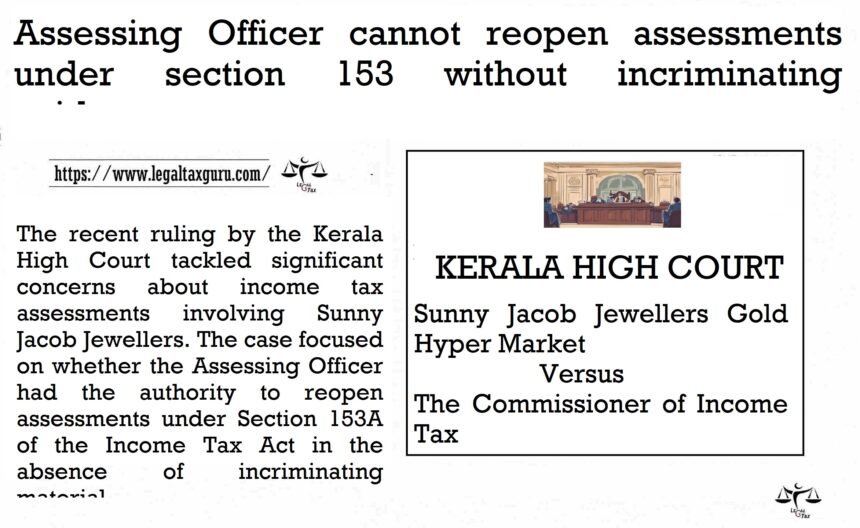
ASSESSING OFFICER CANNOT REOPEN ASSESSMENTS UNDER SECTION 153 WITHOUT INCRIMINATING EVIDENCE
Sunny Jacob Jewellers Gold Hyper Market
Versus
The Commissioner of Income Tax
Appeal No. I.T.A no. 60 of 2019
Date of Judgement/Order : 19/06/2024
Background:
The recent ruling by the Kerala High Court tackled significant concerns about income tax assessments involving Sunny Jacob Jewellers. The case focused on whether the Assessing Officer had the authority to reopen assessments under Section 153A of the Income Tax Act in the absence of incriminating material. The appeals presented to the court spanned several assessment years and centered on whether the AO had adequate grounds to begin new assessment proceedings under Section 153A. The key issue was the lack of incriminating material for the assessment years 2002-03 to 2007-08, despite a search carried out under Section 132 of the Income Tax Act in 2007.
IMPORTANT PARA
PARA 7. In the appeals before us, the following substantial questions of law have been raised while impugning the orders of the Appellate Tribunal. For the sake of convenience and brevity, only the substantial questions of law raised in the appeals preferred for the assessment year 2007-08 are reproduced below., as identical questions of law have been raised in the appeals for the other assessment years:
- Whether on the facts and in the circumstances of the case, the Appellate Tribunal is correct in law and justified in estimating the income from undisclosed source for the Assessment Year 2007-08, amounting to 2,22,65,770/- in the assessment made u/s 153A r.w.s. 143(3) of the I.T. Act, 1961?
- Did not the Appellate Tribunal err in law in estimating the undisclosed income for the above Assessment Year in the absence of any material or evidence found at the time of search and merely based on suspicion and without any proof?
- Should not the Appellate Tribunal have found that in so far as the Assessment Year 2007-08, was concerned, that the assessment is deemed to have completed for that year and did not abate as a result of action u/s 153A in the absence of any incriminating material or other evidence found at the time of search and relatable to the Assessment Year 2007- 08?
- Did not Appellate Tribunal err in law in its observations and findings as regards undisclosed investment in immovable property by understating the value for purchase of immovable properties by partners Shri. Sunny Jacob and Smt. Maggy Sunny for the assessment Years 2002-03 to 2007-08 when such allegations were found to be arbitrary and unfounded in the individual assessment of the respective partners? Are not the above findings perverse in law, which would invalidate the conclusions therefrom in the appellant’s case?
- Did not the Appellate Tribunal err in law in sustaining the estimate of undisclosed profits from the appellant’s jewellery business when there is not a single item of suppression of sale or profit found or established in the regular books of account maintained and produced by the appellant for the business?
- Whether, the Tribunal is justified in law in estimating suppression of turnover and estimate of profit therefrom amounting to 2,22,65,770/-, which has been added in the Assessment Order, on mere assumptions/presumptions, as regards suppression of sales turnover and profit?
- Is not the finding and conclusion of the Tribunal perverse and quixotic in the light of the clear findings of two Appellate
Authorities in the two rounds of litigations and the findings and the conclusions of the CIT(A) in the Appellate Order?
- In the facts and in the circumstances of the case, are not the findings of the Appellate Tribunal and the reversal of the orders of the first Appellate Authority and restoration of additions perverse and contrary to settled principles of law and therefore, illegal and liable to be set aside?
PARA 12. Taking cue from the above judgment of the Supreme Court, we are of the view that as per the amended provisions of Section 153A of the I.T. Act, while the unearthing of incriminating material would unambiguously clothe an Assessing Officer with the jurisdiction to initiate proceedings in terms of Section 153A of the I.T. Act for the block period of six years contemplated under that Section, when it comes to passing fresh assessment orders in respect of each of those assessment years comprised in the block of six assessment years, the Assessing Officer must necessarily relate such unearthed incriminating material to the assessment year in question. This is more so in view of the specific provisions under Section 153A(b), which requires the Assessing Officer to assess or reassess the total income of six assessment years immediately preceding the assessment year relevant to the previous year in which the search was conducted or the requisition made, and the proviso thereto which mandates that the Assessing Officer shall assess or reassess the total income in respect of each assessment year falling within such six assessment years. In our view, the statutory provision gives a clear indication that, based on the material obtained during the search, the Assessing Officer who gets the jurisdiction to re-open the assessments, can do so in respect of the individual assessment years comprised in the block period of six years only if the material obtained during the search under Section 132 of the I.T. Act, or any part thereof, relates to the assessment year in question. In the appeals before us, since it is not in dispute that the materials obtained during the search conducted on 21.08.2007 pertain only to the assessment year 2008-09, and there was no incriminating material against the appellants/assessees pertaining to the assessment years 2002-03 to 2007-08, the finding of the Appellate Tribunal reversing the orders of the First Appellate Authority, cannot be legally sustained.
In the result, we set aside the orders of the Appellate Tribunal, to the extent impugned herein, and answer the substantial questions of law raised by the appellants/assessees in favour of the assessees and against the Revenue. The appeals are disposed as above.