Quick Answer: On a GST order after proprietor's death, the Rajasthan High Court held that a legal heir's liability under Section 93 of the CGST Act is subject to the hearing and reasoned-order mandate of Section 75. Orders passed without independent notice to the widow were quashed, with liberty to proceed afresh after hearing her.
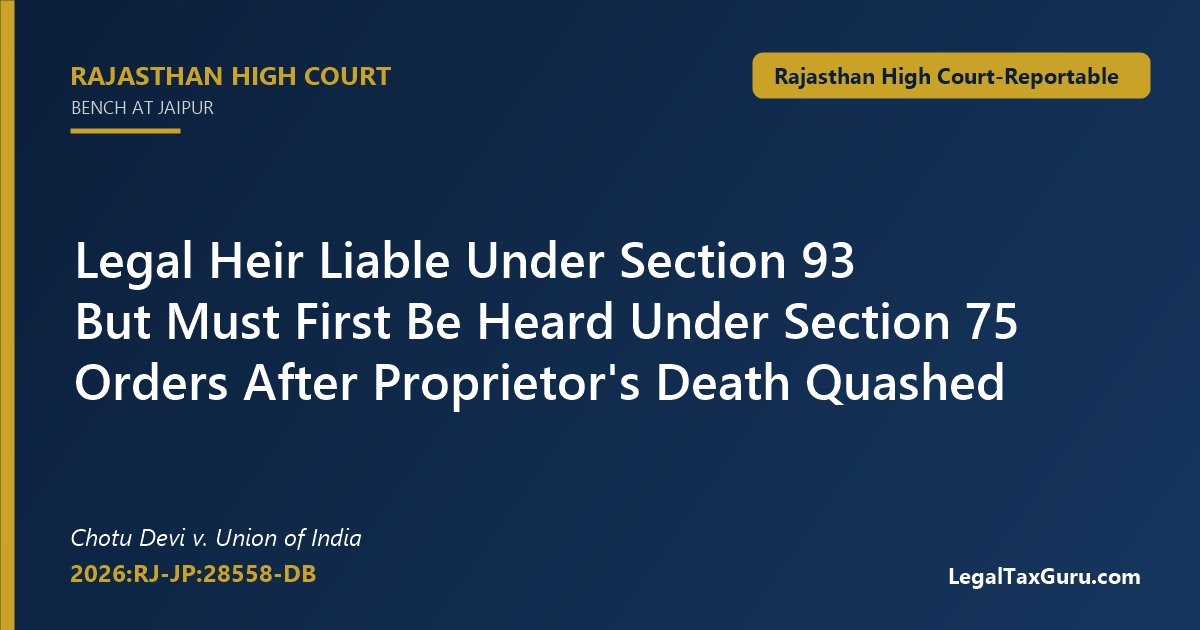
In Chotu Devi v. Union of India (2026:RJ-JP:28558-DB), the Rajasthan High Court quashed a GST order passed after the proprietor's death without notice to his legal heir (paras 9, 12). A Division Bench of Justice Arun Monga and Justice Ashutosh Kumar held that Section 93 liability is subject to the "caveat" in Section 75 (paras 5–7). The Section 74 order dated 31.12.2025 and the Order-in-Original dated 26.03.2026 were set aside, with liberty to proceed afresh after hearing the widow (para 12).
Headnote: GST Order After Proprietor's Death
CGST Act, 2017 and Rajasthan GST Act, 2017 – Sections 74, 75(4), 75(6) and 93(1)(a), (b) – Death of sole proprietor – Liability of legal representative – Notice and hearing to legal heir – Reasoned order – Natural justice – Article 226
Held: (i) A legal heir cannot claim immunity from tax liability, if any, in view of Section 93 (para 5).
(ii) Under Section 93(1)(b), where the business is discontinued on death, the legal representative is liable out of the estate (para 6).
(iii) Section 93 is subject to Section 75, which mandates a hearing and a reasoned, speaking order (para 7).
(iv) Proceedings enforced against heirs are vitiated without compliance with Section 75(4) and (6) (para 8).
(v) The heir was admittedly given no independent notice; the Section 74 order came a day after the death (para 9).
(vi) Orders quashed with liberty to issue notice to the heir and decide afresh after hearing (paras 10–12).
(paras 4–13)
Case Details: Chotu Devi v. Union of India (2026:RJ-JP:28558-DB)
Final Outcome: Writ petition allowed; Section 74 order dated 31.12.2025 and Order-in-Original dated 26.03.2026 quashed; liberty to issue notice to the petitioner and pass fresh orders after hearing (para 12).
Case: Chotu Devi (widow and legal heir of late Shri Hansa Ram Choudhary) v. Union of India & Ors.
Neutral Citation: 2026:RJ-JP:28558-DB
Case No.: D.B. Civil Writ Petition No. 11576/2026
Court: Rajasthan High Court, Bench at Jaipur (Division Bench)
Date of Decision: 24 July 2026
Bench: Justice Arun Monga (author) and Justice Ashutosh Kumar
Relevant Acts & Sections: CGST Act, 2017 and Rajasthan GST Act, 2017 – Sections 74, 75(4), 75(6), 93(1)(a) and 93(1)(b); Constitution of India – Article 226
Impugned Order: Order dated 31.12.2025 under Section 74 of the CGST/RGST Act and Order-in-Original dated 26.03.2026 under the CGST Act, against late Shri Hansa Ram Choudhary, proprietor of M/s Shri Satguru Marbles Industry (paras 1–2.1)
Counsel: Mr. Ravi Gupta for the petitioner; Ms. Mahi Yadav, AAG, with Ms. Chelsi Agarwal, Ms. Anima Chaturvedi, Sr. Standing Counsel, and Mr. C.S. Sinha for the respondents.
Source: Rajasthan High Court (official website)
Key Holdings of the Rajasthan High Court
- A legal heir cannot claim immunity from tax liability, if any, because of Section 93 (para 5).
- Where the business is discontinued on death, the legal representative pays out of the estate (para 6).
- Section 93 operates subject to the Section 75 mandate of hearing and a reasoned order (para 7).
- Proceedings to be enforced against heirs are vitiated if Section 75(4) and (6) are not complied with (para 8).
- An order passed a day after the proprietor's death, without notice to the heir, cannot stand (para 9).
- The impugned order also appeared to fall foul of Section 75(6) (para 10).
Brief Facts of the Case
Late Shri Hansa Ram Choudhary was the sole proprietor of M/s Shri Satguru Marbles Industry. He died on 30.12.2025 (paras 1, 2.1).
An order under Section 74 of the CGST/RGST Act was passed on 31.12.2025, and an Order-in-Original under the CGST Act on 26.03.2026 (para 2.1). Demands included tax of Rs. 8,22,310, Rs. 1,57,600 and Rs. 12,29,041, with interest and penalties (para 2.2).
No notice was issued to his widow, Mrs. Chotu Devi, and she was neither impleaded nor heard (para 2.3). She filed the writ petition as legal heir (paras 1, 2.4).
Issues Before the High Court
- Whether the legal heir of a deceased sole proprietor is liable for GST dues under Section 93 (paras 4–6).
- Whether orders can be enforced against the heir without notice and hearing under Section 75(4) and a reasoned order under Section 75(6) (paras 7–11).
Court's Findings and Reasoning
Petitioner's case (paras 3–3.2): A sole proprietorship has no separate legal existence and ceased to exist on the proprietor's death (para 3). The orders were void ab initio, being passed against a dead person, contrary to Sections 75(4) and 75(6) (para 3.1). No hearing was given to the heir, resulting in one-sided application of mind (para 3.2).
Revenue's case (para 4): The Additional Advocate General, appearing on advance service, relied on Section 93 (para 4). Even after an assessee's death, tax liability is recoverable from legal representatives (para 4).
No immunity under Section 93 (paras 5–6): The Court held the petitioner "cannot claim immunity from the tax liability, if any" in view of Section 93 (para 5). Section 93(1)(b) makes the legal representative liable out of the estate where the business is discontinued (para 6).
Section 75 caveat (paras 7–8): Section 93 is "subject to the caveat" in Section 75 (para 7). Any person on whom liability is proposed must be heard and given a reasoned order (para 7). Proceedings against heirs are vitiated without compliance with Section 75(4) and (6) (para 8).
Conceded facts (para 9): It was a conceded fact that the heir got no independent notice before the order (para 9). The proprietor died on 30.12.2025, and the Section 74 order was passed on 31.12.2025 (para 9).
Reasoned order (paras 10–11): The order "seems to fall foul" of Section 75(6) (para 10). The heir was entitled to be heard, and the order ought to set out facts and the basis of decision (para 11).
Application to facts (para 12): Both orders were quashed, with liberty to issue notice to the petitioner and pass fresh orders after hearing (para 12).
Final Outcome and Directions
- The writ petition was allowed (para 12).
- The Section 74 order dated 31.12.2025 and the Order-in-Original dated 26.03.2026 were quashed (para 12).
- Liberty was given to issue notice to the petitioner and pass fresh orders after a hearing (para 12).
- All pending applications, including the stay petition, were disposed of (para 13).
- The order is silent on costs.
Legal Principle Laid Down
Under Section 93 of the CGST Act, the legal representative of a deceased person is liable for tax, interest or penalty, out of the estate if the business is discontinued. That liability can be fixed only after complying with Section 75: notice and hearing to the legal representative under Section 75(4) and a reasoned order under Section 75(6). Orders passed after death without such compliance are liable to be quashed (paras 5–12).
Precedents Relied Upon
The judgment does not cite or discuss any precedent. The Court decided the case on the text of Sections 75 and 93 of the CGST Act (paras 5–8).
Important Paragraphs of the Judgment
Verbatim extracts from the judgment. For the full text, refer to the judgment PDF below.
Para 5: "Having heard the rival contention of the parties and upon perusal of the record, we are of the view that the petitioner cannot claim immunity from the tax liability, if any, in view of Section 93 of CGST Act..."
Para 7: "However, Section 93, supra, is subject to the caveat contained in Section 75 of the CGST Act, which mandates that any person upon whom tax liability is proposed to be imposed must be afforded an opportunity of personal hearing, and that any order passed pursuant thereto must be a reasoned and speaking order."
Para 9: "The conceded fact in the instant case is that the petitioner, being the legal heir, was not issued any independent notice prior to the passing of the Assessment Order. The husband of the petitioner died on 30.12.2025, and the order under Section 74 was passed on 31.12.2025 and Order-in-Original was passed thereafter, on 26.03.2026."
Para 12: "Accordingly, the writ petition is allowed, order under Section 74 dated 31.12.2025 and Order-in-Original dated 26.03.2026 are quashed and set aside, with liberty to the respondents to issue a notice to the petitioner and proceed to pass fresh orders after affording an opportunity of hearing, in accordance with law."
Practical Impact of the Ruling
- For families of deceased proprietors: Section 93 liability exists, but the department must first notice and hear the legal heir (paras 5–9).
- For proper officers: On learning of a proprietor's death, issue a fresh notice to the legal representative before any order (paras 7–9, 12).
- For practitioners: Argue Section 75(4) and (6) rather than claiming the proprietorship's extinction wipes out liability (paras 3, 5–8).
- For estates: Under Section 93(1)(b), liability is limited to what the estate can meet where the business is discontinued (para 6).
FAQs on GST Order After Proprietor's Death
1. What did the Rajasthan High Court hold in Chotu Devi v. Union of India?
It held that a legal heir is liable under Section 93 but must be heard under Section 75 first. Orders passed after the proprietor's death without notice to the heir were quashed (paras 5–7, 12).
2. Is a legal heir liable for GST dues of a deceased proprietor?
Yes. Under Section 93(1)(b), where the business is discontinued, the legal representative is liable out of the estate, to the extent the estate can meet the charge (paras 5–6).
3. Must the legal heir be given a hearing?
Yes. Section 93 is subject to Section 75, which requires a personal hearing and a reasoned, speaking order (paras 7–8, 11).
4. What was wrong with the orders in this case?
The Section 74 order came a day after the death, and the heir received no independent notice. The order also appeared to fall foul of Section 75(6) (paras 9–10).
5. Can the department issue a fresh order?
Yes. Liberty was given to issue notice to the widow and pass fresh orders after a hearing (para 12).
Keywords: GST order after proprietor's death, Chotu Devi v. Union of India, 2026:RJ-JP:28558-DB, D.B. Civil Writ Petition No. 11576/2026, Section 93 CGST Act, legal representative GST liability, Section 75(4) hearing, Section 75(6) reasoned order, Section 74 order, deceased assessee, sole proprietorship, GST litigation lawyer, Rajasthan High Court, Justice Arun Monga
Related on LegalTaxGuru
- More High Court judgments on GST and indirect tax
- GST articles and updates
- Unsigned GST Show Cause Notice and Order Are Non Est – Mayur Timber v. State of Rajasthan
Download Judgment PDF – Chotu Devi v. Union of India
Judgment PDF: 2026:RJ-JP:28558-DB – Chotu Devi v. Union of India & Ors. (D.B. Civil Writ Petition No. 11576/2026) – Download Judgment PDF
Source: Rajasthan High Court (official website).
Read more: Rajasthan High Court · GST · Liability on Death · Indirect Tax