Quick Answer: An unsigned GST show cause notice, and the Section 74 order founded on it, are no notice and no order in law, because Rule 26(3) of the CGST Rules makes authentication by signature mandatory and a reference number is not authentication. The Rajasthan High Court set aside the notice, the order and the DRC-13 bank recovery, with liberty to issue a duly authenticated notice and decide afresh after hearing.
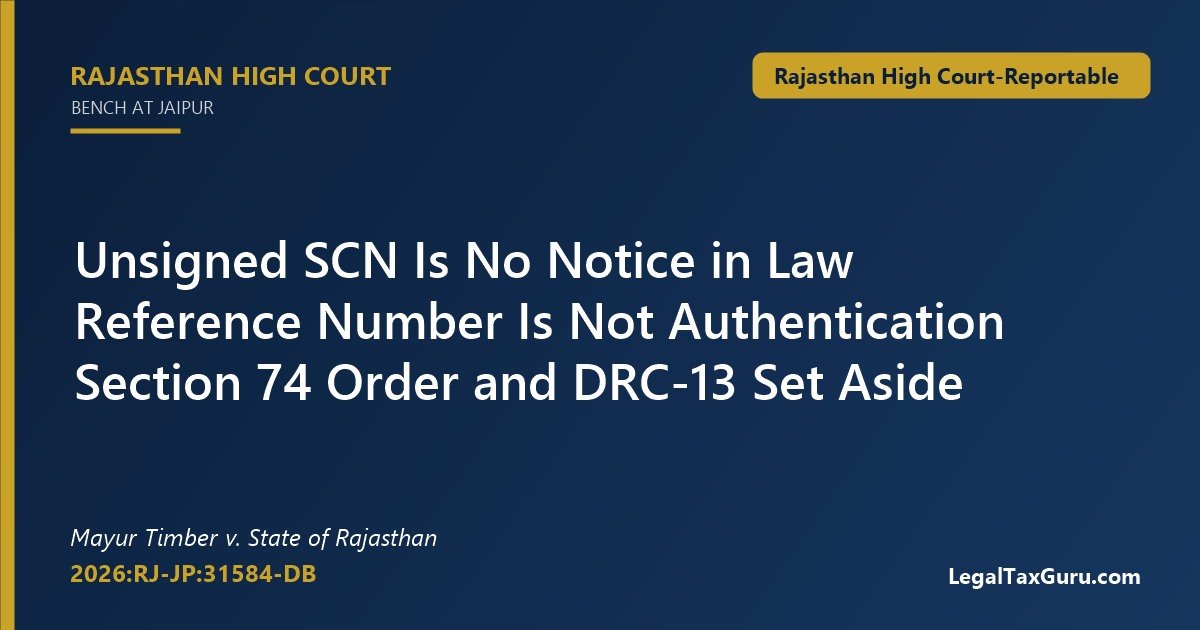
In M/s Mayur Timber v. State of Rajasthan & Ors. (2026:RJ-JP:31584-DB), the Rajasthan High Court held that an unsigned GST show cause notice, and the order founded on it, have no existence in law under Rule 26(3) of the CGST Rules, 2017 (paras 9–11). A Division Bench of Justice Arun Monga and Justice Ashutosh Kumar rejected the argument that a system reference number authenticates the document (para 10). The show cause notice dated 13.06.2024, the Section 74 order dated 15.10.2024 and the DRC-13 recovery notice dated 20.08.2025 were set aside (para 13).
Headnote: Unsigned GST Show Cause Notice
CGST Act, 2017 – Sections 74, 75(4), 75(7), 79(1)(c), 107 and 169(1)(d) – CGST Rules, 2017 – Rule 26(3) – Unsigned show cause notice and order – Digital signature – Reference number – Service on "Additional Notices and Orders" tab – Personal hearing – Alternative remedy – Article 226
Held: (i) Rule 26(3) is mandatory; electronic issuance and authentication by signature are two distinct and cumulative requirements (para 9).
(ii) The signature authenticates the document, fixes accountability and evidences application of mind (para 9.2).
(iii) A system reference number merely tracks a document; "Tracking is not authentication" (para 10).
(iv) An unsigned show cause notice and order are no notice and no order in law; the defect is not curable (para 11).
(v) Upload only under "Additional Notices and Orders", without other service, led to non-hearing in breach of Section 75(4) (para 12).
(vi) Alternative remedy is no bar where natural justice is violated; SCN, order and DRC-13 set aside with liberty to proceed afresh (paras 12–13).
(paras 6–14)
Case Details: Mayur Timber v. State of Rajasthan (2026:RJ-JP:31584-DB)
Final Outcome: Writ petition disposed of; show cause notice dated 13.06.2024, order dated 15.10.2024 and FORM GST DRC-13 dated 20.08.2025 set aside; liberty to issue a duly authenticated notice and decide afresh after hearing (paras 13–14).
Case: M/s Mayur Timber, through its Proprietor Mr. Manoj Kumar Agarwal v. State of Rajasthan & Ors.
Neutral Citation: 2026:RJ-JP:31584-DB
Case No.: D.B. Civil Writ Petition No. 14232/2025
Court: Rajasthan High Court, Bench at Jaipur (Division Bench)
Date of Decision: 11 August 2026
Bench: Justice Arun Monga (author) and Justice Ashutosh Kumar
Relevant Acts & Sections: CGST Act, 2017 – Sections 74, 75(4), 75(7), 79(1)(c), 107 and 169(1)(d); CGST Rules, 2017 – Rule 26(3); Rajasthan GST Act, 2017; Information Technology Act, 2000; FORM GST DRC-01, DRC-07 and DRC-13; Constitution of India – Article 226
Impugned Order: Show cause notice dated 13.06.2024 with FORM GST DRC-01; order dated 15.10.2024 under Section 74 with FORM GST DRC-07 by the Deputy Commissioner, State Tax, Circle-B, Zone-IV, Jaipur; FORM GST DRC-13 dated 20.08.2025 (paras 1–2.2)
Counsel: Mr. Ravi Gupta and Mr. Harsh Lodha for the petitioner; Ms. Mahi Yadav, AAG, Mr. Manish Acharya for Mr. Pawan Pareek, and Mr. Raj Kumar Yadav for the respondents.
Source: Rajasthan High Court (official website)
Key Holdings of the Rajasthan High Court
- Rule 26(3) uses "shall" and admits of no exception; every notice and order must be issued electronically and authenticated (para 9).
- Mere electronic generation on the portal satisfies only the first requirement, not authentication (para 9).
- In a paperless regime, the digital signature does the work the physical signature did on paper (para 9.1).
- A reference number or document identification number only tracks and catalogues; it does not show authentication by the proper officer (para 10).
- Unsigned documents are "still born"; all consequential proceedings share their fate (para 11).
- Upload only under "Additional Notices and Orders", without other service, led to denial of hearing under Section 75(4) (para 12).
- The alternative remedy of appeal was no bar given the violation of natural justice (para 12).
Brief Facts of the Case
The petitioner is a proprietorship in Jaipur dealing in timber, acting through its proprietor (cause title). It was alleged to have availed input tax credit of Rs. 3,13,894 without actual receipt of goods (para 2).
An allegedly unsigned FORM GST DRC-01, with the show cause notice dated 13.06.2024, was issued on the GST portal (para 2). On 15.10.2024, an order under Section 74 with DRC-07 confirmed tax of Rs. 3,13,894, interest of Rs. 4,26,002 and an equal penalty (para 2).
The order was uploaded under "Additional Notices and Orders", not "Notices and Orders". It was not served manually, and no personal hearing was given (para 2.1).
On 20.08.2025, FORM GST DRC-13 under Section 79(1)(c) directed Kotak Mahindra Bank to recover Rs. 9,00,820 (para 2.2). The petitioner learnt of the demand from its banker on 21.08.2025 and then found the order on the portal (para 2.2). The account was released after an affidavit dated 22.08.2025, and the writ followed (para 2.3).
Issues Before the High Court
The issues arising for decision were (para 6):
- Whether a show cause notice and adjudication order bearing neither a digital nor a physical signature can be sustained in law (para 6).
- Whether a system-generated reference number satisfies the authentication requirement of Rule 26(3) (paras 4, 10).
- Whether the writ petition should be entertained despite the appeal remedy under Section 107 (paras 4, 12).
Court's Findings and Reasoning
Petitioner's case (paras 3–3.3): The SCN and order were uploaded under "Additional Notices and Orders" and never otherwise served (para 3). The SCN was unsigned, so the order founded on it could not stand; the order also went beyond the SCN on interest and penalty, contrary to Section 75(7) (para 3.1). No hearing was given under Section 75(4), and the ITC allegation was vague (paras 3.2–3.3).
Revenue's case (para 4): The Additional Advocate General said upload on the portal is valid service under Section 169(1)(d), and a registered taxpayer must stay vigilant (para 4). Each document bore a system-generated reference number, so authenticity could not be doubted for want of a visible signature (para 4). The appeal under Section 107 was an efficacious alternative remedy (para 4).
Documents unsigned (para 7): On a bare look, the SCN, the reminder and the order were neither digitally nor physically signed (para 7). Each carried a reference number, but a signature "in any form" was "conspicuously absent" (para 7).
Rule 26(3) mandatory (paras 8–9): The rule requires issuance electronically through a digital signature certificate, E-signature or a Board-notified mode (para 8). It is couched in mandatory language and admits of no exception (para 9). Issuance and authentication are "two distinct and cumulative requirements" (para 9).
Purpose of the signature (paras 9.1–9.2): The rule-making authority substituted the pen with the digital signature but did not dispense with authentication (para 9.1). The signature authenticates the document, fixes accountability and guards against arbitrariness by evidencing application of mind (para 9.2).
Reference number no substitute (para 10): A reference number merely tracks and catalogues the document and shows when it was created (para 10). It does not show that the proper officer authenticated it (para 10).
Consequence (para 11): An unsigned SCN and order are "no notice and no order in the eyes of law" (para 11). The defect goes to the root and strikes at the authority to proceed (para 11).
Service and hearing (para 12): The unsigned documents were uploaded only under "Additional Notices and Orders", and the petitioner learnt of the demand through its banker (para 12). This led to a miscommunication about the hearing date, so the petitioner was not heard, contrary to Section 75(4) (para 12).
Application to facts (paras 12–13): Where natural justice is violated, an alternative remedy is no bar to writ jurisdiction (para 12). The SCN, the order and the DRC-13 were therefore set aside (para 13).
Final Outcome and Directions
- The show cause notice dated 13.06.2024 was set aside (para 13).
- The consequential order dated 15.10.2024 and the FORM GST DRC-13 dated 20.08.2025 were also set aside (para 13).
- Liberty was reserved to issue a duly authenticated show cause notice and pass a fresh order after an effective hearing (para 13).
- Nothing in the order is an opinion on the merits of the demand; all merits issues are left open (para 13).
- The writ petition was disposed of, with no order as to costs (para 14).
Legal Principle Laid Down
Under Rule 26(3) of the CGST Rules, 2017, a GST notice or order must be both issued electronically and authenticated by digital signature, E-signature or a Board-notified mode. A system reference number does not satisfy authentication. An unsigned show cause notice and order are non est, and all consequential proceedings, including recovery, fall with them. Where natural justice is also breached, the alternative remedy does not bar writ relief (paras 9–13).
Precedents Relied Upon
The judgment does not cite or discuss any precedent by name. The Court decided the case on the text and purpose of Rule 26(3) and on the settled principle that an alternative remedy is no bar where natural justice is violated (paras 8–12).
Important Paragraphs of the Judgment
Verbatim extracts from the judgment. For the full text, refer to the judgment PDF below.
Para 9: "A plain reading of Rule 26(3) shows that it is couched in mandatory language. The rule employs the word "shall". It admits of no exception. Every notice, certificate and order issued under the Chapter must be issued electronically."
Para 9.1: "The requirement of signature, therefore, is not an empty formality or a procedural nicety. It is the very mode by which an electronic document acquires legal existence and binding character."
Para 10: "It does not show that the proper officer authenticated it. Tracking is not authentication. The one cannot substitute the other. Rule 26(3) demands authentication by signature. That demand is not answered by pointing to a reference number."
Para 11: "A show cause notice and an order which are neither digitally signed nor physically signed are no notice and no order in the eyes of law. The defect is not a mere curable irregularity. It goes to the root of the matter and strikes at the very authority to proceed."
Para 12: "It is well settled that the existence of an alternative remedy is no bar to the exercise of writ jurisdiction where the principles of natural justice stand violated."
Practical Impact of the Ruling
- For taxpayers: Check every SCN, reminder and order for a digital or physical signature; an unsigned one can be challenged as non est (paras 7, 11).
- For proper officers: A portal reference number is not enough; each notice and order must be signed or E-signed under Rule 26(3) (paras 9–10).
- For bank recovery: A DRC-13 founded on an unsigned order falls with it (paras 11, 13).
- For practitioners: Pair the signature point with service and Section 75(4) hearing defects to overcome the alternative-remedy objection (para 12).
- For the department: The demand is not extinguished; a fresh, authenticated notice and hearing remain open (para 13).
FAQs on Unsigned GST Show Cause Notice
1. What did the Rajasthan High Court hold in Mayur Timber v. State of Rajasthan?
It held that a GST show cause notice and order bearing neither a digital nor a physical signature are no notice and no order in law. The Section 74 order and the DRC-13 recovery notice were set aside (paras 11, 13).
2. Is a digital signature mandatory on GST notices and orders?
Yes. Rule 26(3) uses "shall" and requires authentication by digital signature, E-signature or a Board-notified mode. Electronic generation alone is not enough (para 9).
3. Does a reference number on the GST portal authenticate a notice?
No. A reference number only tracks and catalogues the document. The Court said "Tracking is not authentication" (para 10).
4. Can a writ be filed despite the appeal remedy under Section 107?
Yes, in this case. The Court held that an alternative remedy is no bar where natural justice is violated, as with the denial of hearing under Section 75(4) (para 12).
5. Can the department issue a fresh notice after this judgment?
Yes. Liberty was reserved to issue a duly authenticated show cause notice and pass a fresh order after an effective hearing. The merits were left open (para 13).
Keywords: unsigned GST show cause notice, Mayur Timber v. State of Rajasthan, 2026:RJ-JP:31584-DB, D.B. Civil Writ Petition No. 14232/2025, Rule 26(3) CGST Rules, digital signature GST order, Section 74 CGST Act, Section 75(4) personal hearing, FORM GST DRC-13, Section 79 recovery, Additional Notices and Orders, GST litigation lawyer, Rajasthan High Court, Justice Arun Monga
Related on LegalTaxGuru
- More High Court judgments on GST and indirect tax
- GST articles and updates
- Unsigned GST Show Cause Notice and Order Are Non Est – Star Raison Landmarks v. Chief Commissioner, State Tax
Download Judgment PDF – Mayur Timber v. State of Rajasthan
Judgment PDF: 2026:RJ-JP:31584-DB – M/s Mayur Timber v. State of Rajasthan & Ors. (D.B. Civil Writ Petition No. 14232/2025) – The judgment PDF will be uploaded here shortly.
Source: Rajasthan High Court (official website).
Read more: Rajasthan High Court · GST · GST Adjudication · Indirect Tax