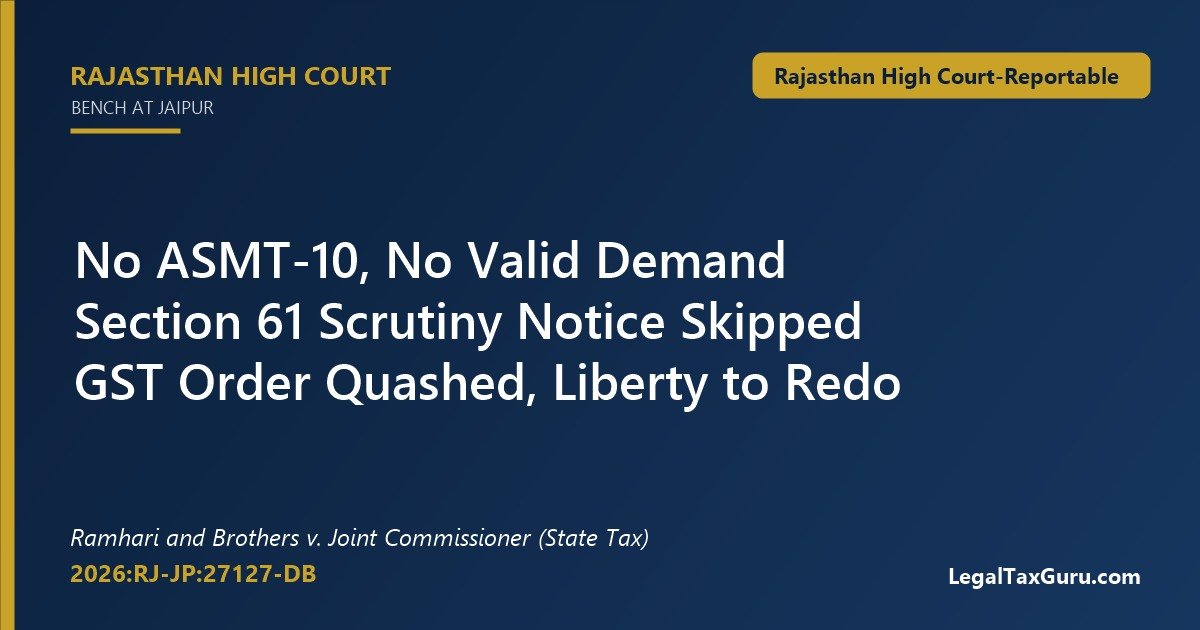
Quick Answer: Where ASMT-10 is not issued before a scrutiny-based GST demand, the order cannot stand, because Section 61 read with Rule 99 requires the proper officer to first seek the assessee's explanation. On the department's candid admission that no ASMT-10 was issued, the Rajasthan High Court quashed the order dated 22.02.2025 with liberty to proceed afresh.
In M/s Ramhari and Brothers v. Joint Commissioner (State Tax) & Ors. (2026:RJ-JP:27127-DB), the Rajasthan High Court quashed a GST demand because the ASMT-10 notice was not issued before adjudication (paras 6, 9). A Division Bench of Justice Arun Monga and Justice Maneesh Sharma held that the ASMT-10 notice aims to avoid litigation and let the assessee explain discrepancies (para 6). Acting on the respondents' "candid admission", the Court set aside the order dated 22.02.2025 with liberty to proceed afresh (para 9).
Headnote: ASMT-10 Not Issued
CGST Act, 2017 and Rajasthan GST Act, 2017 – Sections 61, 73, 75(4), 75(6), 78 and 169 – CGST/RGST Rules, 2017 – Rule 99 – Form GST ASMT-10, ASMT-11 and ASMT-12 – Scrutiny of returns – Turnover difference between audited accounts and GSTR-9C – Service on "Additional Notices and Orders" tab – Bank recovery
Held: (i) Section 61 read with Rule 99 requires the proper officer to issue Form GST ASMT-10 on any discrepancy found in scrutiny (para 6).
(ii) The ASMT-10 notice has a twofold object: to avoid unnecessary litigation and to let the assessee explain the discrepancy (para 6).
(iii) Where the explanation is accepted, no further proceedings are warranted (para 7).
(iv) The respondents' reply admitted the averment that no ASMT-10 was issued or served (para 8).
(v) On that "candid admission", the order dated 22.02.2025 could not survive (para 9).
(vi) Writ allowed with liberty to proceed afresh in accordance with law (para 9).
(paras 5–10)
Case Details: Ramhari and Brothers v. Joint Commissioner (State Tax) (2026:RJ-JP:27127-DB)
Final Outcome: Writ petition allowed; order dated 22.02.2025 quashed; liberty to the respondents to proceed afresh in accordance with law (para 9).
Case: M/s Ramhari and Brothers, through its Authorised Signatory v. Joint Commissioner (State Tax) & Ors.
Neutral Citation: 2026:RJ-JP:27127-DB
Case No.: D.B. Civil Writ Petition No. 20189/2025
Court: Rajasthan High Court, Bench at Jaipur (Division Bench)
Date of Decision: 16 July 2026
Bench: Justice Arun Monga (author) and Justice Maneesh Sharma
Relevant Acts & Sections: Rajasthan GST Act, 2017 and CGST Act, 2017 – Sections 17(5), 61, 73, 75(4), 75(6), 78 and 169; CGST/RGST Rules, 2017 – Rule 99; Forms GST ASMT-10, ASMT-11, ASMT-12 and GSTR-9C; Constitution of India – Articles 14, 19(1)(g), 21, 265 and 300A
Impugned Order: Order dated 22.02.2025 of the Deputy Commissioner, State Tax, Circle-Karauli, Bharatpur, confirming a demand of Rs. 2,15,468 for FY 2020-21 (paras 1, 2.1–2.2)
Counsel: Mr. Mihir Jhanwar and Mr. Pulkit Arora for the petitioner; Ms. Mahi Yadav, AAG, with Ms. Chelsi Agarwal and Mr. Kamal Parswal for the respondents.
Source: Rajasthan High Court (official website)
Key Holdings of the Rajasthan High Court
- Rule 99 obliges the proper officer, on finding a discrepancy, to issue Form GST ASMT-10 seeking an explanation (para 6).
- The ASMT-10 notice serves to avoid unnecessary litigation and to give the assessee a chance to explain (para 6).
- If the explanation is acceptable, no further proceedings are warranted (para 7).
- The respondents' reply "admitted as stated" the petitioner's averment that no ASMT-10 was issued (para 8).
- That "candid admission" left the Court "with no option" but to quash the order (para 9).
- The department was given liberty to proceed afresh in accordance with law (para 9).
Brief Facts of the Case
The petitioner is a sole proprietorship trading in oil at Hindaun City, Karauli, registered under the RGST Act (para 2). On 16.10.2025, its banker, Bank of Baroda, debited Rs. 1,56,177 on the basis of a challan from the GST department (para 2).
The petitioner found nothing under "Notices and Orders" on the portal. On its consultant's advice, it found the show cause notice and order under "Additional Notices and Orders" (para 2.1). It claimed it received no email or SMS of either (para 2.1).
The order confirmed GST of Rs. 1,02,878, interest of Rs. 92,590 and penalty of Rs. 20,000 (para 2.1). The demand was on the difference between turnover in audited accounts and GSTR-9C for FY 2020-21, with ITC reversal proposed under Section 17(5) (para 2.2).
The order recorded that Section 61 scrutiny was undertaken and a hearing given. The petitioner said no ASMT-10 was issued and no hearing took place (para 2.2).
Issues Before the High Court
The issues arising for decision were (paras 5–9):
- Whether a demand following scrutiny of returns can stand when Form GST ASMT-10 under Section 61 and Rule 99 was not issued (paras 6–9).
- What is the purpose of the ASMT-10 notice in the scheme of the Act and Rules (paras 6–7).
- Whether the alternative remedy bars relief where the department admits non-issuance of ASMT-10 (paras 4, 9).
Court's Findings and Reasoning
Petitioner's case (paras 3–3.4): Neither the notice nor the order was served under Section 169, as no SMS or email was sent (para 3.1). The order was non-speaking under Section 75(6), and no hearing was given under Section 75(4) (para 3.2). Recovery under Section 78 was premature, and no ASMT-10 under Section 61 and Rule 99 preceded the Section 73 proceedings (para 3.3).
Revenue's case (para 4): The respondents argued that the petition was filed without availing the alternative statutory remedy (para 4). They also said a hearing had been given before the order was passed (para 4).
Scheme of Section 61 and Rule 99 (para 6): The Court reproduced both provisions. Rule 99 requires the proper officer to issue ASMT-10 on any discrepancy, seeking an explanation within 30 days (para 6).
Twofold purpose (paras 6–7): The ASMT-10 notice is intended "to avoid unnecessary litigation" and "to afford the assessee an opportunity to explain any discrepancy" (para 6). Where the explanation is accepted, no further proceedings are warranted (para 7).
Department's admission (para 8): Paragraph 17 of the petition stated that no ASMT-10 was ever issued or served (para 8). The respondents' reply stated that paras 2 to 20 were "admitted as stated" (para 8).
Application to facts (para 9): This "candid admission" that no notice was issued left the Court with "no option" but to quash the order (para 9). As the ASMT-10 notice dated 12.11.2024 was admittedly not issued, the petition was allowed (para 9).
Other grounds (paras 3–3.4, 9): The Court did not decide the separate arguments on service under Section 169, Section 75(6) or Section 78 recovery (para 9).
Final Outcome and Directions
- The order dated 22.02.2025 was quashed (para 9).
- The writ petition was allowed with liberty to the respondents to proceed afresh in accordance with law (para 9).
- All pending applications were disposed of (para 10).
- The order is silent on costs and on refund of the Rs. 1,56,177 debited from the bank account.
Legal Principle Laid Down
Where a GST demand arises from scrutiny of returns, Section 61 read with Rule 99 requires the proper officer to first issue Form GST ASMT-10 and seek an explanation. The notice avoids unnecessary litigation and gives the assessee a chance to explain. Where the department admits that no ASMT-10 was issued, the resulting order cannot stand, though fresh proceedings are open (paras 6–9).
Precedents Relied Upon
The judgment does not cite or discuss any precedent. The Court decided the case on the text of Section 61 and Rule 99 and on the respondents' admission in their reply (paras 6–9).
Important Paragraphs of the Judgment
Verbatim extracts from the judgment. For the full text, refer to the judgment PDF below.
Para 5: "Having heard the rival contentions and perused the case file, we are unable to accept the stand taken in the respondents' counter-affidavit or the arguments advanced on the same lines."
Para 6: "A cumulative reading of the two provisions, ibid, leaves no manner of doubt that the legislative intent behind the notice in Form GST ASMT-10 is twofold i.e. to avoid unnecessary litigation, and to afford the assessee an opportunity to explain any discrepancy noticed in the return filed by him."
Para 7: "Needless to say, where such an opportunity is granted and the explanation is found acceptable by the competent authority, no further proceedings are warranted."
Para 9: "The aforesaid candid admission by the respondents that no notice was issued leaves us with no option but to quash the impugned order dated 22.02.2025."
Practical Impact of the Ruling
- For taxpayers facing scrutiny demands: Check whether Form GST ASMT-10 was issued before the Section 73 notice; its absence can defeat the order (paras 6, 9).
- For GSTR-9C mismatch cases: Demands on turnover differences must follow the Section 61 and Rule 99 route where scrutiny is the basis (paras 2.2, 6).
- For the department: Replies to writ petitions must be drafted carefully; a blanket admission can decide the case (paras 8–9).
- For practitioners: Specific averments of non-service, if not specifically denied, can be treated as admitted (para 8).
- For recovery disputes: The ruling quashes the order but leaves the department free to start afresh (para 9).
FAQs on ASMT-10 Not Issued
1. What did the Rajasthan High Court hold in Ramhari and Brothers v. Joint Commissioner (State Tax)?
It quashed a GST demand of Rs. 2,15,468 because Form GST ASMT-10 under Section 61 and Rule 99 was admittedly not issued. Liberty was given to proceed afresh (para 9).
2. What is the purpose of Form GST ASMT-10?
The Court held its purpose is twofold: to avoid unnecessary litigation and to give the assessee a chance to explain discrepancies in the return (para 6).
3. What happens if the explanation to ASMT-10 is accepted?
No further proceedings are warranted. Rule 99(3) requires the officer to inform the assessee in Form GST ASMT-12 (paras 6–7).
4. How did the department's reply affect the outcome?
The reply "admitted as stated" the averment that no ASMT-10 was issued. The Court treated this as a candid admission and quashed the order (paras 8–9).
5. Can the department issue a fresh demand?
Yes. The writ was allowed with liberty to the respondents to proceed afresh in accordance with law (para 9).
Keywords: ASMT-10 not issued, Ramhari and Brothers v. Joint Commissioner State Tax, 2026:RJ-JP:27127-DB, D.B. Civil Writ Petition No. 20189/2025, Section 61 CGST Act, Rule 99 CGST Rules, scrutiny of returns, GSTR-9C turnover difference, Section 73 demand, Additional Notices and Orders, GST litigation lawyer, Rajasthan High Court, Justice Arun Monga
Related on LegalTaxGuru
- More High Court judgments on GST and indirect tax
- GST articles and updates
- Unsigned GST Show Cause Notice and Order Are Non Est – Mayur Timber v. State of Rajasthan
Download Judgment PDF – Ramhari and Brothers v. Joint Commissioner (State Tax)
Judgment PDF: 2026:RJ-JP:27127-DB – M/s Ramhari and Brothers v. Joint Commissioner (State Tax) & Ors. (D.B. Civil Writ Petition No. 20189/2025) – The judgment PDF will be uploaded here shortly.
Source: Rajasthan High Court (official website).
Read more: Rajasthan High Court · GST · Scrutiny of Returns · Indirect Tax