Quick Answer: An advance ruling reverse charge recipient is a competent "applicant" under Section 95 of the CGST Act, because it must register under Section 24 and is deemed the supplier under Section 9(3). The Rajasthan High Court quashed the AAR's rejection and remitted the application for a ruling on merits.
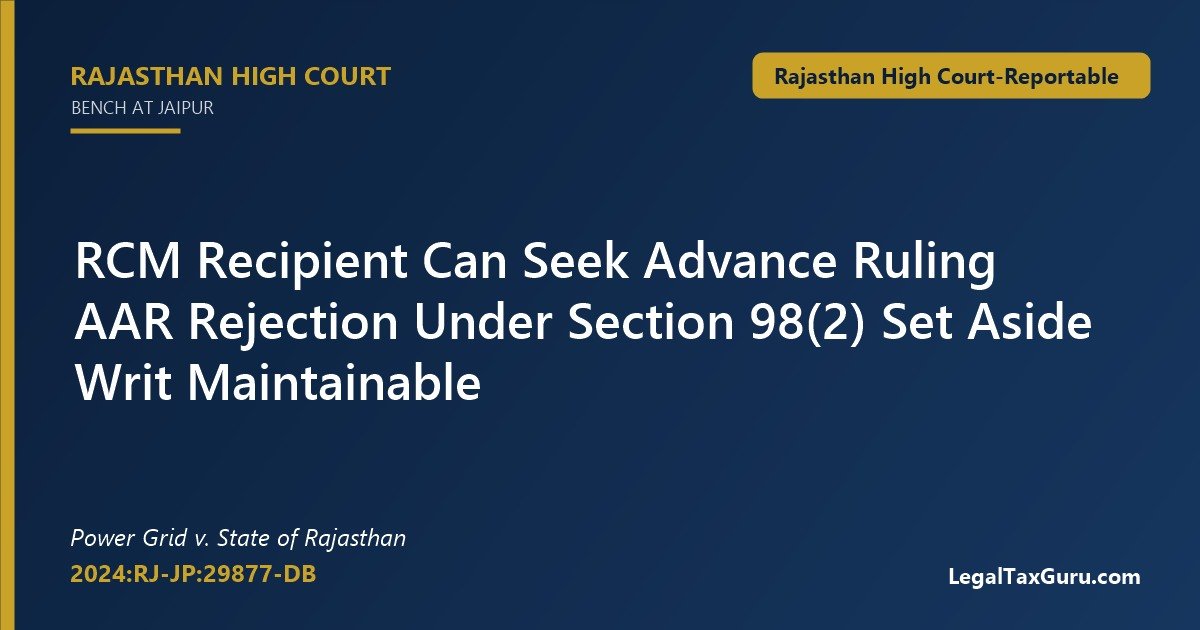
In M/s Power Grid Corporation of India Ltd. v. State of Rajasthan & Ors. (2024:RJ-JP:29877-DB), the Rajasthan High Court held that a recipient liable to pay tax on reverse charge can seek advance ruling (paras 13–14, 17). A Division Bench of Avneesh Jhingan, J and Ashutosh Kumar, J set aside the AAR's order dated 31.05.2021 and allowed the writ petition (paras 19–20). Since no appeal lies against a Section 98(2) rejection, the writ was maintainable and the AAR must now decide under Section 98(4) (paras 18–19).
Headnote: Advance Ruling Reverse Charge Recipient
CGST Act, 2017 – Sections 2(98), 2(105), 2(107), 9(3), 22, 24, 95, 97, 98(2), 98(4), 100 – Advance ruling – Recipient liable under reverse charge – "Applicant" – "Unless the context otherwise requires" – Alternative remedy
Held: (i) A recipient liable to pay tax on reverse charge basis is compulsorily registrable under Section 24 and therefore falls within "applicant" in Section 95(c) (paras 12–13). (ii) The words "being undertaken or proposed to be undertaken by the applicant" in Section 95(a) do not restrict the scope of "applicant"; there is no embargo on an RCM recipient (para 14). (iii) Section 95 opens with "unless the context otherwise requires", leaving room to read definitions in context, as explained in Vanguard Fire and General Insurance (paras 15–16). (iv) The deeming fiction in Section 9(3) must be given full play to bring the RCM recipient within Chapter XVII (para 17). (v) An appeal under Section 100 lies only against a ruling under Section 98(4), not against rejection under Section 98(2), so the writ was maintainable (para 18).
(paras 12–19)
Case Details: Power Grid Corporation (2024:RJ-JP:29877-DB)
Final Outcome: Writ petition allowed; AAR order dated 31.05.2021 set aside; application remitted for fresh decision under Section 98(4) (paras 19–20)
Case: M/s Power Grid Corporation of India Ltd. v. State of Rajasthan & Ors.
Neutral Citation: 2024:RJ-JP:29877-DB
Case No.: D.B. Civil Writ Petition No. 11370/2021
Court: Rajasthan High Court, Bench at Jaipur (Division Bench)
Date of Decision: 18 July 2024
Bench: Avneesh Jhingan, J (author) and Ashutosh Kumar, J
Relevant Acts & Sections: Sections 2(98), 2(105), 2(107), 9(3), 22, 24, 95, 97(1), 97(2)(b), 98(2), 98(4), 100, Central Goods and Services Tax Act, 2017; Serial No. 18, Notification No. 12/2007 Central Tax (Rate) [sic – as written in the judgment]
Impugned Order: Order dated 31.05.2021, Rajasthan Authority for Advance Ruling, Goods and Services Tax, Jaipur (para 1)
Counsel: Mr. Narendra Singhvi with Ms. Priyamvada Joshi, for the petitioner; Mr. Kinshuk Jain with Mr. Saurabh Jain and Mr. Jai Lodha, for the respondents
Source: Rajasthan High Court (official website)
Key Holdings of the Rajasthan High Court
- A person liable to pay tax on reverse charge must register under Section 24(iii), and is therefore an "applicant" under Section 95 (paras 11, 13).
- An RCM recipient is a "taxable person" under Section 2(107), as it is liable to be registered under Section 24 (paras 10, 12).
- The closing words of Section 95(a) do not cut down the definition of "applicant" (para 14).
- The opening words "unless the context otherwise requires" in Section 95 permit a contextual reading of defined terms (paras 15–16).
- Under Section 9(3), the RCM recipient is deemed the supplier for payment of tax, and that fiction must be given full play (para 17).
- No appeal lies under Section 100 against a rejection under Section 98(2) (para 18).
- An AAR order rejecting an RCM recipient's application at the threshold is liable to be set aside and remitted (para 19).
Brief Facts of the Case
The petitioner, M/s Power Grid Corporation of India Ltd., is registered under the GST law and engaged in transmission of electricity. In the course of business, it engages contractors (para 2).
During execution of contracts, material is supplied ex-works. The contractor transports the goods and raises an invoice for transportation (para 2).
The petitioner sought an advance ruling on whether such transportation of goods is exempt under Serial No. 18 of Notification No. 12/2007 Central Tax (Rate) [sic] (para 2).
By order dated 31.05.2021, the Rajasthan Authority for Advance Ruling held the application under Section 97 not maintainable, because the petitioner was not the supplier (paras 1–2).
The respondents were the State of Rajasthan through the Joint Secretary (Tax), Finance Department, the Union of India through the Secretary, Ministry of Finance, and the Rajasthan AAR (cause title). The petitioner sought quashing of the AAR's order, and the matter was reserved on 09.07.2024 (para 1).
Issues Before the High Court
- "Whether recipient of good or services or both liable to pay tax on reverse charge basis can seek Advance Ruling?" (para 6)
- Whether the writ was barred by an alternative appeal remedy under Section 100 (paras 4–5, 18).
Court's Findings and Reasoning
Petitioner's case (paras 3, 5): If the exemption did not apply, the petitioner would be liable to pay tax on reverse charge, the services being in a notified category (para 3). Sections 95 and 97 contain no restriction confining advance rulings to suppliers (para 3). On maintainability, an appeal lies only against an order under Section 98(4), not Section 98(2) (para 5).
Revenue's case (para 4): The respondents objected that the impugned order was appealable. On merits, they argued that only a supplier or proposed supplier can seek an advance ruling, and the petitioner was not a supplier (para 4).
Scheme of Chapter XVII (paras 7–9): Section 95 defines "advance ruling", "Appellate Authority", "applicant" and "application". Under Section 95(c), an "applicant" is any person registered or desirous of obtaining registration (para 7).
Section 97(1) allows any applicant to seek an advance ruling, and Section 97(2)(b) covers "applicability of notification issued under the provisions of this Act" (para 8). Section 98(2) requires the Authority to admit or reject the application, while Section 98(4) requires pronouncement of the ruling after hearing (para 9).
Reverse charge, supplier and taxable person (paras 10–11): Section 2(98) defines "reverse charge" as the recipient's liability to pay tax instead of the supplier (para 10). A taxable person under Section 2(107) is one registered or liable to be registered under Section 22 or 24 (para 10). Section 24(iii) makes registration compulsory for a person liable to pay tax under reverse charge (para 11).
RCM recipient is an "applicant" (paras 12–13): If not exempted, the petitioner is liable to pay tax on reverse charge, so the liability rests on it despite being the recipient. It is therefore a "taxable person" (para 12). Being compulsorily registrable under Section 24, it falls within "applicant" in Section 95 (para 13).
AAR's reading is a fallacy (para 14): The AAR had relied on the words "in relation to the supply of goods or services or both being undertaken or proposed to be undertaken by the applicant". The Court held that this interpretation "has a fallacy" (para 14). There is "no embargo" on an RCM recipient filing an advance ruling application (para 14).
Contextual reading of definitions (paras 15–16): Section 95 opens with "in this chapter, unless the context otherwise requires". This leaves "leverage" to interpret a defined word in its context (para 15).
The Court relied on Vanguard Fire and General Insurance, where the Supreme Court held that even exhaustive definitions must be read subject to their qualifying words and context (para 16).
Deeming fiction under Section 9(3) (para 17): Under Section 9(3), the Government notifies supplies on which the recipient pays tax under reverse charge. All provisions of the Act then apply to the recipient as the person liable to pay tax (para 17). The RCM recipient "is given a deeming fiction of supplier", which must be given full play in Chapter XVII (para 17).
Alternative remedy rejected (para 18): Section 100 provides an appeal against a ruling under Section 98(4), but none against rejection under Section 98(2) (para 18). The petitioner's application was "ousted at threshold" under Section 98(2). As the section is "unambiguous", the writ was maintainable (para 18).
Application to facts (para 19): The Court did not decide whether the transportation is exempt under the notification. It set aside the threshold rejection and sent the question back to the AAR (para 19).
Final Outcome and Directions
- The AAR's order dated 31.05.2021 was set aside (para 19).
- The matter was remitted to the AAR to decide the application afresh under Section 98(4) of the CGST Act (para 19).
- The writ petition was allowed (para 20).
- The exemption question under the notification remains open for the AAR (para 19).
- The judgment is silent on costs and on any time limit for the AAR's fresh decision.
Legal Principle Laid Down
A recipient liable to pay tax on reverse charge under Section 9(3) of the CGST Act is compulsorily registrable under Section 24 and is a "taxable person". It is therefore an "applicant" under Section 95(c) and may seek an advance ruling on any question within Section 97(2), including applicability of an exemption notification. As Section 100 provides an appeal only against a ruling under Section 98(4), a rejection under Section 98(2) can be challenged in writ (paras 12–18).
Precedents Relied Upon
- Vanguard Fire and General Insurance Co. Ltd., Madras v. Fraser and Ross & Anr., AIR 1960 SC 971 – Relied upon – statutory definitions, even exhaustive ones, must be read subject to the qualifying words "unless there is anything repugnant in the subject or context". Discussed at para 16.
Important Paragraphs of the Judgment
Verbatim extracts from the judgment. For the full text, refer to the judgment PDF below.
Para 6 (question framed): "Whether recipient of good or services or both liable to pay tax on reverse charge basis can seek Advance Ruling?"
Para 13 (applicant): "A registered person or a person desirous of obtaining registration under the Act falls within ambit of the 'applicant' in Section 95. It is compulsory for the petitioner to get registered, under Section 24 of CGST Act, being liable to pay tax on reverse charge basis."
Para 14 (no embargo): "The latter part of the definition in relation to supplier of goods or services or both being undertaken or proposed to be undertaken by the applicant does not restricts the scope of definition of applicant. There is no embargo that a person liable to pay tax on reverse charge basis cannot file an application for advance ruling."
Para 17 (deeming fiction): "The recipient liable to pay tax on reverse charge basis is given a deeming fiction of supplier for the purpose of payment of tax. The fiction under Section 9(3) of the CGST Act has to be given full play, by bringing the dealer liable to pay tax on reverse charge basis within the ambit of Chapter XVII for seeking Advance Ruling."
Para 18 (no appeal): "No appeal is provided against rejection of the application under Section 98(2) of the CGST Act. The application of the petitioner was ousted at threshold under Section 98(2), as not maintainable. Section is unambiguous that appeal can be filed only against the orders pronounced under Section 98(4) of the CGST Act."
Practical Impact of the Ruling
- For recipients under reverse charge: Entities paying tax under RCM, such as on goods transport, can seek advance rulings on exemption questions (paras 13–14, 17).
- For PSUs and infrastructure companies: Large recipients of contractor services can obtain certainty on exemption notifications before discharging RCM liability (paras 2–3, 12).
- For Authorities for Advance Ruling: AARs cannot reject an RCM recipient's application merely because it is not the "supplier" in the ordinary sense (paras 14, 19).
- For litigants: A threshold rejection under Section 98(2) can be taken directly to the High Court in writ, as Section 100 does not cover it (paras 18–19).
- For drafting applications: State clearly that, if the exemption does not apply, the applicant will be liable under reverse charge (paras 3, 12).
FAQs on Advance Ruling Reverse Charge Recipient
1. What did the Rajasthan High Court hold in Power Grid Corporation of India v. State of Rajasthan?
The Court held that a recipient liable to pay tax on reverse charge basis can seek an advance ruling under the CGST Act. It set aside the AAR's order dated 31.05.2021 and remitted the application for a fresh decision under Section 98(4) (paras 6, 14, 19).
2. Can an advance ruling reverse charge recipient apply under Section 97 of the CGST Act?
Yes. An RCM recipient must register under Section 24, so it is an "applicant" under Section 95, and the Section 9(3) fiction brings it within Chapter XVII (paras 13, 17).
3. Does the definition of "advance ruling" in Section 95(a) bar a recipient from applying?
No. The Court held that the words "being undertaken or proposed to be undertaken by the applicant" do not restrict the scope of "applicant", and there is no embargo on an RCM recipient (para 14).
4. Is an AAR order rejecting an application under Section 98(2) appealable?
No. An appeal under Section 100 lies only against a ruling pronounced under Section 98(4), so a Section 98(2) rejection can be challenged in a writ petition (para 18).
5. What relief did Power Grid Corporation get from the Rajasthan High Court?
The AAR's rejection was quashed, with a remand for a ruling on merits under Section 98(4). The Court did not decide whether the transportation was exempt under the notification (paras 19–20).
Keywords: 2024:RJ-JP:29877-DB, Power Grid Corporation of India v. State of Rajasthan, advance ruling reverse charge recipient, reverse charge mechanism, Section 95 CGST Act, Section 97, Section 98(2), Section 98(4), Section 100, Section 9(3), Rajasthan Authority for Advance Ruling, tax litigation lawyer, Rajasthan High Court, Justice Avneesh Jhingan
Related on LegalTaxGuru
- More High Court judgments on GST and indirect tax
- GST articles and updates
- AAAR's 90-Day Limit Under Section 101(2) Is Directory – Giri Transport v. AAAR Rajasthan
Download Judgment PDF – Power Grid Corporation of India Ltd. v. State of Rajasthan
Source: Rajasthan High Court (official website).
Read more: Rajasthan High Court · GST · Advance Ruling · Indirect Tax