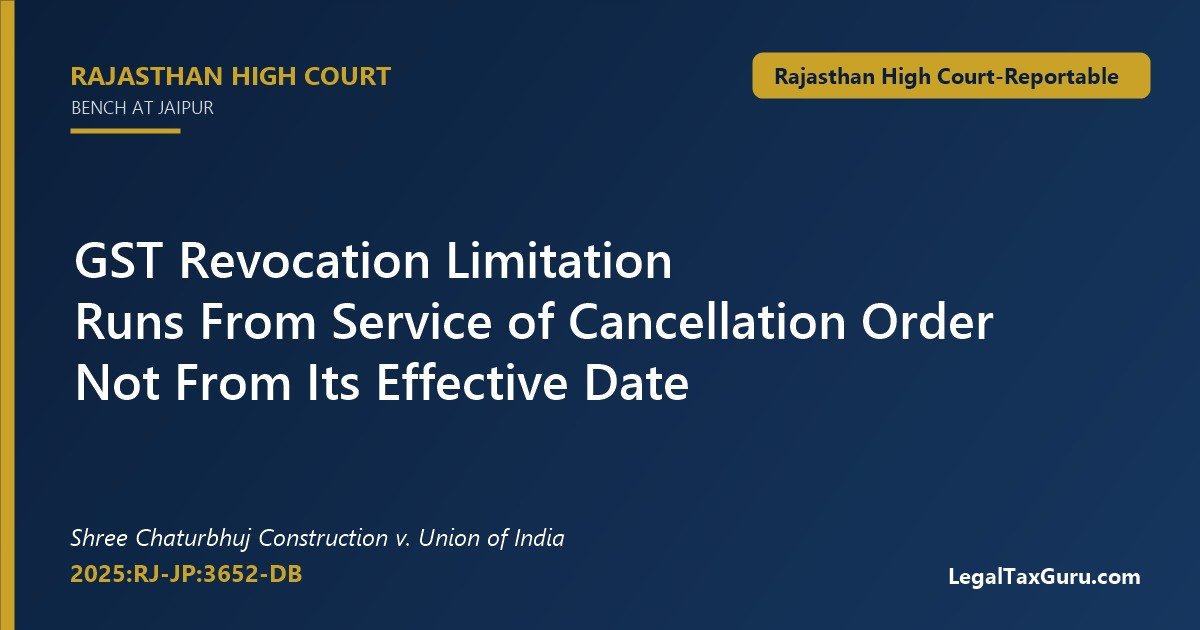
Quick Answer: GST revocation limitation under Section 30 of the CGST Act runs from the date of service of the cancellation order, not the date from which cancellation is effective. The Rajasthan High Court set aside an appellate order that counted time from the effective date and remitted the appeal for fresh decision.
In Shree Chaturbhuj Construction Buildcom v. Union of India & Ors. (2025:RJ-JP:3652-DB), the Rajasthan High Court held that the relevant date for limitation on a revocation application is the date of service of the cancellation order (para 6). A Division Bench of Avneesh Jhingan, J and Shubha Mehta, J allowed the writ petition and set aside the appellate order dated 29.01.2024 (paras 7–8). The appeal now goes back to the appellate authority for a fresh decision without the limitation bar (paras 6–7).
Headnote: GST Revocation Limitation
CGST Act, 2017 – Section 30 – Revocation of cancellation of registration – Limitation – Date of service of cancellation order versus effective date of cancellation – Non-functioning GST Appellate Tribunal – Writ jurisdiction – Remand
Held: (i) Cancellation of a GST registration affects the right of the registered person to carry on trade (para 5). (ii) As the GST Tribunal was not functioning, the petitioner was left remediless, and the writ petition was entertained despite the objection of an appellate remedy (paras 4–5). (iii) For an application for revocation of cancellation, the relevant date for computing limitation is the date of service of the cancellation order (para 6). (iv) An appellate order that computes limitation from the date on which cancellation was made effective rests on a factual error (para 6). (v) The appellate order was set aside and the appeal remitted for fresh decision (para 7).
(paras 5–8)
Case Details: Shree Chaturbhuj Construction (2025:RJ-JP:3652-DB)
Final Outcome: Writ petition allowed; appellate order dated 29.01.2024 set aside; appeal remitted to the appellate authority for fresh decision (paras 7–8)
Case: Shree Chaturbhuj Construction Buildcom v. Union of India & Ors.
Neutral Citation: 2025:RJ-JP:3652-DB
Case No.: D.B. Civil Writ Petition No. 10804/2024
Court: Rajasthan High Court, Bench at Jaipur (Division Bench)
Date of Decision: 24 January 2025
Bench: Avneesh Jhingan, J and Shubha Mehta, J
Relevant Acts & Sections: Section 30, Central Goods and Services Tax Act, 2017 (revocation of cancellation of registration); cancellation for failure to furnish returns for a continuous period of six months; appeal to the GST Appellate Tribunal [specific provisions not cited in the order]
Impugned Order: Order dated 29.01.2024 of the Appellate Authority of State Tax, Rajasthan, Jaipur-II, Commercial Taxes Department, dismissing the appeal against rejection (dated 18.10.2023) of the revocation application (paras 1–2, 7)
Counsel: Mr. Siddharth Ranka with Ms. Satwika Jha, Advocates, for the petitioner; Mr. Kartikeya Sharma, Advocate, for Mr. Sandeep Taneja, AAG, and Mr. Kapil Sharma, Advocate (through VC), with Ms. Ishika Kothari, Advocate, for the respondents
Source: Rajasthan High Court (official website)
Key Holdings of the Rajasthan High Court
- Cancellation of a GST registration affects the registered person's right to carry on trade (para 5).
- Where the GST Tribunal is not functioning, the assessee is left remediless, and a writ petition against the first appellate order can be entertained (para 5).
- The date of service of the cancellation order is the relevant date for computing limitation for a revocation application (para 6).
- Computing limitation from the date on which cancellation was made effective is a factual error (para 6).
- A revocation application filed within thirty days of service of the cancellation order cannot be treated as time-barred (para 6).
- An appellate order dismissing the appeal on such erroneous limitation must be set aside and the appeal remitted for fresh decision (paras 6–7).
Brief Facts of the Case
The petitioner, Shree Chaturbhuj Construction Buildcom, is a firm registered under the GST Acts, acting through its partner (cause title; para 2). The respondents included the Union of India, the State of Rajasthan, the CBIC, the Appellate Authority of State Tax, Jaipur-II, and the Assistant Commissioner of State Tax, Circle-D, Jaipur-II, Ward-II (cause title).
The petitioner failed to furnish GST returns for a continuous period of six months. Its registration was cancelled by order dated 31.07.2023 (para 2).
On 24.08.2023, the petitioner applied under Section 30 of the CGST Act for revocation of the cancellation order (para 2). The application was rejected on 18.10.2023, and the petitioner appealed (paras 1–2).
The appellate authority dismissed the appeal on 29.01.2024. It held that the revocation application was not filed within the stipulated time (paras 1–2).
The petitioner then sought quashing of the orders dated 31.07.2023, 18.10.2023 and 29.01.2024 (para 1). The effective date from which the cancellation operated is not stated in the order.
Issues Before the High Court
The Court did not frame issues formally. From the submissions and findings, the questions were:
- Whether the writ petition was maintainable against the first appellate order when a further appeal was provided under the GST law (paras 4–5).
- Whether, for an application for revocation of cancellation under Section 30, limitation runs from the date of service of the cancellation order or from the effective date of cancellation (para 6).
Court's Findings and Reasoning
Petitioner's case (para 3): The petitioner argued that its registration was cancelled by order dated 31.07.2023. Its revocation application was filed within thirty days of the passing of that order (para 3).
Revenue's case (para 4): The respondents submitted that the petitioner had a remedy of appeal against the first appellate order. On the facts, they stressed that the petitioner had failed to file returns for more than six months, which led to cancellation (para 4).
Writ maintainable as Tribunal non-functional (para 5): The Court noted that cancellation of registration "affects the right of petitioner to carry on trade". It then observed that the non-functioning GST Tribunal had left the petitioner "remediless", and entertained the writ (para 5).
The Court linked maintainability to both factors together: the impact on the right to trade and the absence of a working appellate forum. The respondents' alternative-remedy objection therefore failed (paras 4–5).
Undisputed dates (para 6): The Court recorded that it was "not contested" that the cancellation order was dated 31.07.2023. It was equally uncontested that the revocation application was filed within thirty days of service of that order (para 6).
Factual error in the appellate order (para 6): The Court held that the dismissal of the appeal "was based upon a factual error". The appellate authority had taken the date from which cancellation was effective to compute limitation (para 6).
Relevant date is service of the order (para 6): The Court held that "the relevant date is of service of the cancellation order". Since the application was within thirty days of service, it could not be held barred by time (para 6).
The Court treated the mistake as a factual error, not a contested question of law. The dates were admitted, so the only question was which date starts the clock (para 6).
Merits left open (paras 4, 7): The Court did not enter into the respondents' point that the petitioner had defaulted in filing returns. That question goes to the merits of revocation, which the appellate authority must now decide (paras 4, 7).
Application to facts (paras 6–7): Counted from service, the application of 24.08.2023 was within time on the admitted facts. The Court confined itself to correcting the limitation error and remitted the appeal (paras 2, 6–7).
Final Outcome and Directions
- The appellate authority's order dated 29.01.2024 was set aside (para 7).
- The matter was remitted to the appellate authority for deciding the appeal afresh (para 7).
- The writ petition was allowed (para 8).
- The orders dated 31.07.2023 (cancellation) and 18.10.2023 (rejection of revocation) were not expressly quashed; they will be examined in the remitted appeal (paras 1, 7).
- The order is silent on costs, on any time limit for the fresh decision, and on restoration of registration in the interim.
Legal Principle Laid Down
Under Section 30 of the CGST Act, 2017, the period for applying for revocation of cancellation of GST registration is computed from the date of service of the cancellation order, not from the earlier date from which cancellation is made effective. An appellate order that treats a revocation application as time-barred by counting from the effective date rests on a factual error and is liable to be set aside. Because cancellation affects the right to carry on trade and the GST Appellate Tribunal was not functioning, the High Court may entertain a writ against the first appellate order and remit the appeal for fresh decision on merits (paras 5–7).
Precedents Relied Upon
No precedent is cited or discussed in the order. The Court decided the matter on the undisputed dates and the statutory scheme of Section 30 of the CGST Act, 2017 (paras 5–7).
Important Paragraphs of the Judgment
Verbatim extracts from the judgment. For the full text, refer to the judgment PDF below.
Para 2 (facts): "The brief facts are that the petitioner-firm was registered under the GST Acts. On failure to furnish the GST returns for continuous period of six months, the registration was cancelled vide order dated 31.07.2023. The petitioner on 24.08.2023 filed an application under Section 30 of the CGST Act for revocation of order cancelling registration. The application was rejected on 18.10.2023. The appeal was dismissed holding that application of revocation was not filed within the stipulated time and hence, the present writ petition."
Para 5 (maintainability): "The cancellation of registration certificate affects the right of petitioner to carry on trade. The non-functioning of the GST Tribunal has left the petitioner remediless and hence the writ petition is entertained."
Para 6 (limitation): "It is not contested that the order of cancellation of registration certificate is dated 31.07.2023 and the application of revocation order was filed within thirty days of service of the cancellation order. The dismissal of appeal was based upon a factual error. The date from which the cancellation of registration was effective was taken for computing limitation where as the relevant date is of service of the cancellation order."
Para 7 (relief): "The impugned order of the appellate authority is set-aside and the matter is remitted back for deciding the appeal afresh."
Practical Impact of the Ruling
- For taxpayers: Compute the revocation window from the date the cancellation order is served on you, not from the retrospective effective date shown in it (para 6).
- For practitioners: Keep a record of the date of service, such as the portal communication date, to rebut any limitation objection. Plead the order date, effective date, service date and application date in the writ (paras 2, 6).
- For proper officers and appellate authorities: Using the effective date of cancellation to compute limitation is a factual error that invites quashing (para 6).
- For the department: Objections of alternative remedy may fail where the further appellate forum is not operational (para 5).
- For businesses with return defaults: The ruling removes the limitation bar only. The underlying default and conditions for revocation will still be examined on remand (paras 4, 7).
FAQs on GST Revocation Limitation
1. What did the Rajasthan High Court hold in Shree Chaturbhuj Construction Buildcom v. Union of India?
The Court held that limitation for a revocation application under Section 30 runs from the date of service of the cancellation order. It set aside the appellate order dated 29.01.2024 and remitted the appeal for fresh decision (paras 6–7).
2. When does GST revocation limitation start to run?
GST revocation limitation starts from the date of service of the cancellation order. The Court held that counting from the date on which cancellation was made effective is a factual error (para 6).
3. Was the revocation application in Shree Chaturbhuj filed in time?
Yes. It was undisputed that the cancellation order was dated 31.07.2023 and the application, filed on 24.08.2023, was within thirty days of service of that order (paras 2, 6).
4. Can a writ petition be filed against a GST appellate order when the Tribunal is not functioning?
Yes. The Court entertained the writ because cancellation affects the right to carry on trade and the non-functioning GST Tribunal left the petitioner remediless (para 5).
5. Did the Rajasthan High Court restore the GST registration?
No. The Court set aside only the appellate order and remitted the appeal for fresh decision, leaving the revocation question to the appellate authority (paras 7–8).
Keywords: 2025:RJ-JP:3652-DB, Shree Chaturbhuj Construction Buildcom v. Union of India, GST revocation limitation, Section 30 CGST Act, revocation of cancellation of registration, service of cancellation order, effective date of cancellation, GST Appellate Tribunal, writ jurisdiction, non-filing of returns, tax litigation lawyer, Rajasthan High Court, Avneesh Jhingan J
Related on LegalTaxGuru
- More High Court judgments on GST and indirect tax
- GST articles and updates
- Portal Upload Is Not Communication for GST Appeal Limitation – Manoj Spares and Service Center v. State of Rajasthan
Download Judgment PDF – Shree Chaturbhuj Construction Buildcom v. Union of India
Source: Rajasthan High Court (official website).
Read more: Rajasthan High Court · GST · GST Registration · Indirect Tax