Quick Answer: On the arrest warrant GST offence larger bench question, the Rajasthan High Court did not decide the point but referred it to a Special/Larger Bench because Co-ordinate Benches had taken conflicting views. The question is whether arrest warrants in economic offences can be converted into bailable warrants as of right under Section 70(2) CrPC and Section 72(2) BNSS.
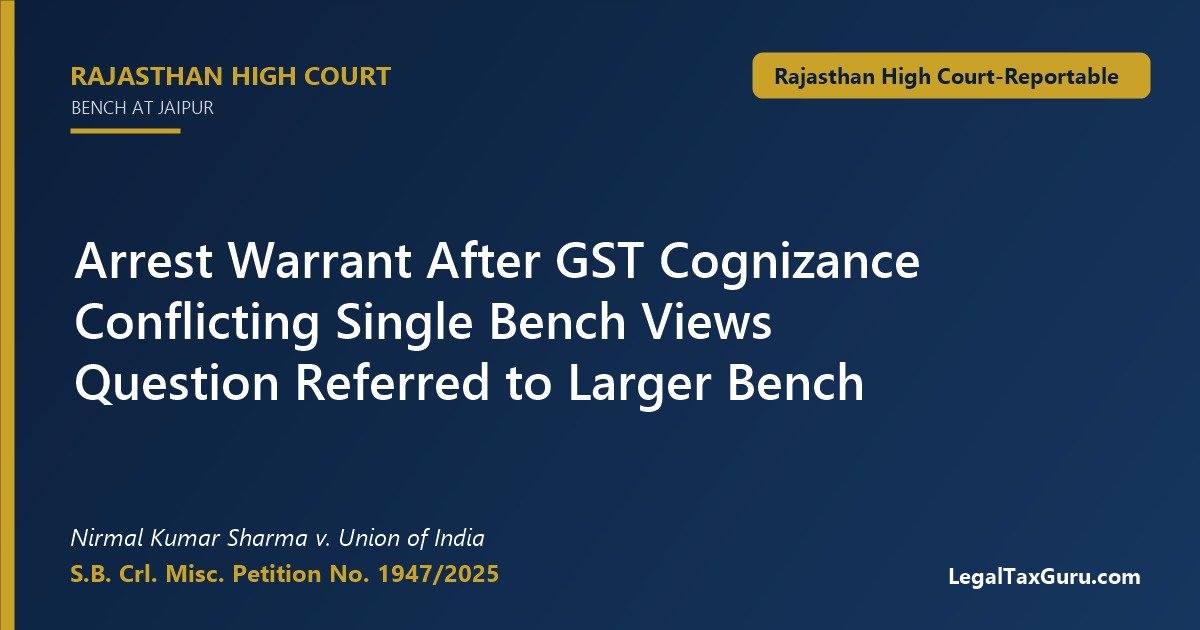
In Nirmal Kumar Sharma v. Union of India (S.B. Criminal Miscellaneous (Petition) No. 1947/2025), the Rajasthan High Court referred the arrest warrant GST offence question to a Larger Bench (paras 28–29). Justice Anoop Kumar Dhand found that Girdhar Gopal Bajoria and P.C. Purohit took conflicting views on converting arrest warrants into bailable warrants (paras 18–22). Bound by judicial discipline, the Court framed the question for a Special/Larger Bench rather than deciding it (paras 23–30).
Headnote: Arrest Warrant GST Offence Larger Bench
CGST Act, 2017 – Section 132(1)(b), (c), (l) – Customs Act, 1962 – Section 132 – Code of Criminal Procedure, 1973 – Section 70(2) – Bharatiya Nagarik Suraksha Sanhita, 2023 – Section 72(2) – Arrest warrant on cognizance – Conversion into bailable warrant – Economic offence – Conflicting Co-ordinate Bench views – Reference to Larger Bench
Held: (i) A prayer to convert arrest warrants into bailable warrants is, in effect, a prayer for anticipatory bail in the form of warrants (para 5).
(ii) There is no straight-jacket formula for bail merely because a Section 132 offence carries five years and is Magistrate-triable (para 10).
(iii) Creating fake firms to pass on fake ITC worth crores falls within grave economic offences (para 12).
(iv) Girdhar Gopal Bajoria and Shyam Sunder Singhvi upheld arrest warrants; P.C. Purohit converted them into bailable warrants (paras 18–21).
(v) A Co-ordinate Bench cannot take a contrary view; it must refer the matter to a Larger Bench (paras 23–26).
(vi) Question referred to a Special/Larger Bench; matter placed before the Chief Justice (paras 28–30).
(paras 5–30)
Case Details: Nirmal Kumar Sharma v. Union of India (S.B. Criminal Miscellaneous (Petition) No. 1947/2025)
Final Outcome: Question referred to a Special/Larger Bench; matter to be placed before the Chief Justice on the administrative side (paras 29–30). The petition itself was not decided.
Case: Nirmal Kumar Sharma s/o Ram Swroop Sharma v. Union of India, through its Superintendent (Tax Evasion Branch), CGST and Central Excise Commissionerate, Jaipur
Neutral Citation: Not available in the copy of the judgment reviewed
Case No.: S.B. Criminal Miscellaneous (Petition) No. 1947/2025
Court: Rajasthan High Court, Bench at Jaipur (Single Bench)
Date of Decision: 13 November 2025 (arguments concluded and reserved on 6 November 2025)
Bench: Justice Anoop Kumar Dhand
Relevant Acts & Sections: CGST Act, 2017 – Section 132(1)(b), (c) and (l); Customs Act, 1962 – Section 132; Code of Criminal Procedure, 1973 – Section 70(2); BNSS, 2023 – Section 72(2); Prevention of Money Laundering Act, 2002 – Sections 3, 4 and 45
Impugned Order: Order dated 11.03.2025 of the Additional Chief Judicial Magistrate (Economic Offences), Jaipur Metropolitan-II, in Criminal Case No. 15/2024, rejecting the application to convert arrest warrants into bailable warrants (para 1)
Counsel: Mr. Rahul Khandelwal for the petitioner; Mr. Amit Gupta, PP, Mr. Akshay Bhardwaj, and Mr. Banwari Lal Takhar with Mr. Prithvi Singh Deora for the respondent.
Source: Rajasthan High Court (official website)
Key Holdings of the Rajasthan High Court
- Seeking conversion of arrest warrants into bailable warrants is, in substance, seeking anticipatory bail (para 5).
- A five-year, Magistrate-triable Section 132 offence does not attract a straight-jacket bail formula (para 10).
- Passing fake ITC through non-existent firms is a grave economic offence (para 12).
- P.C. Purohit was passed without noticing the earlier Girdhar Gopal Bajoria ruling (para 11).
- Conflicting Co-ordinate Bench views made it "difficult" to follow either (para 22).
- Judicial discipline requires reference to a Larger Bench, not a contrary decision (paras 23–26).
Brief Facts of the Case
A complaint under Section 132 of the CGST Act read with Section 132 of the Customs Act was filed against the petitioner (paras 2, 5). The department alleged ITC of Rs. 10,65,23,833 was claimed (paras 3, 5).
On 11.03.2025, the Additional Chief Judicial Magistrate (Economic Offences), Jaipur Metropolitan-II, took cognizance and issued arrest warrants (paras 1–2). The petitioner's application under Section 70(2) CrPC to convert them into bailable warrants was rejected (para 1).
The petitioner said he was not arrested during investigation, was willing to appear, and the evasion alleged was only Rs. 6 lakh (para 2). He relied on P.C. Purohit v. Union of India (para 2).
Issues Before the High Court
The issues arising for decision were (paras 5, 22, 29):
- Whether arrest warrants issued on cognizance in a GST economic offence can be converted into bailable warrants as of right (paras 2, 29).
- How the Court should proceed when Co-ordinate Benches have taken conflicting views on that question (paras 22–28).
Court's Findings and Reasoning
Petitioner's case (para 2): The agency never arrested the petitioner during investigation, and he was ready to appear (para 2). The alleged evasion was Rs. 6 lakh, and the offence carries five years and is Magistrate-triable (para 2).
Revenue's case (para 3): The prosecution alleged evasion of Rs. 10,65,23,833 and called it a heinous economic offence (para 3). It relied on Girdhar Gopal Bajoria, which was not noticed in P.C. Purohit, and on S.K. Kapoor on precedence of the earlier view (para 3).
Nature of the prayer (para 5): The Court noted that cognizance was taken on a prima facie case (para 5). A prayer for converting arrest warrants is "anticipatory bail in the form of warrants" (para 5).
Economic offences (paras 6–17): Applying Y.S. Jagan Mohan Reddy, Nimmagadda Prasad, Rohit Tandon and Mohanlal Jitamalji Porwal, the Court treated such offences as grave (paras 13–16). It rejected bail as of course for a five-year, Magistrate-triable offence (para 10).
Conflicting views (paras 18–21): Girdhar Gopal Bajoria and Shyam Sunder Singhvi upheld arrest warrants in economic offences; the latter's SLP was dismissed on 10.02.2020 (paras 18–20). P.C. Purohit converted arrest warrants into bailable warrants in a GST case (para 21).
Judicial discipline (paras 22–26): Faced with conflicting views, the Court held it is difficult to follow either (para 22). A Co-ordinate Bench that disagrees must refer the matter to a Larger Bench (paras 23–26).
Application to facts (paras 27–30): As there was no settled view, the Court referred the question to a Special/Larger Bench (paras 27–29). The petition was not finally decided (para 30).
Final Outcome and Directions
- The following question was referred to a Special/Larger Bench: whether arrest warrants against accused of economic offences or heinous offences can be converted into bailable warrants as a matter of right under Section 70(2) CrPC and Section 72(2) BNSS (para 29).
- The matter was directed to be placed before the Chief Justice on the administrative side to constitute the Bench (para 30).
- The petition itself was not decided, and no interim protection is recorded in the order.
Legal Principle Laid Down
Where Co-ordinate Benches of a High Court take conflicting views on a question of law, a later Bench of equal strength cannot pick one or take a third view. It must refer the question to a Larger Bench. The Court also observed that prayers to convert arrest warrants in economic offences are, in substance, prayers for anticipatory bail (paras 5, 23–28).
Precedents Relied Upon
- Girdhar Gopal Bajoria v. Rajesh Kumar Sharma, S.B. Criminal Revision Petition Nos. 731–732/2021, decided 23.09.2021 (Rajasthan High Court) – Relied upon – Non-bailable warrants upheld in economic offence. Discussed at paras 3, 11, 18.
- P.C. Purohit v. Union of India, 2025 Supreme (Raj.) 1527 – Conflicting view – Arrest warrants in GST case converted into bailable warrants. Discussed at paras 2, 11, 21.
- Shyam Sunder Singhvi v. Union of India, S.B. Criminal Revision Petition No. 273/2019, decided 24.01.2020; SLP (Crl.) No. 792/2020 dismissed 10.02.2020 – Relied upon. Discussed at paras 19–20.
- Inder Mohan Goswami v. State of Uttaranchal, (2007) 12 SCC 1 – Referred – Principles for issuing warrants. Discussed at paras 18–19.
- Y.S. Jagan Mohan Reddy v. CBI, (2013) 7 SCC 439; Nimmagadda Prasad v. CBI, (2013) 7 SCC 466; Rohit Tandon v. Directorate of Enforcement, (2018) 11 SCC 46; State of Gujarat v. Mohanlal Jitamalji Porwal, (1987) 2 SCC 364 – Relied upon – Economic offences a class apart. Discussed at paras 10, 13–16.
- Union of India v. S.K. Kapoor, (2011) 4 SCC 589; S. Kasi v. State, (2021) 12 SCC 1; Central Board of Dawoodi Bohra Community v. State of Maharashtra, (2005) 2 SCC 673; Sundaradas Kanyalal Bhathija v. Collector, Thane, AIR 1990 SC 261; Ayyaswami Gounder v. Munuswamy Gounder, AIR 1984 SC 1789 – Relied upon – Reference to Larger Bench on conflict. Discussed at paras 23–26.
Important Paragraphs of the Judgment
Verbatim extracts from the judgment. For the full text, refer to the judgment PDF below.
Para 5: "By way of filing this petition, the petitioner has made a prayer for conversion of the arrest warrants into bailable warrants. Meaning thereby that the petitioner has prayed for anticipatory bail in the form of warrants."
Para 12: "Creation of fake/non-existing Firms with an intent to pass on fake ITC on the basis of alleged supply shown in fake invoices and thereby passing on fake ITC to various beneficiaries and thus evading tax in crores of rupees, which affects the economy of the nation, and the same would certainly fall within the purview of grave economic offences."
Para 22: "On the same issue, conflicting views have been given by different Co-ordinate Benches of this Court, hence, it is difficult for this Court to follow a particular view..."
Para 28: "In a situation like the present one, where two conflicting views have been taken by the different Co-ordinate Single Benches of this Court, this Court has no other option but to refer the matter to the Special/Larger Bench so that the controversy is put to rest in accordance with law."
Para 29: "Whether the arrest warrants issued against the accused committing economic offence or heinous offences like murder/rape/dowry death/dacoity etc. can be converted into bailable warrants as a matter of right of the accused by invoking the powers contained under Sections 70(2) Cr.P.C. and 72(2) BNSS as a matter of right?"
Practical Impact of the Ruling
- For accused in GST prosecutions: Conversion of arrest warrants to bailable warrants is now an open question pending the Larger Bench (paras 22, 29).
- For defence counsel: P.C. Purohit is under a cloud; cite it alongside the reference and track the Larger Bench outcome (paras 11, 21, 29).
- For the department: Girdhar Gopal Bajoria and Shyam Sunder Singhvi support arrest warrants in economic offences (paras 18–20).
- For trial courts: Until the reference is answered, conflicting Co-ordinate Bench views exist (para 22).
FAQs on Arrest Warrant GST Offence Larger Bench
1. What did the Rajasthan High Court do in Nirmal Kumar Sharma v. Union of India?
It referred to a Special/Larger Bench whether arrest warrants in economic offences can be converted into bailable warrants as of right. The petition was not decided on merits (paras 29–30).
2. Why was the matter referred?
Co-ordinate Benches had taken conflicting views in Girdhar Gopal Bajoria and P.C. Purohit. Judicial discipline required a reference, not a contrary decision (paras 22–28).
3. How did the Court view a prayer to convert arrest warrants?
As, in effect, a prayer for anticipatory bail in the form of warrants (para 5).
4. Is a Section 132 CGST offence treated as minor because it carries five years?
No. The Court said there is no straight-jacket formula, and fake-ITC schemes are grave economic offences (paras 10, 12).
5. Who will constitute the Larger Bench?
The Chief Justice on the administrative side (para 30).
Keywords: arrest warrant GST offence larger bench, Nirmal Kumar Sharma v. Union of India, S.B. Criminal Misc. Petition No. 1947/2025, Section 132 CGST Act, Section 72(2) BNSS, Section 70(2) CrPC, bailable warrant, P.C. Purohit, Girdhar Gopal Bajoria, economic offence, reference to larger bench, GST prosecution lawyer, Rajasthan High Court, Justice Anoop Kumar Dhand
Related on LegalTaxGuru
- More High Court judgments on GST and indirect tax
- GST articles and updates
- Section 480(6) BNSS Gives No Absolute Right to Bail in GST Fake Invoice Case – Hansraj Gurjar v. Union of India
Download Judgment PDF – Nirmal Kumar Sharma v. Union of India
Judgment PDF: Nirmal Kumar Sharma v. Union of India (S.B. Criminal Miscellaneous (Petition) No. 1947/2025) – Download Judgment PDF
Source: Rajasthan High Court (official website).
Read more: Rajasthan High Court · GST · GST Prosecution · Indirect Tax