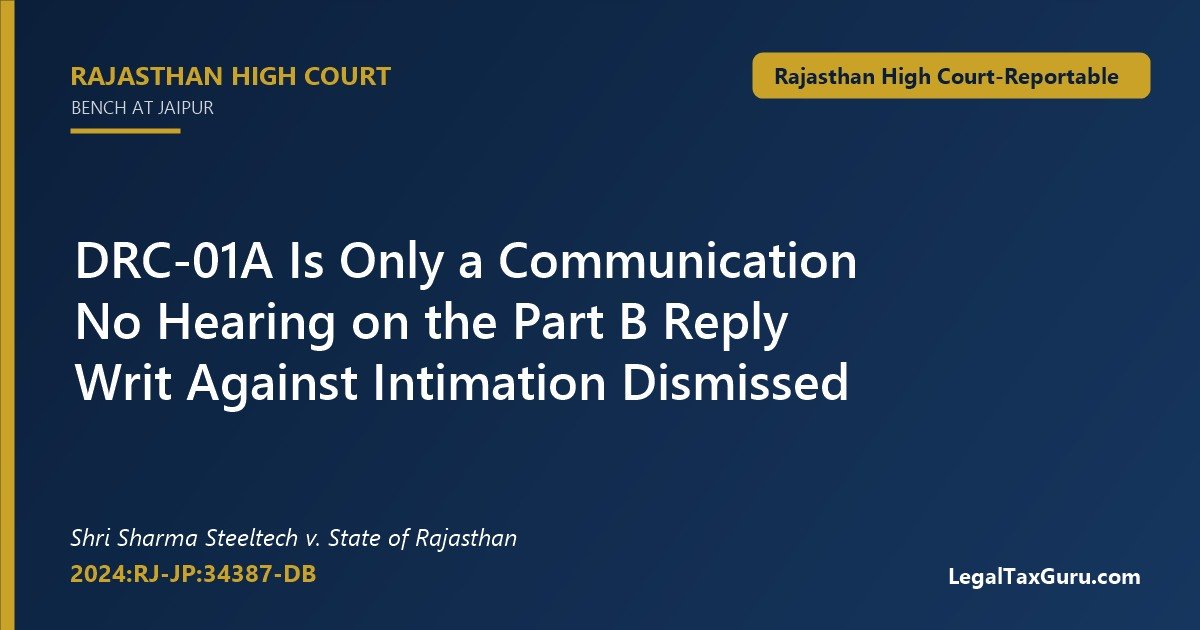
Quick Answer: No DRC-01A reply hearing is required, because a Rule 142(1A) intimation is only a discretionary communication and the rules provide no adjudication of the Part B submissions. The Rajasthan High Court held that the right to a hearing arises only after a show cause notice under Rule 142(1)(a), and dismissed the writ as filed to stall proceedings.
In M/s Shri Sharma Steeltech India Pvt. Ltd. v. State of Rajasthan & Ors. (2024:RJ-JP:34387-DB), the Rajasthan High Court held that no DRC-01A reply hearing or adjudication is contemplated by Rules 142(1A) and 142(2A) of the CGST/RGST Rules, 2017 (paras 11–12). A Division Bench of Justice Pankaj Bhandari and Justice Praveer Bhatnagar declined to follow two Calcutta High Court decisions and applied strict construction of taxing statutes (para 12). The writ petition, found to have been filed "just to stall the proceedings", was dismissed (paras 13–14).
Headnote: DRC-01A Reply Hearing
CGST Act, 2017 and Rajasthan GST Act, 2017 – CGST/RGST Rules, 2017 – Rules 142(1)(a), 142(1A) and 142(2A) – Form GST DRC-01A (Part B) – Pre-show cause intimation – Right of hearing – Writ against intimation – Article 226 – Strict construction of taxing statutes
Held: (i) On a plain reading of Rules 142(1A) and 142(2A), issuing a communication in Form GST DRC-01A is discretionary for the proper officer (para 11).
(ii) Neither Form GST DRC-01A nor its Part B contains any provision for adjudication of the submissions made against the proposed liability (para 11).
(iii) Rule 142(1A) is "basically, only a communication"; the assessee's right arises only after a show cause notice under Rule 142(1)(a), when a hearing is provided (para 12).
(iv) Hearing at different stages was not contemplated by the legislature; the Calcutta High Court decisions cited were not followed (para 12).
(v) Taxing statutes and rules with financial implications must be construed strictly, as held in Ajmera Housing Corporation (para 12).
(vi) A writ against a mere intimation, before any show cause notice, cannot be entertained; petition dismissed (paras 13–14).
(paras 2–15)
Case Details: Shri Sharma Steeltech v. State of Rajasthan (2024:RJ-JP:34387-DB)
Final Outcome: Writ petition dismissed; stay application and other pending applications disposed of (paras 14–15).
Case: M/s Shri Sharma Steeltech India Pvt. Ltd. v. State of Rajasthan, Department of Commercial Taxes & Ors.
Neutral Citation: 2024:RJ-JP:34387-DB
Case No.: D.B. Civil Writ Petition No. 13169/2024
Court: Rajasthan High Court, Bench at Jaipur (Division Bench)
Date of Decision: 13 August 2024
Bench: Justice Pankaj Bhandari and Justice Praveer Bhatnagar [authoring judge not stated – to be verified from certified copy]
Relevant Acts & Sections: Central Goods and Services Tax Act, 2017; Rajasthan Goods and Services Tax Act, 2017; CGST/RGST Rules, 2017 – Rules 142(1)(a), 142(1A) and 142(2A); Form GST DRC-01A (Parts A and B); Constitution of India – Article 226
Impugned Order: No order challenged; grievance was non-consideration of the reply to the intimation in Form GST DRC-01A issued by the Deputy Commissioner (State Tax), Circle-B, Enforcement Wing-II, Jaipur (para 1)
Counsel: Mr. Vagish Kumar Singh assisted by Ms. Sakshi Agarwal for the petitioner; Mr. Sandeep Taneja, AAG, with Ms. Kinjal Surana for respondent Nos. 1 and 2; Mr. Pawan Pareek for respondent No. 3 (Union of India).
Source: Rajasthan High Court (official website)
Key Holdings of the Rajasthan High Court
- Rule 142(1A) gives the proper officer a discretion to issue a communication or not to do so (para 11).
- Part B of Form GST DRC-01A lets the person make submissions, but the rules provide no adjudication of those submissions (para 11).
- The assessee's right arises only after a show cause notice under Rule 142(1)(a), where a hearing is provided (para 12).
- Affording a hearing at different stages was "not contemplated by the legislature" (para 12).
- The Calcutta High Court rulings in Eden Real Estate and Diamond Beverages were respectfully not followed (para 12).
- The RGST/CGST Act and Rules, having financial implications, must be read as promulgated; nothing is to be read in (para 12).
- A writ against a mere communication, filed to stall pending proceedings, will not be entertained (para 13).
Brief Facts of the Case
The petitioner is a private limited company with its registered office in the Sarna Doongar Industrial Area, Jaipur. It approached the High Court through its authorised signatory (cause title).
The proper officer issued an intimation in Form GST DRC-01A under Rule 142(1A) proposing a liability (para 1). The petitioner filed its submissions against the proposed liability, but these were not considered (paras 1, 4, 11).
No show cause notice under Rule 142(1)(a) had been issued when the writ petition was filed (paras 9, 13). The petitioner's only prayer was that the reply be considered before any notice under Rule 142(1)(a) is issued, if required (para 4).
The State, through the Additional Advocate General, appeared on advance notice (para 5). The Union of India was arrayed as respondent No. 3 (cause title).
Issues Before the High Court
The issues arising for decision were (paras 4, 10–12):
- Whether the proper officer is bound to consider, and decide, a reply filed in Part B of Form GST DRC-01A before issuing a show cause notice under Rule 142(1)(a) (paras 2, 4, 11).
- Whether a person served with a Rule 142(1A) intimation is entitled to an opportunity of hearing at that stage (paras 3, 7, 12).
- Whether the writ petition is maintainable when only a communication has been issued and no show cause notice exists (paras 8–9, 13).
Court's Findings and Reasoning
Petitioner's case (paras 2–4): Under Rule 142(1A), notice is to be served and, if a reply is filed under Rule 142(2A), the authorities must consider it before issuing a show cause notice (para 2). Although the rules provide no hearing at this stage, the Calcutta High Court had required one even for pre-show cause intimation (para 3). The petitioner relied on Eden Real Estate and Diamond Beverages and said its facts were no different (paras 3–4).
Revenue's case (paras 6–9): The Additional Advocate General argued that Rule 142(1A) only provides for a communication. Even that is not mandatory, since the rule says the "proper officer may" (para 6). Rule 142(2A) merely enables a person to pay part of the amount or make submissions in Part B of Form GST DRC-01A (para 6).
No hearing at the intimation stage (para 7): The State further argued that the rules provide a hearing only after a show cause notice is issued under Rule 142(1)(a) and replied to (para 7). No such provision exists under Rules 142(1A) or 142(2A) (para 7).
Writ against a pre-SCN step (paras 8–9): The State relied on Krishna Wax that a writ should not normally be entertained against a mere show cause notice (para 8). The Calcutta cases were distinguished because show cause notices had been issued there; here no notice had been issued (para 9).
Discretionary communication (para 11): The Court held that it is discretionary for the proper officer to issue a communication or not. Here a communication was issued and submissions were filed (para 11). However, neither Form GST DRC-01A nor its Part B carries any provision for adjudication of those submissions (para 11).
Calcutta view not followed (para 12): The Court said it "beg[s] to differ" from the Calcutta decisions because the rules provide neither a hearing nor a decision on the submissions (para 12). Rule 142(1A) is "basically, only a communication" which the proper officer "may give" (para 12).
Right arises at the SCN stage (para 12): The assessee's right arises only after a show cause notice under Rule 142(1)(a), where the rules provide for a hearing (para 12). Hearings at several stages were not contemplated by the legislature (para 12).
Strict construction (para 12): Relying on Ajmera Housing Corporation, the Court said a taxing statute is construed strictly. Nothing is to be read in or implied, and hardship or equity is out of place (para 12).
Application to facts (paras 13–14): Since only a communication had been given, there was "no reason to entertain" the writ (para 13). The petition appeared filed "just to stall the proceedings" pending before the authorities, and was dismissed (paras 13–14).
Final Outcome and Directions
- The writ petition was dismissed for want of force (para 14).
- The stay application and any other pending application were disposed of (para 15).
- No direction was issued to consider the DRC-01A reply before a show cause notice (paras 13–14).
- The order is silent on costs.
- The petitioner's rights at the show cause notice stage under Rule 142(1)(a), including the hearing provided there, are left intact (para 12).
Legal Principle Laid Down
An intimation under Rule 142(1A) of the CGST/RGST Rules, 2017 in Form GST DRC-01A is a discretionary, pre-show cause communication. The rules provide no adjudication of the Part B submissions and no hearing at that stage. The assessee's procedural rights, including a hearing, arise only after a show cause notice under Rule 142(1)(a). A writ seeking consideration of the DRC-01A reply before a show cause notice will not be entertained (paras 11–13).
Precedents Relied Upon
- Commissioner of Central Excise, Haldia v. Krishna Wax Private Limited, (2020) 12 SCC 572 – Relied upon – A writ should not normally be entertained against a mere show cause notice; objections must first go to the issuing authority. Discussed at paras 8, 13.
- Ajmera Housing Corporation & Ors. v. Commissioner of Income Tax, 2010 INSC 535 – Relied upon – A taxing statute is construed strictly; nothing is to be read in or implied. Discussed at para 12.
- Eden Real Estate Pvt. Ltd. & Anr. v. Senior Joint Commissioner of Revenue, Kolkata South Circle, WBGST & Ors., WPA No. 1025/2024, decided 07.02.2024 (Calcutta High Court) – Not followed – Hearing required at the pre-show cause intimation stage. Discussed at paras 3, 9, 12.
- Diamond Beverages Private Limited & Anr. v. Assistant Commissioner of CGST & CX, Taltala Division II, Kolkata South Commissionerate & Ors., M.A.T. 1948/2023 in I.A. No. CAN 1 of 2023, decided 15.02.2023 (Calcutta High Court) – Not followed – Same proposition. Discussed at paras 3, 9, 12.
- Union of India v. Guwahati Carbon Ltd. – Referred (within the Krishna Wax extract) – Excise law a complete code; writ not ordinarily appropriate. Discussed at para 8.
- Malladi Drugs & Pharma Ltd. v. Union of India – Referred (within the Krishna Wax extract) – Writ against a show cause notice rightly dismissed. Discussed at para 8.
Important Paragraphs of the Judgment
Verbatim extracts from the judgment. For the full text, refer to the judgment PDF below.
Para 11: "A plain reading of Rule 142(1A) and 142(2A) of the Rules of 2017 would go to show that it is discretionary for the proper Officer to either issue communication or not to do so. However, in the present case, a communication is issued and the person to whom communication is sent, has filed submissions against the proposed liability. In Form GST DRC-01A or in Part - B of Form GST DRC-01A, there is no provision under the Rules for adjudication regarding submissions made by the person referred to in sub-rule (1A) of Rule 142 of Rules of 2017."
Para 12: "Rule 142(1A) of the Rules of 2017 is, basically, only a communication, which the 'proper officer', if he feels so, may give. The right of the assessee arises only after issuance of a show cause notice under Rule 142(1)(a) of the Rules of 2017, in which case there is provision under the Rules for affording an opportunity of hearing."
Para 12: "Affording opportunity of hearing at different stages was not contemplated by the legislature and thus, we beg to differ from the judgments cited at bar, by learned counsel for the petitioner. The RGST/CGST Act and Rules having financial implications have to be interpreted in the manner as promulgated."
Para 13: "Since in the present case, only communication has been given, there is no reason to entertain the present writ petition and the same appears to have been filed just to stall the proceedings, which are pending before the authorities."
Para 14: "Consequently, we do not find any force in the writ petition, hence, the same is dismissed."
Practical Impact of the Ruling
- For taxpayers served with DRC-01A: Filing Part B submissions remains useful, but the officer is not bound to decide them or grant a hearing before issuing a show cause notice (paras 11–12).
- For practitioners: Save the hearing and natural-justice arguments for the Rule 142(1)(a) show cause notice stage, where the rules provide for them (para 12).
- For writ strategy: In the Jaipur Bench, a writ against a mere DRC-01A intimation is likely to be dismissed as premature and as an attempt to stall proceedings (para 13).
- For proper officers: Issuing DRC-01A is discretionary; non-consideration of the Part B reply does not by itself vitiate the later show cause notice under this ruling (paras 11–13).
- For litigants citing other High Courts: The Bench expressly differed from the Calcutta High Court on hearing at the pre-show cause stage (para 12).
FAQs on DRC-01A Reply Hearing
1. What did the Rajasthan High Court hold in Shri Sharma Steeltech v. State of Rajasthan?
It held that a Rule 142(1A) intimation in Form GST DRC-01A is only a discretionary communication. The rules provide no adjudication of the Part B reply and no hearing at that stage, so the writ was dismissed (paras 11–14).
2. Is a hearing required before issuing a show cause notice after a DRC-01A reply?
No. The Court held that a hearing at different stages was not contemplated by the legislature. The right to a hearing arises only after a show cause notice under Rule 142(1)(a) (para 12).
3. Is issuing Form GST DRC-01A mandatory for the proper officer?
No. On a plain reading of Rules 142(1A) and 142(2A), it is discretionary for the proper officer to issue the communication or not. The rule uses the words "proper officer may" (paras 6, 11–12).
4. Why did the Court not follow the Calcutta High Court decisions?
The Court said the rules provide neither a hearing nor a decision on the DRC-01A submissions. It also noted that show cause notices had been issued in those cases, unlike here (paras 9, 12).
5. Can a writ be filed against a DRC-01A intimation?
The Court refused to entertain it, as only a communication had been given. It found the petition filed "just to stall the proceedings", relying on the principle in Krishna Wax (paras 8, 13–14).
Keywords: DRC-01A reply hearing, Shri Sharma Steeltech v. State of Rajasthan, 2024:RJ-JP:34387-DB, D.B. Civil Writ Petition No. 13169/2024, Rule 142(1A) CGST Rules, Rule 142(2A), Form GST DRC-01A Part B, pre-show cause intimation, Rule 142(1)(a) show cause notice, Krishna Wax, Eden Real Estate, Ajmera Housing, GST litigation lawyer, Rajasthan High Court Jaipur
Related on LegalTaxGuru
- More High Court judgments on GST and indirect tax
- GST articles and updates
- Writ Against DGGI Show Cause Notice Premature Without Reply – Baba Minerals v. Union of India
Download Judgment PDF – Shri Sharma Steeltech v. State of Rajasthan
Judgment PDF: 2024:RJ-JP:34387-DB – M/s Shri Sharma Steeltech India Pvt. Ltd. v. State of Rajasthan & Ors. (D.B. Civil Writ Petition No. 13169/2024) – The judgment PDF will be uploaded here shortly.
Source: Rajasthan High Court (official website).
Read more: Rajasthan High Court · GST · Show Cause Notices · Indirect Tax