Quick Answer: On online gaming GST evasion bail, the Rajasthan High Court held that evasion far above Rs. 5 crore under Section 132(1)(i) is a potent and determinative factor against grant of bail. Finding prima facie admissions and a real risk of tampering and flight, it dismissed both bail applications at this stage.
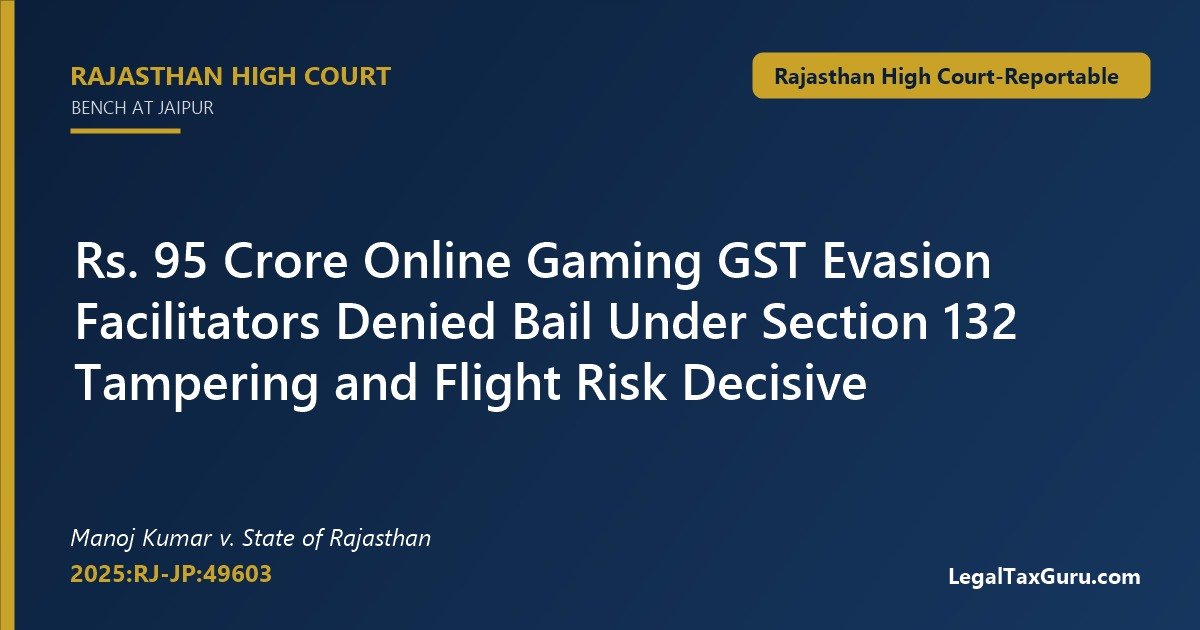
In Manoj Kumar v. State of Rajasthan, with Jagdish v. Union of India (2025:RJ-JP:49603), the Rajasthan High Court refused online gaming GST evasion bail to two accused arrested by the DGGI (paras 15, 17). Justice Sameer Jain held that evasion far above Rs. 5 crore under Section 132(1)(i) is "a potent and determinative factor against grant of bail" (para 10). Finding prima facie admissions, risk of tampering and flight, and concealment of the scale of evasion, the Court dismissed both bail applications "at this stage" (paras 12–13, 17).
Headnote: Online Gaming GST Evasion Bail
CGST Act, 2017 – Sections 67(2), 70, 132(1)(i) and 132(5) – Bharatiya Nagarik Suraksha Sanhita, 2023 – Section 483 – Regular bail – Online money gaming – Specified actionable claims – Shell companies onboarded with payment aggregators – Economic offence – Tampering and flight risk
Held: (i) Evasion substantially above Rs. 5 crore falls in the cognizable, non-bailable limb of Section 132 and is a determinative factor against bail (para 10).
(ii) Section 70 admissions and documentary and electronic material furnish a prima facie basis for the prosecution (para 12).
(iii) Multiple payment aggregators, numerous VPAs and a foreign contact create a real risk of tampering and of moving funds abroad (paras 12–13).
(iv) Concealment of the true scale of evasion amounts to approaching the Court with unclean hands (para 13).
(v) Vineet Jain favours bail under Section 132 save in extraordinary circumstances; evasion of about Rs. 95 crore was treated as such a case (para 15).
(vi) Bail applications dismissed at this stage; observations confined to bail (para 17).
(paras 9–19)
Case Details: Manoj Kumar v. State of Rajasthan (2025:RJ-JP:49603)
Final Outcome: Both bail applications dismissed at this stage; observations confined to bail (para 17).
Case: Manoj Kumar s/o Bhagwanaram v. State of Rajasthan, connected with Jagdish s/o Amraram v. Union of India
Neutral Citation: 2025:RJ-JP:49603
Case No.: S.B. Criminal Miscellaneous Bail Application No. 13655/2025, connected with S.B. Criminal Miscellaneous Bail Application No. 13782/2025
Court: Rajasthan High Court, Bench at Jaipur (Single Bench)
Date of Decision: 6 December 2025 (arguments concluded and reserved on 3 December 2025)
Bench: Justice Sameer Jain
Relevant Acts & Sections: CGST Act, 2017 – Sections 67, 67(2), 70, 132(1), 132(1)(i) and 132(5); Bharatiya Nagarik Suraksha Sanhita, 2023 – Section 483; Finance Ministry Instruction No. 2022-23 (GST Investigation Guidelines), Clause 3.5
Impugned Order: Orders dated 07.10.2025 of the Additional Sessions Judges No. 9 and No. 3, Jaipur Metropolitan-II, rejecting regular bail; DGGI File No. DGGI/INT/INTL/702/2025, Udaipur Regional Unit (paras 1–2)
Counsel: Mr. Naqvi Sehban Najib with Mr. Jaswant Sharma, Ms. Morvi Jangid, Ms. Rabiya Mateen and Mr. Narendra Kumar for the petitioners; Mr. Bharat Vyas, AAG, assisted by Mr. Jitendra Singh Poonia, Spl. PP DGGI, and Ms. Neeti Jain Bhandari, with Ms. Arti Sharma, PP, and Mr. Rhishi Raj Singh Rathore, PP, for the respondents.
Source: Rajasthan High Court (official website)
Key Holdings of the Rajasthan High Court
- Where evasion exceeds Rs. 5 crore, the offence is cognizable and non-bailable, a "potent and determinative factor" against bail (para 10).
- Section 67 search powers were properly exercised, with a search on 10.09.2025 and statements recorded (para 11).
- Section 70 admissions about lending company credentials for commission are cogent prima facie material (para 12).
- Multiple payment aggregators, VPAs and a foreign contact create a "real and demonstrable risk" of tampering (para 12).
- Concealing the true scale of evasion shows unclean hands; "fraud vitiates everything" (para 13).
- In serious economic offences, refusal of bail is sustained where there is a prima facie case and risk of interference, per Sanjay Chandra (para 14).
- The defence precedents were distinguishable, as facts are material in tax evasion bail matters (para 15).
Brief Facts of the Case
The DGGI alleged that the applicants facilitated the onboarding of three companies with online payment aggregators to receive online gaming revenues (paras 3, 9.1). The companies were M/s Invoestr Global Pvt. Ltd., M/s Involanding Games Pvt. Ltd. and M/s Chefbiz Spices Pvt. Ltd. (para 3).
The companies allegedly filed NIL returns for some months, and their registrations were cancelled suo motu (para 6). The demand, first quantified at Rs. 11.20 crore, was revised in the complaint dated 10.11.2025 to about Rs. 95.77 crore (para 9.2).
A search was conducted on 10.09.2025 under Section 67(2), and statements were recorded under Section 70 (paras 7, 9.3). The directors allegedly admitted giving company credentials to Jagdish alias "DJ Jaggi" and onboarding five other companies for commission (para 7).
The applicants were arrested on 12.09.2025 (para 9.3). Their bail applications were rejected by the Additional Sessions Judges on 07.10.2025 (paras 1–2).
Issues Before the High Court
- Whether evasion above the Rs. 5 crore threshold in Section 132 weighs against bail even after the complaint is filed (paras 4, 10).
- Whether the material on record furnishes a prima facie case against the applicants as facilitators (paras 4, 12).
- Whether the risk of tampering, flight and concealment justified refusal of bail despite Vineet Jain (paras 12–15).
Court's Findings and Reasoning
Applicants' case (paras 3–5): Jagdish claimed to provide only facilitation services for company registrations with payment aggregators (para 3). The applicants said the offence carries a maximum of five years, is Magistrate-triable, and the investigation ended with the complaint of 10.11.2025 (para 4). Relying on Clause 3.5 of the GST Investigation Guidelines, they said arrest was unwarranted where the demand arose from divergent interpretation (para 4).
Revenue's case (paras 6–8): The ASG and Special PP said receipts came through various UPI IDs and VPAs with no GST paid (para 6). Admitted receipts of about Rs. 53.21 crore and further collections of Rs. 342.04 crore were alleged, with evasion of about Rs. 14 crore and Rs. 95.77 crore (para 6). A contact saved as "Outman", claiming to reside in China-Hong Kong, was found on Jagdish's phone (para 7).
Threshold under Section 132 (para 10): The allegations disclosed evasion "substantially in excess of Rs.5 crores" (para 10). They fall within the cognizable, non-bailable limb of Section 132(1)(i), which the Court called "a potent and determinative factor against grant of bail" (para 10).
Search and statements (para 11): The Act contemplates stringent penal consequences for large-scale evasion (para 11). Section 67 powers were exercised in this matter through the search of 10.09.2025 and the recorded statements (para 11).
Prima facie case and tampering (para 12): The admissions and seized material furnished a prima facie basis for the prosecution (para 12). The use of numerous aggregators, VPAs and a foreign contact posed a risk of deleting records, influencing intermediaries or moving funds abroad (para 12).
Unclean hands and flight risk (para 13): The applicants concealed the true scale of evasion, as the figures were revised upwards (para 13). Contact with a person claiming foreign residence and the ease of moving funds made absconding a realistic possibility (para 13).
Economic offence principles (para 14): Applying Sanjay Chandra, the Court noted that refusal of bail is sustained where a prima facie case exists and there is a real likelihood of interference (para 14).
Application to facts (para 15): The Court acknowledged that Vineet Jain says bail should normally be granted under Section 132 "unless extraordinary circumstances exits" (para 15). Given evasion of about Rs. 95 crore, the online money gaming supplies and the risks found, the applicants did not make out a case for bail (para 15).
Special statutes (para 16): The Court relied on Radhika Agarwal that judicial review of arrests under special Acts must be exercised cautiously (para 16).
Final Outcome and Directions
- Both bail applications were dismissed "at this stage" (para 17).
- The observations were confined to bail and are not an expression on the merits of the prosecution (para 17).
- Records produced before the Court were directed to be returned under due procedure (para 18).
- A copy of the order was directed to be placed in the connected application (para 19).
- The order is silent on costs.
Legal Principle Laid Down
In a prosecution under Section 132 of the CGST Act, alleged evasion far above the Rs. 5 crore threshold, cogent Section 70 admissions and a real risk of tampering or flight can justify refusal of bail. This applies even though Vineet Jain treats bail as the norm absent extraordinary circumstances. The facts of each tax evasion case remain material (paras 10, 12–15).
Precedents Relied Upon
- Vineet Jain v. Union of India, 2025 LiveLaw (SC) 513 – Considered and distinguished – Bail is normally granted under Section 132 unless extraordinary circumstances exist. Discussed at paras 5, 15.
- Sanjay Chandra v. CBI, (2012) 1 SCC 40 – Relied upon – Refusal of bail sustained in serious economic offences with a prima facie case and risk of interference. Discussed at para 14.
- Radhika Agarwal v. Union of India & Ors., W.P. (Crl.) No. 336 of 2018 – Relied upon – Cautious judicial review of arrests under special Acts. Discussed at para 16.
- Ratnambar Kaushik v. Union of India, MANU/SC/1576/2022; Rajiv Jindal v. State of U.P., SLP (Crl.) Nos. 13548–13550/2024 – Cited by the applicants; distinguished generally. Discussed at paras 5, 15.
- Nemichand Tetarwal, Mukesh Kumar, Vikas Jain, Amit Singhal and Vikas Sain (Rajasthan High Court bail orders) – Cited by the applicants; distinguished generally. Discussed at paras 5, 15.
- P. Radhakrishnan v. Cochin Devaswom Board, 2025 LiveLaw (SC) 90 – Cited by the applicants. Referred at para 5.
Important Paragraphs of the Judgment
Verbatim extracts from the judgment. For the full text, refer to the judgment PDF below.
Para 10: "Such allegations squarely fall within the non-bailable, cognizable limb of Section 132(1)(i) and attract the statutory rigour attendant to large-scale tax frauds. This is a potent and determinative factor against grant of bail."
Para 12: "These admissions and seized materials constitute cogent material which, at this stage, furnish a prima facie basis for the prosecution's case."
Para 13: "It is also noted that the applicants have approached the Court with unclean hands, and it is a settled principle of law that fraud vitiates everything."
Para 15: "...the judgments relied upon by the learned counsel for the applicants are upon distinguishable stance, as in matters of tax evasion, the facts of the case are material for consideration, and the present case reflects an evasion of approximately Rs. 95 Crores, this Court is of the opinion that the applicants have not made out a case for bail."
Para 17: "Accordingly, the instant bail applications are dismissed, at this stage. It is made clear that the observations made herein are confined to the limited question of bail and are not intended to be read as an expression on the merits of the prosecution's case."
Practical Impact of the Ruling
- For online gaming operators and facilitators: Lending company credentials or onboarding entities with payment aggregators can attract Section 132 prosecution (paras 7, 12, 15).
- For accused in GST prosecutions: Vineet Jain is not a guarantee; large evasion and tampering risk can amount to extraordinary circumstances (para 15).
- For defence counsel: Address the tampering and flight concerns directly, especially where digital trails and foreign contacts exist (paras 12–13).
- For DGGI: Section 70 admissions, search material and revised quantification carried weight at the bail stage (paras 10–13).
- For payment intermediaries: Multiple VPAs and UPI IDs used for gaming receipts were treated as aggravating features (paras 6, 12).
FAQs on Online Gaming GST Evasion Bail
1. What did the Rajasthan High Court hold in Manoj Kumar v. State of Rajasthan (with Jagdish v. Union of India)?
It refused bail to two accused alleged to have facilitated online money gaming receipts through shell companies without paying GST. Alleged evasion of about Rs. 95 crore and risk of tampering and flight were decisive (paras 10, 12–15, 17).
2. Is evasion above Rs. 5 crore relevant to bail under the CGST Act?
Yes. Such evasion falls in the cognizable, non-bailable limb of Section 132. The Court called it "a potent and determinative factor against grant of bail" (para 10).
3. Does Vineet Jain mean bail must be granted in GST offences?
No. The Court read Vineet Jain as favouring bail unless extraordinary circumstances exist. Evasion of about Rs. 95 crore and the risks found took this case outside the norm (para 15).
4. Why did the Court see a risk of tampering?
Multiple payment aggregators, numerous VPAs, large electronic flows and a contact claiming residence in China-Hong Kong were involved. These made deletion of records or movement of funds a real risk (paras 12–13).
5. Is the online gaming company a supplier under GST?
For bail, the Court noted the company falls within "supplier" of specified actionable claims in online money gaming. This is a prima facie view confined to bail, not a finding on merits (paras 15, 17).
Keywords: online gaming GST evasion bail, Manoj Kumar v. State of Rajasthan, Jagdish v. Union of India, 2025:RJ-JP:49603, S.B. Criminal Misc. Bail Application No. 13655/2025, Section 132(1)(i) CGST Act, Section 132(5), online money gaming, specified actionable claims, payment aggregators, Vineet Jain, DGGI Udaipur, GST prosecution lawyer, Rajasthan High Court, Justice Sameer Jain
Related on LegalTaxGuru
- More High Court judgments on GST and indirect tax
- GST articles and updates
- Section 480(6) BNSS Gives No Absolute Right to Bail in GST Fake Invoice Case – Hansraj Gurjar v. Union of India
Download Judgment PDF – Manoj Kumar v. State of Rajasthan
Source: Rajasthan High Court (official website).
Read more: Rajasthan High Court · GST · GST Prosecution and Bail · Indirect Tax