Quick Answer: A person who was not a party to a compromise is not barred by Section 96(3) or Order XXIII Rules 3 and 3A of the CPC from appealing against the consent decree. With leave of the appellate court, such a stranger may appeal if the decree prejudicially affects a legally cognisable interest. The Supreme Court upheld the Gujarat High Court's grant of leave, condonation of an 11-year delay and interim injunction.
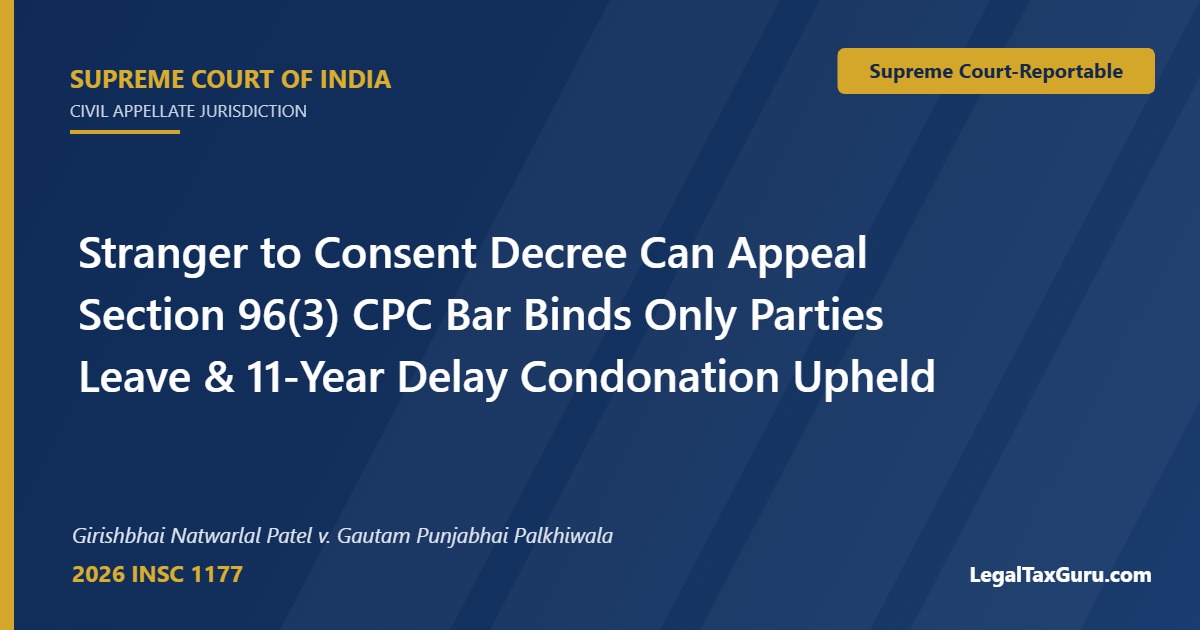
In Girishbhai Natwarlal Patel v. Gautam Punjabhai Palkhiwala (Dead) by LRs & Ors. (2026 INSC 1177), the Supreme Court held that the statutory bar on appeals against a consent decree under Section 96(3) read with Order XXIII Rules 3 and 3A of the Code of Civil Procedure, 1908 operates only against parties to the compromise, and cannot be invoked to shut out a stranger who asserts an independent right prejudiced by the decree (paras 47, 53, 56). A Bench of Justice J.B. Pardiwala and Justice K. Vinod Chandran dismissed the appeals against the Gujarat High Court's orders dated 02.04.2024 and 14.08.2024, which granted leave to appeal to members of an HUF against a 2013 consent decree for specific performance, condoned a delay of about 11 years, and restrained the appellant from dealing with the land (paras 3, 66–69). The Court requested the High Court to decide the main appeal within three months (para 71).
Status: Gujarat High Court's ex parte ad interim order dated 02.04.2024 and judgment dated 14.08.2024 (grant of leave to appeal and condonation of delay) upheld by the Supreme Court; appeals dismissed (paras 66, 69).
Headnote: Appeal by Stranger to Consent Decree
Code of Civil Procedure, 1908 – Section 96(3) – Order XXIII Rules 3 and 3A – Section 11, Explanation 6 – Consent decree – Appeal by person not a party to the suit or compromise – Leave to appeal – "Person aggrieved" – Condonation of delay of 11 years – Limitation for non-party – Ex parte ad interim injunction against a non-party pending leave application – Specific performance – Allegation of fraud and collusion.
Held: (i) The bar under Section 96(3) and the estoppel under Order XXIII Rules 3 and 3A rest on the binding effect of a compromise between its parties; they cannot be mechanically invoked against a person who was not a party to the compromise and asserts an independent legal interest (paras 47, 53).
(ii) The observation in Pushpa Devi Bhagat that no appeal lies against a consent decree relates only to the remedies of a party to the consent decree (para 51); Triloki Nath Singh is distinguishable, as the appellant there traced title through a party to the suit (para 52).
(iii) Non-party status gives no unrestricted right of appeal; the stranger must obtain leave by showing that the decree prejudicially affects his rights. The test for leave is the same as for an ordinary decree – the consent nature of the decree neither dispenses with nor bars it (paras 54–56).
(iv) Leave is not granted to everyone remotely or indirectly affected; the principles summarised in H. Anjanappa v. A. Prabhakar and V.N. Krishna Murthy v. Ravikumar apply (paras 57–58).
(v) For a non-party, delay is not computed mechanically from the date of the decree; when and how the applicant acquired knowledge, and the steps taken thereafter, must be considered (paras 63–65).
(vi) Interim protection to preserve the suit property was justified pending the leave and impleadment applications, especially when the appellant was later heard before the injunction was continued (paras 39–41).
(paras 35–68)
Case Details: Girishbhai Natwarlal Patel v. Gautam Punjabhai Palkhiwala (2026 INSC 1177)
Final Outcome: Appeals dismissed; Gujarat High Court's order dated 02.04.2024 and judgment dated 14.08.2024 upheld; High Court requested to decide the main First Appeal within three months.
Case: Girishbhai Natwarlal Patel v. Gautam Punjabhai Palkhiwala (Dead) by LRs & Ors.
Neutral Citation: 2026 INSC 1177
Case No.: Civil Appeal Nos. 14017–14018 of 2026 (arising out of SLP (Civil) Nos. 29178–29179 of 2024)
Court: Supreme Court of India (Civil Appellate Jurisdiction) – Reportable
Date of Decision: 30 October 2026
Bench: Justice J.B. Pardiwala (author) and Justice K. Vinod Chandran
Relevant Acts & Sections: Code of Civil Procedure, 1908 – Section 96(3), Section 11 Explanation 6, Order XXIII Rules 3 and 3A, Order XLIII Rule 1A(2); condonation of delay; Gujarat Tenancy and Agricultural Lands Act, 1948 (background)
Impugned Orders: Gujarat High Court – ex parte ad interim order dated 02.04.2024 in Civil Application No. 1408 of 2024, and judgment dated 14.08.2024 in Civil Application No. 1408 of 2024 with Civil Application No. 1608 of 2024 in First Appeal No. 7226 of 2024, granting leave to appeal against the consent decree dated 29.04.2013 in Civil Suit No. 322 of 2012
Counsel: Mr. Anshin H. Desai, Senior Advocate, for the appellant; Mr. Mihir J. Thakore and Ms. Megha Jani, Senior Advocates, for Respondent Nos. 1–9
Source: Supreme Court of India (official website)
Key Holdings of the Supreme Court
- Section 96(3) and Order XXIII Rules 3 and 3A CPC bind only parties to the compromise and operate as estoppel only against them (paras 47, 53).
- A non-party cannot be deemed to have consented to a decree merely because others consented to it (para 53).
- A stranger may appeal with leave if bound by, aggrieved by, or prejudicially affected by the decree, including where it would operate as res judicata under Explanation 6 to Section 11 (para 55).
- The test for leave against a consent decree is the same as for any other decree – a legally cognisable interest prejudicially affected (para 56).
- Leave is not given to persons remotely or indirectly affected or suffering only an imaginary injury (paras 57–58).
- For a non-party, delay must be assessed from the date of knowledge and the steps taken thereafter, not merely from the date of decree (paras 63–65).
- Interim protection to preserve the subject matter can be granted before the leave application is decided where alienation is a real risk (paras 39–41).
Brief Facts of the Case
By a registered sale deed dated 29.08.1975, the original owner Purshottambhai Punjabhai sold the subject land to Vikram Punjabhai Palkhiwala, and Mutation Entry No. 3106 was recorded. Respondent Nos. 1–9 are members of the Punjabhai Mohanbhai HUF, whose name was entered in the revenue records by Entry No. 7597 dated 20.11.1997 (paras 18, 24, 60).
On 11.09.1996, the heirs of the original owner executed a registered agreement to sell the same land in favour of Geetagram Cooperative Housing Society (Respondent No. 10). On 22.03.2012, those heirs executed a power of attorney in favour of the appellant, and in May 2012 the Society filed Civil Suit No. 322 of 2012 for specific performance. The appellant filed a vakalatnama for the defendants as their attorney (paras 18, 26).
The suit ended in a consent decree on 29.04.2013. No execution was filed until 2020. On 18.06.2022, the Court Commissioner executed a sale deed in favour of the appellant, with the Society as confirming party, and Mutation Entry No. 5327 was certified on 20.04.2023 (paras 18, 26, 61).
Respondent Nos. 1–9 say they learnt of the change in revenue records in 2023. On 28.02.2024 they filed a First Appeal with applications for leave to appeal, condonation of delay, interim relief, impleadment of the appellant and additional evidence. RTI documents received on 21.03.2024 allegedly showed that the appellant had been Chairman of the Society in 2002–2003 (paras 24, 26, 64).
On 02.04.2024 the High Court granted an ex parte ad interim injunction restraining the appellant from dealing with the land. After hearing the parties over several dates, on 14.08.2024 it continued the injunction, condoned the delay and granted leave to appeal (paras 3–7, 24).
Issues Before the Supreme Court
- Whether the High Court erred in granting the ex parte ad interim injunction dated 02.04.2024 against the appellant and continuing it on 14.08.2024 (para 34(i)).
- Whether leave to appeal could be granted to Respondent Nos. 1–9, who were not parties to the suit that ended in the consent decree (para 34(ii)).
- Whether the condonation of the 11-year delay in preferring the appeal was justified (para 34(iii)).
Court's Findings and Reasoning
Appellant's case (paras 12–22): Senior Counsel argued that no appeal lies against a consent decree, that a non-party gets no cause of action to challenge it, and that an injunction could not be granted on a draft amendment without impleading and hearing the appellant. He also argued that the 11-year delay was condoned mechanically, that the HUF and not its members was the aggrieved party, and that the respondents suppressed material revenue entries and did not challenge the execution sale deed (paras 12–21).
Respondents' case (paras 23–33): Senior Counsel argued that the heirs of the original owner had no title left to agree to sell in 1996, and that the suit was collusive: the appellant held the defendants' power of attorney, later took the conveyance, and was linked to the plaintiff Society. Reliance was placed on H. Anjanappa v. A. Prabhakar on leave to appeal (paras 25–31).
Scope (para 35): The Court clarified that it was examining only leave, delay and interim injunction, and that none of its observations on fraud or collusion are final findings on merits.
Interim injunction (paras 36–41): Prima facie, it was doubtful whether the heirs had any title to convey, and the appellant appeared connected with both sides and became the beneficiary of the decree. Since impleadment could be heard only after leave was decided, the land could have been alienated in the meantime. The appellant was later heard and the injunction was continued only after that hearing, so the High Court could not be faulted.
Stranger to a consent decree (paras 43–55): Reading Section 96(3) with Order XXIII Rules 3 and 3A, and relying on Banwari Lal v. Chando Devi, the Court held that the bar is founded on the binding effect of a compromise between its parties. Pushpa Devi Bhagat and R. Rajanna deal with the remedies of a party to the consent decree. Triloki Nath Singh was distinguished because the appellant there traced title through a party to the suit, whereas Respondent Nos. 1–9 were complete strangers who did not claim through any party.
Principles for leave (paras 56–62): Applying V.N. Krishna Murthy and H. Anjanappa, the Court found that the 1975 sale deed, the conflicting revenue entries, the 16-year gap before suit, the 7-year gap before execution, the power of attorney in favour of the appellant and the non-appearance of the Society and the heirs together showed a grievance that was not tenuous. Respondent Nos. 1–9 had asserted a legally cognisable interest that may be prejudiced by the decree, and leave was rightly granted.
Condonation of delay (paras 63–65): As non-parties, the respondents could not be presumed to know of the decree from 2013. Their explanation of learning of the revenue change around August 2023 and taking steps, including the RTI reply of 21.03.2024, justified condonation. Condonation only permits the issues to be examined in appeal.
Final Outcome and Directions
- The ex parte ad interim injunction of 02.04.2024, continued on 14.08.2024, does not warrant interference (para 66(i)).
- The grant of leave to appeal to Respondent Nos. 1–9 is upheld (para 66(ii)).
- The condonation of delay is upheld (para 66(iii)).
- Findings are confined to these questions; merits of title and allegations of fraud and collusion remain open (para 67).
- Appeals dismissed; High Court requested to hear and decide the main appeal within three months; copy to be sent to the Gujarat High Court (paras 69–72).
Legal Principle Laid Down
The bar on appeals against a consent decree under Section 96(3) CPC, and the estoppel under Order XXIII Rules 3 and 3A, apply only to the parties to the compromise and to those claiming through them. A stranger to the suit and the compromise who asserts an independent legal interest prejudicially affected by the decree may appeal under Section 96 with leave of the appellate court, judged by the ordinary "person aggrieved" test. For such a non-party, delay is to be assessed with reference to the date of knowledge and the diligence shown thereafter.
Precedents Relied Upon
- Banwari Lal v. Chando Devi, 1992 SCC OnLine SC 541 – Relied upon – Section 96(3) applies where the factum of compromise is not in dispute. Discussed at para 48.
- Pushpa Devi Bhagat v. Rajinder Singh, (2006) 5 SCC 566 – Explained – observation limited to parties to the consent decree. Discussed at paras 49, 51.
- R. Rajanna v. S.R. Venkataswamy, (2014) 15 SCC 471 – Explained – lawfulness of compromise to be decided by the court that recorded it. Discussed at paras 50–51.
- Triloki Nath Singh v. Anirudh Singh, (2020) 6 SCC 639 : 2020 INSC 385 – Distinguished – appellant there claimed through a party to the suit. Discussed at para 52.
- V.N. Krishna Murthy v. Ravikumar, (2020) 9 SCC 501 (three-Judge Bench) – Relied upon – stranger may appeal only if a "person aggrieved". Discussed at para 57.
- H. Anjanappa v. A. Prabhakar, 2025 INSC 121 – Relied upon – eight principles governing leave to appeal. Discussed at para 58.
- Jatan Kumar Golcha v. Golcha Properties, (1970) 3 SCC 573; State of Punjab v. Amar Singh, (1974) 2 SCC 70; Baldev Singh v. Surinder Mohan Sharma, (2003) 1 SCC 34; A. Subash Babu v. State of A.P., (2011) 7 SCC 616; K. Ponnalagu Ammani v. State of Madras, 1952 SCC OnLine Mad 300 – Referred (as quoted in V.N. Krishna Murthy). Discussed at para 57.
- R. Janakiammal v. S.K. Kumarasamy, (2021) 9 SCC 114; Acqua Borewell Pvt. Ltd. v. Swayam Prabha, (2022) 15 SCC 511; Kishorsinh Ratansinh Jadeja v. Maruti Corporation, (2009) 11 SCC 229; Postmaster General v. Living Media, (2012) 3 SCC 563 and other delay cases – Cited by the appellant; not applied. Discussed at paras 13–16, 43.
Important Paragraphs of the Judgment
Verbatim extracts from the judgment. For the full text, refer to the judgment PDF below.
Para 47: "The statutory bar, however, cannot be mechanically invoked to defeat the right of a person who was not a party to the compromise and who asserts an independent legal interest prejudicially affected by the decree."
Para 53: "A stranger to a compromise decree cannot be said to be barred under Section 96(3) read Order XXIII Rule 3 & Rule 3A of the CPC, 1908, since the scope and import of these provisions are limited to the parties to the compromise and act as an estoppel only with respect to them."
Para 54: "At the same time, non-party status does not confer an unrestricted right of appeal."
Para 56: "The fact that the decree in question is a consent decree neither dispenses with this requirement nor, in itself, constitutes a bar to the grant of leave."
Para 63: "... it would be erroneous to proceed on the assumption that they had knowledge of the decree from the date of its passing ..."
Para 65: "The order of condonation does not determine the merits of their claim or validate the allegations made by them; it merely permits those issues to be examined in the appellate proceedings."
Practical Impact of the Ruling
- For true owners and HUFs: A collusive consent decree affecting their land can be challenged by appeal with leave, even though they were not parties to the suit (paras 53–55).
- For purchasers under consent decrees: Title derived through a compromise decree remains exposed to challenge by third parties with an independent claim (paras 56, 62).
- For litigators on limitation: A non-party's delay runs from knowledge; document the date of discovery and every step taken thereafter, such as RTI applications (paras 63–65).
- For trial and appellate courts: Interim protection of the property can be granted while leave and impleadment applications are pending (paras 39–41).
- For civil practitioners: Pushpa Devi Bhagat and Triloki Nath Singh cannot be cited against a stranger who does not claim through a party (paras 51–52).
FAQs on Appeal by a Stranger to a Consent Decree
1. What did the Supreme Court hold in Girishbhai Natwarlal Patel v. Gautam Punjabhai Palkhiwala?
It held that a person who was not a party to the compromise can appeal against the consent decree with leave if the decree prejudicially affects his independent rights, and upheld the Gujarat High Court's leave, condonation of delay and injunction (paras 53, 66).
2. Does Section 96(3) CPC bar every appeal against a consent decree?
No. The bar and the estoppel under Order XXIII Rules 3 and 3A apply only to parties to the compromise (paras 47, 53).
3. Who can seek leave to appeal as a non-party?
A person who is bound by, aggrieved by, or prejudicially affected by the decree; not a person remotely or indirectly affected (paras 55, 57–58).
4. How is delay counted for a non-party?
Not mechanically from the date of decree; the court looks at when the applicant acquired knowledge and the steps taken thereafter (paras 63–65).
5. Did the Supreme Court decide whether the consent decree was fraudulent?
No. All observations are prima facie; title and the allegations of fraud and collusion are left to the High Court, which was asked to decide the appeal within three months (paras 35, 67, 71).
Keywords: 2026 INSC 1177, Girishbhai Natwarlal Patel v. Gautam Punjabhai Palkhiwala, appeal against consent decree, stranger to compromise decree, Section 96(3) CPC, Order XXIII Rule 3A CPC, leave to appeal by non-party, person aggrieved, condonation of delay 11 years, specific performance, collusive decree, ad interim injunction, Justice J.B. Pardiwala, Supreme Court reportable judgment, civil lawyer
Related on LegalTaxGuru
Download Judgment PDF – Girishbhai Natwarlal Patel v. Gautam Punjabhai Palkhiwala
Source: Supreme Court of India (official website).