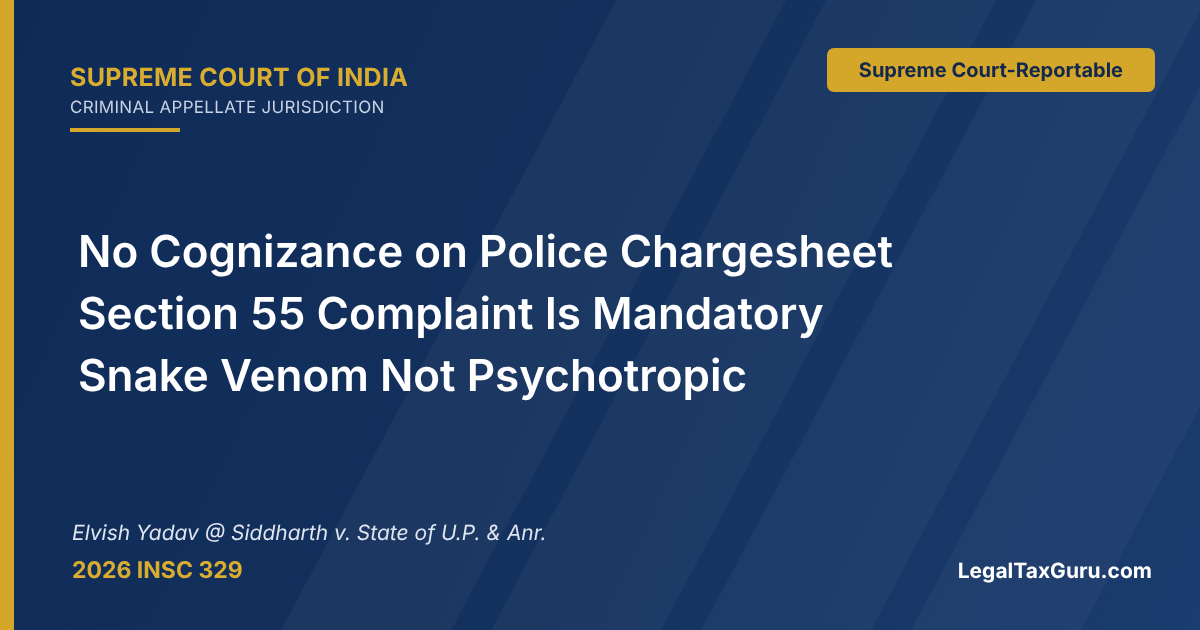
Quick Answer: A court cannot take cognizance of an offence under the Wild Life (Protection) Act, 1972 on a police chargesheet; Section 55 requires a complaint by the officers or authorities named in it. Snake venom, or antibodies to it, is not in the NDPS Schedule and so is not a "psychotropic substance". The Supreme Court quashed the snake-venom case against Elvish Yadav, but left the competent Wild Life authorities free to proceed under Section 55.
In Elvish Yadav @ Siddharth v. State of U.P. & Anr. (2026 INSC 329), the Supreme Court held that under Section 55 of the Wild Life (Protection) Act, 1972, cognizance can be taken only on a complaint by the officers or authorities mentioned in it, and cognizance taken on a chargesheet is without jurisdiction; under the principle of "ripple effect", everything that follows a void action is also a nullity (paras 20–22, 34, 42). It further held that since snake venom and its antibodies are not in the Schedule to the NDPS Act, they are not psychotropic substances under Section 2(xxiii), and the NDPS Act could not be invoked (para 36). A Bench of Justice M.M. Sundresh and Justice Nongmeikapam Kotiswar Singh set aside the Allahabad High Court's order and quashed the proceedings, with liberty to the Section 55 authorities (paras 45–48).
Status: Allahabad High Court's order dated 12.05.2025 in Application U/S 528 BNSS No. 14438/2025 set aside; proceedings arising out of FIR No. 461/2023 and Chargesheet No. 1/2024 quashed; liberty to the competent authorities under Section 55 of the 1972 Act; appeal disposed of (paras 45–49).
Headnote: Cognizance Under Section 55 Wild Life Act and Snake Venom Under NDPS
Wild Life (Protection) Act, 1972 – Section 55 – Cognizance of offences – Complaint by authorised officer – Chargesheet not a complaint – Narcotic Drugs and Psychotropic Substances Act, 1985 – Section 2(xxiii) – Psychotropic substance – Snake venom not in Schedule – Indian Penal Code, 1860 – Sections 284, 289 – Earlier complaint closed – Bharatiya Nagarik Suraksha Sanhita, 2023 – Section 528 – Quashing – Special statute – Generalia specialibus non derogant – Void ab initio – Ripple effect.
Held: (i) Under Section 55 of the 1972 Act, a court can take cognizance of an offence only on a complaint made by the officers or authorities mentioned in it; where a statute provides a special procedure it must be followed, and penal law is strictly construed (para 20).
(ii) Power exercised without jurisdiction is a nullity, and all proceedings flowing from it are also nullified; this is the principle of "ripple effect". A mere procedural irregularity may be curable, but an action taken in complete absence of authority is illegal from inception (paras 21–23, 42).
(iii) Following State of Bihar v. Murad Ali Khan, and pari materia rulings under the TOHO Act, the MMDR Act and the Drugs and Cosmetics Act, cognizance on a police report is impermissible where a special statute prescribes a complaint by a specified authority (paras 24–31).
(iv) What Section 55 requires is a complaint by a competent "authorized officer" empowered by the provision itself (para 34).
(v) A "psychotropic substance" under Section 2(xxiii) of the NDPS Act must be included in the Schedule; snake venom and its antibodies are not, so their recovery does not attract the NDPS Act. Stringent statutes call for a higher degree of care by investigators (paras 36–38).
(vi) The allegations behind Sections 284 and 289 IPC had been the subject of an earlier complaint that ended in a closure report, and could not form part of the present proceedings started by an agency without jurisdiction (para 40).
(paras 20–48)
Case Details: Elvish Yadav v. State of U.P. (2026 INSC 329)
Final Outcome: Appeal disposed of; High Court's order set aside; criminal proceedings under the IPC, the 1972 Act and the NDPS Act quashed; liberty to the competent authorities under Section 55 of the 1972 Act to take appropriate measures, if so advised.
Case: Elvish Yadav @ Siddharth v. State of U.P. & Anr.
Neutral Citation: 2026 INSC 329
Case No.: Criminal Appeal No. ___ of 2026 (arising out of SLP (Crl.) No. 11480 of 2025)
Court: Supreme Court of India (Criminal Appellate Jurisdiction) – Reportable
Date of Decision: 19 March 2026
Bench: Justice M.M. Sundresh and Justice Nongmeikapam Kotiswar Singh (Order; no individual author named)
Relevant Acts & Sections: Wild Life (Protection) Act, 1972 – Sections 9, 39, 48-A, 49, 50, 51 and 55; Narcotic Drugs and Psychotropic Substances Act, 1985 – Sections 2(xxiii), 8, 22, 29, 30 and 32; Indian Penal Code, 1860 – Sections 120-B, 284 and 289; Code of Criminal Procedure, 1973 – Sections 2(d), 173, 190; Bharatiya Nagarik Suraksha Sanhita, 2023 – Section 528
Impugned Order: Order dated 12.05.2025 of the High Court of Judicature at Allahabad in Application U/S 528 BNSS No. 14438/2025, dismissing the appellant's petition to quash the FIR, chargesheet and summoning order (paras 2, 10)
Counsel: Ms. Mukta Gupta, Senior Counsel, for the appellant; Mr. Apoorva Aggarwal, Additional Advocate General, for the State; counsel for respondent no. 2 (para 4)
Source: Supreme Court of India
Key Holdings of the Supreme Court
- Cognizance of an offence under the 1972 Act can be taken only on a complaint by the officers or authorities named in Section 55, not on a chargesheet (paras 20, 34).
- An action without jurisdiction is void ab initio, and all later proceedings stemming from it are also void (paras 21–22, 42).
- Special statutes that prescribe who may complain exclude the general route of a police report under the CrPC; general things do not derogate from special things (paras 30–31).
- Snake venom and antibodies to snake venom are not psychotropic substances under Section 2(xxiii) of the NDPS Act, as they are not in its Schedule (para 36).
- Where a statute is stringent, investigators must act with a higher degree of care and caution (para 38).
- The IPC allegations, already the subject of an earlier complaint closed by a closure report, could not be revived in these proceedings (para 40).
- The Section 55 authorities remain free to proceed against the appellant, if so advised (para 48).
Brief Facts of the Case
The complainant (respondent no. 2), an Animal Welfare Officer with the NGO "People for Animals", received information through an informant that the appellant and his associates were organising rave parties in Noida and the NCR and were illegally procuring venomous snakes for using their venom as a narcotic (para 5).
On 02.11.2023, five persons arrived with snakes at a banquet hall in Noida. Police and Forest Department officials recovered 20 millilitres of a light-yellow liquid and nine snakes, including five cobras and a python. FIR No. 461/2023 was registered on 03.11.2023 (para 6).
On 29.11.2023, the State Forensic Science Laboratory, Jaipur reported that the liquid tested positive for antibodies of snake venom of four common snakes. At the remand stage on 20.03.2024, the Magistrate opined that Sections 27 and 27-A of the NDPS Act were not made out (paras 7–8).
A chargesheet dated 05.04.2024 named the appellant as accused no. 1 under Sections 120-B, 284 and 289 IPC, Sections 9, 39, 48-A, 49, 50 and 51 of the 1972 Act and Sections 8, 22, 29, 30 and 32 of the NDPS Act. The Magistrate took cognizance on 31.07.2024 and issued summons (paras 2, 9).
The appellant's petition under Section 528 BNSS to quash the proceedings was dismissed by the High Court on 12.05.2025, leading to this appeal (para 10).
Issues Before the Supreme Court
- Whether cognizance of offences under the 1972 Act could be taken on a chargesheet, in view of Section 55 of that Act (paras 3, 19).
- Whether snake venom, or antibodies to it, is a psychotropic substance under Section 2(xxiii) of the NDPS Act (paras 3, 35).
- Whether the offences under Sections 284 and 289 IPC could be pursued in these proceedings (para 39).
Court's Findings and Reasoning
Appellant's case (paras 11–15): Senior Counsel argued that the cognizance order on a chargesheet violated the mandatory bar in Section 55, since a "complaint" under Section 2(d) CrPC excludes a police report; that snake venom is not a scheduled substance and nothing was recovered from the appellant; and that the IPC allegations based on a video had already been the subject of an earlier FIR in Gurugram that ended in a closure report.
Respondents' case (paras 16–17): The State accepted that the recovered substance is not in the NDPS Schedule but argued that there was enough material, and that a procedural breach of Section 55 would not mean a clean chit. The complainant's counsel said the complaint was made in his capacity with the private organisation, not as an Honorary Animal Welfare Officer.
Special procedure must be followed (paras 20–23): Section 55 permits cognizance only on a complaint by the specified officers or authorities. Power exercised without jurisdiction is a nullity and, by a ripple effect, so are all later steps. A fundamental illegality must be distinguished from a curable procedural irregularity.
Precedents on special statutes (paras 24–32): In Murad Ali Khan, cognizance under the 1972 Act could be taken only on the complaint of the Section 55 officer. Jeewan Kumar Raut (TOHO Act), State (NCT of Delhi) v. Sanjay (MMDR Act) and Union of India v. Ashok Kumar Sharma (Drugs and Cosmetics Act) took the same approach, and A.R. Antulay recognised that a statute may restrict who can set the criminal law in motion. The maxim generalia specialibus non derogant applies.
Complaint by authorised officer required (paras 33–34): Courts should not interfere lightly with competent authorities' exercise of power, but what Section 55 requires is a complaint by a competent authorised officer; authorities lacking jurisdiction cannot take over that role.
Snake venom not psychotropic (paras 35–38): Section 2(xxiii) covers only substances in the Schedule. The legislature's conscious omission of snake venom or its antibodies means they cannot be treated as psychotropic substances. Relying on Raj Kumar Karwal and Balbir Singh, the Court stressed that stringent statutes demand thorough and careful investigation.
IPC offences (paras 39–42): Sections 284 and 289 IPC are cognizable and bailable. An earlier complaint on the same issue by the complainant's brother, who is also a prosecution witness, ended in a closure report on 21.11.2024. Those allegations could not be part of the present proceedings, initiated by an agency without jurisdiction. Relying on B.N. John v. State of U.P., the Court reiterated that proceedings stemming from an exercise of power without jurisdiction are void.
Final Outcome and Directions
- The High Court's order dated 12.05.2025 in Application U/S 528 BNSS No. 14438/2025 is set aside (para 45).
- The criminal proceedings arising out of FIR No. 461/2023 and Chargesheet No. 1/2024, under the IPC, the 1972 Act and the NDPS Act, are quashed (para 46).
- The Court did not go into the other facts and issues on merits (paras 43, 47).
- Liberty is given to the competent authorities under Section 55 of the 1972 Act to take appropriate measures against the appellant, if so advised (para 48).
- Appeal disposed of; pending applications disposed of (paras 49–50).
Legal Principle Laid Down
Where a special statute such as the Wild Life (Protection) Act, 1972 provides that cognizance can be taken only on a complaint by specified officers or authorities, cognizance on a police chargesheet is without jurisdiction, and every proceeding flowing from it is void. A substance is a "psychotropic substance" under Section 2(xxiii) of the NDPS Act only if it is included in the Schedule; snake venom and its antibodies are not (paras 20–22, 34, 36, 42).
Precedents Relied Upon
- State of Bihar v. Murad Ali Khan, (1988) 4 SCC 655 – Relied upon – cognizance under the 1972 Act only on the complaint of the Section 55 officer. Discussed at paras 12, 24.
- Jeewan Kumar Raut v. Central Bureau of Investigation, (2009) 7 SCC 526 – Relied upon – TOHO Act bars cognizance except on complaint by the authorised authority. Discussed at paras 25–26.
- State (NCT of Delhi) v. Sanjay, (2014) 9 SCC 772 – Relied upon – MMDR Act offences require complaint by authorised officer. Discussed at para 28.
- Union of India v. Ashok Kumar Sharma, (2021) 12 SCC 674 – Relied upon – police report alien to Section 32 of the Drugs and Cosmetics Act. Discussed at paras 29–30.
- A.R. Antulay v. Ramdas Sriniwas Nayak, (1984) 2 SCC 500 – Relied upon – anyone can set criminal law in motion unless the statute says otherwise. Discussed at para 32.
- Raj Kumar Karwal v. Union of India, (1990) 2 SCC 409 and Balbir Singh v. State of Haryana, (1987) 1 SCC 533 – Relied upon – stringent statutes demand greater care in investigation. Discussed at paras 37–38.
- B.N. John v. State of U.P., 2025 SCC OnLine SC 7 – Relied upon – proceedings quashed where cognizance was wrongly taken; investigation without jurisdiction vitiated. Discussed at para 41.
Important Paragraphs of the Judgment
Verbatim extracts from the judgment. For the full text, refer to the judgment PDF below.
Para 20: "A bare perusal of the provision makes it clear that under Section 55 of the 1972 Act, cognizance of an offence can be taken by a Court only on the basis of a Complaint made by the officers/authorities mentioned therein."
Para 22: "This can be understood as the principle of ripple effect, wherein, an initial action which is void for want of jurisdiction would lead to the inevitable consequence that all subsequent actions, thereafter, would also result in a nullity."
Para 34: "... what is required to be presented under Section 55 of the 1972 Act is a private complaint by a competent “authorized officer” who is empowered to do so by the provision itself."
Para 36: "The conscious omission of the legislature in not placing snake venom or anti-bodies to snake venom under the Schedule of the NDPS Act, would clearly mean that that the said substances could not have been construed as psychotropic substances, by any stretch of imagination, warranting application of the provisions under the NDPS Act."
Para 40: "Since, the said issue was the subject matter of an earlier complaint, as stated above, the same cannot form part of the present criminal proceedings initiated qua the appellant, that too by a different agency not having jurisdiction."
Para 42: "Hence, we would like to reiterate that once a power is exercised without jurisdiction, it is void ab initio, and any subsequent action or proceedings which stems from it, would likewise be rendered void."
Practical Impact of the Ruling
- For accused persons: Wild Life Act prosecutions launched on a police chargesheet, rather than a Section 55 complaint, are open to quashing as void from inception (paras 20, 34, 42).
- For Forest and Wild Life authorities: Prosecution under the 1972 Act must be started by a complaint from the officers or authorities named in Section 55; here they retain liberty to act (paras 34, 48).
- For police and prosecutors: The NDPS Act cannot be invoked for a substance that is not in its Schedule, however harmful it is said to be (para 36).
- For investigators under stringent laws: Investigation must be thorough and conducted with great circumspection (para 38).
- For complainants: Allegations already investigated and closed in an earlier complaint cannot simply be folded into a fresh prosecution (para 40).
FAQs on Section 55 Wild Life Act and Snake Venom Under NDPS
1. What did the Supreme Court decide in Elvish Yadav v. State of U.P.?
It set aside the Allahabad High Court's order and quashed the criminal proceedings under the IPC, the Wild Life Act and the NDPS Act arising out of FIR No. 461/2023, with liberty to the Section 55 authorities (paras 45–48).
2. Can a court take cognizance of a Wild Life Act offence on a chargesheet?
No. Under Section 55 of the 1972 Act, cognizance can be taken only on a complaint by the officers or authorities specified in it (paras 20, 34).
3. Is snake venom a psychotropic substance under the NDPS Act?
No. Section 2(xxiii) covers only substances in the Schedule, and snake venom and its antibodies are not included, so the NDPS Act does not apply (para 36).
4. Why were the IPC offences under Sections 284 and 289 also quashed?
The same allegations had been the subject of an earlier complaint that ended in a closure report, and could not be part of proceedings started by an agency without jurisdiction (para 40).
5. Does this end all action against the appellant?
Not necessarily. The Court gave liberty to the competent authorities under Section 55 of the 1972 Act to take appropriate measures, if so advised (para 48).
Keywords: 2026 INSC 329, Elvish Yadav v. State of U.P., snake venom case, Section 55 Wild Life Protection Act, cognizance on complaint, chargesheet not complaint, Section 2(xxiii) NDPS Act, psychotropic substance, snake venom not in NDPS Schedule, Section 284 IPC, Section 289 IPC, Section 528 BNSS, quashing, void ab initio, ripple effect, Murad Ali Khan, Justice M.M. Sundresh, Justice Nongmeikapam Kotiswar Singh, Supreme Court judgment
Related on LegalTaxGuru
Download Judgment PDF – Elvish Yadav v. State of U.P.
Judgment PDF: 2026 INSC 329 – Elvish Yadav @ Siddharth v. State of U.P. & Anr. (SLP (Crl.) No. 11480 of 2025) – Download Judgment PDF
Source: Supreme Court of India (official website).