Quick Answer: When the negotiation process under the Inter-State River Water Disputes Act, 1956 fails, the Central Government is bound to constitute a Tribunal. In Tamil Nadu's original suit over Karnataka's check dam and diversion works on the Pennaiyar river, the Supreme Court recorded that negotiations since 2018 had not produced any mutually acceptable outcome and directed the Centre to notify and constitute a Water Disputes Tribunal within one month. All questions, including the reliefs claimed, are left open for the Tribunal.
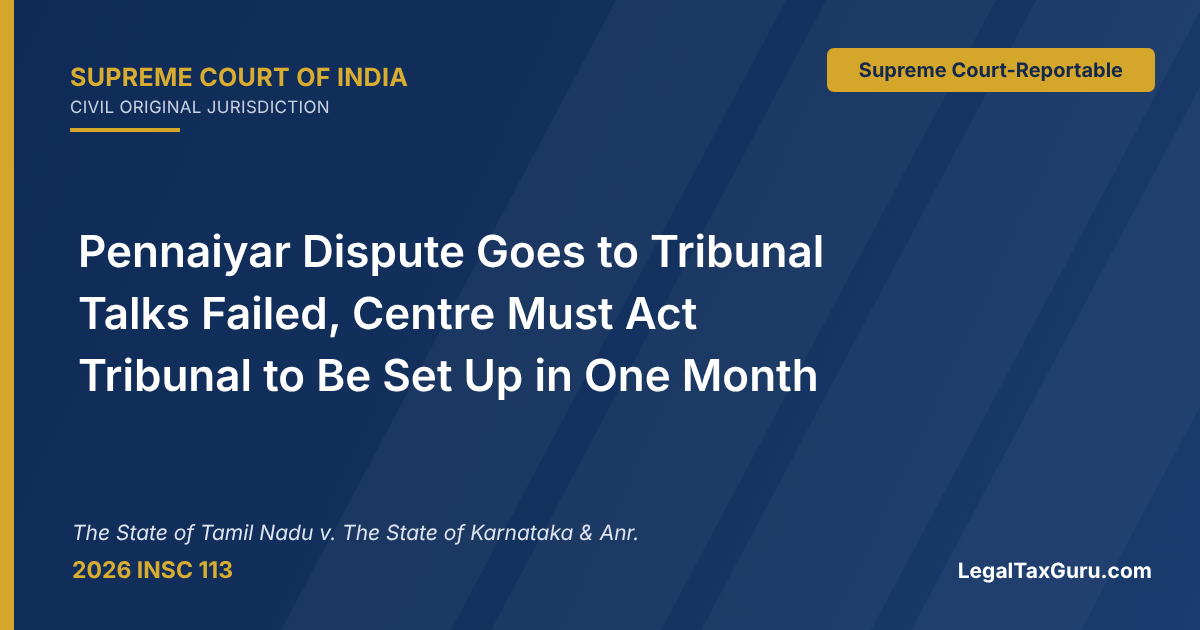
In The State of Tamil Nadu v. The State of Karnataka & Anr. (2026 INSC 113), the Supreme Court, exercising original jurisdiction under Article 131 of the Constitution, held that the negotiation process in the Pennaiyar river water dispute had not yielded any mutually acceptable outcome, and that the Central Government must therefore constitute a Tribunal under the statutory framework (paras 7–8). Relying on T.N. Cauvery Neerppasana Vilaiporulgal Vivasayigal Nala Urimai Padhugappa Sangam v. Union of India, a Bench of Justice Vikram Nath and Justice N.V. Anjaria directed the Centre to issue a notification in the Official Gazette and constitute a Water Disputes Tribunal within one month, and disposed of the suit (paras 9–10, 12).
Status: Original Suit No. 1 of 2018 disposed of with a direction to the Central Government to constitute a Water Disputes Tribunal within one month; all questions, including reliefs, kept open for the Tribunal (paras 10, 12–13).
Headnote: Pennaiyar River Water Disputes Tribunal
Constitution of India – Article 131 – Original suit between States – Inter-State River Water Disputes Act, 1956 – Sections 3 and 4 – Pennaiyar river – Check dam and diversion works by upper riparian State – Agreement of 1892 between Madras and Mysore – Failure of negotiations under the aegis of the Central Government – Mandatory constitution of Tribunal – Reliefs left open.
Held: (i) The dispute had been pending since 2018, and multiple efforts at an amicable resolution had not yielded any mutually acceptable outcome (para 7).
(ii) The Union's affidavit dated 07.10.2025 showed that, in view of Tamil Nadu's firm stand for adjudication by a Tribunal, the ministerial-level negotiations had been deferred indefinitely (paras 5, 8).
(iii) Following T.N. Cauvery Neerppasana Vilaiporulgal Vivasayigal Nala Urimai Padhugappa Sangam, where the statutorily prescribed negotiation process fails, it becomes imperative for the Central Government to constitute a Tribunal and refer the dispute to it (para 9).
(iv) The Central Government was directed to issue an appropriate notification in the Official Gazette and constitute a Water Disputes Tribunal within one month (para 10).
(v) All questions, including the reliefs that may be available to the parties, were kept open for the Tribunal (para 13).
(vi) With this direction, the suit was disposed of (para 12).
(paras 7–13)
Case Details: State of Tamil Nadu v. State of Karnataka (2026 INSC 113)
Final Outcome: Suit disposed of; Central Government directed to notify and constitute a Water Disputes Tribunal for the Pennaiyar river dispute within one month; all questions, including reliefs, kept open for the Tribunal.
Case: The State of Tamil Nadu v. The State of Karnataka & Anr.
Neutral Citation: 2026 INSC 113
Case No.: Original Suit No. 1 of 2018
Court: Supreme Court of India (Civil Original Jurisdiction) – Reportable
Date of Decision: 2 February 2026
Bench: Justice Vikram Nath (author) and Justice N.V. Anjaria
Relevant Acts & Sections: Constitution of India – Article 131; Supreme Court Rules, 2013 – Part III; Inter-State River Water Disputes Act, 1956 – Sections 3 and 4
Impugned Order: None; original suit under Article 131 of the Constitution (para 1)
Counsel: Mr. V. Krishnamurthy and Mr. P. Wilson, Senior Advocates, for the plaintiff-State of Tamil Nadu; Mr. Shyam Diwan and Mr. Mohan V. Katarki, Senior Advocates, with Mr. Shashi Kiran Shetty, Advocate-General, for the defendant-State of Karnataka; Ms. Aishwarya Bhati, Additional Solicitor General, for the Union of India (para 6)
Source: Supreme Court of India (official website)
Key Holdings of the Supreme Court
- The negotiation process in the Pennaiyar river water dispute had failed to yield any mutually acceptable outcome (para 7).
- The Union had deferred the negotiations indefinitely in view of Tamil Nadu's stand that the dispute be resolved by a Tribunal (para 8).
- Once negotiation under the aegis of the Central Government fails, constituting a Tribunal is imperative under Section 4 of the 1956 Act (para 9).
- The Centre must notify and constitute a Water Disputes Tribunal within one month (para 10).
- The Court did not decide the merits; all questions and reliefs are for the Tribunal (para 13).
Brief Facts of the Case
Tamil Nadu and Karnataka are two of the three basin States, along with the Union Territory of Puducherry, through which the inter-State river Pennaiyar flows. Tamil Nadu sued under Article 131, seeking a declaration that Karnataka's unilateral construction of check dams, dams and diversion structures on the Pennaiyar and its tributaries without its prior consent was illegal, an injunction against the check dam across Markandeyanadhi near Yargol village, a direction to ensure natural flows, and a direction to the Union to act on its letter dated 16.03.2018 (paras 1, 2.1).
Tamil Nadu relied on an 1892 agreement between the erstwhile States of Madras and Mysore and alleged that five works planned by Karnataka would reduce the waters reaching it and affect lakhs of farmers. By its reply dated 01.07.2013, Karnataka asserted that the 1892 agreement was a political arrangement that ceased to have effect after independence, so no consent of the lower riparian State was required (paras 2.2–2.6).
The plaint is dated 18.05.2018. On 14.11.2019, the Court declined interim relief because about 75% of the construction was complete and the project prima facie had the requisite sanctions, but granted liberty to approach the Central Government for a Tribunal. Tamil Nadu lodged a complaint under Section 3 of the 1956 Act on 30.11.2019 and also applied to this Court for a direction to constitute a Tribunal (paras 2.7–3).
The Union's affidavits dated 02.01.2025 and 07.10.2025 recorded that the Negotiation Committee could not reach consensus, that Karnataka had offered a total 15% release of water at the border, that Tamil Nadu maintained that a Tribunal be constituted, and that the ministerial meeting had been postponed indefinitely (paras 4–5).
Issues Before the Supreme Court
- Whether, in view of the failure of negotiations, the Central Government should be directed to constitute a Tribunal for the Pennaiyar river water dispute (paras 7–10).
Court's Findings and Reasoning
Negotiations exhausted (para 7): The Court noted that the dispute had been pending since 2018 and that multiple efforts by the stakeholders had not produced any mutually acceptable outcome. Given the parties' inability to settle, it considered it appropriate to call upon the Central Government to constitute a Tribunal under the statutory framework.
Union's own record (para 8): The Union's affidavit dated 07.10.2025 recorded that Tamil Nadu had unequivocally conveyed that the dispute should be resolved through adjudication by a Tribunal, and that the Union had therefore deferred the negotiation process indefinitely.
Constitution of Tribunal mandatory (para 9): Relying on T.N. Cauvery Neerppasana Vilaiporulgal Vivasayigal Nala Urimai Padhugappa Sangam, the Court reiterated that Parliament substituted "may" with "shall" in Section 4, and that once the stage is reached where the water dispute can no longer be settled by negotiation, the Central Government is obliged to constitute a Tribunal and refer the dispute to it.
Direction (para 10): The Court found no reason to refrain from directing the Central Government to issue a notification in the Official Gazette and constitute a Water Disputes Tribunal within one month.
Final Outcome and Directions
- The Central Government shall issue an appropriate notification in the Official Gazette and constitute a Water Disputes Tribunal for adjudication of the dispute within one month (para 10).
- The suit stands disposed of with this direction (para 12).
- All questions, including those relating to the reliefs available to the parties, are kept open for the Tribunal (para 13).
Legal Principle Laid Down
Where a complaint under Section 3 of the Inter-State River Water Disputes Act, 1956 has been made and the negotiation process conducted under the aegis of the Central Government fails to resolve the dispute, the Central Government is obliged under Section 4 to constitute a Water Disputes Tribunal and refer the dispute to it; the Supreme Court may direct it to do so within a fixed time, leaving the merits to the Tribunal (paras 9–10, 13).
Precedents Relied Upon
- T.N. Cauvery Neerppasana Vilaiporulgal Vivasayigal Nala Urimai Padhugappa Sangam v. Union of India, (1990) 3 SCC 440 – Relied upon – constitution of a Tribunal under Section 4 is mandatory once negotiation fails. Discussed at para 9.
Important Paragraphs of the Judgment
Verbatim extracts from the judgment. For the full text, refer to the judgment PDF below.
Para 7: "However, we have no hesitation in recording that the negotiation process has not yielded any mutually acceptable outcome."
Para 7: "In view of the inability of the parties to arrive at a common settlement, we consider it appropriate to call upon the Central Government to constitute a Tribunal in terms of the statutory framework, so that the dispute may be adjudicated in accordance with law."
Para 8: "It was in view of this firm stand adopted by the plaintiff-State that defendant no. 2 took a decision to indefinitely defer the negotiation process."
Para 9: "where the statutorily prescribed negotiation process conducted under the aegis of the Central Government fails to bring about a resolution of an inter-State River water dispute, it becomes imperative for the Central Government to constitute a River Water Disputes Tribunal, and to refer the dispute for adjudication to such Tribunal."
Para 10: "We, therefore, find no reason to refrain from directing the Central Government to issue an appropriate notification in the Official Gazette and to constitute a Water Disputes Tribunal for the adjudication of the inter se water dispute between the parties herein, within a period of one month from today."
Para 13: "Needless to mention that all questions, including those relating to the reliefs that may be available to the parties, are kept open for consideration by the Tribunal."
Practical Impact of the Ruling
- For riparian States: Once negotiations under the Centre's aegis have clearly failed, a State can obtain a time-bound direction for constitution of a Tribunal (paras 9–10).
- For the Central Government: Prolonged or indefinitely deferred negotiations do not relieve the Centre of its obligation under Section 4 of the 1956 Act (paras 8–9).
- For the Pennaiyar dispute: Issues such as the effect of the 1892 agreement, the check dam works and the reliefs claimed will be decided by the Tribunal, not by the Supreme Court in the suit (paras 2.6, 13).
- For practitioners: The ruling applies T.N. Cauvery Sangam to direct constitution of a Tribunal in an Article 131 suit (paras 1, 9–10).
FAQs on Pennaiyar River Water Disputes Tribunal
1. What did the Supreme Court decide in State of Tamil Nadu v. State of Karnataka?
It directed the Central Government to notify and constitute a Water Disputes Tribunal for the Pennaiyar river dispute within one month and disposed of the suit (paras 10, 12).
2. Why did the Court direct constitution of a Tribunal?
Because the negotiation process since 2018 had not yielded any mutually acceptable outcome, and the Union had deferred negotiations indefinitely (paras 7–8).
3. Is the Central Government bound to constitute a Tribunal?
Yes. Following T.N. Cauvery Sangam, once a dispute cannot be settled by negotiation, constitution of a Tribunal under Section 4 of the 1956 Act is mandatory (para 9).
4. Did the Court decide whether Karnataka's check dam was illegal?
No. All questions, including the reliefs available to the parties, are kept open for the Tribunal (para 13).
5. Was interim relief granted earlier against the Yargol dam?
No. On 14.11.2019 the Court declined interim relief since about 75% of the work was complete and prima facie sanctioned, but gave liberty to seek a Tribunal (para 2.9).
Keywords: 2026 INSC 113, State of Tamil Nadu v. State of Karnataka, Pennaiyar river, Pennaiyar water dispute, Inter-State River Water Disputes Act 1956, Section 4, Water Disputes Tribunal, Article 131, original suit, Yargol dam, Markandeyanadhi, 1892 agreement, T.N. Cauvery Sangam, Justice Vikram Nath, Justice N.V. Anjaria, Supreme Court reportable judgment
Related on LegalTaxGuru
Download Judgment PDF – State of Tamil Nadu v. State of Karnataka
Judgment PDF: 2026 INSC 113 – The State of Tamil Nadu v. The State of Karnataka & Anr. (Original Suit No. 1 of 2018) – Download Judgment PDF
Source: Supreme Court of India (official website).