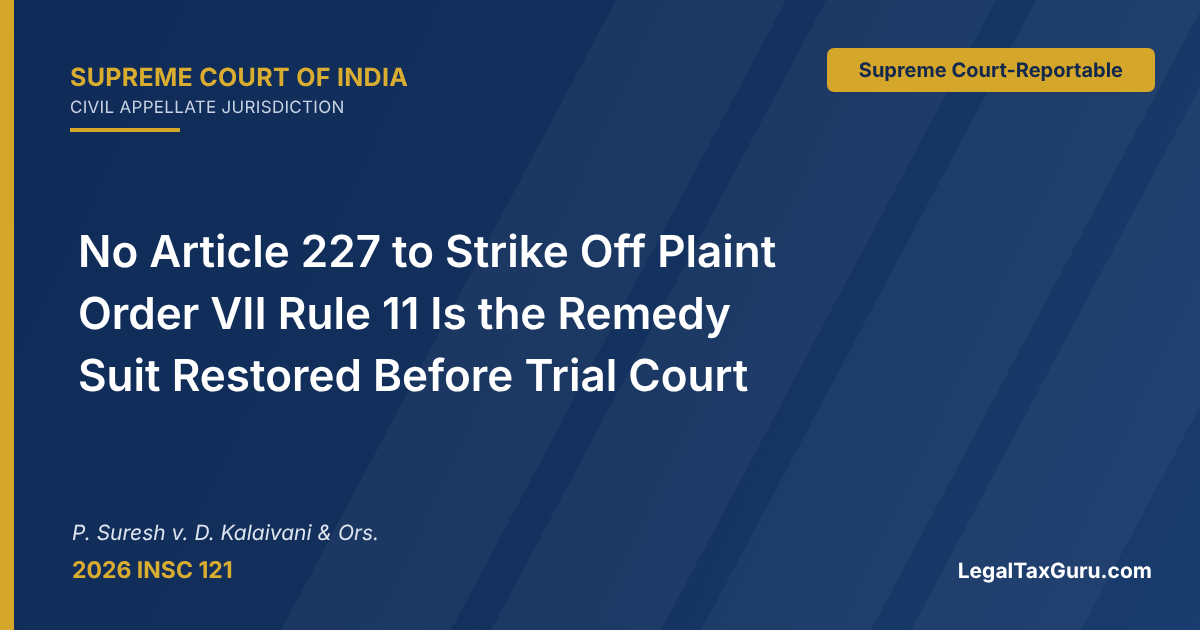
Quick Answer: A High Court cannot use its supervisory power under Article 227 of the Constitution to strike off a plaint when Order VII Rule 11 CPC already gives a specific remedy for rejecting it. The Supreme Court set aside a Madras High Court order that had struck off a suit for injunction as fraudulent. It restored the suit before the trial court and left the defendants free to apply under Order VII Rule 11.
In P. Suresh v. D. Kalaivani & Ors. (2026 INSC 121), the Supreme Court held that once the specific provision under Order VII Rule 11 of the CPC is available, the High Court cannot exercise powers under Article 227 to reject or strike off a plaint. An alternative remedy under the CPC is a near total bar on supervisory jurisdiction, except where its exercise becomes absolutely necessary (paras 7.1–7.4, 9). A Bench of Justice Aravind Kumar and Justice N.V. Anjaria also held that Order VI Rule 16 CPC permits striking out parts of a pleading, not the entire plaint (paras 6.4–6.4.1, 10).
Status: The Madras High Court's judgment dated 03.06.2025 in CRP No. 3197 of 2024 and CMP No. 17106 of 2024 is set aside. Original Suit No. 93 of 2020 is restored before the District Munsif, Tambaram, with liberty to file an Order VII Rule 11 application, and the appeal is allowed (paras 10.1, 11).
Headnote: Article 227 Cannot Be Used to Strike Off a Plaint
Constitution of India – Article 227 – Supervisory jurisdiction of High Court – Alternative remedy under CPC – Code of Civil Procedure, 1908 – Order VII Rule 11 – Rejection of plaint – Order VI Rule 16 – Striking out pleadings – Suit for permanent injunction – Allegation of fabricated sale deed – Disputed questions of fact – Civil revision petition – Striking off plaint.
Held: (i) The power under Article 227 is supervisory and discretionary and must be exercised sparingly. It is not meant to correct mere errors and cannot be used as an appeal in disguise (paras 5.1–5.4).
(ii) Where proceedings are under the CPC before a civil court, an available CPC remedy is to be treated as a near total bar on exercising Article 227 jurisdiction (paras 5.6.2–5.7, 7.4).
(iii) The grounds for rejecting a plaint under Order VII Rule 11 call for a factual inquiry. That inquiry should not be undertaken under Article 227, and supervisory jurisdiction cannot replace the remedy the CPC itself provides (paras 6.2.1–6.2.3).
(iv) Order VI Rule 16 deals with striking out a part of a pleading that is unnecessary, scandalous, frivolous, vexatious or abusive. It cannot be stretched to strike down the entire plaint, and it cannot justify using Article 227 (paras 6.1.1, 6.4–6.4.1).
(v) Civil suits usually involve disputed questions of fact to be decided on evidence. Property disputes should not be taken up under Article 227 as a routine matter (paras 6.3–6.3.2).
(vi) Exercising supervisory jurisdiction is an exceptional step where an alternative efficacious remedy exists. The High Court should insist that the party use that remedy, out of regard for legislative intent (paras 7.1, 7.3, 8–9).
(paras 5–10)
Case Details: P. Suresh v. D. Kalaivani (2026 INSC 121)
Final Outcome: Appeal allowed. The High Court's order striking off the plaint is set aside, and the suit is restored, with the parties to appear before the trial court on 16.02.2026. The defendants have liberty to file an Order VII Rule 11 application, and no costs are awarded.
Case: P. Suresh v. D. Kalaivani & Ors.
Neutral Citation: 2026 INSC 121
Case No.: Civil Appeal No. 739 of 2026 (arising out of SLP (Civil) No. 20423 of 2025)
Court: Supreme Court of India (Civil Appellate Jurisdiction) – Reportable
Date of Decision: 3 February 2026
Bench: Justice Aravind Kumar and Justice N.V. Anjaria (author)
Relevant Acts & Sections: Constitution of India – Articles 226 and 227; Code of Civil Procedure, 1908 – Order VI Rule 16 and Order VII Rule 11
Impugned Order: Judgment and order dated 03.06.2025 of the High Court of Madras in CRP No. 3197 of 2024 and CMP No. 17106 of 2024. Acting under Article 227, the High Court struck off the plaint in Original Suit No. 93 of 2020 before the District Munsif, Tambaram (para 2.1).
Counsel: Mr. Abdulla Naseeh for the appellant; Mr. V. Prabhakar, Senior Advocate, with Mr. S. Rajappa, Advocate-on-Record, for the respondents (para 4)
Source: Supreme Court of India (official website)
Key Holdings of the Supreme Court
- Once Order VII Rule 11 CPC is available, the High Court cannot use Article 227 to reject or strike off a plaint (para 7.4).
- Supervisory jurisdiction cannot be used to replace a remedy that the CPC specifically provides (para 6.2.3).
- Order VI Rule 16 CPC allows only infirm or abusive parts of a pleading to be struck out, not the whole plaint (para 6.4.1).
- An alternative remedy displaces constitutional jurisdiction under Article 227 just as it does under Article 226 (para 7.2).
- An alternative civil remedy is a near total bar on Article 227 jurisdiction, except where its exercise becomes absolutely necessary (para 9).
- The High Court committed a manifest error and should have left the defendants to apply under Order VII Rule 11 (para 10).
Brief Facts of the Case
The appellant-plaintiff filed a suit before the District Munsif, Tambaram, seeking a permanent injunction to stop the defendants from interfering with his possession of the suit land. He claimed the land through a registered sale deed of 1975 in favour of his mother, inherited it as her sole legal heir, and had the revenue records mutated in his name (paras 3–3.1).
He alleged that defendant No. 2 trespassed and stopped him from erecting a fence, and that the defendants, who claimed to be relatives of the original owner, threatened to encroach on the land (para 3.1.1).
The defendants said the sale deed was fabricated, that the certified copy related to another document (a mortgage deed by a third party), and that they owned the land through purchases made in 1922 and 1928. They called the suit fraudulent (paras 3.2–3.3).
In a Civil Revision Petition under Article 227, the defendants argued that the plaintiff had not sought a declaration of title, and they relied on Order VII Rule 11 and Order VI Rule 16 CPC. The High Court found that the sale deed was forged and the suit false, and noted that the suit had been dismissed for default on 05.07.2022 and not pursued for about a year. It allowed the petition and struck off the plaint (paras 3.4–3.5).
Issues Before the Supreme Court
- Whether the High Court could exercise supervisory power under Article 227 to strike off a plaint when Order VII Rule 11 CPC provides a specific remedy (paras 2, 6.3).
- Whether Order VI Rule 16 CPC could justify striking off the entire plaint under Article 227 (paras 6, 6.4).
Court's Findings and Reasoning
Parties' submissions (paras 4.1–4.2): The appellant argued that Article 227 powers are supervisory and to be used sparingly, especially where Order VII Rule 11 is available. The respondents argued that the supervisory power is wide and that Order VI Rule 16 permits pleadings to be struck off.
Nature of Article 227 (paras 5–5.4): Relying on Shalini Shyam Shetty, Navjot Sandhu, A. Venkateshubbiah Naidu and Rajendra Diwan, the Court said the power must be kept to the minimum. It exists to keep subordinate courts within their authority, not to correct mere errors or act as an appeal in disguise.
CPC remedies bar Article 227 (paras 5.5–5.7): K. Valarmathi held that Article 227 cannot be invoked to supplant a statutory remedy under the CPC or to entertain a prayer for rejection of a plaint. Virudhunagar and Radhey Shyam hold that, in civil court proceedings, the availability of a CPC remedy is a near total bar.
Order VII Rule 11 needs factual inquiry (paras 6.2–6.2.3): Each ground for rejection, from the absence of a cause of action to the bar of law and the valuation and stamp defects, requires the facts to be considered. Such issues should not be decided under supervisory jurisdiction.
Title dispute and fraud plea (paras 6.3–6.3.2): The suit was essentially a title dispute, and the defence was that it rested on false documents. Such disputed facts have to be decided on evidence by the civil court, and Shalini Shyam Shetty disapproved of routinely entertaining property disputes under Article 227.
Order VI Rule 16 misapplied (paras 6.4–6.4.1): The rule allows the court to strike out infirm or abusive matter in a pleading. Striking down or rejecting the plaint on the legal grounds in Order VII Rule 11 is entirely different.
Self-imposed discipline (paras 7–9): Article 227 should not be exercised where not exercising it causes no miscarriage of justice or loss of remedy. Out of regard for legislative intent, the High Court should require the party to use the specific remedy.
Final Outcome and Directions
- The High Court's judgment dated 03.06.2025 in CRP No. 3197 of 2024 and CMP No. 17106 of 2024 striking off the plaint is set aside (paras 10–10.1).
- Original Suit No. 93 of 2020 is restored to its original file, and the parties are to appear before the trial court on 16.02.2026 without further notice (para 11).
- The defendants have liberty to file an application under Order VII Rule 11 CPC, to be considered strictly in accordance with law (para 11).
- The appeal is allowed with no costs, and pending applications are disposed of (para 11).
Legal Principle Laid Down
Where the Code of Civil Procedure provides a specific remedy, such as rejection of a plaint under Order VII Rule 11, the High Court should not exercise supervisory jurisdiction under Article 227 to reject or strike off a plaint. An alternative civil remedy is a near total bar on such jurisdiction, except where its exercise becomes absolutely necessary. Order VI Rule 16 allows only offending parts of a pleading to be struck out and cannot be used to strike down the entire plaint (paras 6.4.1, 7.1–7.4, 9).
Precedents Relied Upon
- Shalini Shyam Shetty v. Rajendra Shankar Patil, (2010) 8 SCC 329 – Relied upon – Article 227 is to be used sparingly, and property disputes are not to be entertained routinely. Discussed at paras 5.1–5.1.1, 6.3.1.
- State v. Navjot Sandhu, (2003) 6 SCC 641 – Relied upon – Article 227 is not for correcting mere errors or for use as an appeal in disguise. Discussed at para 5.2.
- A. Venkateshubbiah Naidu v. S. Chellappan, (2000) 7 SCC 695 – Relied upon – a party should be directed to use the available remedies first. Discussed at para 5.3.
- Rajendra Diwan v. Pradeep Kumar Ranibala, 2019 (20) SCC 143 – Relied upon – Article 227 is not an alternative appellate forum. Discussed at para 5.4.
- K. Valarmathi v. Kumaresan, 2025 SCC OnLine SC 985 – Relied upon – Article 227 cannot supplant Order VII Rule 11. Discussed at paras 5.5–5.5.1.
- Virudhunagar Hindu Nadargal Dharma Paribalana Sabai v. Tuticorin Educational Society, (2019) 9 SCC 538 – Relied upon – a CPC remedy is a near total bar. Discussed at paras 5.6–5.6.3, 7.3.
- Radhey Shyam v. Chhabi Nath, (2015) 5 SCC 423 (three-Judge Bench) – Relied upon – orders of civil courts stand on a different footing. It overruled Surya Dev Rai v. Ram Chander Rai, (2003) 6 SCC 675. Discussed at para 5.7.
Important Paragraphs of the Judgment
Verbatim extracts from the judgment. For the full text, refer to the judgment PDF below.
Para 6.2.3: "In any view, the overriding criteria in law is that the supervisory jurisdiction cannot be applied to substitute the remedy available specifically in the CPC itself."
Para 6.4.1: "It would be stretching beyond the logic of law to interpret and imply that Order VI Rule 16 can be utilized and employed for striking down the entire plaint."
Para 7.1: "The principle is therefore to be emphasized that the exercise of supervisory jurisdiction under Article 227 of the Constitution has to be treated as an exceptional resort when an alternative efficacious civil remedy by way of appeal or revision or any other, like Order VII Rule 11, CPC in the present case, is available to the party for the redressal of the grievance."
Para 7.4: "It is held, therefore, that once the specific provision under Order VII Rule 11 of the CPC, is available, the High Court cannot exercise powers under Article 227 to reject or strike off the plaint."
Para 9: "Availability of an alternative civil remedy and/or under the CPC shall be treated as complete and near total bar on the High Court to venture to invoke and exercise its power available under Article 227 of the Constitution, except where exercise of supervisory jurisdiction becomes absolutely necessary."
Para 10: "... this court is of the view that High Court committed a manifest error in exercising its powers under Article 227 of the Constitution to strike down the plaint."
Practical Impact of the Ruling
- For defendants: A plaint said to be false or fraudulent must be challenged under Order VII Rule 11 before the trial court, not through a revision under Article 227 (paras 7.4, 10, 11).
- For High Courts: Civil revision petitions under Article 227 that seek to strike off a plaint should not be entertained where a CPC remedy exists (paras 7.3, 9).
- For plaintiffs in property suits: Disputed questions of title and allegations of forged documents are for trial on evidence and cannot be decided summarily under supervisory jurisdiction (paras 6.3–6.3.2).
- For practitioners: Order VI Rule 16 can be used against offending parts of a pleading only, not to dispose of the whole suit (para 6.4.1).
FAQs on Article 227 and Rejection of Plaint
1. What did the Supreme Court hold in P. Suresh v. D. Kalaivani?
It held that the High Court cannot use Article 227 to reject or strike off a plaint when Order VII Rule 11 CPC is available. It set aside the order striking off the plaint and restored the suit (paras 7.4, 10–11).
2. Can a High Court strike off a plaint under Article 227 if it finds the suit fraudulent?
No. The plea that the suit rested on forged documents raised disputed questions of fact in a title dispute. The defendants had to use Order VII Rule 11 before the trial court (paras 6.3, 6.3.2, 10).
3. Can Order VI Rule 16 CPC be used to strike out the whole plaint?
No. It covers striking out unnecessary, scandalous, frivolous, vexatious or abusive matter in a pleading, not the entire plaint (paras 6.4–6.4.1).
4. Is the bar on Article 227 absolute where a CPC remedy exists?
It is a near total bar. Supervisory jurisdiction may be exercised only where it becomes absolutely necessary (paras 7.4, 9).
5. What happens to the suit now?
It is restored before the District Munsif, Tambaram, with the parties to appear on 16.02.2026. The defendants may file an Order VII Rule 11 application, to be decided strictly in accordance with law (para 11).
Keywords: 2026 INSC 121, P. Suresh v. D. Kalaivani, Article 227 Constitution, supervisory jurisdiction, Order VII Rule 11 CPC, rejection of plaint, Order VI Rule 16 CPC, striking out pleadings, alternative remedy, civil revision petition, suit for injunction, Virudhunagar, Radhey Shyam v. Chhabi Nath, K. Valarmathi v. Kumaresan, Justice N.V. Anjaria, Justice Aravind Kumar, Supreme Court judgment
Related on LegalTaxGuru
Download Judgment PDF – P. Suresh v. D. Kalaivani
Judgment PDF: 2026 INSC 121 – P. Suresh v. D. Kalaivani & Ors. (Civil Appeal No. 739 of 2026) – Download Judgment PDF
Source: Supreme Court of India (official website).