Quick Answer: ASMT-12 bars Section 73 notice on the same return discrepancies: the Rajasthan High Court held that Section 61 must be complied with first, and once the explanation is accepted in Form ASMT-12 no further proceedings lie. The show cause notice dated 21.09.2023 and the ASMT-12 enclosure retaining jurisdiction were set aside.
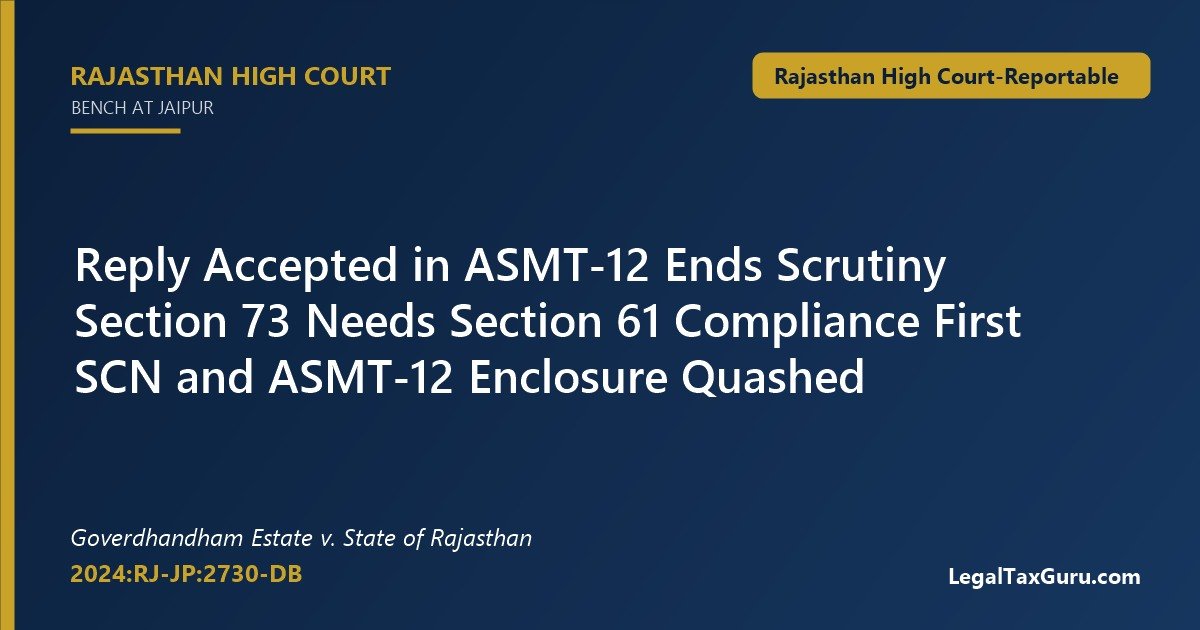
In Goverdhandham Estate Private Limited v. State of Rajasthan & Ors. (2024:RJ-JP:2730-DB), the Rajasthan High Court held that an ASMT-12 acceptance bars a Section 73 notice on the same return discrepancies (paras 27–29). A Division Bench of Acting Chief Justice Manindra Mohan Shrivastava and Justice Shubha Mehta distinguished the Allahabad High Court's Nagarjuna Agro Chemicals ruling (para 23). The show cause notice dated 21.09.2023 and the enclosure to the ASMT-12 retaining jurisdiction were set aside (para 29).
Headnote: ASMT-12 Bars Section 73 Notice
CGST Act, 2017 and Rajasthan GST Act, 2017 – Sections 17(5)(c), (d), 61, 73 and 74 – CGST/RGST Rules, 2017 – Rule 99 – Forms GST ASMT-10, ASMT-11 and ASMT-12 – Scrutiny of returns – Satisfactory explanation – Show cause notice on return discrepancies – ITC on lifts and air conditioners in hotel
Held: (i) Under Section 61(3), Sections 73 and 74 can be invoked only when no satisfactory explanation is furnished, or discrepancies accepted are not corrected (para 17).
(ii) Once an explanation is offered, the proper officer must examine it and record reasons on whether it is satisfactory (paras 18–19).
(iii) The Section 73 notice did not record that the explanation was unsatisfactory or deal with the "plant and machinery" plea (paras 20–22).
(iv) Where the notice rests only on return discrepancies, Section 61 must be followed before Section 73; Nagarjuna Agro Chemicals distinguished (paras 23–25).
(v) Once the explanation is accepted in Form ASMT-12, no further proceedings can be drawn (paras 26–28).
(vi) The show cause notice and the ASMT-12 enclosure retaining jurisdiction are illegal and set aside (para 29).
(paras 13–30)
Case Details: Goverdhandham Estate v. State of Rajasthan (2024:RJ-JP:2730-DB)
Final Outcome: Writ petition allowed; show cause notice dated 21.09.2023 and the assumption of power in the enclosure to ASMT-12 dated 29.09.2023 declared illegal and set aside; no order as to costs (paras 29–30).
Case: Goverdhandham Estate Private Limited, through its Director v. State of Rajasthan & Ors.
Neutral Citation: 2024:RJ-JP:2730-DB
Case No.: D.B. Civil Writ Petition No. 16702/2023
Court: Rajasthan High Court, Bench at Jaipur (Division Bench)
Date of Decision: 17 January 2024
Bench: Acting Chief Justice Manindra Mohan Shrivastava and Justice Shubha Mehta
Relevant Acts & Sections: Rajasthan GST Act, 2017 and CGST Act, 2017 – Sections 7, 9, 17(5)(c) and (d), 50, 59, 60, 61, 65, 66, 67, 73 and 74; CGST/RGST Rules, 2017 – Rule 99; Forms GST ASMT-10, ASMT-11 and ASMT-12; Constitution of India – Article 226
Impugned Order: Show cause notice dated 21.09.2023 under Section 73; enclosure to Form GST ASMT-12 dated 29.09.2023 stating that the SCN remained valid (paras 2, 6–7)
Counsel: Mr. Sandeep Taneja with Mr. Kartikey Sharma for the petitioner; Mr. Punit Singhvi, Mr. Ayush Singh, Mr. Ajay Shukla and Mr. Pushpendra Badgoti for the respondents.
Source: Rajasthan High Court (official website)
Key Holdings of the Rajasthan High Court
- Section 61(2) mandates that where the explanation is acceptable, "no further action shall be taken" (paras 15–17).
- Sections 73 and 74 are reached through Section 61(3) only when no satisfactory explanation is furnished (para 17).
- "In case no satisfactory explanation is furnished" must be construed meaningfully, not as an empty formality (para 19).
- The proper officer must examine the explanation and record reasons before issuing a Section 73 notice (para 19).
- A Section 73 notice silent on the "plant and machinery" explanation falls short of the legal requirement (paras 20–22).
- Where the notice rests only on return discrepancies, Section 61 is a precondition; Nagarjuna Agro Chemicals concerned independent material (paras 23–25).
- After ASMT-12 acceptance, retaining jurisdiction by an enclosure is a "misconceived notion of law" (para 28).
Brief Facts of the Case
The petitioner runs a hotel and is registered under GST (para 3). Its GSTR-3B returns for FY 2017-18 were scrutinised, and on 01.09.2023 a notice in Form GST ASMT-10 was issued under Section 61 (para 3).
The notice said ITC on lifts bought from M/s Kone Elevators India Pvt. Ltd. and on air conditioners was blocked under Section 17(5) (para 3). It proposed reversal of Rs. 18,44,884 (SGST and CGST of Rs. 9,22,442 each) with interest (para 3).
On 15.09.2023, the petitioner filed a preliminary reply, seeking time till 01.10.2023 (para 4). It argued that lifts and air conditioners are plant and machinery used for hotel services, outside clauses (c) and (d) of Section 17(5) (paras 4–5).
On 21.09.2023, a Section 73 show cause notice was issued (para 6). On 29.09.2023, Form GST ASMT-12 accepted the reply as satisfactory, but an enclosure said this did not affect the SCN (para 7). The SCN was not withdrawn (para 8).
Issues Before the High Court
- Whether a Section 73 notice can be issued on return discrepancies without considering the explanation given to the Section 61 notice (paras 9, 18–22).
- Whether, after acceptance of the explanation in Form ASMT-12, proceedings under Section 73 can continue on the same discrepancies (paras 10, 26–28).
- Whether Sections 61 and 73 are independent powers, as held in Nagarjuna Agro Chemicals (paras 12, 23).
Court's Findings and Reasoning
Petitioner's case (paras 9–10): Once Section 61 scrutiny was invoked, Section 73 could not be invoked without considering the explanation (para 9). Once the explanation was accepted, no proceedings under Section 73 could be drawn on the return discrepancy (para 10).
Revenue's case (paras 11–12): The reply was "half-hearted", but was considered, and only then was Section 73 invoked (para 11). Section 73(1) is not confined to scrutiny discrepancies, and Sections 61 and 73 are independent, relying on Nagarjuna Agro Chemicals (paras 11–12).
Notice founded on return discrepancies (para 14): The ASMT-10 notice showed jurisdiction was invoked on discrepancies in the return "and not on the basis of any other material" (para 14).
Scheme of Section 61 (paras 15–17): Section 61(1) allows scrutiny and seeking an explanation. Sub-section (2) applies where it is acceptable, and sub-section (3) where it is not (para 16). Only under sub-section (3) does the officer assume jurisdiction under Sections 65, 66, 67, 73 or 74 (para 17).
Duty to consider the explanation (paras 18–19): Before a Section 73 notice, the officer was "mandated under the law" to consider the explanation (para 18). Faced with a preliminary reply and a time request, the officer had to extend time or apply mind to the reply (para 19).
Notice silent on explanation (paras 20–22): The notice of 21.09.2023 nowhere recorded that the explanation was unsatisfactory (para 20). It merely reproduced Section 17(5) and ignored the "plant and machinery" plea (paras 21–22).
Nagarjuna Agro Chemicals distinguished (paras 23–25): That case involved action on independent grounds of classification, with no Section 61 proceeding (para 23). Here the Section 73 notice rested on return discrepancies, so Section 61 had to be followed first (paras 24–25).
Effect of ASMT-12 (paras 26–28): The ASMT-12 of 29.09.2023 accepted the reply as satisfactory under Section 61(2) and Rule 99(3) (para 26). Once the explanation is offered and accepted, "further proceedings are not required to be drawn" (para 27). The enclosure retaining jurisdiction reflected a "misconceived notion of law" (para 28).
Application to facts (para 29): The show cause notice was against Section 61. The notice and the assumption of power in the ASMT-12 enclosure were declared illegal and set aside (para 29).
Final Outcome and Directions
- The show cause notice dated 21.09.2023 was declared illegal and set aside (para 29).
- The assumption of power in the enclosure to ASMT-12 dated 29.09.2023 was also set aside (para 29).
- The writ petition was allowed with no order as to costs (para 30).
- No liberty to issue a fresh notice on the same discrepancies was reserved (paras 28–30).
Legal Principle Laid Down
Where the department scrutinises returns under Section 61 and the show cause notice under Section 73 rests only on discrepancies in those returns, Section 61 is a mandatory precondition. The proper officer must consider the explanation and record why it is unsatisfactory before invoking Section 73. Once the explanation is accepted in Form GST ASMT-12, no further proceedings can be drawn on those discrepancies (paras 17–19, 25–28).
Precedents Relied Upon
- Nagarjuna Agro Chemicals Pvt. Ltd. v. State of U.P. & Anr., Writ Tax No. 336/2023 (Allahabad High Court, Division Bench) – Distinguished – Sections 61 and 74 are separate where action rests on independent material; not applicable where the notice rests on return discrepancies. Discussed at paras 12, 23–24.
Important Paragraphs of the Judgment
Verbatim extracts from the judgment. For the full text, refer to the judgment PDF below.
Para 17: "It is only when no satisfactory explanation is furnished within the stipulated period or where discrepancy having been accepted, corrective measures are not taken, the proper officer assumes jurisdiction to initiate appropriate proceedings under Sections 65 or 66 or 67 or proceed to determine the tax and other dues under Section 73 or Section 74."
Para 19: "The statutory scheme engrafted in Section 61 does not allow the authority to invoke powers under Section 73 of the Act and issue show cause notice unless the explanation submitted by the registered person is considered."
Para 23: "Where show cause notice is based on discrepancies found in the return and not on any other independent material, the proper officer is obliged under the law to follow the mandate of Section 61 before invoking jurisdiction under Section 73 of the Act."
Para 28: "It appears that the proper officer under a misconceived notion of law sought to retain jurisdiction contrary to the provisions of law. Where the discrepancy in the return is found, the law requires explanation to be obtained from the registered person. The power under Section 73 could be invoked only when the explanation offered is not satisfactory. Once the explanation is accepted, no further proceedings could be drawn."
Para 29: "In view of above, the show cause notice issued to the petitioner is found against the provisions contained in Section 61 of the Act. Resultantly, the show cause notice as well as the assumption of power under enclosure to ASMT-12 both are declared illegal and unsustainable in law and therefore set aside."
Practical Impact of the Ruling
- For taxpayers under scrutiny: Reply to ASMT-10 on substance; an accepted reply in ASMT-12 closes the matter on those discrepancies (paras 26–28).
- For proper officers: A Section 73 notice on return discrepancies must record why the Section 61 explanation is unsatisfactory (paras 19–20).
- For practitioners: Check whether the SCN rests only on return discrepancies; if so, Section 61 non-compliance is a strong ground (paras 23–25).
- For hotels and service providers: The Court did not decide whether lifts and air conditioners are "plant and machinery" under Section 17(5); only the procedure was decided (paras 22, 29).
- For the department: Boilerplate enclosures to ASMT-12 cannot keep a Section 73 notice alive (para 28).
FAQs on ASMT-12 Bars Section 73 Notice
1. What did the Rajasthan High Court hold in Goverdhandham Estate v. State of Rajasthan?
It held that once the ASMT-10 explanation is accepted in ASMT-12, no Section 73 proceedings can be drawn on the same return discrepancies. The SCN and the ASMT-12 enclosure were set aside (paras 27–29).
2. Can a Section 73 notice be issued without considering the Section 61 reply?
No, where the notice rests on return discrepancies. The officer must consider the explanation and record whether it is satisfactory (paras 18–19, 23).
3. Are Sections 61 and 73 independent powers?
They can be where action rests on independent material, as in Nagarjuna Agro Chemicals. But where the notice rests only on return discrepancies, Section 61 must be followed first (paras 23–25).
4. What is the effect of Form GST ASMT-12?
It records that the explanation is acceptable under Section 61(2) and Rule 99(3). Thereafter, no further action can be taken on those discrepancies (paras 26–27).
5. Did the Court decide ITC eligibility on lifts and air conditioners?
No. It decided only the procedural question under Section 61 and set aside the notice, without ruling on Section 17(5) (paras 22, 29).
Keywords: ASMT-12 bars Section 73 notice, Goverdhandham Estate v. State of Rajasthan, 2024:RJ-JP:2730-DB, D.B. Civil Writ Petition No. 16702/2023, Section 61 CGST Act, Section 61(3), Section 73 show cause notice, Rule 99, ASMT-10, Section 17(5) plant and machinery, Nagarjuna Agro Chemicals, GST litigation lawyer, Rajasthan High Court
Related on LegalTaxGuru
- More High Court judgments on GST and indirect tax
- GST articles and updates
- No ASMT-10 Scrutiny Notice, No Valid GST Demand – Ramhari and Brothers v. Joint Commissioner (State Tax)
Download Judgment PDF – Goverdhandham Estate v. State of Rajasthan
Source: Rajasthan High Court (official website).
Read more: Rajasthan High Court · GST · Scrutiny of Returns · Indirect Tax