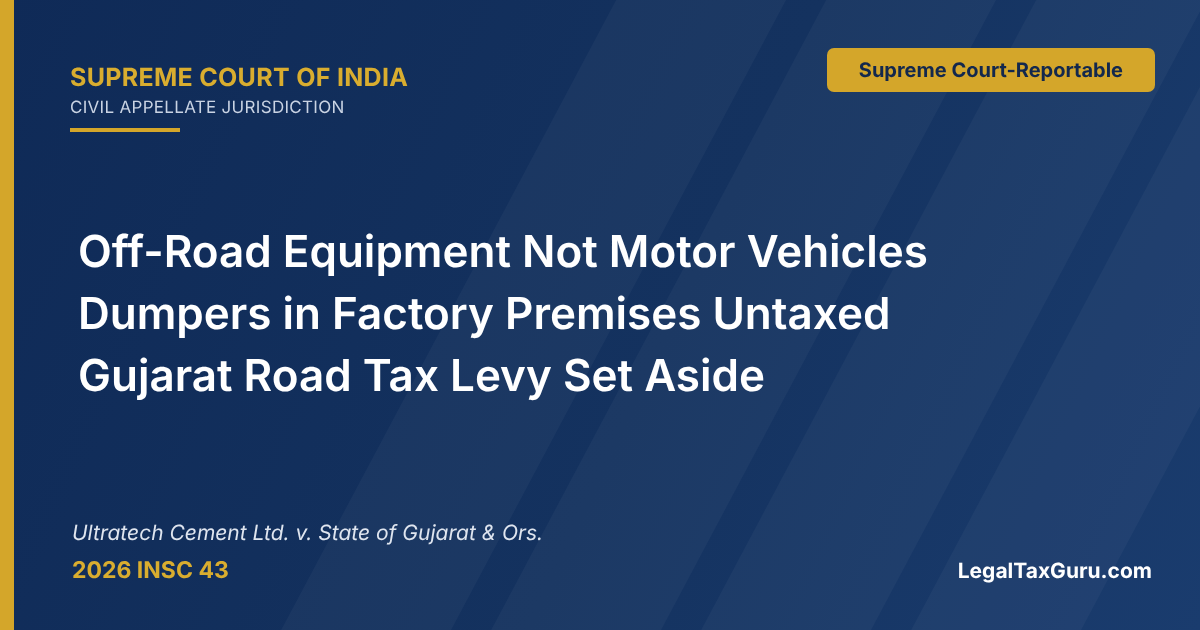
Quick Answer: Construction equipment vehicles such as Dumpers, Loaders, Excavators, Surface Miners, Dozers, Drills and Rock Breakers, which are special-type vehicles meant for use only within a factory or other enclosed premises and not on roads, fall outside the definition of "motor vehicle" in Section 2(28) of the Motor Vehicles Act, 1988 and are not liable to road tax under the Gujarat Motor Vehicles Tax Act, 1958. The Supreme Court set aside the Gujarat High Court judgments upholding the levy on Ultratech Cement's off-road equipment, while clarifying that such vehicles found using roads remain subject to the law.
In Ultratech Cement Ltd. v. State of Gujarat & Ors. (2026 INSC 43), the Supreme Court held that although such vehicles fall within the first part of Section 2(28), they stand excluded by its second part as "a vehicle of a special type adapted for use only in a factory or in any other enclosed premises" (paras 37–39). Entry 57 of List II permits tax only on vehicles suitable for use on roads, the Gujarat Tax Act cannot travel beyond it, and Schedule I prescribes no rate for construction equipment vehicles (paras 31, 42, 44, 55). A Bench of Justice Pankaj Mithal and Justice Prasanna B. Varale followed Bolani Ores Ltd. v. State of Orissa and allowed the appeals (paras 45, 56).
Status: Gujarat High Court judgments dated 15.07.2011 and 19.12.2012 set aside; Civil Appeal Nos. 3352-3353, 3357 and 3358 of 2017 allowed; no order as to costs (para 56).
Headnote: Road Tax on Off-Road Construction Equipment Vehicles
Motor Vehicles Act, 1988 – Section 2(28) – Gujarat Motor Vehicles Tax Act, 1958 – Sections 2(10), 3(1) and Schedule I – Constitution of India – Article 265 and Entry 57 of List II of the Seventh Schedule – Central Motor Vehicles Rules, 1989 – Rule 2(cab) – Heavy Earth Moving Machinery – Construction equipment vehicles – Dumpers, Loaders, Excavators, Surface Miners – Off-road use within factory or enclosed premises – Exclusion from definition of motor vehicle – Liability to road tax – MoRTH circular dated 13.07.2020.
Held: (i) Read with Article 265, Entry 57 of List II permits the State to levy tax only on vehicles suitable for use on roads; Section 3 of the Gujarat Tax Act, which taxes all motor vehicles used or kept for use in the State, cannot travel beyond Entry 57 (paras 26–28, 31).
(ii) "Motor vehicle" in the Gujarat Tax Act takes its meaning from Section 2(28) of the Motor Vehicles Act, 1988, which has an inclusive first part and an exclusive second part; the second part consciously excludes vehicles of a special type adapted for use only in a factory or other enclosed premises (paras 33–37).
(iii) The appellants' vehicles are construction equipment vehicles meant for use only within enclosed premises, carried to site on trailers, with no road-worthiness certificate issued by manufacturers; though within the first part of Section 2(28), they stand excluded by the second part (paras 38–39).
(iv) Under Rule 2(cab) of the Central Motor Vehicles Rules, 1989 such vehicles are "construction equipment vehicles" of a special kind, and Schedule I of the Gujarat Tax Act prescribes no rate of tax for them, so they are not chargeable (paras 40–42).
(v) The MoRTH circular dated 13.07.2020, clarifying that such vehicles not run on roads do not qualify as motor vehicles, may not override the statute but is binding on the departmental authorities, as held in K.P. Varghese v. ITO (para 43).
(vi) Bolani Ores Ltd. v. State of Orissa supports this view; Natwar Parikh, Western Coalfields and the Division Bench decisions to the contrary did not consider the exclusion in the second part of Section 2(28). Such vehicles found using roads are not free from Section 2(28) and Section 3 and may face seizure and penalty (paras 45–55).
(paras 26–56)
Case Details: Ultratech Cement Ltd. v. State of Gujarat (2026 INSC 43)
Final Outcome: Appeals allowed; High Court judgments dated 15.07.2011 and 19.12.2012 set aside; no order as to costs.
Case: Ultratech Cement Ltd. v. The State of Gujarat & Ors. (with connected appeals)
Neutral Citation: 2026 INSC 43
Case No.: Civil Appeal Nos. 3352-3353 of 2017 with Civil Appeal No. 3357 of 2017 and Civil Appeal No. 3358 of 2017
Court: Supreme Court of India (Civil Appellate Jurisdiction) – Reportable
Date of Decision: 8 January 2026
Bench: Justice Pankaj Mithal (author) and Justice Prasanna B. Varale
Relevant Acts & Sections: Motor Vehicles Act, 1988 – Sections 2(28), 39; Gujarat Motor Vehicles Tax Act, 1958 – Sections 2(10), 3(1) and Schedule I; Central Motor Vehicles Rules, 1989 – Rule 2(cab); Constitution of India – Article 265 and Entry 57 of List II of the Seventh Schedule
Impugned Order(s): Judgments and orders of the High Court of Gujarat dated 15.07.2011 and 19.12.2012 (paras 15, 56)
Counsel: Shri P. Chidambaram, Senior Counsel, for the appellant in Civil Appeal Nos. 3352-3353 of 2017; Shri Nakul Dewan, Senior Counsel, for the appellant in Civil Appeal Nos. 3357 and 3358 of 2017; Shri K. Parameshwar, Senior Counsel, for the State of Gujarat (paras 1, 22)
Source: Supreme Court of India (official website)
Key Holdings of the Supreme Court
- The State's power to tax vehicles under Entry 57 of List II extends only to vehicles suitable for use on roads (paras 28, 31, 44).
- Section 2(28) of the Motor Vehicles Act excludes vehicles of a special type adapted for use only in a factory or other enclosed premises (para 37).
- The appellants' Dumpers, Loaders, Excavators, Surface Miners, Dozers, Drills and Rock Breakers are such special-type construction equipment vehicles and stand excluded (paras 5, 38–39, 41).
- Schedule I of the Gujarat Tax Act prescribes no rate of tax on construction equipment vehicles, so no tax can be collected on them (para 42).
- The MoRTH circular dated 13.07.2020 binds the departmental authorities (para 43).
- Decisions holding such vehicles taxable did not consider the second part of Section 2(28) and were held inapplicable (paras 47–53).
- If such vehicles are found using roads, they remain subject to Section 2(28), Section 3 and proceedings for seizure and penalty (para 55).
Brief Facts of the Case
Ultratech Cement Ltd. manufactures clinker and cement at two plants in Gujarat and uses Heavy Earth Moving Machinery and construction equipment there; in the leading appeals these were mainly Dumpers and Loaders, and in the connected appeals Excavators, Surface Miners, Dozers, Drillers and Rock Breakers (paras 4–5). The vehicles were transported to the premises in dismantled condition on trailers and used only within the factory or enclosed premises (para 9).
The Regional Transport Officer, Bhuj, by letter dated 04.06.1996 acknowledged that Dumpers used within private premises did not require registration. However, a press advertisement of 20.11.1999 by the Transport Commissioner directed registration of all special service vehicles and payment of road tax, and an inspection in January 2000 led to a direction to register and pay tax. The appellant protested on 02.02.2000 (paras 6–8).
Certificates from Bharat Earth Movers Limited (23.03.2000), Hindustan Motors Limited (17.03.2000) and the Automotive Research Association of India (04.06.2004) stated that the vehicles were meant for off-road use only; these were not controverted by the State (paras 10–13).
A show cause notice dated 09.11.2006 demanded Rs. 59,39,401 towards registration fee, tax and arrears with 2 per cent interest and 25 per cent penalty from 1999. The appellant registered the vehicles and deposited Rs. 88.45 lakhs under protest. Its challenge to the notice and claim for refund were dismissed by the High Court on 15.07.2011, holding the vehicles to be motor vehicles chargeable to tax (paras 14–15).
Issues Before the Supreme Court
- Whether Heavy Earth Moving Machinery, special services vehicles or construction equipment vehicles such as Dumpers, Loaders, Excavators, Surface Miners, Dozers, Drills and Rock Breakers are "motor vehicles" within Section 2(28) of the Motor Vehicles Act, 1988 (paras 2, 25, 32).
- Whether such vehicles are liable to tax under the Gujarat Motor Vehicles Tax Act, 1958 (paras 2, 25).
Court's Findings and Reasoning
Constitutional limit (paras 26–31): On a conjoint reading of Article 265 and Entry 57 of List II, the State can tax motor vehicles only if they are suitable for use on roads. Section 3 of the Gujarat Tax Act omits the words "suitable for use on roads", but it cannot travel beyond Entry 57.
Two-part definition (paras 33–39): By Section 2(10) of the Gujarat Tax Act, "motor vehicle" bears the meaning in Section 2(28) of the 1988 Act. The second part of that definition excludes vehicles running on fixed rails and special-type vehicles adapted for use only in a factory or enclosed premises. The appellants' vehicles, though capable of being used on roads, are essentially meant for enclosed premises, do not ply on roads even to reach the site, and carry no road-worthiness certificate; they are therefore excluded.
Rules and Schedule (paras 40–42): Rule 2(cab) of the Central Motor Vehicles Rules defines construction equipment vehicles as those designed for off-highway operations. Item VI(f)(ii) of Schedule I of the Gujarat Tax Act mentions construction equipment vehicles but prescribes no corresponding rate, so no tax is chargeable on them.
MoRTH circular (para 43): The circular dated 13.07.2020 clarifies that special-type or construction vehicles not run on roads do not qualify as motor vehicles for regular registration. Following K.P. Varghese v. ITO, it binds the departmental authorities.
Precedents (paras 45–54): In Bolani Ores, a three-Judge Bench held that dumpers, rockers and tractairs used only within enclosed premises cannot be taxed, as tax under Entry 57 is regulatory and compensatory. Natwar Parikh concerned tractor-trailers as goods carriages, and Western Coalfields simply followed Natwar Parikh, without examining the exclusion in the second part of Section 2(28). The Division Bench decisions to the contrary also did not consider that exclusion, and applying them absolutely would lead to the anomaly of taxing Air Force aircraft or Army tanks capable of using highways. Rajasthan SRTC v. Santosh, on the "Jugaad", was distinguished, while Tarachand Logistic supported the view that a vehicle not used in a public place should not bear motor vehicle tax.
Final Outcome and Directions
- The vehicles used by the appellants are off-road construction equipment vehicles excluded from Section 2(28) of the Motor Vehicles Act and from tax under Entry 57 of List II and Schedule I of the Gujarat Tax Act (para 55).
- Such vehicles, if found using roads, are not free from Section 2(28) of the Act and Section 3 of the Gujarat Tax Act and may face seizure and penalty in accordance with law (para 55).
- High Court judgments dated 15.07.2011 and 19.12.2012 set aside; appeals allowed with no order as to costs (para 56).
Legal Principle Laid Down
A vehicle of a special type, such as construction equipment designed and used only within a factory or other enclosed premises and not on roads, is excluded from the definition of "motor vehicle" by the second part of Section 2(28) of the Motor Vehicles Act, 1988, even if it is mechanically propelled and capable of use on a road. A State motor vehicles tax law, limited by Entry 57 of List II to vehicles suitable for use on roads, cannot tax such vehicles, particularly where the Schedule prescribes no rate for them (paras 37–39, 42, 44, 55).
Precedents Relied Upon
- Bolani Ores Ltd. v. State of Orissa, (1974) 2 SCC 777 – Followed – vehicles used only within enclosed premises and not on public roads cannot be taxed; "adapted for use" means suitable or fit for use on road. Discussed at para 45.
- K.P. Varghese v. ITO, (1981) 4 SCC 173 – Relied upon – circulars bind departmental authorities. Discussed at para 43.
- Tarachand Logistic Solutions Ltd. v. State of Andhra Pradesh, 2025 SCC OnLine SC 1851 – Relied upon – no motor vehicle tax where the vehicle is not used in a public place and no benefit of public infrastructure is derived. Discussed at para 54.
- Natwar Parikh & Co. Ltd. v. State of Karnataka, (2005) 7 SCC 364 – Distinguished – concerned tractor-trailers as goods carriages. Discussed at paras 47–48.
- Western Coalfields Ltd. v. State of Maharashtra, (2016) 11 SCC 613 – Distinguished – followed Natwar Parikh without examining the exclusion in Section 2(28). Discussed at paras 49–50.
- Travancore Tea Estates, Chowgule, Central Coal Fields, Jagannath Area, Bose Abraham and Akhil Gujarat Pravasi V.S. Mahamandal – Not followed – Division Bench decisions that did not consider the second part of Section 2(28). Discussed at paras 51–52.
- Chairman, Rajasthan SRTC v. Santosh, (2013) 7 SCC 94 – Distinguished – concerned whether a motorised cart "Jugaad" is a motor vehicle. Discussed at para 53.
Important Paragraphs of the Judgment
Verbatim extracts from the judgment. For the full text, refer to the judgment PDF below.
Para 31: "The Gujarat Tax Act cannot travel beyond Entry 57 of List II of Seventh Schedule of the Constitution of India so as to tax vehicles which are not suitable for being used on roads."
Para 37: "It means that the legislature has consciously provided for the exclusion of the vehicles of the special kind which have been adapted for use only in a factory or any other enclosed premises from the definition of motor vehicle."
Para 39: "In view of the above, we can safely conclude that though the vehicles used by the appellant are “motor vehicles” within the first part of the definition under Section 2 (28) of the Act but they stand excluded from the definition of “motor vehicles” on account of their very nature of use and the place of the use by virtue of the second part of the definition."
Para 44: "Even otherwise in view of the language employed in Entry 57 of List II of Seventh Schedule of the Constitution of India, no authority is authorized to levy or collect tax on vehicles which are not suitable for use on roads and have been designed for off-road use in factory or enclosed premises."
Para 45: "It was categorically held that if a vehicle does not use the public roads, it cannot be taxed."
Para 55: "However, if any such kind of vehicles are found using roads, they would not be free from the rigors of Section 2 (28) of the Act and Section 3 of the Gujarat Tax Act and may also be subject to proceedings for seizure and penalty in accordance with the law."
Practical Impact of the Ruling
- For mining, cement and industrial units: Dumpers, loaders, excavators and similar equipment used only within factory or enclosed premises are outside State road tax (paras 38–39, 55).
- For evidence: Manufacturer and testing-agency certificates showing off-road design and absence of road-worthiness certification carried weight, especially when uncontroverted (paras 13, 38).
- For transport departments: The MoRTH circular dated 13.07.2020 binds departmental authorities (para 43).
- For operators: The protection is tied to off-road use; equipment found plying on roads can be taxed and face seizure and penalty (para 55).
FAQs on Road Tax on Construction Equipment Vehicles
1. What did the Supreme Court decide in Ultratech Cement v. State of Gujarat?
It held that construction equipment vehicles used only within enclosed premises are not motor vehicles under Section 2(28) and are not liable to tax under the Gujarat Motor Vehicles Tax Act, and set aside the High Court judgments (paras 55–56).
2. Are dumpers and excavators "motor vehicles"?
They fall within the first part of Section 2(28) but are excluded by its second part when they are special-type vehicles adapted for use only in a factory or enclosed premises (paras 37–39).
3. Why can the State not tax such vehicles?
Entry 57 of List II allows tax only on vehicles suitable for use on roads, and Schedule I of the Gujarat Tax Act prescribes no rate for construction equipment vehicles (paras 31, 42, 44).
4. Is the MoRTH circular of 13.07.2020 relevant?
Yes. It may not override the statute, but it binds the departmental authorities, following K.P. Varghese v. ITO (para 43).
5. What if such equipment is driven on public roads?
It would not be free from Section 2(28) and Section 3 of the Gujarat Tax Act and may be subject to seizure and penalty in accordance with law (para 55).
Keywords: 2026 INSC 43, Ultratech Cement v. State of Gujarat, road tax on construction equipment, Section 2(28) Motor Vehicles Act, special type vehicle enclosed premises, Gujarat Motor Vehicles Tax Act 1958, Entry 57 List II, dumpers, loaders, excavators, Heavy Earth Moving Machinery, Rule 2(cab) CMVR, MoRTH circular 13.07.2020, Bolani Ores, Justice Pankaj Mithal, Supreme Court reportable judgment
Related on LegalTaxGuru
Download Judgment PDF – Ultratech Cement v. State of Gujarat
Judgment PDF: 2026 INSC 43 – Ultratech Cement Ltd. v. State of Gujarat & Ors. (Civil Appeal Nos. 3352-3353 of 2017) – Download Judgment PDF
Source: Supreme Court of India (official website).