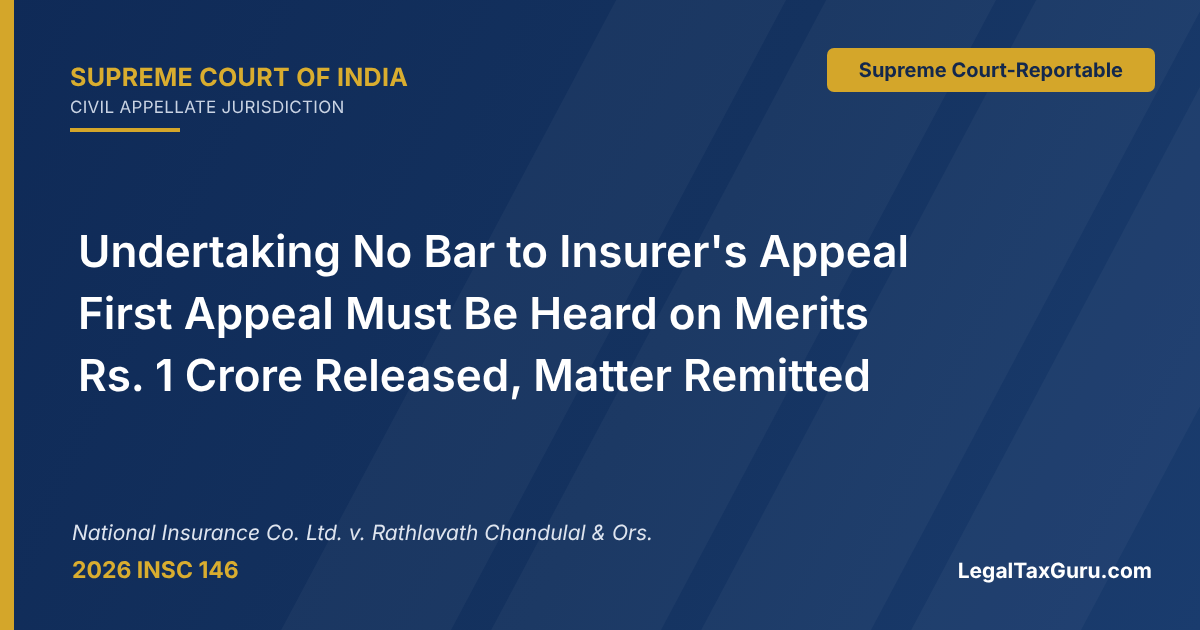
Quick Answer: An insurer's undertaking in execution proceedings to satisfy a motor accident award does not mean it gave up its appeal against that award. The Supreme Court set aside a Telangana High Court order that dismissed National Insurance's first appeal only because its local manager had given such an undertaking, remitted the appeal for a decision on merits within six months, and directed Rs. 1 crore to be released to the injured claimant. It also flagged handwritten, illegible Tribunal order sheets.
In National Insurance Co. Ltd. v. Rathlavath Chandulal & Ors. (2026 INSC 146), the Supreme Court held that the High Court could not dismiss the insurer's appeal merely by referring to an undertaking given by its local manager before the Tribunal to satisfy the award, since there was no undertaking that the appeal would not be pressed on merits (para 10). At most, it was a case where no stay was granted and the award had to be satisfied; a first appeal, open on law and facts, still had to be decided on merits (paras 14–14.1). A Bench of Justice Rajesh Bindal and Justice Vijay Bishnoi also criticised the Executing Court's attachment of the insurer's office furniture, fixtures and computers (paras 13.1–13.2).
Status: Telangana High Court's orders dated 19.11.2025 in MACMA No. 1503 of 2025 and 06.01.2026 in I.A. No. 4 of 2025 (review) set aside; appeal remitted for fresh decision; Rs. 1,00,00,000 to be released to the claimant; appeals allowed (paras 15–16).
Headnote: Undertaking in Execution and the Right of Appeal
Motor accident compensation – First appeal by insurer – Undertaking by local manager before Executing Court to satisfy award – Dismissal of appeal without considering merits – Code of Civil Procedure – Order XXI Rules 43, 64, 66 and 106 – Attachment of office furniture, fixtures and computers – Fairness of execution procedure – Order XLVII Rule 1 – Review – Article 136 – Remand – Interim release of compensation – Handwritten Tribunal orders – e-Courts.
Held: (i) An undertaking by the insurer's local manager to satisfy the award is no reason to dismiss its appeal without touching the merits; there was no undertaking that the appeal would not be pressed (para 10).
(ii) Where the award was about three times the amount claimed, the High Court should have examined the circumstances of the undertaking and whether the compensation was in accordance with law (para 13).
(iii) Attaching all office furniture, fixtures and computers of a public sector insurer, when other modes such as attaching its accounts were available, was apparently done without application of judicial mind; the Executing Court and the High Court failed to adhere to a fair procedure (paras 13.1–13.2).
(iv) The claimant's statement about the undertaking could have been relevant to the prayer for stay, but a first appeal, open on law and facts, had to be considered on merits (paras 14–14.1).
(v) As the merits were not touched and the matter was only remitted, the appeal could be decided without issuing notice to the claimant, with liberty to the respondents to seek recall (paras 9, 16).
(vi) Handwritten, illegible order sheets without officers' names or UID numbers are unjustified given the e-Courts project; High Courts are to examine the reasons and take corrective steps (paras 17–19).
(paras 9–19)
Case Details: National Insurance v. Rathlavath Chandulal (2026 INSC 146)
Final Outcome: Appeals allowed; High Court's orders set aside; appeal remitted for fresh decision on merits, preferably within six months; Rs. 1,00,00,000 to be released to the claimant within four weeks of his furnishing bank details; liberty to respondents to seek recall.
Case: National Insurance Co. Ltd. v. Rathlavath Chandulal and Others
Neutral Citation: 2026 INSC 146
Case No.: Civil Appeal Nos. 490-491 of 2026 (arising out of SLP (Civil) Nos. 3255-3256 of 2026)
Court: Supreme Court of India (Civil Appellate Jurisdiction) – Reportable
Date of Decision: 23 January 2026
Bench: Justice Rajesh Bindal (author of the order) and Justice Vijay Bishnoi
Relevant Acts & Sections: Code of Civil Procedure, 1908 – Order XXI Rules 43, 64, 66 and 106; Order XLVII Rule 1; Constitution of India – Article 136
Impugned Orders: Order dated 19.11.2025 of the High Court for the State of Telangana at Hyderabad in MACMA No. 1503 of 2025, upholding the award dated 20.09.2024 in MVOP No. 1011 of 2021, and order dated 06.01.2026 in I.A. No. 4 of 2025 dismissing the review application (paras 2, 4)
Counsel: Ms. Meenakshi Arora, Senior Advocate, for the appellant; notice was not issued to the respondents (para 9; record of proceedings)
Source: Supreme Court of India
Key Holdings of the Supreme Court
- An undertaking to satisfy an award in execution does not amount to giving up the appeal against it (para 10).
- The High Court should have examined whether compensation, about three times the amount claimed, was in accordance with law (para 13).
- Attaching an insurer's office furniture, fixtures and computers, when its accounts could have been attached, reflected an unfair execution procedure (paras 13.1–13.2).
- Absence of a stay may require the award to be satisfied, but cannot be a ground to dismiss the first appeal (paras 14–14.1).
- The Supreme Court remitted the matter rather than deciding compensation itself, as that exercise belongs to the First Appellate Court (para 9).
- Tribunal orders should not be handwritten; High Courts must examine why computers are not used (paras 17–18).
Brief Facts of the Case
The first respondent, aged 22 and a second-year ITI student, suffered severe injuries in a road accident on 13.02.2020, with functional disability assessed at 100%. He claimed Rs. 1,00,00,000. Accepting that he assisted his father in farming, the Tribunal assessed his income at Rs. 25,000 per month and awarded Rs. 2,72,03,416 with 6% interest (para 3).
While the insurer's appeal was pending, the claimant filed an execution petition. The Executing Court proceeded ex parte against the insurer and issued an attachment warrant on 22.10.2025 against office furniture, fixtures and computers. The insurer's local office gave an undertaking on 31.10.2025 to comply with the award within two weeks (paras 4, 6, 11–11.2).
On 19.11.2025 the High Court dismissed the appeal only because of the undertaking. In review, the insurer explained that the officer was pressured into giving the undertaking, attempted suicide and died on 22.11.2025. The High Court dismissed the review on 06.01.2026 (paras 6.1, 12–12.2).
Issues Before the Supreme Court
- Whether the High Court could dismiss the insurer's first appeal merely because its local manager had undertaken to satisfy the award (paras 10, 14).
- Whether the execution procedure adopted by the Tribunal was fair (paras 13.1–13.2).
- Whether the Supreme Court should decide compensation itself or remit the matter (para 9).
Court's Findings and Reasoning
Undertaking is not a waiver of appeal (para 10): The appeal was dismissed merely by referring to the manager's undertaking to satisfy the award. There was no undertaking that the appeal would not be pressed on merits, and the manager may not even have been authorised to make such a statement.
Duty to examine merits (paras 13, 14–14.1): With the award running into crores and about three times the claim, the High Court should not have shut its eyes. Though compensation can exceed the amount claimed, the High Court had to consider the circumstances of the undertaking and the legality of the award. Lack of a stay may oblige the judgment-debtor to pay, but the first appeal still had to be heard on merits.
Unfair execution (paras 10, 13.1–13.2): The manner of execution showed the hurry the Tribunal was in. Attaching all office furniture, fixtures and computers would have paralysed the company's working, though other modes such as attaching its accounts were available. Recovery from a public sector insurer was not difficult; the issue was the fairness of the procedure.
Remand without notice (para 9): The Court proceeded without issuing notice to the claimant because it was not touching the merits, and issuing notice would delay disbursement of compensation. Assessing compensation is for the High Court as First Appellate Court, given the scope of Article 136.
Handwritten order sheets (paras 17–18): The Tribunal's order sheets were handwritten, illegible and did not show the officers' names or UID numbers, despite the e-Courts project begun in 2007. The Court said the system is moving towards paperless courts.
Final Outcome and Directions
- Appeals allowed; the High Court's orders set aside and the matter remitted for consideration afresh, preferably within six months (para 15).
- Respondents at liberty to apply to the Supreme Court for recall of the order if aggrieved (para 16).
- The insurer shall release Rs. 1,00,00,000 to the first respondent by bank transfer within four weeks of his furnishing bank details, keeping in view the directions in Parminder Singh v. Honey Goyal (para 16).
- The High Court shall examine why Tribunal orders are not typed on computers and take immediate appropriate action (para 18).
- Copy to the Registrar General of the High Court and of other High Courts, for placing before the Chief Justices for corrective steps (para 19).
Legal Principle Laid Down
An undertaking by a judgment-debtor in execution proceedings to satisfy an award, given in the absence of a stay, does not take away its right to have its first appeal decided on merits. The appellate court must examine the appeal on law and facts, and execution must follow a fair procedure with application of judicial mind (paras 10, 13.1–13.2, 14–14.1).
Precedents Relied Upon
- Parminder Singh v. Honey Goyal, 2025 INSC 361 : (2025) 9 SCC 539 – Followed – directions on payment of compensation to claimants to be kept in view. Discussed at para 16.
Important Paragraphs of the Judgment
Verbatim extracts from the judgment. For the full text, refer to the judgment PDF below.
Para 10: "That cannot be a reason for not touching the appeal on merits. There was no undertaking given by the manager of the appellant-company that the appeal filed by it impugning the award of the Tribunal will not be pressed on merits."
Para 13.1: "There were other modes to recover the amount. One of them could be attachment of the accounts of the Insurance Company but for reasons best known to the Executing Court, the process of attachment of the office furniture, fixtures and computers was adopted, apparently without application of any judicial mind."
Para 13.2: "The question here is regarding the fairness of the procedure adopted, which in our view, the Executing Court as well as the High Court has failed to adhere to."
Para 14.1: "Even in that eventuality, the appeal could not have been dismissed merely on that ground and had to be considered on merits by the High Court."
Para 17: "In that situation, we do not find any justification for the orders of the Tribunal to be handwritten, which otherwise are also not legible."
Para 18: "We cannot loose sight of the fact that the entire Court system is moving towards ‘paperless Courts’, which means from bottom to top."
Practical Impact of the Ruling
- For insurers: Complying with an award under pressure of execution does not forfeit the right to challenge it on merits in appeal (paras 10, 14.1).
- For High Courts: A first appeal in a motor accident case must be decided on law and facts; an undertaking is at most relevant to stay (para 14).
- For Executing Courts and Tribunals: Execution against a public sector insurer should use proportionate modes, such as attaching accounts, rather than seizing office equipment (paras 13.1–13.2).
- For claimants: Part of the award may be released while the appeal is reheard, as with the Rs. 1 crore directed here (para 16).
- For court administration: Tribunal orders should be typed and identify the officer (paras 17–19).
FAQs on Undertaking in Execution and the Right of Appeal
1. What did the Supreme Court decide in National Insurance v. Rathlavath Chandulal?
It set aside the Telangana High Court's dismissal of the insurer's appeal, remitted the appeal for decision on merits and directed release of Rs. 1 crore to the claimant (paras 15–16).
2. Does an undertaking to satisfy an award end the insurer's appeal?
No. Unless the insurer undertakes not to press the appeal, the appeal must still be decided on merits (paras 10, 14.1).
3. Why did the Court criticise the execution proceedings?
The Executing Court attached the insurer's office furniture, fixtures and computers when other modes such as attaching its accounts were available (paras 13.1–13.2).
4. Why did the Supreme Court not decide the compensation itself?
Assessing compensation under each head is for the High Court as First Appellate Court, given the scope of Article 136 (para 9).
5. What did the Court say about handwritten Tribunal orders?
It found no justification for handwritten, illegible orders and asked High Courts to examine the reasons and take corrective steps (paras 17–19).
Keywords: 2026 INSC 146, National Insurance v. Rathlavath Chandulal, motor accident claim, insurer appeal, undertaking to satisfy award, execution, Order XXI Rule 43 CPC, attachment of office furniture, first appeal on merits, remand, Order XLVII Rule 1, review, e-Courts, handwritten orders, Justice Rajesh Bindal, Justice Vijay Bishnoi, Supreme Court judgment
Related on LegalTaxGuru
Download Judgment PDF – National Insurance v. Rathlavath Chandulal
Source: Supreme Court of India (official website).