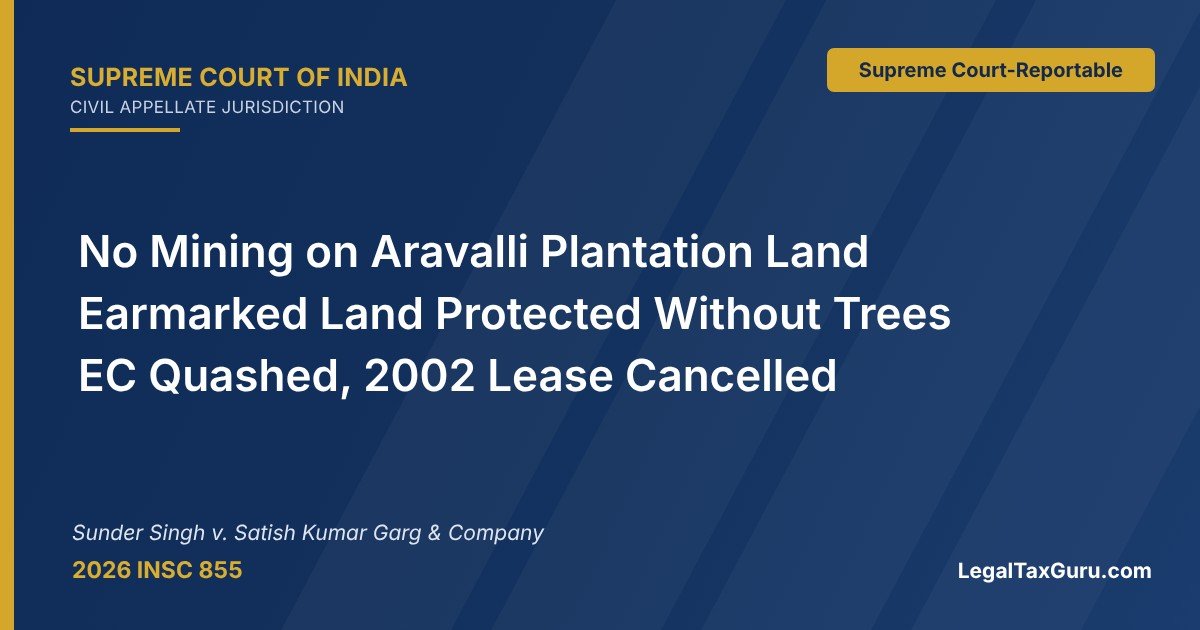
Quick Answer: Land earmarked for the Aravalli plantation project carries the same protection as land where trees have actually been planted. The Supreme Court set aside a High Court order that had directed a forest NOC for mining in Haryana's Mahendergarh district, quashed the Environmental Clearance, ordered the 2002 mining lease to be cancelled, and directed Haryana to survey and terminate all mining rights on earmarked Aravalli plantation land.
In Sunder Singh & Anr. v. M/s Satish Kumar Garg & Company & Ors. (2026 INSC 855), the Supreme Court held that lands identified for afforestation under the Aravalli Project must be treated as bearing the character of plantation land even if saplings were never actually planted, so mining cannot be permitted on them (paras 17–21). A Bench of Chief Justice Surya Kant, Justice Joymalya Bagchi and Justice V. Mohana set aside the Punjab and Haryana High Court's order dated 26.04.2018, upheld the Forest Department's refusal of NOC, quashed the Environmental Clearance dated 08.08.2023, and issued directions for survey and termination of mining rights on such land (paras 25–28).
Status: High Court's order dated 26.04.2018 in CWP No. 2682 of 2018 set aside; NOC refusal upheld; SEIAA decision and EC quashed; mining lease dated 29.04.2002 to be cancelled; appeals allowed with directions (paras 26, 28).
Headnote: Mining on Earmarked Aravalli Plantation Land
Environment – Aravalli Hills and Ranges – Aravalli Project plantation – Land earmarked for afforestation – Forest NOC for mining – Mines and Minerals (Development and Regulation) Act, 1957 – Environment (Protection) Act, 1986 – EIA notification dated 14.09.2006 – Environmental Clearance – Dead rent – Cancellation of mining lease – Directions to State of Haryana.
Held: (i) The High Court erred in reasoning that mining is permissible on land earmarked for afforestation merely because actual plantation has not taken place; there is an "inherent fallacy" in such an inference (paras 14–16).
(ii) Afforestation is a long-term project; lands identified for near-future plantation must be held to bear the character of land already planted, and earmarking must carry the same protection (paras 17–19).
(iii) Lands earmarked for Aravalli plantation, including those where no fresh saplings were planted, have the same protective status as afforested land (paras 20–21).
(iv) Since the subject land was earmarked under the Aravalli Project, the direction to grant an NOC for mining was unfounded, and the SEIAA decision and EC must also fall (paras 23–25).
(v) The mining lease dated 29.04.2002 must be cancelled and all consequential rights purged (para 26).
(vi) The High Court's directions ran against the Supreme Court's continuing directions for protection of the Aravalli Hills and Ranges, under which mining in the region is barred pending the suo motu proceedings (para 27).
(paras 12–30)
Case Details: Sunder Singh v. Satish Kumar Garg & Co. (2026 INSC 855)
Final Outcome: Appeals allowed; High Court's order set aside; NOC refusal upheld; EC quashed; mining lease to be cancelled; directions issued for survey and termination of mining rights on earmarked Aravalli plantation land.
Case: Sunder Singh & Anr. v. M/s Satish Kumar Garg & Company & Ors., with connected appeal (Diary No. 19180/2021)
Neutral Citation: 2026 INSC 855
Case No.: Civil Appeal No. ___ of 2026 (arising out of SLP (Civil) No. 21759 of 2023), with Civil Appeal No. ___ of 2026 (arising out of SLP (Civil) No. ___ of 2026, Diary No. 19180/2021)
Court: Supreme Court of India (Civil Appellate Jurisdiction) – Reportable
Date of Decision: 29 July 2026
Bench: Chief Justice Surya Kant (author), Justice Joymalya Bagchi and Justice V. Mohana
Relevant Acts & Sections: Section 10, Mines and Minerals (Development and Regulation) Act, 1957; Mineral Concession Rules, 1960; Section 3, Environment (Protection) Act, 1986 and notification dated 14.09.2006
Impugned Order: Punjab and Haryana High Court (Division Bench) – order dated 26.04.2018 in CWP No. 2682 of 2018 (para 4)
Counsel: Mr. Maninder Singh, Senior Advocate, for the appellants; Mr. Mukul Rohatgi, Mr. Guru Krishna Kumar and Mr. Narendra Hooda, Senior Advocates, for the Mining Lessee; Additional Advocates General for the State of Haryana (paras 8–10)
Source: Supreme Court of India (official website)
Key Holdings of the Supreme Court
- Earmarking land for Aravalli plantation gives it the same protection as land where plantation has actually taken place (paras 19, 21).
- Ambiguity about whether trees were actually planted does not justify granting a forest NOC or allowing mining (paras 23–24).
- The direction to grant NOC was unfounded; the SEIAA decision and EC dated 08.08.2023 are quashed (paras 25, 28).
- The 2002 NOC and its consequences stand effaced, and the non-grant of NOC dated 28.10.2016 is upheld (para 28).
- The mining lease dated 29.04.2002 must be cancelled and consequential rights purged (para 26).
- The State's Mines Department appeared motivated by claims for dead rent and royalties, contrary to the Forest Department's stand (para 26).
- Haryana must survey all earmarked Aravalli plantation land and terminate subsisting mining rights (para 28).
Brief Facts of the Case
The Mining Lessee, a partnership firm, obtained a 20-year mining lease, executed on 29.04.2002, for quartz, felspar and barytes over 79.32 hectares in Village Musnota, District Mahendergarh, Haryana. The Forest Department granted an NOC on 16.09.2002 stating that the land was not forest land (paras 5.1–5.3).
While the Environment Management Plan was pending, the EIA regime changed by notification dated 14.09.2006. Pursuant to M.C. Mehta, the Deputy Commissioner, Mahendergarh, in his report dated 05.04.2007, listed the subject Khasra numbers as Aravalli Plantation land (paras 5.4–5.5).
In 2013, the Expert Appraisal Committee required a fresh NOC. On 28.10.2016, the Divisional Forest Officer refused it because the land fell in the Aravalli Plantation list. On 31.05.2017, the Mining Officer demanded dead rent arrears of about Rs. 2.56 crore with interest (paras 5.6–5.8).
The High Court, by order dated 26.04.2018, allowed the Mining Lessee's writ petition, set aside the NOC refusal and permitted mining, reasoning that the land had been mined from 1977 to 2007 and there was ambiguity about where plantation had actually occurred (paras 5.9–5.10).
An earlier SLP by another resident was withdrawn after an interim stay. The appellants, residents of a nearby village concerned about the ecology, then challenged the order. Meanwhile, SEIAA granted EC on 08.08.2023, but the Supreme Court barred tree-felling and further steps, and no mining has begun (paras 5.11–6).
Issues Before the Supreme Court
- Whether the subject land falls within the Aravalli Project (para 12).
- Whether mining can be permitted on land earmarked for Aravalli plantation where actual plantation is not shown (paras 14–15, 23).
Court's Findings and Reasoning
Fallacy in the High Court's reasoning: The High Court held that the DC Report earmarking the land was not enough and actual tree planting had to be shown. The Court found an inherent fallacy in the premise that land earmarked for afforestation can be mined if plantation has not yet happened (paras 14–16).
Nature of afforestation projects: Afforestation requires first identifying land and then long-term planting and protection. If only standing trees counted, earmarked land not yet planted would always be open to mining, which is antithetical to its true character (paras 17–18).
Earmarked land protected: Lands identified for near-future plantation must be treated as plantation land. The Aravalli plantation drive, funded by foreign aid since the early 1990s and supported by M.C. Mehta, could not cover the entire identified area, so earmarked lands without saplings must have the same protection (paras 19–21).
Application: The subject land was clearly earmarked under the Aravalli Project, though no party could say whether planting actually occurred. The High Court ignored the earmarking, and allowing mining would let the lessee undermine the Forest Department's afforestation by clearing trees and excavating minerals (paras 22–24).
Conflicting stands of State departments: The Mines and Geology Department supported mining, apparently driven by dead rent and royalty claims, while the Forest Department opposed it. No action was taken on the lease once the land was found earmarked, so the lease must be cancelled (paras 10–11, 26).
Aravalli suo motu proceedings: The Court referred to its orders dated 29.12.2025, 26.02.2026 and 25.05.2026 in Suo Moto WP (Civil) No. 10/2025, under which no mining can take place in the Aravalli Hills and Ranges without its permission, and a High-Powered Committee report is awaited (para 27).
Final Outcome and Directions
- The High Court's judgment is set aside (para 28(i)).
- The NOC refusal dated 28.10.2016 is upheld; the NOC dated 16.09.2002 and its consequences stand effaced (para 28(ii)).
- The SEIAA decision of 02.08.2023 and the EC dated 08.08.2023 are quashed (para 28(iii)).
- The subject land and other lands in the DC Report shall not be made available for mining; any subsisting mining right shall be terminated, subject to final directions in Suo Moto WP (Civil) No. 10/2025 (para 28(iv)).
- Haryana shall survey all land earmarked for Aravalli plantation, identify subsisting mining rights, cancel them in accordance with law, and file a compliance report (para 28(v)).
- Haryana, Rajasthan, Gujarat and the NCT of Delhi must strictly comply with the Aravalli directions; violations will be viewed seriously, and copies are to go to their Chief Secretaries (paras 29–31).
Legal Principle Laid Down
Land identified and earmarked for afforestation, such as under the Aravalli Project, bears the character of plantation land and carries the same protection as land where trees have actually been planted. Mining cannot be permitted on such land merely because actual plantation has not been shown, and any NOC, environmental clearance or mining right that ignores the earmarking is liable to be set aside.
Precedents Relied Upon
- M.C. Mehta v. Union of India, (2004) 12 SCC 118 – Relied upon – identification and protection of Aravalli plantation areas; no mining on such areas. Discussed at paras 5.5, 20.
- M.C. Mehta v. Union of India, (2006) 11 SCC 582 – Relied upon – grave risk of mining to Aravalli plantations. Discussed at para 20.
- In Re: Definition of Aravalli Hills and Ranges and Ancillary Issues, Suo Moto WP (Civil) No. 10/2025 – orders dated 29.12.2025, 26.02.2026 and 25.05.2026 – mining in the Aravallis barred without the Court's permission. Discussed at paras 27–29.
Important Paragraphs of the Judgment
Verbatim extracts from the judgment. For the full text, refer to the judgment PDF below.
Para 16: "There is, however, in our view, an inherent fallacy in such a conclusion or inference."
Para 19: "Earmarking of the land for plantation ought to, thus, necessarily accord the same protection which is attributed to afforestation plantations."
Para 21: "That being so, the lands which had been earmarked for Aravalli plantation drives, including those which may not have had any fresh saplings planted, ought to have the same protective status as those which bore the afforestation."
Para 24: "By permitting mining in such a situation, the Mining Lessee was allowed to effectively undermine the afforestation efforts of the Forest Department by clearing existing trees and initiating excavation of minerals."
Para 26: "In our considered opinion, the mining lease dated 29.04.2002 must be cancelled and all consequential rights be purged forthwith."
Para 27: "The said report is yet to be received, and any mining in the region during the pendency of the matter is unquestionably barred."
Practical Impact of the Ruling
- For mining lessees: Leases over land earmarked for Aravalli plantation face cancellation even if no trees stand on it (paras 21, 26, 28).
- For State governments: Haryana must survey earmarked land and terminate mining rights; other Aravalli States must comply strictly with the Court's directions (paras 28–29).
- For environment authorities: NOCs and ECs cannot be granted by ignoring earmarking for afforestation (paras 24–25).
- For local residents and environmental litigants: Earmarking in official records, such as a DC report, is sufficient to resist mining on plantation land (paras 19–23).
- For government departments: Revenue interests such as dead rent cannot override ecological protection (para 26).
FAQs on Mining on Aravalli Plantation Land
1. What did the Supreme Court hold in Sunder Singh v. Satish Kumar Garg & Co.?
It held that land earmarked for the Aravalli plantation project carries the same protection as planted land, and set aside the High Court order permitting mining on such land (paras 19–21, 28).
2. Does land need actual trees to be protected?
No. Land identified for near-future plantation bears the character of plantation land even if saplings were never planted (paras 19, 21).
3. What happened to the Environmental Clearance?
The SEIAA decision of 02.08.2023 and the EC dated 08.08.2023 were quashed (paras 25, 28(iii)).
4. What directions were given to Haryana?
To survey all land earmarked for Aravalli plantation, identify and cancel subsisting mining rights, and file a compliance report in the Aravalli suo motu case (para 28(v)).
5. Is mining allowed in the Aravallis now?
The Court noted that under its orders in Suo Moto WP (Civil) No. 10/2025, no mining can take place in the Aravalli Hills and Ranges without its permission while the matter is pending (para 27).
Keywords: 2026 INSC 855, Sunder Singh v. Satish Kumar Garg, Aravalli plantation mining, Aravalli Project earmarked land, forest NOC mining Haryana, Mahendergarh mining lease, environmental clearance quashed, SEIAA Haryana, M.C. Mehta Aravalli, Chief Justice Surya Kant, Supreme Court judgment, environment law
Related on LegalTaxGuru
Download Judgment PDF – Sunder Singh v. Satish Kumar Garg & Co.
Source: Supreme Court of India (official website).