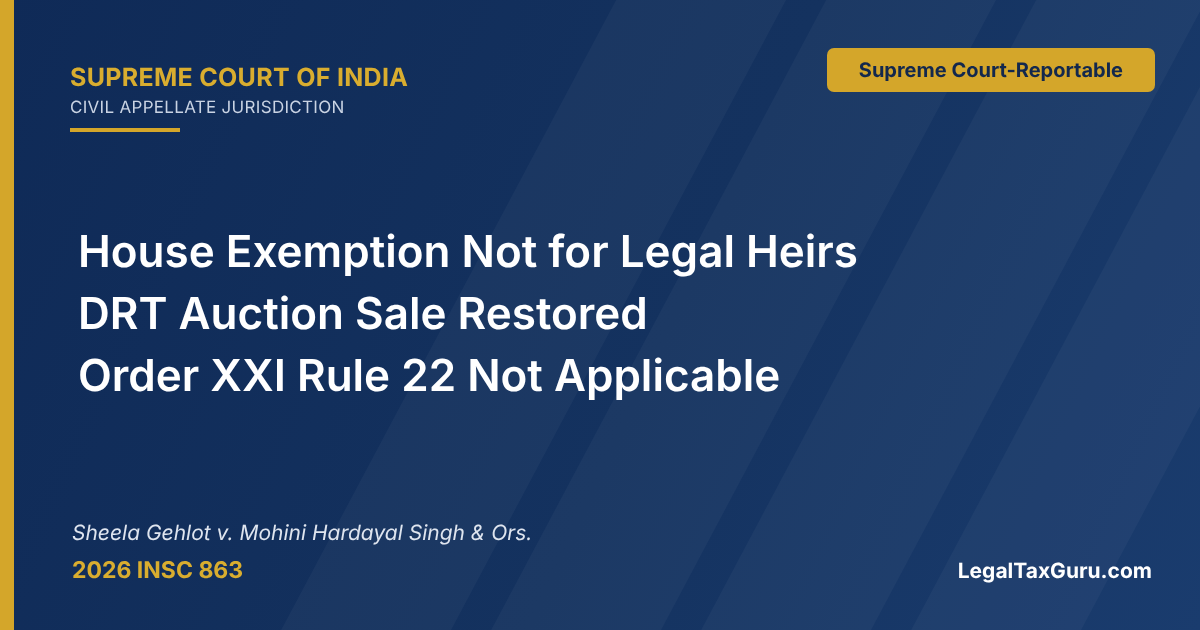
Quick Answer: The exemption of a judgment-debtor's main residential house from attachment under Section 60(1)(ccc) CPC, as applicable to Delhi, is personal to the judgment-debtor and cannot be claimed by his legal representatives. The Supreme Court also held that a confirmed DRT auction is not void for want of an Order XXI Rule 22 CPC notice or a Rule 2 notice under the Second Schedule to the Income Tax Act where the heirs knew of the execution and did not use Rule 61. The auction of the Delhi house was restored.
In Sheela Gehlot v. Mohini Hardayal Singh & Ors. (2026 INSC 863), with connected appeals by Punjab & Sind Bank and by the judgment-debtor's son, the Supreme Court held that once execution was transferred to the Debts Recovery Tribunal under Section 31 of the Recovery of Debts and Bankruptcy Act, 1993, the Recovery Officer proceeded under Section 29 and the Second Schedule to the Income Tax Act, 1961, so Order XXI Rule 22 CPC had no impact on the auction (para 37). The absence of a Rule 2 notice did not render the execution or sale void (para 40), and the Section 60(1)(ccc) exemption was not available to the legal representatives and had never been pleaded before the Recovery Officer (paras 43–46). A Bench of Justice Pamidighantam Sri Narasimha and Justice Alok Aradhe set aside the Madhya Pradesh High Court's remand (paras 47–48).
Status: Judgment dated 15.05.2009 of the High Court of Madhya Pradesh at Jabalpur in Writ Petition No. 2199 of 2008 set aside; C.A. Nos. 182 and 190 of 2016 allowed; C.A. No. 191 of 2016 dismissed; no costs (paras 47–48).
Headnote: DRT Auction and Residential House Exemption
Recovery of Debts and Bankruptcy Act, 1993 – Sections 22, 29, 31 and 31A – Income Tax Act, 1961 – Second Schedule – Rules 2, 10, 60 and 61 – Code of Civil Procedure, 1908 – Section 60(1)(ccc) (as applicable to Delhi) and Order XXI Rule 22 – Execution of bank's compromise decree – Transfer of execution to DRT – Auction sale of residential property – Notice to legal representatives – Substantial injury – Exemption personal to judgment-debtor – Mixed question of law and fact in writ.
Held: (i) Order XXI Rule 22 CPC is mandatory, but on transfer of the execution to the DRT under Section 31 of the 1993 Act the Recovery Officer proceeds under Section 29 read with the Second Schedule to the 1961 Act, in supersession of the CPC procedure; Order XXI Rule 22 therefore has no impact on the validity of the auction sale (paras 31, 37).
(ii) In any case, under the proviso to Order XXI Rule 22(2) as applicable to Punjab and Delhi, after more than two years of unsuccessful attempts to serve notice, non-issuance would only be an irregularity and not a defect in jurisdiction (paras 34–35).
(iii) Rule 61 of the Second Schedule supplies the remedy for non-service of the Rule 2 notice: an application within 30 days of the sale, with the sale set aside only on proof of substantial injury (paras 38–39).
(iv) The widow and children were parties to the execution, knew of it, and objected to the auction order, but never invoked Rule 61; the absence of a Rule 2 notice did not render the execution or the sale void (para 40).
(v) The protection of Section 60(1)(ccc) CPC is by its own text personal to the judgment-debtor and does not extend to his legal representatives, as held by the Delhi and Punjab & Haryana High Courts for decades (paras 42–44).
(vi) A mixed question of law and fact cannot be raised for the first time in a writ petition; the exemption was never pleaded or proved before the Recovery Officer, so the High Court erred in remitting it for evidence (paras 45–46).
(paras 26–48)
Case Details: Sheela Gehlot v. Mohini Hardayal Singh (2026 INSC 863)
Final Outcome: Appeals of the auction-purchaser and the Bank allowed; appeal of the judgment-debtor's son dismissed; High Court's remand order set aside; no order as to costs.
Case: Sheela Gehlot v. Mohini Hardayal Singh & Ors., with Punjab & Sind Bank v. Mohini Hardayal Singh & Ors. and Jagminder Singh v. Punjab & Sind Bank & Ors.
Neutral Citation: 2026 INSC 863
Case No.: Civil Appeal No. 182 of 2016, with Civil Appeal No. 190 of 2016 and Civil Appeal No. 191 of 2016
Court: Supreme Court of India (Civil Appellate Jurisdiction) – Reportable
Date of Decision: 14 August 2026
Bench: Justice Pamidighantam Sri Narasimha and Justice Alok Aradhe (author)
Relevant Acts & Sections: Recovery of Debts and Bankruptcy Act, 1993 (formerly Recovery of Debts Due to Banks and Financial Institutions Act) – Sections 22, 29, 31 and 31A; Income Tax Act, 1961 – Second Schedule, Rules 2, 10, 60 and 61; Code of Civil Procedure, 1908 – Section 60(1)(ccc) and Order XXI Rules 22 and 66; Punjab Relief of Indebtedness Act, 1934 – Section 35
Impugned Order: Judgment dated 15.05.2009 of the Division Bench of the High Court of Madhya Pradesh at Jabalpur in Writ Petition No. 2199 of 2008, setting aside the DRAT, Allahabad order dated 01.02.2008 and remitting the matter to the DRT, Jabalpur (paras 1, 19–20)
Counsel: Dr. A.M. Singhvi, Senior Advocate, for the auction-purchaser (C.A. No. 182 of 2016); Mr. D.N. Goburdhun, Senior Advocate, for the Bank (C.A. No. 190 of 2016); Mr. Rajiv Shakdher, Senior Advocate, for the appellant in C.A. No. 191 of 2016; Mr. Shekhar Naphde, Senior Advocate, for respondent no. 1 (paras 22–25)
Source: Supreme Court of India
Key Holdings of the Supreme Court
- After transfer of execution to the DRT under Section 31, the Second Schedule procedure governs and Order XXI Rule 22 CPC does not affect the auction (para 37).
- Non-service of a Rule 2 notice must be raised under Rule 61 within 30 days and requires proof of substantial injury (paras 39–40).
- Heirs who were parties to and aware of the execution, and who objected to the auction, suffered no substantial injury (para 40).
- The Section 60(1)(ccc) CPC residential house exemption is personal to the judgment-debtor and not available to legal representatives (paras 42–44).
- A mixed question of law and fact not pleaded below cannot be raised for the first time in a writ petition (paras 45–46).
Brief Facts of the Case
A malt manufacturing company availed credit facilities from Punjab & Sind Bank, with its two Directors, including the late judgment-debtor, as personal guarantors. The judgment-debtor's Delhi residential property was not mortgaged for the loan. After the unit closed in 1983, the Bank sued; a compromise decree was passed on 15.10.1991 by the Morena court, under which the title deeds of the Delhi property, furnished as collateral, were released without affecting the judgment-debtor's personal liability (paras 2–5).
The judgment-debtor died on 17.11.1994. The Trust that had taken over the Company paid about Rs. 82 lakhs and then defaulted. The Bank filed execution in 1995 against the widow (respondent no. 1) and children; repeated attempts to serve them failed. The execution was transferred to the DRT, Jabalpur under Section 31 of the 1993 Act, and on 20.09.2004 the Recovery Officer ordered auction of the Delhi property (paras 6–8).
The widow's recall application was rejected on 10.10.2006. The property was auctioned on 27.11.2006 to the appellant in C.A. No. 182 of 2016, and the sale was confirmed with a sale certificate on 01.03.2007 (paras 9–12). After several rounds, the DRT on 29.05.2007 set aside the Recovery Officer's orders, but the DRAT on 01.02.2008 set that order aside on the appeals of the auction-purchaser and the Bank. The High Court on 15.05.2009 set aside that order and remitted the matter for an inquiry into prejudice from non-service of notice and into the Section 60(1)(ccc) exemption (paras 13–20).
Issues Before the Supreme Court
- Whether the plea of non-compliance of Order XXI Rule 22 CPC has any impact on the auction sale (para 26).
- Whether failure to serve notice under Rule 2 of the Second Schedule to the 1961 Act on the widow and children rendered the execution or sale void (para 26).
- Whether the Delhi property was exempt from attachment under Rule 10 of the Second Schedule read with Section 60(1)(ccc) CPC (para 26).
Court's Findings and Reasoning
Statutory framework (paras 27–29): Under Section 22 of the 1993 Act the Tribunal is not bound by CPC procedure, and Section 29 applies the Second and Third Schedules to the 1961 Act to recovery of debts under the Act.
Order XXI Rule 22 (paras 30–37): The Rule is mandatory. The Morena court had tried to serve the widow and children on numerous dates between 1995 and 1997, and she was aware of the execution at least by 10.07.2003. Under the Punjab proviso applicable to Delhi, non-issuance would be an irregularity. More fundamentally, the property was attached and sold under the 1993 Act, and the transfer under Section 31 clothed the Recovery Officer with power to proceed under the Second Schedule in supersession of the CPC.
Rule 2 notice and Rule 61 (paras 38–40): Rule 2 incorporates natural justice, but Rule 61 provides the remedy for its breach. The widow and children were already parties, the widow had referred to the pending execution in M.A. No. 65 of 2003 and had sought recall of the auction order, and no Rule 61 application was filed. There was no substantial injury, and the execution and sale were not void.
Section 60(1)(ccc) exemption (paras 41–44): The clause, introduced by the Punjab Relief of Indebtedness Act, 1934 and extended to Delhi, protects one main residential house belonging to and occupied by the judgment-debtor. Following Yogesh Sharma (Delhi) and the Punjab & Haryana High Court decisions, which had held the field for thirty-seven years, the protection is personal and does not extend to legal representatives.
Plea not raised below (paras 45–46): The widow did not raise the exemption in her recall application, M.A. No. 65 of 2003, her DRT appeal or her first writ petition, and led no evidence on it before the DRT. Relying on Greater Mohali Area Development Authority v. Manju Jain, the Court held that the High Court erred in entertaining it and remitting it for evidence.
Final Outcome and Directions
- Judgment dated 15.05.2009 in Writ Petition No. 2199 of 2008 quashed and set aside (para 47).
- C.A. No. 182 of 2016 (auction-purchaser) and C.A. No. 190 of 2016 (Bank) allowed (para 48).
- C.A. No. 191 of 2016 (son of the judgment-debtor) dismissed (para 48).
- No order as to costs (para 48).
Legal Principle Laid Down
When a decree is executed through the Recovery Officer after transfer to the DRT under Section 31 of the Recovery of Debts and Bankruptcy Act, 1993, the procedure is governed by Section 29 and the Second Schedule to the Income Tax Act, 1961, not Order XXI Rule 22 CPC. Non-service of the Rule 2 notice is remediable only under Rule 61, within 30 days and on proof of substantial injury, and does not by itself make the sale void. The residential house exemption in Section 60(1)(ccc) CPC, as applicable to Delhi, is personal to the judgment-debtor and cannot be claimed by his legal representatives (paras 37, 39–40, 42–44).
Precedents Relied Upon
- Satyanarain Bajoria v. Ramnarain Tiberwal, (1993) 4 SCC 414, Barkat Ali v. Badrinarain, (2008) 4 SCC 615, Rahul S. Shah v. Jinendra Kumar Gandhi, (2021) 6 SCC 418 and Bharat Kantilal Dalal v. Chetan Surendra Dalal, 2025 SCC OnLine SC 2502 – Referred to – Order XXI Rule 22 CPC is mandatory. Discussed at para 31.
- Yogesh Sharma v. Devi Dayal, AIR 1977 Delhi 270 – Approved – legal representative cannot claim the judgment-debtor's personal exemption under Section 60(1)(ccc). Discussed at paras 43–44.
- K.L. Bawa v. Basant Textiles, AIR 1982 P&H 275 and Pargat Singh v. Gurmail Kaur, 2014 SCC OnLine P&H 23436 – Approved – same view. Discussed at paras 43–44.
- Greater Mohali Area Development Authority v. Manju Jain, (2010) 9 SCC 157 – Relied upon – mixed question of law and fact cannot be raised for the first time in a writ petition. Discussed at para 45.
Important Paragraphs of the Judgment
Verbatim extracts from the judgment. For the full text, refer to the judgment PDF below.
Para 37: "The transfer of execution proceeding from Morena court to the DRT, effected under Section 31 of the 1993 Act, did not merely change the forum of execution, it clothed the Recovery Officer, with the power to recover the amount in accordance with the procedure prescribed under Section 29 of the 1993 Act read with Second Schedule to the 1961 Act, in supersession of procedure under the Code before the Morena Court."
Para 37: "Therefore, Order XXI Rule 22 of the Code has no impact on the validity of the auction sale."
Para 40: "Therefore, in the facts and circumstance of the case, absence of notice under Rule 2 of the Second Schedule to the 1961 Act, does not render either the execution or the sale void."
Para 43: "Thus, the plea of exemption under Section 60(1)(ccc) of the Code is personal to the judgment-debtor and is not available to be raised by his legal representatives."
Para 45: "It is a well-settled legal proposition that a pure question of law can be raised at any stage of the proceeding but a question of fact that requires an investigation and inquiry for which no factual foundation has been laid cannot be allowed to be agitated in a writ petition."
Para 46: "Therefore, the High Court erred in entertaining and in remitting the matter to the Recovery Officer, DRT to decide the same after giving an opportunity to the parties to lead evidence."
Practical Impact of the Ruling
- For banks: Recovery through the DRT after transfer of a civil execution is governed by the Second Schedule procedure, not the CPC execution rules (para 37).
- For auction-purchasers: A confirmed DRT sale is not lightly unsettled on pleas of non-service where the objectors knew of the proceedings and bypassed Rule 61 (para 40).
- For legal heirs of guarantors: The Section 60(1)(ccc) residential house exemption in Punjab, Haryana and Delhi cannot be claimed by heirs (paras 42–44).
- For writ courts: Factual pleas not raised before the Recovery Officer cannot be entertained and remitted for evidence in writ jurisdiction (paras 45–46).
FAQs on DRT Auction and the Residential House Exemption
1. What did the Supreme Court decide in Sheela Gehlot v. Mohini Hardayal Singh?
It set aside the High Court's remand, upheld the DRT auction of the Delhi property, allowed the auction-purchaser's and Bank's appeals and dismissed the son's appeal (paras 47–48).
2. Does Order XXI Rule 22 CPC apply to execution before the DRT Recovery Officer?
No. After transfer under Section 31 of the 1993 Act, the Recovery Officer follows Section 29 and the Second Schedule to the Income Tax Act, which require a Rule 2 notice (para 37).
3. What is the remedy if the Rule 2 notice is not served?
An application under Rule 61 within 30 days of the sale; the sale is set aside only if substantial injury is shown (para 39).
4. Can legal heirs claim the Section 60(1)(ccc) exemption for the family house?
No. The exemption is personal to the judgment-debtor and does not extend to his legal representatives (paras 42–43).
5. Why was the exemption plea rejected on procedure too?
It was a mixed question of law and fact never pleaded before the Recovery Officer or DRT and raised first in a writ petition (paras 45–46).
Keywords: 2026 INSC 863, Sheela Gehlot v. Mohini Hardayal Singh, Punjab & Sind Bank, DRT auction, Recovery Officer, Recovery of Debts and Bankruptcy Act 1993, Section 29, Section 31, Second Schedule Income Tax Act, Rule 2 notice, Rule 61, substantial injury, Order XXI Rule 22 CPC, Section 60(1)(ccc) CPC, residential house exemption, legal representatives, auction-purchaser, Justice Alok Aradhe, Justice Pamidighantam Sri Narasimha, Supreme Court judgment
Related on LegalTaxGuru
Download Judgment PDF – Sheela Gehlot v. Mohini Hardayal Singh
Source: Supreme Court of India (official website).