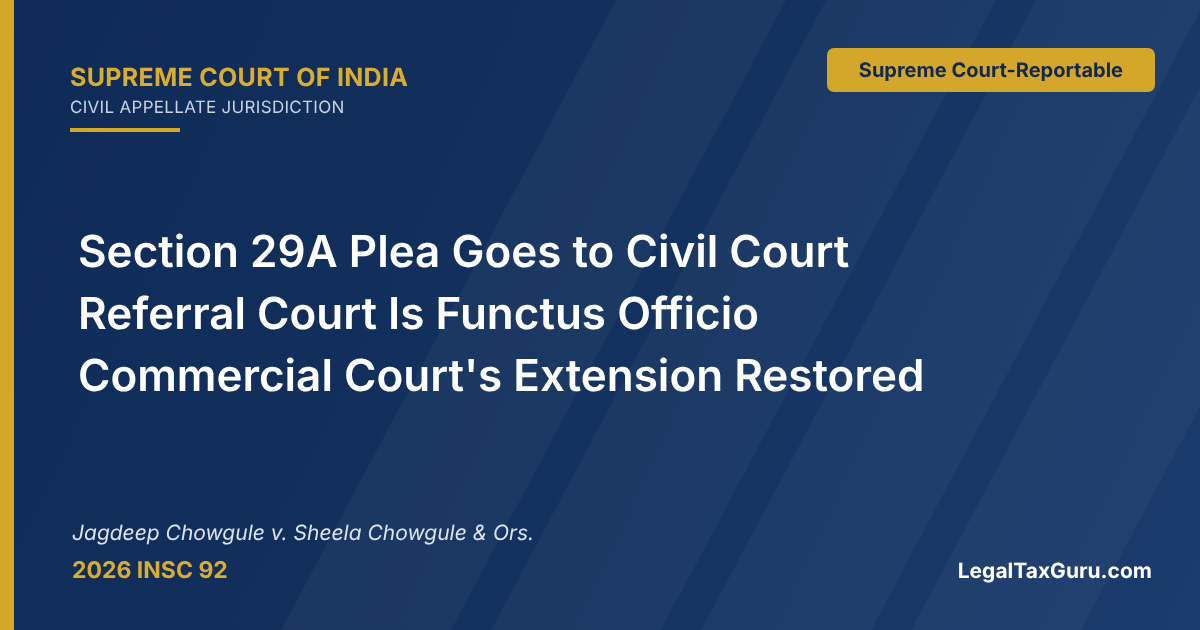
Quick Answer: An application to extend the mandate of an arbitral tribunal under Section 29A of the Arbitration and Conciliation Act, 1996 lies before the “Court” as defined in Section 2(1)(e), that is, the principal Civil Court of original jurisdiction (or a High Court exercising ordinary original civil jurisdiction), even where the arbitrator was appointed by the High Court under Section 11(6). The Supreme Court set aside the Bombay High Court (Goa) view to the contrary and restored the Commercial Court’s order extending time.
In Jagdeep Chowgule v. Sheela Chowgule & Ors. (2026 INSC 92), the Supreme Court held that the jurisdiction of the High Court or the Supreme Court under Section 11 is exhausted on constitution of the arbitral tribunal, after which the referral court is functus officio, and that the powers of extension and substitution under Section 29A vest in the Court defined in Section 2(1)(e) (paras 15–16, 23). It rejected the view, taken by several High Courts, that hierarchy, “conflict of power” or a “jurisdictional anomaly” supplies a context to depart from the statutory definition (paras 17, 20). A Bench of Justice Pamidighantam Sri Narasimha and Justice R. Mahadevan allowed the appeals (para 27).
Status: Division Bench reference answer dated 07.08.2024 and Single Judge judgment dated 21.08.2024 in Writ Petition No. 88 of 2024 set aside; Commercial Court’s order dated 02.01.2024 in CMA No. 20/2023/A restored; parties at liberty to seek further extension before the Commercial Court; appeals allowed, no costs (paras 27–28).
Headnote: Court Competent Under Section 29A
Arbitration and Conciliation Act, 1996 – Sections 2(1)(e), 11(2), 11(6), 29A(4), 29A(5), 29A(6) and 42 – Extension of mandate of arbitral tribunal – Substitution of arbitrator – Meaning of “Court” – Arbitrator appointed by High Court under Section 11(6) – Referral court functus officio – “Unless the context otherwise requires” – Hierarchy of courts not a context – Commercial Court competent.
Held: (i) There was no need to split the question by reference to appointment under Section 11(6) or Section 11(2); the single question is which Court can extend time under Section 29A, and the perceived duality in the appointment process led to divergent High Court views (paras 5–6).
(ii) The Section 11 jurisdiction of the High Court or the Supreme Court is limited and stands exhausted upon constitution of the arbitral tribunal; no residual supervisory power remains, and the referral court becomes functus officio (paras 13–15).
(iii) The “Court” under Section 29A is the Court defined in Section 2(1)(e), not the High Court or the Supreme Court acting under Section 11(6); the same Court exercises the substitution power under Section 29A(6) (paras 16(v), 16(ix), 23–24).
(iv) Perceptions of status, hierarchy, “conflict of power” or “jurisdictional anomaly” cannot supply a “context” for departing from the statutory definition; jurisdiction comes from law alone (paras 17–20).
(v) Following Associated Contractors and Nimet Resources, Section 2(1)(e) is exhaustive, and matters of curial supervision such as extension or substitution of a mandate must go to the Court so defined (paras 21–23).
(vi) Section 42 does not route Section 29A applications to the High Court merely because a Section 11 application was filed there, since the Chief Justice or designate under Section 11 is not a “Court” under Section 2(1)(e) (paras 25–26).
(paras 5–27)
Case Details: Jagdeep Chowgule v. Sheela Chowgule (2026 INSC 92)
Final Outcome: Appeals allowed; impugned Division Bench reference answer and Single Judge judgment set aside; Commercial Court’s extension order restored; liberty to seek further extension under Section 29A(5); no order as to costs.
Case: Jagdeep Chowgule v. Sheela Chowgule & Ors.
Neutral Citation: 2026 INSC 92
Case No.: Civil Appeal No(s). ___ of 2026 (arising out of SLP (C) Nos. 10944–10945 of 2025)
Court: Supreme Court of India (Civil Appellate Jurisdiction) – Reportable
Date of Decision: 29 January 2026
Bench: Justice Pamidighantam Sri Narasimha and Justice R. Mahadevan (the judgment does not name its author)
Relevant Acts & Sections: Arbitration and Conciliation Act, 1996 – Sections 2(1)(e), 11(2), 11(6), 11(6A), 14, 16, 29A and 42
Impugned Orders: Order dated 07.08.2024 of the Division Bench of the High Court of Bombay at Goa answering the reference, and judgment dated 21.08.2024 of the Single Judge in Writ Petition No. 88 of 2024 quashing the Commercial Court’s order (paras 3–4, 27)
Counsel: Mr. Abhay Anil Anturkar for the appellant; Mr. Amit Pai for the respondents (para 5)
Source: Supreme Court of India
Key Holdings of the Supreme Court
- A Section 29A application lies before the Court defined in Section 2(1)(e), whether the tribunal was constituted by the High Court under Section 11(6) or by the parties (paras 6, 16(v), 23).
- Once the arbitral tribunal is constituted, the referral court under Section 11 becomes functus officio and keeps no supervisory role (para 15).
- The power to substitute arbitrators under Section 29A(6) is consequential to the power of extension and vests in the same Court (paras 16(ix), 24).
- Hierarchy of courts, “conflict of power” or “jurisdictional anomaly” is not a valid ground to depart from the statutory definition of “Court” (paras 17, 20).
- Section 42 does not make the High Court the Court for Section 29A merely because the Section 11 application was filed there (para 26).
Brief Facts of the Case
The dispute arose out of a Memorandum of Family Settlement dated 11.01.2021 among members of the Chowgule family. Arbitration was invoked under clause 24 of the MFS on 18.05.2021. On 05.08.2023 respondent No. 2 applied to the Commercial Court for extension under Section 29A (para 7).
After the presiding arbitrator resigned, respondent No. 2 sought appointment under Section 11, which the High Court allowed on 31.10.2023. The Commercial Court then allowed the Section 29A application on 02.01.2024. Respondent No. 1 challenged that order by a writ petition filed on 08.01.2024, contending that the Commercial Court lacked jurisdiction because the arbitrator had been appointed by the High Court (para 7).
On 15.04.2024 the Single Judge referred two questions to a Division Bench. On 07.08.2024 the Division Bench answered that where the tribunal is constituted by the High Court under Section 11(6), the Section 29A(4) application lies to the High Court. Following it, the Single Judge on 21.08.2024 set aside the Commercial Court’s order but permitted the parties to approach the High Court (paras 2–4, 7).
Issues Before the Supreme Court
- If an arbitral tribunal, appointed by the High Court or by the parties, does not complete proceedings within the required or extended time, should the Section 29A application be filed before the High Court or the Civil Court (para 5)?
- Whether considerations of hierarchy or jurisdictional anomaly supply a “context” to depart from the definition of “Court” in Section 2(1)(e) (paras 17–20).
- Whether Section 42 requires a Section 29A application to be filed in the High Court that made the Section 11 appointment (paras 25–26).
Court's Findings and Reasoning
Divergent High Court views (paras 8–10.2): One stream (Mormugao Port Trust, A'Xykno Capital, Dr. V.V. Subbarao) held that Section 29A refers to the Section 2(1)(e) Court irrespective of how the tribunal was constituted. The other stream (including Nilesh Ramanbhai Patel and DDA v. Tara Chand Sumit Construction) read “Court” contextually to mean the High Court where it had appointed the arbitrator, to avoid a Civil Court substituting a High Court appointee.
Limited Section 11 jurisdiction (paras 13–15): Relying on SBP and Co. v. Patel Engineering and later decisions on Section 11(6A), the Court held that the enquiry under Section 11 is confined to the existence of an arbitration agreement and is exhausted on appointment. The referral court is not a “Big Brother” watching the proceedings.
Text and context of Section 29A (para 16): Reading Section 29A as a whole, the Court held that the Court that extends time and may substitute arbitrators is the Section 2(1)(e) Court; there is no statutory outer limit for extension, but the power is to be used with circumspection.
Hierarchy is not context (paras 17–20): Interpretation based on a perception of status or hierarchy of courts is opposed to the rule of law. Citing A.R. Antulay and State of Jharkhand v. Hindustan Construction Co., the Court held that jurisdiction flows only from law and does not shift because a superior court appointed the arbitrator. The contrary approach was rejected.
Definition of “Court” (paras 21–24): Following Associated Contractors and Nimet Resources, Section 2(1)(e) is exhaustive. Extension or substitution under Section 29A is not “appointment” under Section 11 but a measure for timely conclusion of arbitration. Chief Engineer (NH) PWD (Roads) v. BSC&C and C JV is directly on point; it had been distinguished on the ground that the arbitrator there was not appointed by the Court, but Section 11 has no bearing on Section 29A, which sits in Chapters V and VI.
Section 42 (paras 25–26): As held in Hindustan Construction Co. and Associated Contractors, a court acting under Section 11 is not a Court under Section 2(1)(e), so Section 42 does not draw later applications to it.
Final Outcome and Directions
- Appeals allowed; Division Bench reference answer dated 07.08.2024 and Single Judge judgment dated 21.08.2024 in Writ Petition No. 88 of 2024 set aside (para 27).
- Commercial Court’s judgment dated 02.01.2024 in Civil Miscellaneous Application No. 20/2023/A restored (para 27).
- Parties at liberty to move the Commercial Court for further extension under Section 29A(5); the Court shall hear the parties and pass appropriate orders (para 27).
- No order as to costs (para 28).
Legal Principle Laid Down
The “Court” competent to extend the mandate of an arbitral tribunal, and to substitute arbitrators, under Section 29A of the Arbitration and Conciliation Act, 1996 is the Court defined in Section 2(1)(e). This holds even where the arbitrator was appointed by the High Court or the Supreme Court under Section 11, because the referral court becomes functus officio upon appointment, and considerations of hierarchy do not provide a context to depart from the statutory definition (paras 15–17, 20, 23).
Precedents Relied Upon
- SBP and Co. v. Patel Engineering Ltd., (2005) 8 SCC 618 – Relied upon – nature and purpose of the Section 11 power. Discussed at para 13.
- A.R. Antulay v. R.S. Nayak, (1988) 2 SCC 602 – Relied upon – jurisdiction flows only from law. Discussed at para 18.
- State of Jharkhand v. Hindustan Construction Co. Ltd., (2018) 2 SCC 602 – Relied upon – superior court appointing an arbitrator does not become the court of first instance. Discussed at paras 19, 26.
- State of West Bengal v. Associated Contractors, (2015) 1 SCC 32 – Relied upon – Section 2(1)(e) is exhaustive; Section 42 inapplicable to Section 11. Discussed at paras 21, 26.
- Nimet Resources Inc. v. Essar Steels Ltd., (2009) 17 SCC 313 – Relied upon – applications on mandate go to the defined Court; Section 11 court functus officio. Discussed at paras 22–23.
- Chief Engineer (NH) PWD (Roads) v. BSC&C and C JV, 2024 SCC OnLine SC 1801 – Followed – power under Section 29A(4) and (6) vests in the Section 2(1)(e) Court. Discussed at para 24.
Important Paragraphs of the Judgment
Verbatim extracts from the judgment. For the full text, refer to the judgment PDF below.
Para 15: "Exercise of jurisdiction under Section 11 stands exhausted upon the constitution of the arbitral tribunal. There is no residual supervisory or controlling power left with the High Court or the Supreme Court over the arbitral proceedings after appointment is made."
Para 15: "The referral Court becomes functus officio once appointment has been made, it has no role or function as a Subjudice Sentinel."
Para 16(ix): "Vesting of the power of substitution, under Section 29A(6), is on the Court and this Court is the Court as defined in Section 2(1)(e)."
Para 17: "We have no hesitation in holding that interpretation based on a perception of status or hierarchy of Courts is opposed to the fundamental conception of rule of law."
Para 20: "For the reasons stated above, we are of the opinion that the conclusion on the ground that there will be hierarchical difficulties, conflict of power or jurisdictional anomaly if a Civil Court entertains application under Section 29A for extension of time of an arbitral tribunal if the High Court under Section 11(6) of the Act has appointed the arbitrator(s) is untenable."
Para 23: "The extension of mandate or substitution of an arbitrator under Section 29A does not partake the character of “appointment” under Section 11, but is a measure designed to ensure timely conclusion of arbitration."
Practical Impact of the Ruling
- For parties to domestic arbitrations: Applications to extend time or substitute arbitrators should be filed before the principal Civil Court or Commercial Court (or a High Court with ordinary original civil jurisdiction), not before the High Court that appointed the arbitrator under Section 11 (paras 16(v), 23, 27).
- For High Courts: Decisions treating the appointing High Court as the Section 29A Court on grounds of hierarchy stand rejected (paras 10–10.2, 20).
- For Commercial and Civil Courts: They may substitute arbitrators appointed by a High Court while extending time under Section 29A(6) (paras 16(viii)–(ix), 24).
- For counsel: Section 42 cannot be used to argue that later applications must follow a Section 11 application into the High Court (paras 25–26).
FAQs on the Court Competent Under Section 29A
1. What did the Supreme Court decide in Jagdeep Chowgule v. Sheela Chowgule?
It held that a Section 29A application lies before the Court defined in Section 2(1)(e), set aside the Bombay High Court’s contrary view and restored the Commercial Court’s order extending time (paras 23, 27).
2. Does it matter that the High Court appointed the arbitrator under Section 11(6)?
No. The Section 11 jurisdiction is exhausted on appointment and the referral court becomes functus officio (paras 6, 15).
3. Can a Civil Court substitute an arbitrator appointed by the High Court?
Yes. The substitution power under Section 29A(6) vests in the Court defined in Section 2(1)(e), the same Court that extends time (paras 16(ix), 24).
4. Why did the Court reject the “jurisdictional anomaly” argument?
Because interpretation based on hierarchy or status of courts is opposed to the rule of law, and jurisdiction comes from law alone (paras 17–20).
5. Does Section 42 require the Section 29A application to go to the High Court?
No. A court acting under Section 11 is not a “Court” under Section 2(1)(e), so Section 42 does not apply to it (para 26).
Keywords: 2026 INSC 92, Jagdeep Chowgule v. Sheela Chowgule, Section 29A Arbitration Act, extension of mandate of arbitrator, Section 2(1)(e) Court, Section 11(6), functus officio, substitution of arbitrator, Section 42, Commercial Court, Nimet Resources, Associated Contractors, Chief Engineer (NH) PWD v. BSC&C, Justice Pamidighantam Sri Narasimha, Justice R. Mahadevan, Supreme Court judgment
Related on LegalTaxGuru
Download Judgment PDF – Jagdeep Chowgule v. Sheela Chowgule
Source: Supreme Court of India (official website).