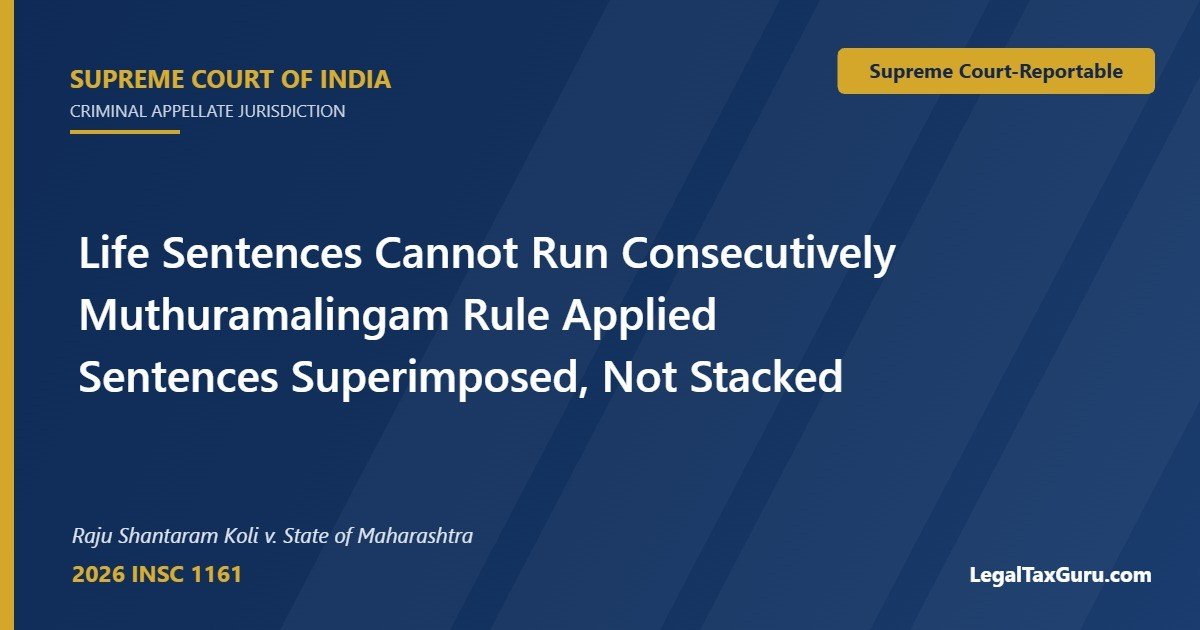
Quick Answer: Life sentences imposed for different offences in a single trial cannot be directed to run consecutively, because a life sentence means imprisonment for the rest of the convict's life. Following the Constitution Bench in Muthuramalingam, the Supreme Court set aside the direction that the life sentences under Sections 302 and 376 IPC run one after the other, and directed that they be superimposed on each other so that remission of one does not automatically remit the other.
In Raju Shantaram Koli v. State of Maharashtra (2026 INSC 1161), the Supreme Court held that two life sentences awarded in one trial for offences under Section 302 and Section 376 read with Section 342 of the Indian Penal Code, 1860 cannot run consecutively, applying the Constitution Bench ruling in Muthuramalingam v. State (paras 13–15). A Bench of Justice K.V. Viswanathan and Justice Arun Palli partly allowed the appeal against the Bombay High Court's judgment dated 10.06.2016, set aside the direction for consecutive sentences, kept the convictions and sentences otherwise intact, and directed that the two life sentences be superimposed over each other (paras 16–18).
Status: Bombay High Court's judgment dated 10.06.2016 in Criminal Appeal No. 975/2014 set aside only to the extent it upheld consecutive life sentences; conviction and remaining sentence maintained; connected appeal against the order dated 13.01.2025 disposed of as infructuous (paras 16, 19).
Headnote: Consecutive Life Sentences in a Single Trial
Code of Criminal Procedure, 1973 – Section 31 – Section 427(2) – Indian Penal Code, 1860 – Sections 302, 376 and 342 – Multiple life sentences in a single trial – Consecutive v. concurrent sentences – Superimposition of life sentences – Remission and commutation – Condonation of delay where convict in custody.
Held: (i) The question was whether the Trial Court and the High Court were justified in imposing consecutive life sentences in a single trial for offences under Section 302 and Section 376 read with Section 342 IPC (para 11).
(ii) The issue is covered by the Constitution Bench decision in Muthuramalingam v. State, (2016) 8 SCC 313, which held that imprisonment for life is a sentence for the remainder of the convict's life (paras 13–14).
(iii) Life sentences awarded for multiple offences in a single trial cannot be directed to run consecutively (para 15).
(iv) Such sentences are superimposed over each other, so that remission or commutation granted in respect of one does not ipso facto result in remission of the other (paras 15, 18).
(v) The direction of the Trial Court, as confirmed by the High Court, that the substantive sentences "shall run consecutively, one after other, and not concurrently" was set aside; the rest of the operative order was maintained (paras 16–17).
(vi) Since the appellant's direct challenge to the High Court's appellate judgment was admitted, the Court did not decide whether a writ court could order concurrent sentences, and the writ-related appeal became infructuous (paras 12, 19).
(paras 11–19)
Case Details: Raju Shantaram Koli v. State of Maharashtra (2026 INSC 1161)
Final Outcome: Criminal Appeal arising out of Diary No. 49371 of 2026 partly allowed; consecutive running of the two life sentences set aside; life sentences to be superimposed; Criminal Appeal arising out of SLP (Crl.) No. 8535 of 2025 disposed of as infructuous.
Case: Raju Shantaram Koli v. The State of Maharashtra
Neutral Citation: 2026 INSC 1161
Case No.: Criminal Appeal No. 5072 of 2026 (arising out of SLP (Crl.) No. 8535 of 2025) with Criminal Appeal No. 5073 of 2026 (arising out of SLP (Crl.) No. 20839 of 2026, Diary No. 49371 of 2026)
Court: Supreme Court of India (Criminal Appellate Jurisdiction) – Reportable
Date of Decision: 27 October 2026
Bench: Justice K.V. Viswanathan (author) and Justice Arun Palli
Relevant Acts & Sections: Indian Penal Code, 1860 – Sections 302, 376, 342; Code of Criminal Procedure, 1973 – Sections 31, 427(2), 428
Impugned Orders: Bombay High Court – judgment dated 10.06.2016 in Criminal Appeal No. 975/2014, and order dated 13.01.2025 in Criminal Writ Petition No. 842/2024 (paras 3, 8)
Counsel: Mr. M.Y. Deshmukh for the appellant; Mr. Bharat Bagla for the State (para 10)
Source: Supreme Court of India (official website)
Key Holdings of the Supreme Court
- Life sentences awarded for multiple offences in a single trial cannot be directed to run consecutively (para 15).
- Imprisonment for life means imprisonment for the remainder of the convict's natural life, so a direction to serve it twice over is anomalous (para 14, quoting Muthuramalingam).
- Multiple life sentences may be awarded, but they are superimposed over each other (paras 14–15).
- Remission or commutation of one life sentence does not ipso facto remit the other (paras 15, 18).
- Only the consecutive-running direction was set aside; the convictions, life sentences, fines and set-off under Section 428 CrPC remain (paras 16–17).
- Delay in filing the appeal was condoned because the appellant had been in jail throughout (para 1).
Brief Facts of the Case
The appellant was arrested on 30.04.2010 on the allegation that he had raped and murdered a minor girl on 29.04.2010. He was tried in Sessions Case No. 282/2010 before the Additional Sessions Judge, Thane (para 5).
By judgment dated 27.09.2013, the Trial Court convicted him under Section 302 IPC and, separately, under Section 376 read with Section 342 IPC, sentencing him to imprisonment for life with a fine of Rs. 5,000 on each count (para 6).
The Trial Court directed that the substantive sentences run consecutively, one after the other, and not concurrently (para 7).
The Bombay High Court, by judgment dated 10.06.2016 in Criminal Appeal No. 975/2014, confirmed the conviction and sentence, expressly declining to interfere with the consecutive sentences (para 8).
The appellant later filed Criminal Writ Petition No. 842/2024 seeking that the life sentences run concurrently. The High Court disposed of it on 13.01.2025, holding that a writ court cannot review the appellate judgment, and left it open to him to challenge the sentence before the appropriate court (para 3).
The appellant then challenged both the writ order and, by a separate appeal, the High Court's judgment of 10.06.2016 on the limited issue of consecutive sentences (paras 3–4, 9).
Issues Before the Supreme Court
- Whether the Trial Court and the High Court were justified in imposing consecutive life sentences in a single trial for offences under Section 302 and Section 376 read with Section 342 IPC (para 11).
- Whether a writ court could have ordered the sentences to run concurrently (left undecided, para 12).
Court's Findings and Reasoning
Condonation of delay (para 1): Considering the nature of the matter and that the appellant had been in jail throughout, the delay was condoned and leave granted.
Writ question not decided (para 12): Since the appeal against the High Court's appellate judgment itself was admitted, the Court did not need to decide whether a writ court could order concurrent sentences.
Constitution Bench in Muthuramalingam (paras 13–14): The Court relied on Muthuramalingam v. State, which held that life imprisonment is imprisonment for the remainder of the convict's life, that Section 31 CrPC permits consecutive running only of sentences that are not life sentences, and that multiple life sentences are superimposed over one another rather than run consecutively.
Correct legal position (para 15): Life sentences for multiple offences in a single trial cannot be directed to run consecutively, but are superimposed so that remission or commutation of one does not automatically remit the other.
Relief (paras 16–18): The direction for consecutive sentences was set aside, the remaining operative order of the Trial Court as affirmed by the High Court was maintained and restated, and the two life sentences were directed to be superimposed over each other.
Final Outcome and Directions
- Criminal Appeal arising out of Diary No. 49371 of 2026 partly allowed (para 16).
- Direction that the life sentences under Section 302 and under Section 376 read with Section 342 IPC run consecutively set aside (para 16).
- Convictions, life sentences, fines and set-off under Section 428 CrPC maintained; the operative order restated (paras 16–17).
- The two life sentences shall be superimposed over each other; remission or commutation of one will not ipso facto remit the other (para 18).
- Criminal Appeal arising out of SLP (Crl.) No. 8535 of 2025 disposed of as infructuous (para 19).
Legal Principle Laid Down
Where an accused is sentenced in a single trial to imprisonment for life for more than one offence, the life sentences cannot be ordered to run consecutively, since a life sentence means imprisonment for the rest of the convict's life. The sentences are instead superimposed over one another, so that remission or commutation granted in respect of one sentence does not by itself remit the other.
Precedents Relied Upon
- Muthuramalingam v. State, (2016) 8 SCC 313 (Constitution Bench) – Followed – life sentences cannot run consecutively; they are superimposed. Discussed at paras 13–15, 18.
- O.M. Cherian, Duryodhan Rout, Ranjit Singh and Kamalanantha cases – Referred to within the extract from Muthuramalingam. Discussed at para 14.
Important Paragraphs of the Judgment
Verbatim extracts from the judgment. For the full text, refer to the judgment PDF below.
Para 1: "Considering the nature of the matter and the fact that the appellant has been in jail throughout, delay is condoned."
Para 11: "The question before us is whether the Trial Court as well as the High Court were justified in imposing consecutive life sentences in a single trial for offences under Section 302 and Section 376 read with 342 of the IPC?"
Para 14 (quoting Muthuramalingam, para 18): "Any direction that requires the offender to undergo imprisonment for life twice over would be anomalous and irrational for it will disregard the fact that humans like all other living beings have but one life to live."
Para 15: "The correct legal position, as set out by this Court in Muthuramalingam (supra) is, life sentences awarded for multiple offences in a single Trial, cannot be directed to run consecutively."
Para 15: "However, such sentences would be super imposed over each other so that any remission or commutation granted by the competent authority qua one, does not ipso facto result in remission of sentence awarded to the prisoner for the other."
Para 18: "... the life sentence imposed for the offence punishable under Section 302 and the life sentence imposed for the offences punishable under Section 376 read with 342, shall be superimposed over each other ..."
Practical Impact of the Ruling
- For trial courts: Where two or more life sentences are imposed in one trial, a direction that they run consecutively is impermissible (para 15).
- For convicts serving multiple life terms: Existing consecutive-running directions can be challenged in appeal on the strength of Muthuramalingam (paras 9, 16).
- For prison and remission authorities: Superimposed life sentences must be considered separately; remission of one does not automatically cover the other (para 18).
- For criminal practitioners: A direct appeal against the sentencing direction is the proper route; the Court left open whether a writ court can alter it (para 12).
- For appellate courts: Delay may be condoned where the convict has been in custody throughout and the issue concerns legality of sentence (para 1).
FAQs on Consecutive Life Sentences
1. What did the Supreme Court hold in Raju Shantaram Koli v. State of Maharashtra?
It held that two life sentences imposed in one trial under Sections 302 and 376 IPC cannot run consecutively and must be superimposed over each other (paras 15–18).
2. Can a court order life sentences to run one after another?
No. Following Muthuramalingam, life sentences awarded for multiple offences in a single trial cannot be directed to run consecutively (paras 13–15).
3. What does "superimposed" life sentences mean?
The sentences run together, but remission or commutation granted for one does not automatically apply to the other (paras 15, 18).
4. Was the conviction disturbed?
No. Only the consecutive-running direction was set aside; the convictions, life sentences, fines and set-off were maintained (paras 16–17).
5. What happened to the challenge to the writ court's order?
Since the direct appeal was decided, that appeal was disposed of as infructuous and the writ question was left undecided (paras 12, 19).
Keywords: 2026 INSC 1161, Raju Shantaram Koli v. State of Maharashtra, consecutive life sentences, concurrent sentences, Muthuramalingam, Section 31 CrPC, superimposed life sentences, remission, Section 302 IPC, Section 376 IPC, Justice K.V. Viswanathan, Supreme Court reportable judgment, criminal law
Related on LegalTaxGuru
Download Judgment PDF – Raju Shantaram Koli v. State of Maharashtra
Judgment PDF: 2026 INSC 1161 – Raju Shantaram Koli v. The State of Maharashtra (Criminal Appeal No. 5072 of 2026) – Download Judgment PDF
Source: Supreme Court of India (official website).