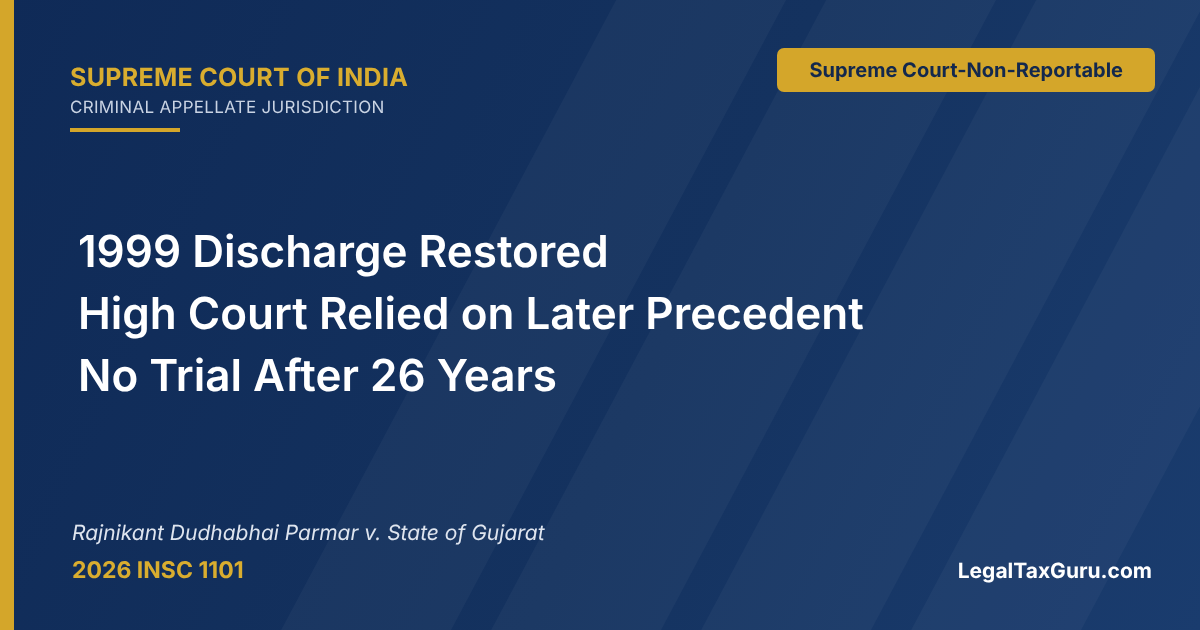
Quick Answer: The Supreme Court set aside a 2025 Gujarat High Court judgment that had revived criminal proceedings against a former prison Sipahi discharged in 1999. The High Court faulted the Sessions Court for ignoring a 2010 precedent that did not exist when the discharge was ordered, and putting the appellant on trial some 26 years later was not in the interest of justice.
In Rajnikant Dudhabhai Parmar v. State of Gujarat & Ors. (2026 INSC 1101), the Supreme Court allowed the appeal of a former Sipahi of Sabarmati Central Prison and restored his discharge ordered by the Sessions Court on 13 September 1999 (paras 2, 8–9). The Court noted that the High Court had blamed the Sessions Court for losing sight of State of Andhra Pradesh v. Golkonda Linga Swamy, (2010) 9 SCC 368, a decision that was not in existence when the discharge was ordered (paras 5–6). Treating that error as technical, the Court still held that subjecting the appellant to trial at this distance of time, with no counter affidavit and no information on the trial of the other accused, would not serve the interest of justice (para 7).
Status: Gujarat High Court judgment dated 11.08.2025 in Criminal Revision Application No. 595 of 1999 set aside; discharge order dated 13.09.1999 stands; appeal allowed (paras 2, 8–9).
Headnote: Revision Against Discharge After 26 Years
Code of Criminal Procedure, 1973 – Sections 227, 397 – Discharge – Revision by State against discharge – Delay of over two decades in deciding revision – Reliance on a precedent not in existence on the date of the discharge order – Interest of justice – Indian Penal Code, 1860 – Sections 122, 120-B – Arms Act, 1959 – Explosive Substances Act, 1908.
Held: (i) The High Court erred in holding that the Sessions Court had lost sight of the principles in Golkonda Linga Swamy (2010), since that decision did not exist when the appellant was discharged in 1999 (paras 5–6).
(ii) The error was termed merely technical, but even otherwise the impugned judgment could not be sustained (para 7).
(iii) An accused discharged on 13.09.1999 should not, in the interest of justice, be subjected to trial at this distance of time, particularly when the State filed no counter affidavit and the fate of the trial of the other accused was unknown (para 7).
(iv) The High Court's judgment restoring the proceedings was set aside and the appeal allowed (paras 8–9).
(paras 5–9)
Case Details: Rajnikant Dudhabhai Parmar v. State of Gujarat (2026 INSC 1101)
Final Outcome: Appeal allowed; Gujarat High Court judgment dated 11.08.2025 set aside; appellant's discharge dated 13.09.1999 restored.
Case: Rajnikant Dudhabhai Parmar v. The State of Gujarat & Ors.
Neutral Citation: 2026 INSC 1101
Case No.: Criminal Appeal No. ___ of 2026 (arising out of SLP (Crl.) No. 21169 of 2025)
Court: Supreme Court of India (Criminal Appellate Jurisdiction) – Non-Reportable
Date of Decision: 5 October 2026
Bench: Justice Dipankar Datta and Justice Sheel Nagu (Order; no authoring judge named)
Relevant Acts & Sections: Code of Criminal Procedure, 1973 – Sections 2(d), 227, 397; Indian Penal Code, 1860 – Sections 122, 120-B; Arms Act, 1959 – Sections 25(1-B), 28, 35, 36; Explosive Substances Act, 1908 – Sections 4, 6
Impugned Order: Gujarat High Court at Ahmedabad – judgment dated 11.08.2025 in R/Criminal Revision Application No. 595 of 1999, setting aside the appellant's discharge (paras 2, 4)
Source: Supreme Court of India (official website)
Key Holdings of the Supreme Court
- A discharge order cannot be faulted for ignoring a precedent that was delivered more than a decade after the order was passed (para 6).
- Though the High Court's error was technical, a trial at this distance of time would not be in the interest of justice (para 7).
- The State's failure to file a counter affidavit left the Court without information on the fate of the trial against the co-accused (para 7).
- The High Court's judgment was set aside and the appellant's discharge of 1999 stands (paras 8–9).
Brief Facts of the Case
The appellant was serving as a Sipahi at Sabarmati Central Prison. On 23.03.1998, a police raid at certain premises led to an exchange of fire and the recovery of arms, explosives, ammunition and cellular phones, and Crime No. 22/1998 was registered at Dariapur Police Station, inter alia under Section 122 IPC (para 3).
The role attributed to the appellant was that one of the accused had given him a mobile phone for repair while he was on duty at the prison. After the chargesheet, he applied for discharge under Section 227 CrPC (para 3).
On 13.09.1999, the Additional Sessions Judge, Court No. 10, Ahmedabad, discharged the appellant and directed framing of charges against the remaining four accused under Sections 122 and 120-B IPC, the Arms Act and the Explosive Substances Act (para 3).
The State filed a revision in 1999. After a considerable lapse of time, the High Court allowed it on 11.08.2025 and set aside the discharge, holding that the trial court had made a roving inquiry and lost sight of Golkonda Linga Swamy (paras 2, 4–5).
Issues Before the Supreme Court
- Whether the High Court was right in faulting the 1999 discharge order for ignoring a 2010 precedent (paras 5–6).
- Whether the appellant should be put to trial more than two decades after his discharge (para 7).
Court's Findings and Reasoning
Precedent not in existence (paras 5–6): The High Court held that the trial court had lost sight of the principles in State of Andhra Pradesh v. Golkonda Linga Swamy, (2010) 9 SCC 368. The Supreme Court noted that this decision was not in existence on the date the Sessions Court allowed the discharge application, so the High Court erred in its observation.
Technical error, but the result still unjust (para 7): The Court viewed the error as merely technical. Even otherwise, it held that a person discharged on 13.09.1999 should not be subjected to trial at this distance of time.
No counter affidavit (para 7): The State filed no counter affidavit, and the fate of the trial against the other accused was therefore unavailable to the Court.
Result (paras 8–9): The impugned judgment was set aside and the appeal allowed.
Final Outcome and Directions
- Appeal allowed (para 9).
- Gujarat High Court judgment dated 11.08.2025 set aside (para 8).
- Pending applications disposed of (para 10).
Legal Principle Laid Down
A revisional court cannot fault a discharge order for ignoring a precedent that came into existence after the order was passed. Where a revision against discharge is decided after a delay of over two decades, the court may decline to send the discharged accused to trial in the interest of justice, especially when the State has not placed material on record about the trial of the co-accused (paras 6–7).
Precedents Relied Upon
- State of Andhra Pradesh v. Golkonda Linga Swamy, (2010) 9 SCC 368 – relied on by the High Court; the Supreme Court noted it did not exist when the discharge was ordered (paras 5–6).
Important Paragraphs of the Judgment
Verbatim extracts from the judgment. For the full text, refer to the judgment PDF below.
Para 3: "The role attributed to the appellant was that one of the accused persons had given a mobile phone to him for repair while he was discharging his duties at the prison."
Para 4: "After a considerable lapse of time, the High Court, vide judgment dated 11th August, 2025, allowed the revision and set aside the appellant’s discharge."
Para 6: "Curiously enough, the decision relied on by the High Court was not in existence on the date the Sessions Court allowed the application for discharge and, therefore, the High Court erred in observing that the Sessions Court has lost sight of the principles laid down therein."
Para 7: "Although we see such error as merely technical, even otherwise, we are of the considered opinion that the appellant having been discharged by an order dated 13th September, 1999, it would not in the interest of justice to uphold the impugned judgment and subject him to a trial at this distance of time particularly when no counter affidavit has been filed and, thereby, the fate of the trial qua the other accused is unavailable."
Para 8: "The impugned judgment, thus, stands set aside."
Practical Impact of the Ruling
- For accused persons: A discharge that has stood for decades may not be reopened merely because a revision was pending, especially where the State has not filed a counter affidavit (para 7).
- For prosecuting agencies: The State must pursue revisions promptly and place full material, including the status of the co-accused's trial, before the court (para 7).
- For revisional courts: A discharge order must be judged by the law as it stood on the date of the order, not by later precedents (para 6).
FAQs on Revision Against Discharge After Long Delay
1. What did the Supreme Court decide in Rajnikant Dudhabhai Parmar v. State of Gujarat?
It set aside the Gujarat High Court's 2025 judgment that had revived proceedings against the appellant, and restored his 1999 discharge (paras 8–9).
2. What was the appellant accused of?
As a prison Sipahi, he was alleged to have received a mobile phone for repair from one of the accused in a 1998 arms and explosives case (para 3).
3. What mistake did the High Court make?
It faulted the Sessions Court for ignoring Golkonda Linga Swamy (2010), a decision that did not exist when the discharge was ordered in 1999 (paras 5–6).
4. Why was the appellant not sent for trial?
Because subjecting him to trial so many years after his discharge would not be in the interest of justice, particularly as the State filed no counter affidavit (para 7).
5. Is this a reportable judgment?
No. It is a non-reportable Order of a Bench of Justice Dipankar Datta and Justice Sheel Nagu dated 05.10.2026.
Keywords: 2026 INSC 1101, Rajnikant Dudhabhai Parmar v. State of Gujarat, discharge Section 227 CrPC, revision against discharge, delay in revision, Golkonda Linga Swamy, Sabarmati Central Prison, interest of justice, Supreme Court non-reportable judgment
Related on LegalTaxGuru
Download Judgment PDF – Rajnikant Dudhabhai Parmar v. State of Gujarat
Judgment PDF: 2026 INSC 1101 – Rajnikant Dudhabhai Parmar v. State of Gujarat & Ors. (SLP (Crl.) No. 21169 of 2025) – Download Judgment PDF
Source: Supreme Court of India (official website).