Quick Answer: An assessee who has not filed a valid revised return cannot use a revision under Section 264 of the Income-tax Act, 1961 to raise a fresh claim that was never before the Assessing Officer. Following Om Siddhakala Associates and Goetze (India), the Supreme Court held that the Revisional Authority may entertain a new point of law, but not anything beyond the facts available with the Assessing Authority.
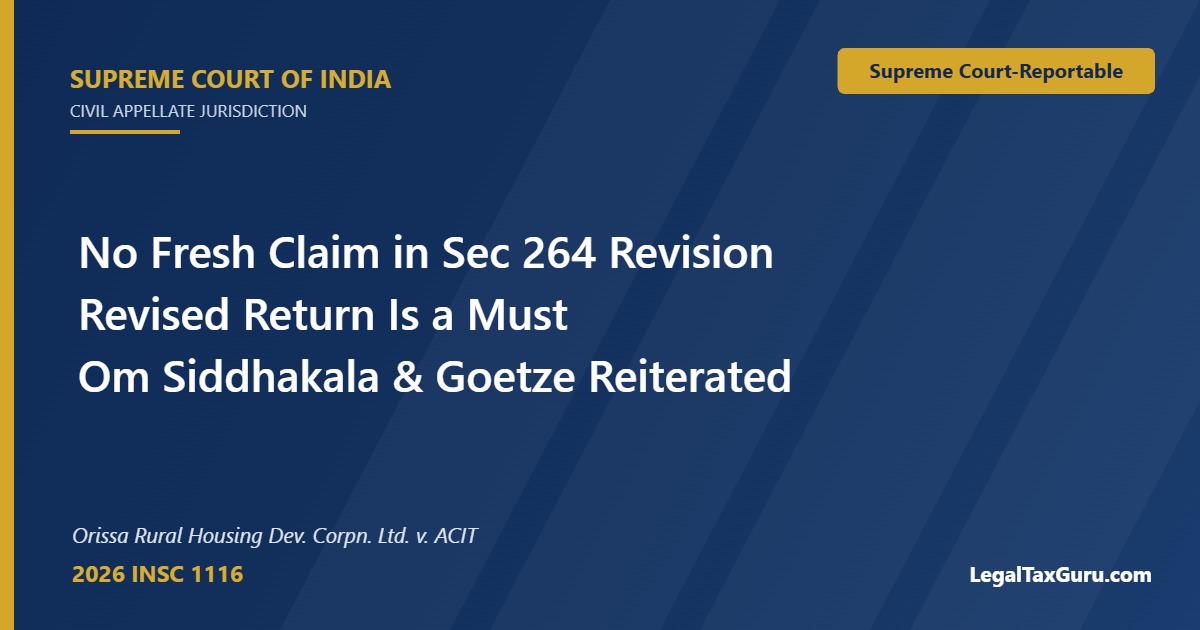
In Orissa Rural Housing Development Corporation Ltd. v. Assistant Commissioner of Income Tax & Ors. (2026 INSC 1116), the Supreme Court held that whether a fresh claim can be raised before the Revisional Authority without filing a revised return is no longer res integra, and that such a claim cannot be raised by invoking Section 264 (paras 8, 11, 13). A Bench of Justice Prashant Kumar Mishra and Justice Shree Chandrashekhar distinguished Wipro Finance, Dwarka Nath and Sirpur Paper Mills, and dismissed the appeals against the High Court's dismissal of the assessee's writ petition for Assessment Year 2006-07 (paras 1, 9, 14).
Status: High Court's order dismissing the writ petition against the assessment order dated 23.12.2008, the Section 264 order dated 11.03.2010 and the CIT (Appeals) order dated 15.09.2010 upheld; appeals dismissed (paras 1, 14).
Headnote: Fresh Claim in Section 264 Revision
Income-tax Act, 1961 – Section 264 – Revisional jurisdiction of the Commissioner – Fresh claim without revised return – Section 139(5) – Section 143(2) and 142(1) – Section 254 – Powers of Assessing Officer, Revisional Authority and Tribunal – Goetze (India), Om Siddhakala Associates and Shriram Investments followed – Wipro Finance, Dwarka Nath and Sirpur Paper Mills distinguished – Assessment Year 2006-07.
Held: (i) In the absence of a revised return filed within time and in accordance with law, an assessee cannot raise a fresh claim before the Revisional Authority under Section 264; the issue is no longer res integra after Om Siddhakala Associates (paras 7–8).
(ii) Wipro Finance, Dwarka Nath and Sirpur Paper Mills are distinguishable, as none of them concerned the effect of not filing a revised return within time and in accordance with law (para 9).
(iii) The scope of revisional jurisdiction explained in Dwarka Nath does not enlarge an assessee's right to raise a fresh claim without filing a revised return (para 9).
(iv) The view in Goetze (India) and Om Siddhakala Associates is reiterated, since reading the revisional power otherwise would allow endless fresh claims based on new facts not before the Assessing Officer (paras 10–11).
(v) Shriram Investments had already explained that Wipro Finance dealt with the Tribunal's appellate power under Section 254, not the Assessing Officer's power to consider a claim after the time for a revised return expired (para 12).
(vi) The power of the Revisional Authority extends to a new question or point of law, not to anything beyond the facts available with the Assessing Authority (para 13).
(paras 8–14)
Case Details: Orissa Rural Housing Development Corporation v. ACIT (2026 INSC 1116)
Final Outcome: Appeals dismissed; fresh claim not permissible in Section 264 revision without a valid revised return; pending applications disposed of.
Case: Orissa Rural Housing Development Corporation Ltd. v. The Asst. Commissioner of Income Tax & Ors.
Neutral Citation: 2026 INSC 1116
Case No.: Civil Appeal Nos. 7249–7250 of 2015
Court: Supreme Court of India (Civil Appellate Jurisdiction) – Reportable
Date of Decision: 8 October 2026
Bench: Justice Prashant Kumar Mishra and Justice Shree Chandrashekhar (Order of the Court; no separate author named)
Relevant Acts & Sections: Income-tax Act, 1961 – Sections 139(5), 142(1), 143(2), 234B, 254 and 264
Impugned Order: High Court's order dismissing the writ petition that challenged the assessment order dated 23.12.2008, the order of the Commissioner of Income Tax, Bhubaneswar dated 11.03.2010 under Section 264, and the order of the CIT (Appeals)-I, Bhubaneswar dated 15.09.2010 (para 1)
Source: Supreme Court of India (official website)
Key Holdings of the Supreme Court
- Without a revised return filed within time and in accordance with law, a fresh claim cannot be raised before the Revisional Authority under Section 264 (paras 7–8).
- Om Siddhakala Associates has settled the issue; a Section 264 revision cannot be used to revise the return under the garb of a revision (para 8).
- Wipro Finance, Dwarka Nath and Sirpur Paper Mills do not deal with the effect of non-filing of a revised return and are distinguishable (para 9).
- Goetze (India) and Om Siddhakala Associates are reiterated (paras 10–11).
- Allowing fresh claims in revision would make the assessment procedure and assessment order endless (para 11).
- Shriram Investments confirmed that Wipro Finance concerned the Tribunal's power under Section 254 (para 12).
- The Revisional Authority may entertain a new question or point of law, but not anything beyond the facts available with the Assessing Authority (para 13).
Brief Facts of the Case
The appellant filed its return for Assessment Year 2006-07 within time, disclosing a total loss of Rs. 1,94,48,311. The Assessing Officer issued notice under Section 143(2) on 10.10.2007 and a notice under Section 142(1) on 03.10.2008 (para 2).
The appellant filed a petition before the Assistant Commissioner of Income Tax, Circle-1, Bhubaneswar to revise the return, but it was not taken into account. The assessment order dated 23.12.2008 raised a demand of Rs. 7,58,33,470 and interest under Section 234B of Rs. 2,50,25,022, totalling Rs. 10,08,58,492 (para 3).
The appellant's revision before the Commissioner of Income Tax was dismissed on the ground that an assessee who has filed an original return cannot make a fresh claim other than by filing a revised return (para 4).
Its first appeal before the CIT (Appeals) was dismissed as not maintainable, as the appellant had already availed of the revision under Section 264 (para 5).
The High Court dismissed the writ petition challenging these orders, which also sought refund of the tax collected (para 1).
Issues Before the Supreme Court
- Whether a fresh claim can be raised before the Revisional Authority under Section 264 without filing a revised return (paras 6–8).
- Whether Wipro Finance, Dwarka Nath and Sirpur Paper Mills support the appellant's claim (paras 6, 9, 12).
Court's Findings and Reasoning
Appellant's case (para 6): Relying on Wipro Finance Ltd. v. CIT, Dwarka Nath v. ITO and Sirpur Paper Mills Ltd. v. CWT, counsel argued that a fresh claim can be raised before the Revisional Authority.
Revenue's case (para 7): Counsel relied on DCIT v. M/s. Om Siddhakala Associates (Civil Appeal No. 10175 of 2026, decided on 05.08.2026), under which a fresh claim cannot be raised before the Revisional Authority without a revised return filed in accordance with law.
Issue settled (para 8): The Court held the issue is no longer res integra. In Om Siddhakala Associates, a claim not made in the return and not raised by a timely revised return could not be raised under Section 264, which would be an attempt to revise the return under the garb of a revision.
Precedents distinguished (paras 9–10, 12): None of the appellant's authorities concerned the effect of not filing a revised return within time. Goetze (India) had already laid down the limits, and Shriram Investments explained that Wipro Finance dealt only with the Tribunal's appellate power under Section 254.
No endless fresh claims (paras 11, 13): If revisional power were read as the appellant urged, fresh claims based on new facts not before the Assessing Officer could be raised without end. The Revisional Authority may consider a new question of law, but not matters beyond the facts available with the Assessing Authority.
Final Outcome and Directions
- The appeals are dismissed as lacking substance (para 14).
- Pending applications, if any, stand disposed of (para 15).
Legal Principle Laid Down
A revision under Section 264 of the Income-tax Act, 1961 cannot be used to raise a fresh claim that the assessee did not make in the return and did not raise by a revised return filed within time and in accordance with law. The Revisional Authority may entertain a new question or point of law for the first time, but not a claim that depends on facts beyond those available with the Assessing Authority.
Precedents Relied Upon
- DCIT v. M/s. Om Siddhakala Associates, Civil Appeal No. 10175 of 2026 (05.08.2026) – Followed – no fresh claim under Section 264 without a timely revised return. Discussed at paras 7–8, 11.
- Goetze (India) Ltd. v. CIT, (2006) 284 ITR 323 – Reiterated. Discussed at paras 10–11.
- Shriram Investments v. CIT, (2024) 468 ITR 372 – Relied upon – Wipro Finance explained and distinguished. Discussed at para 12.
- Wipro Finance Ltd. v. CIT, (2022) 443 ITR 250 – Distinguished – concerned the Tribunal's power under Section 254. Discussed at paras 6, 9, 12.
- Dwarka Nath v. ITO, (1965) 57 ITR 349 – Distinguished. Discussed at paras 6, 9.
- Sirpur Paper Mills Ltd. v. CWT, (1970) 1 SCC 795 – Distinguished. Discussed at paras 6, 9.
Important Paragraphs of the Judgment
Verbatim extracts from the judgment. For the full text, refer to the judgment PDF below.
Para 8: "... the issue as to whether a fresh claim can be raised before the Revisional Authority without filing a revised return is no longer res integra ..."
Para 9: "The scope of revisional jurisdiction as has been explained in Dwarka Nath (supra) would not enlarge an assessee's right to raise fresh claim without filing revised return ..."
Para 11: "... if the power of the Revisional Authority is read in the manner sought to be agitated before this Court, then there would be no end to raising any fresh claim basing a new fact which was not before the Assessing Officer."
Para 11: "Allowing this, would make the assessment procedure and the assessment order endless, and any party can raise fresh claim before the Revisional Authority even though there are no foundational facts available before the Assessing Authority to consider such claim."
Para 13: "... the power of the Revisional Authority is for entertaining for the first time a new question of law or point of law, and not anything which is beyond the facts which were available with the Assessing Authority."
Practical Impact of the Ruling
- For assessees: File a revised return within the time under Section 139(5) for any new claim; a later Section 264 revision will not cure the omission (paras 8, 11).
- For tax practitioners: Wipro Finance cannot be cited to support fresh factual claims before the Commissioner in revision (paras 9, 12).
- For Commissioners in revision: New points of law can be considered, but not claims needing facts that were not before the Assessing Officer (para 13).
- For choice of remedy: Once a Section 264 revision is availed, a later appeal may be held not maintainable, as happened here (para 5).
- For the Revenue: Om Siddhakala Associates and Goetze (India) now stand reiterated by a reportable decision (paras 10–11).
FAQs on Fresh Claims in Section 264 Revision
1. What did the Supreme Court hold in Orissa Rural Housing Development Corporation v. ACIT?
It held that without a valid revised return, an assessee cannot raise a fresh claim before the Revisional Authority under Section 264, and dismissed the appeals (paras 8, 14).
2. Can a fresh claim be raised in a Section 264 revision?
Not if it was not made in the return or by a timely revised return; that would be revising the return under the garb of a revision (para 8).
3. Can the Revisional Authority consider a new point of law?
Yes, it may entertain a new question or point of law for the first time, but not anything beyond the facts available with the Assessing Authority (para 13).
4. Why did Wipro Finance not help the appellant?
Wipro Finance concerned the Tribunal's appellate power under Section 254 and not the effect of failing to file a revised return in time, as explained in Shriram Investments (paras 9, 12).
5. Why does the Court limit revisional power this way?
Otherwise fresh claims based on new facts could be raised without end, making the assessment procedure and assessment order endless (para 11).
Keywords: 2026 INSC 1116, Orissa Rural Housing Development Corporation v. ACIT, Section 264 Income Tax Act, fresh claim in revision, revised return Section 139(5), Om Siddhakala Associates, Goetze India, Shriram Investments, Wipro Finance distinguished, revisional jurisdiction, Assessment Year 2006-07, Supreme Court reportable judgment, income tax case law
Related on LegalTaxGuru
Download Judgment PDF – Orissa Rural Housing Development Corporation v. ACIT
Source: Supreme Court of India (official website).