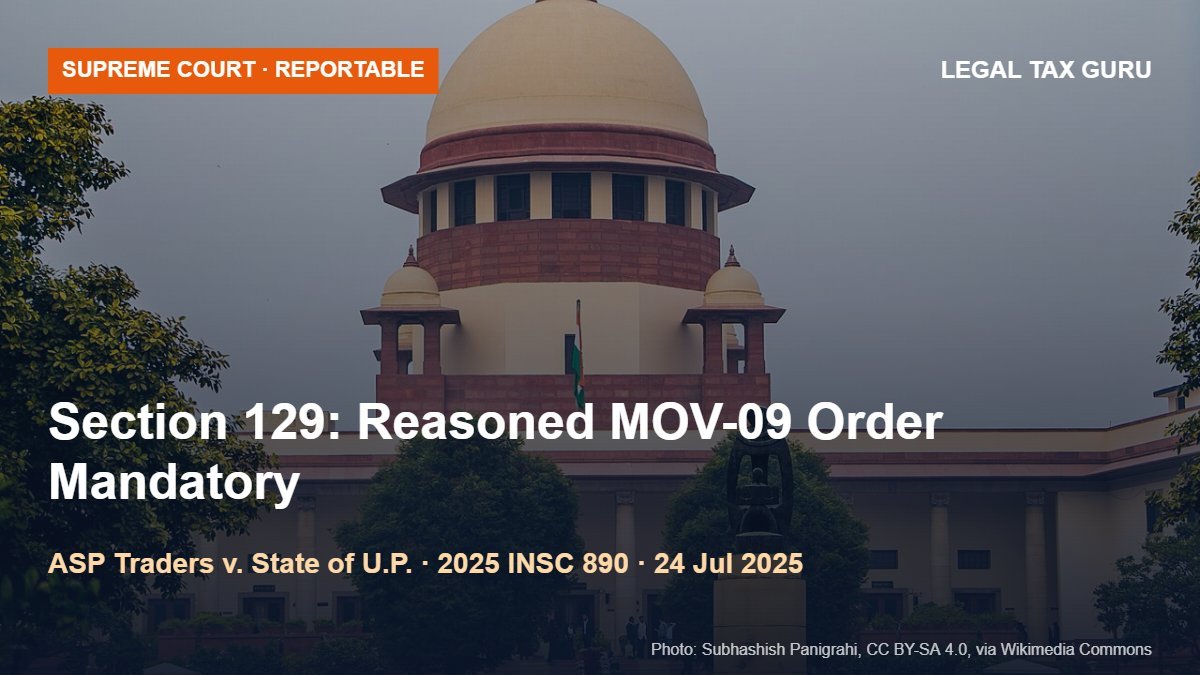
The Supreme Court held that even where a taxpayer pays the tax and penalty demanded in a Section 129(3) notice to get detained goods released, the proper officer must still pass a reasoned final order in Form GST MOV-09 and upload its summary in Form GST DRC-07, particularly where objections were filed and payment was made under protest. The deeming fiction in Section 129(5) only means no further proceedings follow; it does not waive the taxpayer's right to challenge the levy or dispense with adjudication. Without an order, the right of appeal under Section 107 becomes illusory (paras 14–21).
Headnote
Goods and Services Tax — Detention of goods in transit — Payment of tax and penalty under protest — Deemed conclusion of proceedings — Requirement of speaking order — Right of appeal — CGST Act, 2017, Ss. 107, 129(1), 129(3), 129(4), 129(5), 168; IGST Act, 2017, S. 20; CGST Rules, 2017, R. 142; CBIC Circular No. 41/15/2018-GST dated 13.04.2018; Constitution of India, Art. 265.
Goods detained; notice in MOV-07 under S. 129(3); taxpayer filed objections but paid Rs. 7,20,440 through DRC-03 owing to business exigencies and goods were released in MOV-05; no final order passed, the Department relying on S. 129(5) and an alleged oral withdrawal of objections — Held, every show cause notice must culminate in a reasoned final order; S. 129(5) does not mean the assessee has waived the right to challenge the levy and does not absolve the proper officer of the duty to pass an order in MOV-09 and upload DRC-07; once objections are filed, adjudication is imperative; payment through DRC-03, which the portal treats as voluntary without any protest option, cannot be treated as voluntary here; there can be no acquiescence in tax under Art. 265. High Court order set aside; direction to pass a reasoned order within one month after hearing.
(Paras 8, 10, 14–21)
Judgment Intelligence
| Final Outcome | Appeal allowed. |
|---|---|
| Case | M/s ASP Traders v. State of Uttar Pradesh & Ors. |
| Neutral Citation | 2025 INSC 890 (Reportable) |
| Case No. | Civil Appeal No. 9764 of 2025 (arising out of SLP (C) No. 17995 of 2022) |
| Court | Supreme Court of India |
| Date of Decision | 24 July 2025 |
| Bench | Justices J.B. Pardiwala and R. Mahadevan (authored by Justice R. Mahadevan) |
| Relevant Acts & Sections | CGST Act, 2017 – Sections 107, 129(1), 129(3), 129(4), 129(5), 168; IGST Act, 2017 – Section 20; CGST Rules, 2017 – Rule 142; CBIC Circular No. 41/15/2018-GST dated 13.04.2018; Constitution – Article 265 |
| Impugned Order | Allahabad High Court judgment dated 18.07.2022 in Writ Tax No. 955 of 2022 |
| Source | Supreme Court of India (sci.gov.in), decided 24.07.2025 |
Key Holdings
- Every show cause notice must culminate in a final, reasoned order; Section 129(3) requires the officer to issue a notice "and thereafter, pass an order" (paras 14–15).
- The deeming fiction in Section 129(5) does not mean the assessee has waived or abandoned the right to challenge the levy, nor does it relieve the officer of the duty to pass an order in MOV-09 and upload DRC-07 (para 14).
- Once objections are filed and payment is made under protest, adjudication is not optional (para 15).
- A written reply prevails over an alleged oral withdrawal not supported by any record (para 16).
- Payment through DRC-03, which the portal treats as voluntary with no option to record protest, cannot be treated as voluntary where objections are on record and payment was compelled by business needs (para 16).
- There can be no acquiescence in tax; Article 265 bars both levy and collection without authority of law (para 16.1).
Brief Facts
The appellant, a Karnataka dealer in arecanut, consigned 17,850 kg of dry arecanut worth Rs. 51,72,930 in 255 bags to a Delhi buyer with an e-way bill. During transit the goods were transhipped to another vehicle, with 7 bags missing (paras 3.1–3.2). The vehicle was detained at Jhansi on 17.01.2022; MOV-04 and a detention order in MOV-06 were issued on 20.01.2022, followed by a notice in MOV-07 dated 21.01.2022 alleging the shortfall, a non-existent consignee and an incorrect consignor address (paras 3.3–3.4). The appellant filed a detailed reply on 24.01.2022 but, owing to business exigencies, paid Rs. 7,20,440 through DRC-03 on 27.01.2022, and the goods were released by MOV-05 the same day (para 3.5). No final order was passed; the Department claimed the appellant's representative had orally withdrawn the reply. The Allahabad High Court dismissed the writ petition holding that the proceedings stood concluded under Section 129(5) read with Rule 142(3) (paras 3.6–3.9).
Issue (para 8)
- Whether, upon payment of tax and penalty within the time stipulated in a notice under Section 129(3), the proper officer must still pass a final order under Section 129(3), or whether the deeming fiction in Section 129(5) dispenses with it?
Court's Findings
CBIC Circular is binding: Circular No. 41/15/2018-GST, binding under Section 168, requires the proper officer, after payment, to release the goods in MOV-05 and to pass a formal demand order in MOV-09 and upload its summary in DRC-07 (para 10).
Meaning of Section 129(5): "Conclusion" only signifies that no further proceedings will be initiated; it does not absolve the officer of passing an order concluding the proceedings, as required by Rule 142(5) and the Circular (para 14).
Objections and protest: The discharge order did not record any withdrawal of objections. With objections on record and payment under protest, a speaking order was imperative to safeguard the appeal under Section 107 (paras 13–16).
No waiver or acquiescence: Waiver requires a conscious abandonment of a right; payment by itself is not waiver, especially where the demand was objected to. Reliance on Dilip Kumar & Co. (strict interpretation of exemptions) was misplaced as the issue concerned due process (paras 16.1–17).
Reasons are the soul of justice: Absence of a reasoned order creates a legal vacuum, renders the appeal illusory and may violate Article 265 (paras 18–19).
Final Outcome / Directions (paras 21–22)
- Allahabad High Court order set aside.
- Respondent No. 3 to pass a reasoned final order under Section 129(3) in MOV-09, after a hearing under Section 129(4), and upload its summary in DRC-07 within one month of receipt of the judgment.
- Appellant free to pursue legal remedies against that order.
- Appeal allowed; no costs.
Legal Principle
Payment of tax and penalty to secure release of detained goods does not end the taxpayer's right to contest the levy; the proper officer must adjudicate by a reasoned order in MOV-09 (with DRC-07), especially where objections have been filed, so that the statutory right of appeal remains real.
Precedents Relied Upon
- Kranti Associates (P) Ltd. v. Masood Ahmed Khan, (2010) 9 SCC 496 – Relied upon · Discussed at para 18.1: duty of quasi-judicial authorities to give reasons.
- Sha Mulchand & Co. Ltd. v. Jawahar Mills Ltd. and other decisions on waiver and acquiescence – Relied upon · Discussed at para 16.2: payment alone is not waiver.
- Commissioner of Customs (Import), Mumbai v. Dilip Kumar & Co., (2018) 9 SCC 1 – Distinguished · Discussed at para 17: relates to strict interpretation of exemptions, not due process.
Important Paragraphs of the Judgment
Para 14: "It is a well settled principle that every show cause notice must culminate in a final, reasoned order. While Section 129(5) of the CGST Act, 2017 provides that proceedings shall be deemed to be concluded upon payment of tax and penalty, this deeming fiction cannot be interpreted to imply that the assessee has agreed to waive or abandon the right to challenge the levy – a right that is protected by the very enactment itself. The term "conclusion" as used in Section 129(5) merely signifies that no further proceedings for prosecution will be initiated. It does not absolve the responsibility of the proper officer to pass an order concluding the proceedings…"
Para 15: "…Once objections are filed, adjudication is not optional, it becomes imperative to pass a speaking order to justify the demand of tax and penalty, to safeguard the right of appeal under Section 107 of the CGST Act, 2017. The language of section 129(3) is categorical in stating that the officer "shall issue a notice… and thereafter, pass an order"…"
Para 16: "…Significantly, the GST payment portal permits payments only through Form GST DRC-03, which is automatically classified as a voluntary payment, and does not provide any mechanism for an assessee to indicate that the payment is being made under protest… We are, therefore, of the considered opinion that the payment made by the appellant in the present case cannot be treated as voluntary, and the absence of a mechanism to record protest should not operate to the detriment of the assessee…"
Para 19: "Therefore, even assuming that the payment was made by the appellant, voluntarily or otherwise, the proper officer could not be absolved of the statutory obligation to pass a reasoned order in Form GST MOV-09 and upload the corresponding summary in Form GST DRC-07…"
What the Ruling Means: Practical Impact
- Pay and contest: Transporters and owners can pay to secure release of goods and still insist on a reasoned MOV-09 order to file an appeal.
- Always file written objections: A written reply on record outweighs any alleged oral withdrawal and makes adjudication mandatory.
- Record protest outside the portal: Since DRC-03 has no protest option, communicate the protest in writing at the time of payment.
- Seek the order in writing: If no MOV-09 is passed, request it in writing and, if refused, approach the High Court.
Frequently Asked Questions
Is an order under Section 129(3) required if the taxpayer pays the penalty?
Yes. Even after payment, the proper officer must pass a reasoned order in MOV-09 and upload DRC-07, particularly where objections were filed (paras 14–15, 19).
Does Section 129(5) bar an appeal after payment?
No. Section 129(5) only means no further proceedings will be initiated; it does not waive the right to challenge the levy (para 14).
Is payment through DRC-03 always voluntary?
Not necessarily. The portal treats DRC-03 as voluntary with no protest option; where objections are on record and payment was compelled by business needs, it cannot be treated as voluntary (para 16).
What did the Supreme Court direct in ASP Traders?
The proper officer must pass a reasoned MOV-09 order after hearing and upload DRC-07 within one month, after which the appellant may pursue remedies (para 21).
Read more: Supreme Court Reportable GST Judgments · High Court GST Judgments · GST Legal News
Download Judgment: 2025 INSC 890 – M/s ASP Traders v. State of Uttar Pradesh (PDF, sci.gov.in)
Judgment digest by Legal Tax Guru: a summary of the Court's judgment, not its text. The judgment itself is the authoritative version. In case of any error or discrepancy, the original judgment prevails – please verify with the official copy. See our Judgment Summary & Editorial Accuracy Policy.