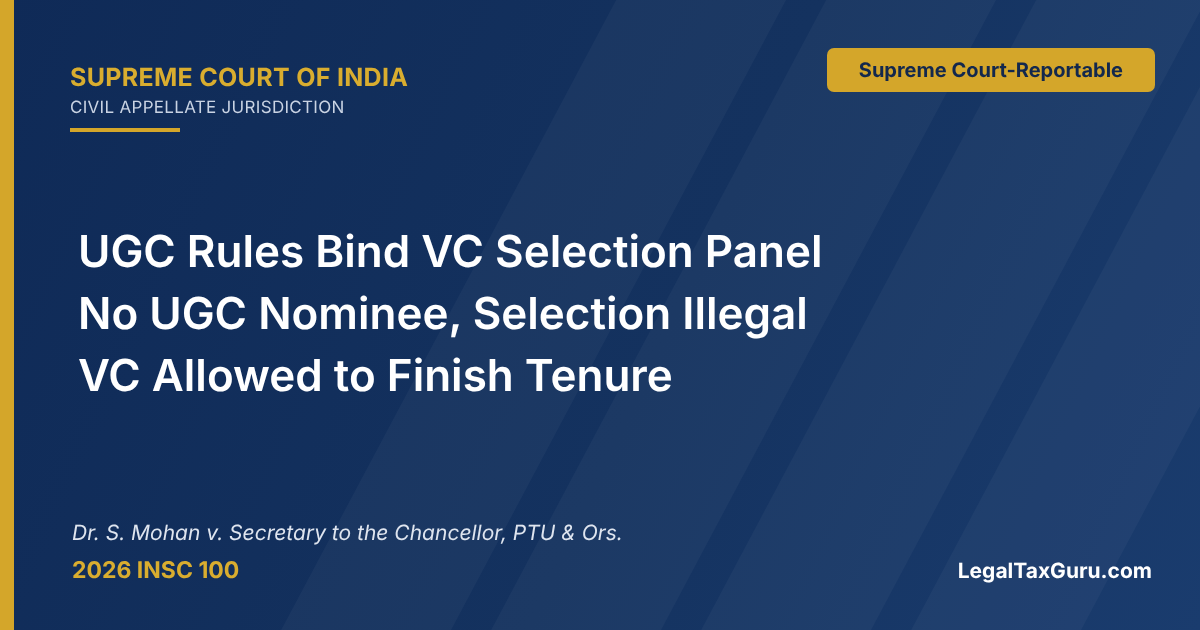
Quick Answer: A State or Union Territory university law cannot provide a Vice-Chancellor Search-cum-Selection Committee that departs from Regulation 7.3 of the UGC Regulations, 2018, which requires a nominee of the UGC Chairman and members not connected with the University. The Supreme Court upheld the Madras High Court's ruling that the Puducherry Technological University Vice-Chancellor's selection was illegal, but under Article 142 allowed him to continue until the end of his tenure or until a new Vice-Chancellor is selected, whichever is earlier.
In Dr. S. Mohan v. Secretary to the Chancellor, Puducherry Technological University & Ors. (2026 INSC 100), the Supreme Court held that Section 14(5) of the Puducherry Technological University Act, 2019, to the extent it prescribes a Search-cum-Selection Committee contrary to the UGC Regulations, 2018, is ultra vires those Regulations, which are traceable to Entry 66 of List I and occupy the field (paras 40–41). Since the UGC Act operates under List I and the PTU Act under Entry 25 of List III, repugnancy and Presidential assent under Article 254 do not arise (paras 45–48). A Bench of Justice Vikram Nath and Justice Sandeep Mehta affirmed the High Court's findings but protected the appellant's tenure under Article 142 (paras 49–52).
Status: High Court's common judgment dated 19.12.2023 in W.P. Nos. 28147 of 2022 and 4174 of 2023 affirmed on the illegality of the Search-cum-Selection Committee; appellant to continue as Vice-Chancellor till the end of his normal tenure or the selection of a new Vice-Chancellor, whichever is earlier; appeals disposed of (paras 49–54).
Headnote: UGC Regulations and Vice-Chancellor Selection
Constitution of India – Articles 142, 246 and 254 – Seventh Schedule, Entry 66 of List I and Entry 25 of List III – University Grants Commission Act, 1956 – Sections 14, 26(1)(e) and 26(1)(g) – UGC Regulations, 2018 – Regulation 7.3 – Puducherry Technological University Act, 2019 – Section 14(5) and proviso – Appointment of Vice-Chancellor – Search-cum-Selection Committee – Nominee of UGC Chairman – Conflict of interest – Repugnancy – Presidential assent – Moulding of relief.
Held: (i) The State's power over education under Entry 25 of List III is subject to Entry 66 of List I; it cannot impinge upon or dilute the standards prescribed by the Union (paras 38–39).
(ii) The UGC Regulations, 2018 are framed under the UGC Act, enacted under Entry 66 of List I; the PTU Act was required to operate in strict conformity with Regulation 7.3, and inclusion of a nominee of the UGC Chairman is an integral component of the standards prescribed (paras 40–41).
(iii) Section 14(5) of the PTU Act, to the extent it prescribes a composition contrary to the UGC Regulations, 2018, has to be declared ultra vires those Regulations (para 41).
(iv) Inclusion of the Secretary to Government (Higher & Technical Education), who was Pro-Chancellor and a former member of the Governing Body of the erstwhile Puducherry Engineering College, contravened the requirement that members not be connected with the University (para 42).
(v) As the two laws are referable to different entries, List I and List III, the doctrine of repugnancy and the need for Presidential assent under Article 254 are not attracted; the conflict between Kaiser-I-Hind and Rajiv Sarin need not be examined (paras 45–48).
(vi) Given the appellant's unchallenged merit, four years of service and tenure ending in December 2026, the Court invoked Article 142 to let him continue till the end of his tenure or a fresh selection, whichever is earlier, and permitted him to participate in any fresh selection (paras 50–52).
(paras 36–53)
Case Details: Dr. S. Mohan v. Puducherry Technological University (2026 INSC 100)
Final Outcome: High Court's findings on the illegal constitution of the Search-cum-Selection Committee affirmed; appellant permitted under Article 142 to continue as Vice-Chancellor till the end of his normal tenure or until a new Vice-Chancellor is selected in accordance with law, whichever is earlier; appeals disposed of.
Case: Dr. S. Mohan v. The Secretary to the Chancellor, Puducherry Technological University, Puducherry & Ors. etc.
Neutral Citation: 2026 INSC 100
Case No.: Civil Appeal Nos. 54–55 of 2025 (arising out of SLP (C) Nos. 4593–4594 of 2024)
Court: Supreme Court of India (Civil Appellate Jurisdiction) – Reportable
Date of Decision: 30 January 2026
Bench: Justice Vikram Nath and Justice Sandeep Mehta (author)
Relevant Acts & Sections: Constitution of India – Articles 136, 142, 246 and 254, Seventh Schedule (Entry 66 of List I, Entry 25 of List III); University Grants Commission Act, 1956 – Sections 14, 26(1)(e) and 26(1)(g); UGC Regulations, 2018 – Regulation 7.3; Puducherry Technological University Act, 2019 – Sections 3 and 14
Impugned Order: Common judgment and order dated 19.12.2023 of the High Court of Judicature at Madras in Writ Petition Nos. 28147 of 2022 and 4174 of 2023, setting aside the appellant's appointment as Vice-Chancellor (para 2)
Counsel: Shri Nidhesh Gupta, Senior Counsel, for the appellant (para 18)
Source: Supreme Court of India
Key Holdings of the Supreme Court
- The UGC Regulations, 2018, traceable to Entry 66 of List I, occupy the field and have overriding effect over a university statute on the composition of a Vice-Chancellor Search-cum-Selection Committee (paras 40–41).
- A Search-cum-Selection Committee without a nominee of the UGC Chairman is constituted in clear disregard of Regulation 7.3 (para 41).
- Including an official connected with the University as a member violates Regulation 7.3(ii) (para 42).
- Article 254 repugnancy and Presidential assent do not arise where the Central law is referable to List I (paras 46–47).
- The High Court's findings suffer from no legal infirmity (para 49).
- Relief moulded under Article 142 to avoid stigma to the appellant and disruption to the University (paras 51–52).
Brief Facts of the Case
The Legislative Assembly of the Union Territory of Puducherry enacted the PTU Act, 2019, which received Presidential assent on 31.03.2020. Section 14(5) provided for a Search Committee of a nominee of the Chancellor, a nominee of the Government and a nominee of the Board of Governors, with the Secretary to Government (Higher and Technical Education) in place of the last for appointment of the first Vice-Chancellor (paras 5–7).
A Committee so constituted by the Lieutenant Governor on 20.01.2021 issued an advertisement on 22.02.2021 and recommended a panel. The appellant was appointed the first Vice-Chancellor on 17.12.2021 for five years or until he attained 70 years, whichever was earlier (paras 8–11).
One writ petition challenged the appointment and another challenged Section 14(5) and its proviso. It was contended that the Committee lacked a nominee of the UGC Chairman and included a Secretary connected with the University, contrary to Regulation 7.3. On 19.12.2023 the High Court struck down Section 14(5) as ultra vires the UGC Regulations, 2018 and invalidated the appointment, but permitted the appellant to continue until a successor assumed charge or 30.06.2024, whichever was earlier. On 26.02.2024 the Supreme Court stayed that judgment (paras 3, 12–16).
Issues Before the Supreme Court
- Whether Section 14(5) of the PTU Act, prescribing a Search-cum-Selection Committee without a nominee of the UGC Chairman, is valid in the face of Regulation 7.3 of the UGC Regulations, 2018 (paras 40–43).
- Whether the question turns on repugnancy and Presidential assent under Article 254 (paras 45–48).
- Whether the appellant should be removed from office as a consequence (paras 50–52).
Court's Findings and Reasoning
Legislative scheme (paras 36–39): Under Article 246 read with the Seventh Schedule, Entry 25 of List III is expressly subject to Entry 66 of List I. Following Dr. Preeti Srivastava, the State may regulate education so long as the field is unoccupied but cannot dilute standards prescribed by the Union.
UGC Regulations prevail (paras 40–41): The UGC Regulations, 2018 are framed under Sections 26(1)(e) and 26(1)(g) read with Section 14 of the UGC Act. Inclusion of a nominee of the UGC Chairman is an integral component of the standards; it was undisputed that the Committee was constituted without one, so Section 14(5) to that extent is ultra vires the Regulations.
Conflict of interest (paras 42–43): The proviso to Section 14(5) placed on the Committee the Secretary (Higher & Technical Education), who as Pro-Chancellor and former Governing Body member was directly connected with the University, contrary to Regulation 7.3(ii). These deviations vitiate the Committee and render such appointments legally vulnerable.
Gambhirdan followed (para 44): UGC Regulations, being subordinate legislation laid before Parliament, form part of the UGC Act, and an appointment contrary to them is unsustainable.
No question of repugnancy (paras 45–48): Relying on Hoechst Pharmaceuticals, the Court held that Article 254 is attracted only when both laws operate within the Concurrent List. Here the Central law occupies a List I field, so the arguments on Presidential assent, and the asserted conflict between Kaiser-I-Hind and Rajiv Sarin, did not arise.
Moulding relief (paras 49–52): The High Court's findings were affirmed. But there was not even a whisper of allegation against the appellant's qualifications, integrity or administrative acumen; immediate cessation would cause grave stigma and avoidable disruption, and a fresh selection under Regulation 7.3 would take time.
Final Outcome and Directions
- Impugned judgment affirmed insofar as it holds the constitution of the Search-cum-Selection Committee to be illegal (paras 49–50).
- Under Article 142, the appellant shall continue as Vice-Chancellor till the end of his normal tenure or till a new Vice-Chancellor is selected in accordance with law, whichever is earlier (para 52).
- The appellant is entitled to participate in any fresh selection process without being prejudiced by the impugned judgment (para 52).
- The Puducherry Legislature remains at liberty to amend the PTU Act to bring it in conformity with the UGC Regulations, 2018 (para 53).
- Appeals disposed of; pending applications disposed of (paras 54–55).
Legal Principle Laid Down
The UGC Regulations, 2018, framed under the UGC Act and traceable to Entry 66 of List I, occupy the field on the selection of Vice-Chancellors, and a State or Union Territory university law under Entry 25 of List III must conform to them. A provision constituting a Search-cum-Selection Committee without a nominee of the UGC Chairman, or with members connected with the University, is ultra vires the Regulations to that extent. Because the laws lie in different Lists, Article 254 repugnancy and Presidential assent cannot save such a provision (paras 39–42, 45–47).
Precedents Relied Upon
- Dr. Preeti Srivastava v. State of M.P., (1999) 7 SCC 120 – Relied upon – State cannot impinge on standards under Entry 66 of List I. Discussed at paras 32, 39.
- Gambhirdan K. Gadhvi v. State of Gujarat, (2022) 5 SCC 179 – Followed – Vice-Chancellor appointment contrary to UGC Regulations unsustainable. Discussed at paras 15, 44.
- Hoechst Pharmaceuticals Ltd. v. State of Bihar, (1983) 4 SCC 45 – Relied upon – repugnancy under Article 254 arises only within the Concurrent List. Discussed at para 47.
- Kaiser-I-Hind Pvt. Ltd. v. National Textile Corporation (Maharashtra North) Ltd., (2002) 8 SCC 182 – Not necessary to examine – Presidential assent under Article 254(2). Discussed at paras 14, 32, 48.
- Rajiv Sarin v. State of Uttarakhand, (2011) 8 SCC 708 – Not necessary to examine – general Presidential assent. Discussed at paras 20, 48.
Important Paragraphs of the Judgment
Verbatim extracts from the judgment. For the full text, refer to the judgment PDF below.
Para 41: "In the present case, it is undisputed that the Search-cum-Selection Committee was constituted without the inclusion of the nominee of the Chairman, UGC, in clear disregard of Regulation 7.3 of the UGC Regulations, 2018."
Para 41: "Consequently, Section 14(5) of the PTU Act, to the extent it prescribes a composition of the Search-cum-Selection Committee contrary to the mandate of the UGC Regulations, 2018, has to be declared ultra vires the UGC Regulations, 2018, which have been framed under a Central enactment traceable to Entry 66 of List I, which occupies the field and therefore, possess overriding effect."
Para 42: "The Secretary to the Government (Higher & Technical Education) in the capacity of Pro-Chancellor and as a former member of the Governing Body of the erstwhile Puducherry Engineering College, stands directly connected with the University, thereby giving rise to a clear conflict of interest and placing the said provision in direct contravention of the UGC Regulations, 2018."
Para 45: "The two enactments, therefore, do not operate within the same legislative field, but are founded on distinct heads of legislative competence allocated under the Constitution of India."
Para 46: "Undeniably, in the present case, the Central legislation occupies a field exclusively reserved for the Parliament under List I, and consequently the question of testing or determining repugnancy, or of curing the same by recourse to Article 254(2), does not arise at all."
Para 52: "In the absence of any material on record to show that the appellant was, in any manner, disqualified to hold the office of Vice-Chancellor and bearing in mind that the process of selection of a new Vice-Chancellor by adhering to Clause 7.3 of the UGC Regulations, 2018 is likely to consume some time, we, in order to do complete justice, exercise our powers under Article 142 of the Constitution, and direct that the appellant shall continue to hold the post of Vice-Chancellor till the end of his normal tenure or till a new Vice-Chancellor is selected in accordance with law, whichever is earlier."
Practical Impact of the Ruling
- For State and UT legislatures: University statutes must provide Vice-Chancellor Search-cum-Selection Committees in line with Regulation 7.3, including a UGC Chairman's nominee; Presidential assent will not cure a deviation (paras 41, 46, 53).
- For universities and Chancellors: Committees must exclude persons connected with the University, such as ex officio Pro-Chancellors (para 42).
- For sitting Vice-Chancellors: A flawed selection may be set aside even where the incumbent's merit is unquestioned, though the Court may mould relief to avoid stigma and disruption (paras 50–52).
- For litigants on legislative competence: Conflicts between a List I Central law and a List III State law are tested on competence, not on Article 254 repugnancy (paras 45–47).
FAQs on UGC Regulations and Vice-Chancellor Appointments
1. What did the Supreme Court decide in Dr. S. Mohan v. Puducherry Technological University?
It affirmed that the Search-cum-Selection Committee that selected the appellant was illegally constituted, but allowed him to continue as Vice-Chancellor till the end of his tenure or a fresh selection, whichever is earlier (paras 49–52).
2. Must a Vice-Chancellor selection committee include a UGC nominee?
Yes. Regulation 7.3 of the UGC Regulations, 2018 requires one member nominated by the UGC Chairman, and a State law providing otherwise is ultra vires to that extent (paras 13, 41).
3. Can Presidential assent under Article 254(2) save the State law?
No. Article 254 applies only when both laws are in the Concurrent List; the UGC Act and Regulations are referable to Entry 66 of List I (paras 45–47).
4. Why was the Secretary's membership on the Committee objectionable?
As Pro-Chancellor and a former Governing Body member of the erstwhile Puducherry Engineering College, he was connected with the University, contrary to Regulation 7.3(ii) (para 42).
5. Can the appellant apply in the fresh selection?
Yes. He is entitled to participate in any fresh selection without being prejudiced by the impugned judgment (para 52).
Keywords: 2026 INSC 100, Dr. S. Mohan v. Puducherry Technological University, Vice-Chancellor appointment, UGC Regulations 2018, Regulation 7.3, Search-cum-Selection Committee, UGC Chairman nominee, Section 14(5) PTU Act, Entry 66 List I, Entry 25 List III, Article 254 repugnancy, Presidential assent, Article 142, Gambhirdan, Preeti Srivastava, Hoechst Pharmaceuticals, Justice Sandeep Mehta, Justice Vikram Nath, Supreme Court judgment
Related on LegalTaxGuru
Download Judgment PDF – Dr. S. Mohan v. Puducherry Technological University
Source: Supreme Court of India (official website).