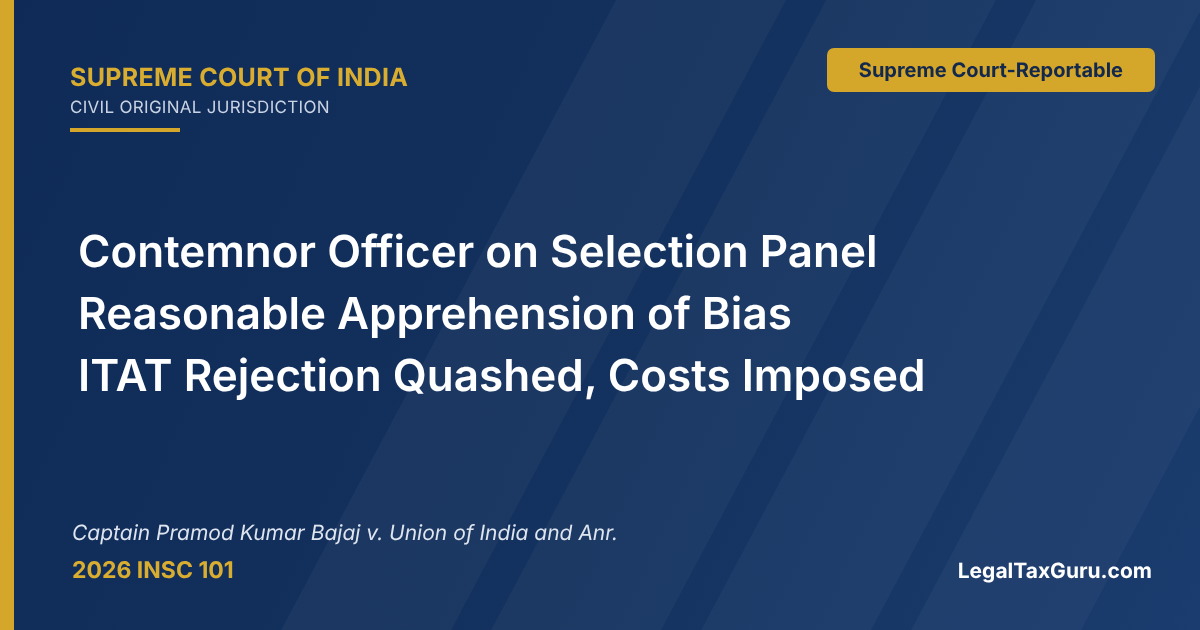
Quick Answer: An officer who had faced contempt proceedings at the instance of a candidate should not sit on the Search-cum-Selection Committee that evaluates that candidate; his presence creates a reasonable apprehension of bias and vitiates the decision. The Supreme Court set aside the SCSC minutes rejecting Captain Pramod Kumar Bajaj for appointment as Member (Accountant), ITAT, ordered a fresh SCSC meeting within four weeks without that officer, and imposed costs of Rs. 5 lakhs on the respondents.
In Captain Pramod Kumar Bajaj v. Union of India & Anr. (2026 INSC 101), the Supreme Court held that the inclusion in the fourth SCSC of an officer (referred to as “the Officer”) who had earlier faced contempt proceedings initiated by the petitioner gave rise to a reasonable apprehension of bias and was in gross violation of the principles of natural justice, even though he was only one member of the Committee (paras 41–42, 45). Noting that no counter affidavit was filed and the petitioner’s averments stood uncontroverted, a Bench of Justice Vikram Nath and Justice Sandeep Mehta set aside the SCSC minutes dated 1st September, 2024 insofar as they related to the petitioner and imposed costs of Rs. 5 lakhs (paras 35–37, 45–47).
Status: Minutes of the SCSC meeting dated 1st September, 2024 set aside qua the petitioner; fresh SCSC to be convened within four weeks excluding “the Officer”; outcome to be communicated within two weeks thereafter; costs of Rs. 5 lakhs on the respondents; Writ Petition disposed of (paras 46–48).
Headnote: Bias in a Search-cum-Selection Committee
Constitution of India – Article 32 – Service law – Appointment of Member (Accountant), Income Tax Appellate Tribunal – Search-cum-Selection Committee – Rule against bias – Member who had faced contempt proceedings initiated by the candidate – Reasonable apprehension of bias – Duty to recuse – Natural justice – Non-filing of counter affidavit – Averments uncontroverted – Costs.
Held: (i) The inclusion of “the Officer”, who had earlier faced contempt proceedings at the petitioner’s instance in the very same tussle, as a member of the SCSC that rejected the petitioner’s candidature created a genuine perception of bias and was in gross violation of the principles of natural justice (para 41).
(ii) Though “the Officer” was only one of the members of the Committee, his presence and participation rendered the decision-making process vulnerable and gave rise to a reasonable apprehension of bias (para 41).
(iii) Following State of Gujarat v. R.A. Mehta, actual bias need not be proved; a reasonable apprehension of bias is sufficient, and an authority exercising adjudicatory or selection functions must not only act fairly but must also appear to act fairly (para 42).
(iv) Approving the principles collected in Km. Shailja Srivastava v. Banaras Hindu University, if even one member of a selection committee is disqualified by bias the entire selection is vitiated, and such a person should disassociate himself from the proceedings (para 43).
(v) In the absence of a counter affidavit, the petitioner’s averments of bias and mala fides remained uncontroverted; “the Officer” ought to have recused on his own, and his failure to do so fortified the aspersion of bias (paras 37, 45).
(vi) Given the rank procrastination and deliberate obstacles created by the respondents, costs of Rs. 5 lakhs were imposed, payable to the petitioner (para 47).
(paras 36–47)
Case Details: Captain Pramod Kumar Bajaj v. Union of India (2026 INSC 101)
Final Outcome: Writ Petition disposed of; SCSC minutes dated 1st September, 2024 set aside qua the petitioner; fresh SCSC meeting within four weeks excluding “the Officer”; costs of Rs. 5 lakhs on the respondents.
Case: Captain Pramod Kumar Bajaj v. Union of India and Anr.
Neutral Citation: 2026 INSC 101
Case No.: Writ Petition (Civil) No. 1180 of 2025
Court: Supreme Court of India (Civil Original Jurisdiction) – Reportable
Date of Decision: 30 January 2026
Bench: Justice Vikram Nath and Justice Sandeep Mehta (author)
Relevant Acts & Sections: Constitution of India – Article 32; principles of natural justice (rule against bias); Fundamental Rules – Rule 56(j) (in the earlier round)
Impugned Action: Minutes of the meeting of the fourth Search-cum-Selection Committee held on 1st September, 2024, communicated to the petitioner in November, 2025, not recommending him for appointment as Member (Accountant), ITAT (paras 32–34, 46)
Counsel: The petitioner appeared in person; no one appeared for the respondents on 15th January, 2026 (para 35)
Source: Supreme Court of India
Key Holdings of the Supreme Court
- A member of a selection committee who had faced contempt proceedings at the instance of the candidate creates a reasonable apprehension of bias by sitting on that committee (para 41).
- It is no answer that he was only one of several members; his participation vitiates the decision-making process (paras 41, 43).
- Actual bias need not be proved; the test is the reasonableness of the apprehension, viewed from the standpoint of the people at large (para 42).
- Such a member ought to recuse on his own; failure to do so fortifies the aspersion of bias (para 45).
- Where the respondents file no counter affidavit despite a specific direction, the petitioner’s averments stand uncontroverted (paras 35–37, 45).
Brief Facts of the Case
The petitioner, a former Army officer released from service on account of disability attributable to military operations, joined the Indian Revenue Service (1990 batch) and was promoted Commissioner of Income Tax on 12th January, 2012. In 2014 he applied for the post of Member (Accountant), ITAT and was placed at All India Rank One by an SCSC chaired by Justice T.S. Thakur, but no appointment letter was issued on the basis of adverse IB inputs said to arise from litigation with his estranged spouse (paras 3–4, 7–9).
Orders of the Central Administrative Tribunal (10th February, 2017), the High Court at Lucknow (30th May, 2017) and this Court (15th November, 2017, dismissing the SLP) directed reconsideration; a re-constituted SCSC on 26th April, 2018 reiterated his merit position. Meanwhile a vigilance inspection, show cause notice, withholding of vigilance clearance, placement on the “Agreed List”, a charge memorandum dated 17th June, 2019, suspension on 1st July, 2019 and compulsory retirement under FR 56(j) on 27th September, 2019 followed, while contempt proceedings by the petitioner were pending (paras 11–21).
By judgment dated 3rd March, 2023 in Civil Appeal No. 6161 of 2022, this Court quashed the compulsory retirement as punitive. When it was still not implemented, the petitioner filed Contempt Petition (Civil) No. 210 of 2024; the then Revenue Secretary (“the Officer”) was summoned and tendered an unconditional apology. The charge memorandum was dropped on 2nd August, 2024 (paras 27–30).
The petitioner was then asked to appear before a fourth SCSC on 1st September, 2024, where “the Officer” was a member. His candidature was rejected, which he learnt of in November, 2025. Despite notice and time granted, the respondents filed no counter affidavit and did not appear on 15th January, 2026 (paras 31–35).
Issues Before the Supreme Court
- Whether the presence of “the Officer”, who had faced contempt proceedings at the petitioner’s instance, on the SCSC vitiated its decision not to recommend the petitioner (paras 38–41).
- What relief should follow, given the uncontroverted record of obstruction by the respondents (paras 36–37, 45–47).
Court's Findings and Reasoning
Pattern of obstruction (paras 36–37, 40): The respondents had at every stage created hurdles, either by cooked-up charges or by non-compliance with orders of various fora. The failure to file a counter affidavit despite a specific direction showed an intent to waste time while the petitioner approached the outer age limit of 70 years for the assignment. The allegations of bias and vendetta remained uncontroverted.
Presence of “the Officer” (para 41): Refraining from comment on his role because he holds a sensitive position, the Court held that his inclusion in the SCSC created a genuine perception of bias. He had faced contempt proceedings in the very same tussle, and his presence, though he was only one member, was not justified and gave rise to a reasonable apprehension of bias.
Doctrine of bias (paras 42–43): Relying on R.A. Mehta, the Court said the rule against bias applies where the person involved in the evaluation has a personal connection with, interest in, or prior involvement in the matter, and is meant to preserve public confidence. The principles in Km. Shailja Srivastava, drawing on A.K. Kraipak and other decisions, show that bias in one member vitiates the whole selection and that a disqualified member should disassociate himself.
Mala fides and process review (para 44): Power exercised for extraneous purposes or actuated by malice in law cannot be sustained; judicial review is directed at the decision-making process itself.
Failure to recuse (para 45): In the absence of a counter affidavit, the Court proceeded on the basis that all relevant facets may not have been placed before the SCSC, including the contempt history. “The Officer” ought to have recused on his own.
Final Outcome and Directions
- SCSC minutes dated 1st September, 2024, insofar as they relate to the petitioner and did not recommend him for appointment as Member (Accountant), ITAT, set aside (para 46).
- Respondent No. 1-DoPT to ensure that a fresh SCSC meeting is convened within four weeks to consider the petitioner’s candidature, excluding “the Officer” (para 46).
- Outcome to be communicated to the petitioner within a further two weeks (para 46).
- Costs of Rs. 5 lakhs imposed on the respondents, to be deposited in the Registry within four weeks and paid to the petitioner (para 47).
- Writ Petition disposed of; pending applications disposed of (paras 48–49).
Legal Principle Laid Down
A person who has faced contempt proceedings at the instance of a candidate in the same dispute must not take part in a selection committee evaluating that candidate. Actual bias need not be shown; a reasonable apprehension of bias suffices, and the participation of even one such member vitiates the decision of the committee. Such a member is expected to recuse on his own (paras 41–43, 45).
Precedents Relied Upon
- State of Gujarat v. R.A. Mehta, (2013) 3 SCC 1 – Relied upon – doctrine of bias; reasonable apprehension suffices. Discussed at para 42.
- Km. Shailja Srivastava v. Banaras Hindu University, 1992 SCC OnLine All 465 – Relied upon – presence of a person against whom allegations are made vitiates the Board; principles on bias in selection bodies. Discussed at para 43.
- Captain Pramod Kumar Bajaj v. Union of India, judgment dated 3rd March, 2023 in Civil Appeal No. 6161 of 2022 – Referred to – compulsory retirement quashed with findings on the respondents’ conduct. Discussed at paras 27, 40.
- Pratap Singh v. State of Punjab, 1963 SCC OnLine SC 10; Jaichand Lal Sethia v. State of W.B., 1966 SCC OnLine SC 96; E.P. Royappa v. State of Tamil Nadu, 1974 AIR 555 – Referred to – law on mala fide exercise of power. Discussed at para 44.
Important Paragraphs of the Judgment
Verbatim extracts from the judgment. For the full text, refer to the judgment PDF below.
Para 37: "This attribution and perception of bias pleaded in the writ petition remains uncontroverted, as no reply or counter affidavit has been filed on behalf of the respondents."
Para 41: "Nonetheless, we feel that the inclusion of “the Officer” as a member of the SCSC, which rejected the petitioner’s candidature, has undoubtedly created a genuine perception of bias in the mind of the petitioner and was in gross violation of the principles of natural justice."
Para 41: "True it is, that “the Officer” was only one among the members of the Committee; however, his presence and participation in the selection process, inspite of his arraignment as a contemnor in the contempt proceedings initiated at the instance of the petitioner, was not justified and rendered the decision-making process vulnerable on the touchstone of the principles of natural justice and gives rise to a reasonable apprehension of bias."
Para 42: "The aforesaid observations made by this Court makes it clear that an authority exercising adjudicatory or selection functions must not only act fairly but must also appear to act fairly, for justice must manifestly be seen to be done."
Para 44: "Judicial review in such circumstances is directed not merely at the decision but at the decision-making process itself."
Para 45: "In the interest of fairness and to dispel any reasonable apprehension of bias, it would have been appropriate for “the Officer” to have recused from the evaluation process on his own. His failure to do so fortifies the aspersion of bias."
Practical Impact of the Ruling
- For candidates before selection committees: Prior adversarial litigation, such as contempt proceedings, against a committee member is a recognised ground to challenge the committee’s decision on the basis of bias (paras 41, 45).
- For selection bodies and officers: A member with prior involvement in a dispute with a candidate should recuse; the fact that he is one among several members does not cure the defect (paras 41, 43, 45).
- For the Government as litigant: Failure to file a counter affidavit despite directions leaves the petitioner’s averments uncontroverted and may attract costs (paras 35–37, 47).
- For tribunal appointments: The DoPT must reconvene the SCSC within a fixed time, keeping in view the short window left for the candidate (paras 35, 46).
FAQs on Bias in a Selection Committee
1. What did the Supreme Court decide in Captain Pramod Kumar Bajaj v. Union of India?
It set aside the SCSC minutes of 1st September, 2024 rejecting the petitioner for Member (Accountant), ITAT, directed a fresh SCSC meeting excluding “the Officer”, and imposed Rs. 5 lakhs costs on the respondents (paras 46–47).
2. Why was the SCSC decision set aside?
Because “the Officer”, who had earlier faced contempt proceedings initiated by the petitioner, sat on the Committee, creating a reasonable apprehension of bias in violation of natural justice (para 41).
3. Does bias of one member vitiate the decision of a multi-member committee?
Yes. The Court held that his presence was not justified even though he was only one member, and endorsed the principle that bias in one member vitiates the entire selection (paras 41, 43).
4. Must actual bias be proved?
No. A reasonable apprehension of bias, judged objectively from the viewpoint of the people at large, is sufficient (para 42).
5. Why were costs imposed on the respondents?
For their rank procrastination, including not filing a counter affidavit despite directions, and the deliberate obstacles created in the petitioner’s path (paras 36, 47).
Keywords: 2026 INSC 101, Captain Pramod Kumar Bajaj v. Union of India, rule against bias, reasonable apprehension of bias, Search-cum-Selection Committee, ITAT Member (Accountant), recusal, natural justice, contempt proceedings, State of Gujarat v. R.A. Mehta, Article 32, costs, Justice Sandeep Mehta, Justice Vikram Nath, Supreme Court judgment
Related on LegalTaxGuru
Download Judgment PDF – Captain Pramod Kumar Bajaj v. Union of India
Source: Supreme Court of India (official website).