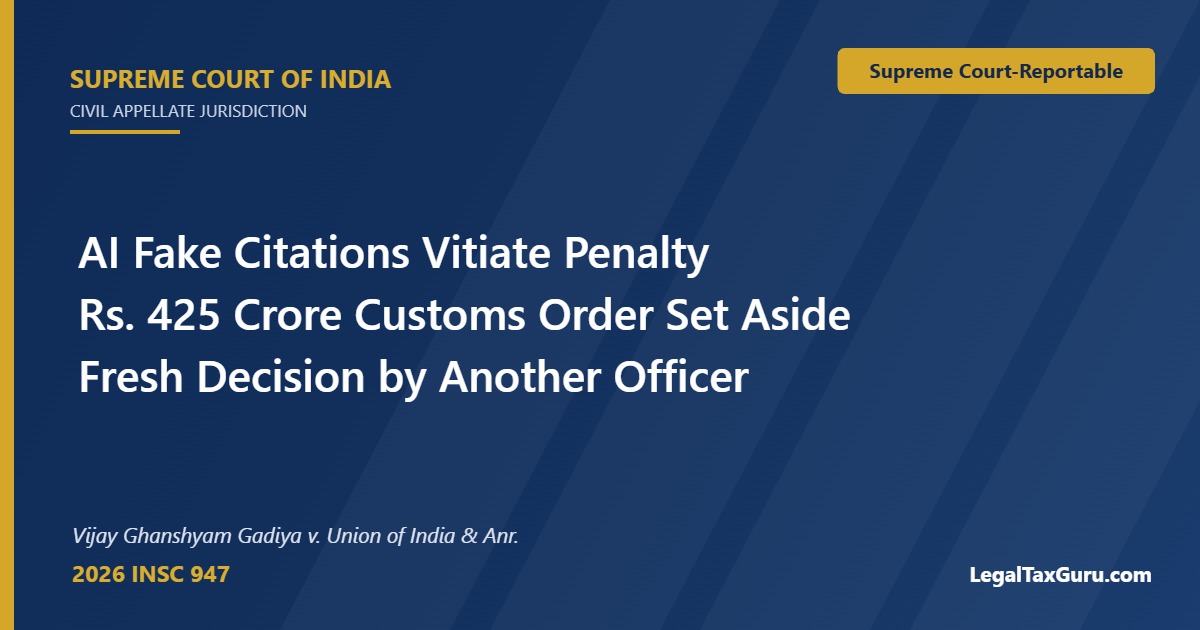
Quick Answer: A quasi-judicial order that relies on non-existent, fake or misquoted case laws generated by Artificial Intelligence cannot stand. The Supreme Court set aside a customs penalty of Rs. 425,27,99,100 imposed on the appellant, along with the Gujarat High Court's order confirming it, because the adjudicating officer had relied on AI-hallucinated precedents, and remanded the case to a different officer of the same rank.
In Vijay Ghanshyam Gadiya v. Union of India & Anr. (2026 INSC 947), the Supreme Court held that the reliance placed by the Additional Commissioner of Customs, Surat on judgments and articles that were either non-existent, carried fake citations or did not lay down the ratio attributed to them, apparently generated by Artificial Intelligence, was fatal to the order imposing a penalty under Section 114 of the Customs Act, 1962 (paras 3–7). A Bench of Justice Dipankar Datta and Justice Sheel Nagu set aside the Gujarat High Court's order dated 20.01.2026 and the Order-in-Original dated 08.10.2025, revived the proceedings before an officer of the same rank other than the author of the order, and left it to the appointing authority to consider action against that officer (paras 8, 9, 11).
Status: Gujarat High Court's order dated 20.01.2026 and the Order-in-Original dated 08.10.2025 set aside; proceedings revived for fresh decision by another officer of the same rank; appeal allowed (paras 8–9).
Headnote: AI-Generated Fake Citations in Adjudication
Customs Act, 1962 – Section 114 – Penalty for misdeclaring natural diamonds as lab-grown diamonds – Order-in-Original relying on judgments and articles generated by Artificial Intelligence – Non-existent and fake citations – Hallucinated ratio – Zero tolerance for AI-generated precedents – Remand to another officer – Use of AI as assistive tool in adjudication.
Held: (i) Where the adjudicating authority has relied on case laws that are non-existent or carry fake citations, or on existing decisions that do not lay down the ratio deduced from them, the order rests on dubious material (para 4).
(ii) Following Pooja Ramesh Singh v. Jammu & Kashmir Bank Ltd., a decision that relies on fake or hallucinated AI-generated material as precedent is no decision in the eyes of the law and must be set aside, even if only an iota of such material enters the decision-making process (para 5).
(iii) AI may be used as an assistive tool, and the Supreme Court has released draft Regulations for Use of Artificial Intelligence in Courts, 2026, but assistance can never substitute adjudication (para 6).
(iv) Reliance on dubious AI-generated material was fatal to the sustainability of the penalty order, making it unnecessary to examine the merits of the challenge (paras 3, 7).
(v) The proceedings were revived for fresh decision by an officer of the same rank other than the one who passed the order, and the appointing authority was left to consider action against the author of that order (paras 8, 11).
(paras 3–11)
Case Details: Vijay Ghanshyam Gadiya v. Union of India (2026 INSC 947)
Final Outcome: Appeal allowed; Gujarat High Court's order dated 20.01.2026 and Order-in-Original dated 08.10.2025 set aside; proceedings revived before another officer of the same rank.
Case: Vijay Ghanshyam Gadiya v. Union of India & Anr.
Neutral Citation: 2026 INSC 947
Case No.: Civil Appeal No. ___ of 2026 (arising out of SLP (Civil) No. 15605 of 2026)
Court: Supreme Court of India (Civil Appellate Jurisdiction) – Reportable
Date of Decision: 2 September 2026
Bench: Justice Dipankar Datta (author of the order) and Justice Sheel Nagu
Relevant Acts & Sections: Customs Act, 1962 – Section 114; draft Regulations for Use of Artificial Intelligence in Courts, 2026 (referred)
Impugned Orders: Gujarat High Court – order dated 20.01.2026 dismissing the appellant's appeal; Order-in-Original dated 08.10.2025 passed by the Additional Commissioner of Customs, Surat (para 2)
Counsel: Learned Additional Solicitor General for the Revenue (name not stated in the order), who did not join issue (para 7)
Source: Supreme Court of India (official website)
Key Holdings of the Supreme Court
- The Court itself verified the citations and found that the adjudicating officer had relied on case laws that were non-existent or carried fake citations (para 4).
- Some of the decisions relied on did exist but did not lay down the ratio deduced from them, which appeared to be an AI hallucination (para 4).
- Courts and authorities must adopt zero tolerance for citing or relying on unverified AI-generated precedents, as held in Pooja Ramesh Singh (para 5).
- AI may serve as an assistive tool to speed up decision-making, but it can never replace adjudication (para 6).
- Reliance on dubious AI-generated material was fatal to the penalty order, so the merits were not examined (paras 3, 7).
- The case must be decided afresh by an officer of the same rank other than the author of the vitiated order (para 8).
Brief Facts of the Case
The Additional Commissioner of Customs, Surat passed an Order-in-Original dated 08.10.2025 imposing a penalty of Rs. 425,27,99,100 on the appellant under Section 114 of the Customs Act, 1962, for misdeclaring a consignment of natural diamonds as lab-grown diamonds to pay a lower tariff (para 2).
The appellant's challenge to the penalty before the Gujarat High Court failed, and his appeal was dismissed by order dated 20.01.2026, which was impugned before the Supreme Court (para 2).
Before the Supreme Court, the appellant contended that several judgments and articles cited in the Order-in-Original had been generated using Artificial Intelligence (para 3).
Issues Before the Supreme Court
- Whether the Order-in-Original relied on judgments and articles generated by AI that were non-existent, fake or misquoted (paras 3–4).
- Whether such reliance vitiated the penalty order and the High Court's order confirming it (paras 5, 7).
- What consequential directions should follow (paras 8, 11).
Court's Findings and Reasoning
Merits not examined (para 3): The Court found it unnecessary to enter into the merits once the appellant contended that the authorities cited in the Order-in-Original were AI-generated.
Independent verification (para 4): The Bench individually verified the judgments and articles cited. It found reliance on case laws that were non-existent or carried fake citations, and on existing decisions that did not lay down the ratio deduced from them, which appeared to be an AI hallucination.
Zero tolerance for fake precedents (para 5): Relying on Pooja Ramesh Singh v. Jammu & Kashmir Bank Ltd., the Court reiterated that a decision based on fake or hallucinated AI-generated material is no decision in the eyes of the law and must be set aside, while the rightful use of AI remains unaffected.
AI as an assistive tool (para 6): Referring to the draft Regulations for Use of Artificial Intelligence in Courts, 2026, the Court accepted that AI can assist in speeding up decision-making, but cautioned that it cannot replace adjudication.
Penalty order unsustainable (para 7): Reliance on dubious material was fatal to the order imposing penalty, compelling interference and remand. The Additional Solicitor General did not join issue.
Final Outcome and Directions
- The Gujarat High Court's order confirming the penalty and the Order-in-Original dated 08.10.2025 are set aside (para 8).
- The proceedings against the appellant stand revived for fresh decision by an officer of the same rank other than the one who passed the order dated 08.10.2025 (para 8).
- The civil appeal is allowed and pending applications are disposed of (paras 9–10).
- The appointing authority may initiate such action against the author of the order dated 08.10.2025 as may be warranted, in accordance with law (para 11).
Legal Principle Laid Down
An adjudicating authority must not rely on unverified AI-generated material as precedent. An order that rests on non-existent case laws, fake citations or a ratio wrongly attributed to an existing decision is vitiated and cannot be sustained, irrespective of its merits, and the matter must be decided afresh by a different officer. AI may assist the decision-maker but can never substitute adjudication.
Precedents Relied Upon
- Pooja Ramesh Singh v. Jammu & Kashmir Bank Ltd., 2026 SCC OnLine SC 1258 – Relied upon – zero tolerance for AI-generated fake or hallucinated precedents; such a decision is no decision in the eyes of the law. Discussed at para 5.
Important Paragraphs of the Judgment
Verbatim extracts from the judgment. For the full text, refer to the judgment PDF below.
Para 4: "Upon verifying such judgments and articles, it does appear that the second respondent has relied upon case laws that are either non-existent or have fake citations."
Para 4: "A further investigation has also revealed that some of the case laws relied upon by the second respondent, which do exist, do not lay down the ratio deduced therefrom and it appears to be a hallucination of AI."
Para 5 (quoting Pooja Ramesh Singh, para 7): "It is necessary for courts to adopt a zero-tolerance mode for producing, citing or using artificial intelligence-generated precedents without verification."
Para 6: "However, a note of caution must be sounded: assistance can never be substituted for adjudication. AI may well serve as training wheels but entrusting it with the pilot’s seat would be both imprudent and dangerous."
Para 7: "The use of AI in this case, resulting in reliance placed by the second respondent on material which is dubious, proves fatal to the sustainability of the order imposing penalty on the appellant."
Para 11: "We leave it to the wisdom of the appointing authority to initiate such action against the author of the order dated 8th October, 2025, as may be warranted in the circumstances, in accordance with law."
Practical Impact of the Ruling
- For adjudicating officers and tribunals: Every precedent cited in an order must be verified; relying on AI-generated fake or misquoted case laws invites the order being set aside and possible action against the officer (paras 4–5, 11).
- For taxpayers and importers: A penalty or demand order can be challenged on the ground that it rests on non-existent or hallucinated authorities, without first arguing the merits (paras 3, 7).
- For advocates: Checking every authority cited by the other side or by the authority can expose fatal flaws in an order (paras 3–4).
- For the use of AI in courts: AI may assist and speed up work, but the decision itself must remain a human act of adjudication (para 6).
FAQs on AI-Generated Fake Citations in Orders
1. What did the Supreme Court hold in Vijay Ghanshyam Gadiya v. Union of India?
It set aside a customs penalty of Rs. 425,27,99,100 and the High Court's order upholding it because the adjudicating officer relied on AI-generated case laws that were non-existent, fake or misquoted, and remanded the matter to another officer (paras 4, 7–8).
2. Did the Court decide whether the diamonds were misdeclared?
No. The Court found it unnecessary to enter into the merits, since reliance on dubious AI-generated material was itself fatal to the order (paras 3, 7).
3. Who will now decide the case?
An officer of the same rank other than the one who passed the order dated 08.10.2025 (para 8).
4. Can AI be used at all in adjudication?
Yes, as an assistive tool to speed up decision-making, but assistance can never be substituted for adjudication (para 6).
5. Will any action be taken against the officer?
The Court left it to the appointing authority to initiate such action against the author of the order as may be warranted, in accordance with law (para 11).
Keywords: 2026 INSC 947, Vijay Ghanshyam Gadiya v. Union of India, AI fake citations, AI hallucination in orders, Section 114 Customs Act, customs penalty set aside, lab-grown diamonds misdeclaration, Pooja Ramesh Singh, Artificial Intelligence in courts, Justice Dipankar Datta, Supreme Court reportable judgment
Related on LegalTaxGuru
Download Judgment PDF – Vijay Ghanshyam Gadiya v. Union of India
Judgment PDF: 2026 INSC 947 – Vijay Ghanshyam Gadiya v. Union of India & Anr. (SLP (Civil) No. 15605 of 2026) – Download Judgment PDF
Source: Supreme Court of India (official website).