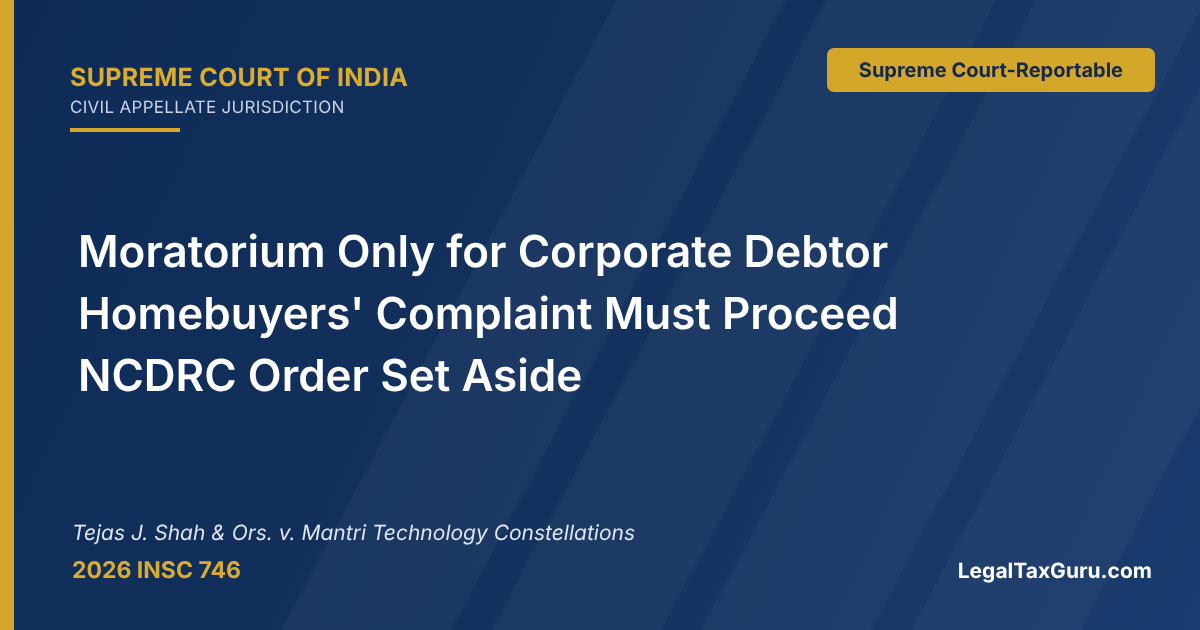
Quick Answer: The moratorium under Section 14 of the IBC protects only the corporate debtor. It does not bar a consumer complaint by homebuyers from proceeding against the developer's associated company, its promoters/directors or the landowners. The Supreme Court set aside the NCDRC's order that had adjourned the homebuyers' complaint sine die, and directed the NCDRC to hear it against Respondent Nos. 2 to 7, while the corporate debtor stays covered by the moratorium.
In Tejas J. Shah & Amisha T. Shah & Ors. v. Mantri Technology Constellations Pvt. Ltd. (now Buoyant Technology Constellations Pvt. Ltd.) & Ors. (2026 INSC 746), the Supreme Court held that the scope of the Section 14 IBC moratorium is statutory and operates against the corporate debtor alone; no other category, such as a subsidiary, managers/directors or personal guarantors, can be added unless specifically provided (para 6). As no independent moratorium operated in favour of the other respondents, the NCDRC erred in refusing to proceed against them, and it wrongly decided at the interlocutory stage the very question of liability that was yet to be adjudicated (paras 11–13). A Bench of Justice Vikram Nath and Justice Sandeep Mehta partly allowed the appeals (paras 15–17).
Status: NCDRC order dated 20.01.2025 rejecting I.A. Nos. 15656 and 14200 of 2024 in Consumer Complaint No. 13 of 2023 set aside; applications allowed; NCDRC to hear the complaint against Respondent Nos. 2 to 7; appeals partly allowed (paras 15–17).
Headnote: IBC Moratorium and Consumer Complaints Against Non-Debtors
Insolvency and Bankruptcy Code, 2016 – Section 14 – Moratorium – Scope confined to corporate debtor – Consumer complaint by homebuyers – Continuation against associated company, promoters/directors and landowners – Consumer Protection Act – NCDRC – Interlocutory applications – Adjournment sine die – Liability not to be decided at interlocutory stage.
Held: (i) Once a moratorium is declared under Section 14 IBC, pending suits and proceedings against the corporate debtor come to an automatic halt; its object is to preserve the assets of the corporate debtor and facilitate an orderly resolution (para 5).
(ii) The scope of the moratorium is statutory; neither the adjudicating authority nor the Court can enlarge it, and it operates against the corporate debtor alone, not subsidiaries, managers/directors or personal guarantors unless specifically provided (paras 6–7).
(iii) The protective sweep of a moratorium must remain within the four walls carved out by the statute and ought not to be expanded so as to stultify remedies under the Consumer Protection Act, unless expressly provided (para 8).
(iv) Respondent No. 1 alone was the corporate debtor; in the absence of any independent moratorium or legal bar, the NCDRC was not justified in refusing to proceed against Respondent Nos. 2 to 7 (para 11).
(v) Having observed that liability for deficiency in service was yet to be determined, the NCDRC could not simultaneously conclude that the deficiency was attributable only to Respondent No. 1; the question at the interlocutory stage was whether the complaint could proceed, not whether the other respondents were liable (paras 12–13).
(vi) Objections on privity of contract, maintainability and absence of independent obligation are for the NCDRC to decide; the Supreme Court declined to decide the complaint itself (para 14).
(paras 5–17)
Case Details: Tejas J. Shah v. Mantri Technology Constellations (2026 INSC 746)
Final Outcome: Appeals partly allowed; NCDRC's rejection of I.A. Nos. 15656 and 14200 of 2024 set aside and the applications allowed; NCDRC to hear and dispose of Consumer Complaint No. 13 of 2023 insofar as Respondent Nos. 2 to 7 are concerned; proceedings against Respondent No. 1 remain governed by the moratorium; prayer to allow the complaint directly declined.
Case: Tejas J. Shah & Amisha T. Shah & Ors. v. Mantri Technology Constellations Pvt. Ltd. (now known as Buoyant Technology Constellations Pvt. Ltd.) & Ors.
Neutral Citation: 2026 INSC 746
Case No.: Civil Appeal Nos. 4289–4290 of 2025
Court: Supreme Court of India (Civil Appellate Jurisdiction) – Reportable
Date of Decision: 27 July 2026
Bench: Justice Vikram Nath (author) and Justice Sandeep Mehta
Relevant Acts & Sections: Insolvency and Bankruptcy Code, 2016 – Sections 9, 14 and 96; Consumer Protection Act; Negotiable Instruments Act, 1881 – Section 138 (as discussed in P. Mohanraj)
Impugned Order: Judgment and order dated 20.01.2025 of the National Consumer Disputes Redressal Commission in I.A. No. 15656 of 2024 and I.A. No. 14200 of 2024 in Consumer Complaint No. 13 of 2023 (para 1)
Counsel: Mr. D. Seshadri Naidu, Senior Counsel, for Respondent No. 2; Mr. Sajan Povayya, Senior Counsel, for Respondent Nos. 6 and 7; Mr. Shekhar G Devasa, Senior Counsel, for Respondent Nos. 3 to 5; Mr. Ashutosh Dubey for Respondent No. 1 (para 3)
Source: Supreme Court of India
Key Holdings of the Supreme Court
- The Section 14 moratorium operates against the corporate debtor alone and cannot be enlarged by the adjudicating authority or the Court (para 6).
- A moratorium against the corporate debtor gives no protection to its promoters and directors in a consumer complaint, following Ansal Crown Heights Flat Buyers Association (para 7).
- The moratorium must not be stretched to stultify Consumer Protection Act remedies unless expressly provided, as reflected in Saranga Anilkumar Aggarwal (para 8).
- Absent any moratorium in their favour, the complaint must proceed against the associated company, the promoters/directors and the landowners (paras 11, 13).
- The NCDRC could not foreclose the inquiry into liability at the interlocutory stage (paras 12–13).
Brief Facts of the Case
The appellants are homebuyers who booked apartments in the project "Mantri Manyata Energia", developed by Respondent No. 1. Respondent No. 2 was alleged to be associated with the development, Respondent Nos. 3 to 5 were alleged to be promoters/directors of Respondent Nos. 1 and 2, and Respondent Nos. 6 and 7 were the landowners. Construction agreements and agreements for sale of undivided share were executed with Respondent No. 1 in 2016, with possession due on or before 31.12.2018 (para 2.1).
Possession was not delivered despite substantial payment, and the appellants with other homebuyers filed Consumer Case No. 13 of 2023 before the NCDRC against Respondent Nos. 1 to 7 alleging deficiency in service and unfair trade practices (para 2.2).
On 23.08.2024 the NCLT, Bengaluru Bench admitted a Section 9 IBC application against Respondent No. 1 and initiated CIRP, bringing the Section 14 moratorium into force. The appellants filed I.A. Nos. 14200 and 15656 of 2024 seeking to continue the complaint against Respondent Nos. 2 to 7. By order dated 20.01.2025 the NCDRC rejected them and adjourned the complaint sine die (paras 2.3–2.6).
Issues Before the Supreme Court
- Whether the NCDRC was justified in rejecting the applications to continue the consumer complaint against Respondent Nos. 2 to 7 on account of the moratorium operating against Respondent No. 1 (para 4).
- Whether the Supreme Court should itself allow the consumer complaint and grant the reliefs claimed (para 14).
Court's Findings and Reasoning
Nature of the moratorium (paras 5–6): The Section 14 moratorium halts pending suits and proceedings against the corporate debtor to preserve its assets and facilitate orderly resolution. Its scope is statutory and limited to the corporate debtor; P. Mohanraj v. Shah Brothers Ispat Pvt. Ltd. held, in the context of Section 138 NI Act proceedings, that Section 14 applies only to the corporate debtor and natural persons can be held liable.
Promoters and directors not protected (para 7): In Ansal Crown Heights Flat Buyers Association v. Ansal Crown Infrabuild Pvt. Ltd., a consumer complaint against developers, the Court held that the moratorium does not protect promoters and directors and proceedings can continue against them.
Consumer remedies not to be stultified (para 8): Saranga Anilkumar Aggarwal v. Bhavesh Dhirajlal Sheth, though under Section 96 IBC, shows that the moratorium must stay within its statutory limits; the object of the Code is to facilitate resolution, not to eclipse statutory remedies.
NCDRC's approach erroneous (paras 10–12): The NCDRC observed that liability was yet to be determined, yet held that the deficiency pertained only to Respondent No. 1 because all agreements were with it, so the proceedings could not be split. This effectively answered the very question yet to be adjudicated.
Correct question at the interlocutory stage (para 13): The issue was whether, absent any moratorium in their favour, the complaint could proceed against Respondent Nos. 2 to 7. The NCDRC was required to adjudicate the complaint against them on the rival pleadings and could not foreclose that inquiry.
No decision on merits (para 14): The respondents raised objections including absence of privity of contract, maintainability and absence of independent obligations. As these were yet to be decided by the NCDRC, the Court declined to grant the reliefs itself and expressed no opinion on merits.
Final Outcome and Directions
- The impugned order cannot be sustained; the appeals are partly allowed (para 15).
- Rejection of I.A. No. 15656 of 2024 and I.A. No. 14200 of 2024 set aside, and the applications allowed (para 16).
- The NCDRC shall proceed to hear Consumer Complaint No. 13 of 2023 (para 16).
- Proceedings against Respondent No. 1 shall continue to remain governed by the Section 14 moratorium; the NCDRC shall dispose of the complaint against Respondent Nos. 2 to 7 in accordance with law (para 17).
Legal Principle Laid Down
The moratorium under Section 14 of the Insolvency and Bankruptcy Code, 2016 is confined by statute to the corporate debtor. It cannot be extended by a court or forum to associated companies, promoters, directors, guarantors or landowners unless the statute so provides. A consumer forum must therefore proceed with a homebuyers' complaint against such non-debtor parties, deciding their liability on the merits, rather than adjourning the complaint sine die or deciding the liability question at the interlocutory stage (paras 6–8, 11–13).
Precedents Relied Upon
- P. Mohanraj v. Shah Brothers Ispat Pvt. Ltd., (2021) 6 SC 258 (as cited in the judgment) – Relied upon – Section 14 applies only to the corporate debtor; natural persons can be held liable under Section 138 NI Act. Discussed at para 6.
- Ansal Crown Heights Flat Buyers Association v. Ansal Crown Infrabuild Pvt. Ltd., (2024) 5 SCC 745 – Relied upon – moratorium does not protect promoters and directors in a consumer complaint. Discussed at para 7.
- Saranga Anilkumar Aggarwal v. Bhavesh Dhirajlal Sheth & Ors., 2025 INSC 314 – Relied upon – moratorium to remain within statutory limits and not stultify consumer remedies. Discussed at para 8.
Important Paragraphs of the Judgment
Verbatim extracts from the judgment. For the full text, refer to the judgment PDF below.
Para 6: "The scope of the moratorium is statutory. It is not open either to the adjudicating authority or the Court to enlarge its ambit beyond what the statute contemplates. A plain reading of the provision makes it clear that the moratorium operates against the corporate debtor alone."
Para 8: "It ought not be expanded in a manner that stultifies remedies envisaged under the Consumer Protection Act, unless expressly provided."
Para 11: "In the present case, Respondent No.1 alone is the corporate debtor against whom the CIRP has been initiated. No independent moratorium or independent protection operates in favour of Respondent Nos. 2 to 7."
Para 12: "In doing so, the Commission effectively answered the very question which was yet to be adjudicated."
Para 13: "The question that fell for consideration while deciding the interlocutory applications was not whether Respondent Nos.2 to 7 were liable. The question was whether, in the absence of any moratorium operating in their favour, the consumer complaint could proceed against them."
Para 14: "Since all the objections are yet to be decided by the NCDRC, it would not be appropriate for this Court to undertake that exercise for the first time in the present appeal."
Practical Impact of the Ruling
- For homebuyers: Insolvency of the developer company does not stall their consumer complaint against associated companies, promoters/directors or landowners named in it (paras 11, 16–17).
- For promoters, directors and landowners: They cannot shelter behind the corporate debtor's moratorium; their defences, such as absence of privity, must be decided on merits (paras 6–7, 14).
- For consumer commissions: Complaints should not be adjourned sine die against non-debtor respondents, nor should liability be pre-judged at the interlocutory stage (paras 12–13).
- For resolution professionals and creditors: Proceedings against the corporate debtor itself remain barred during the moratorium (para 17).
FAQs on IBC Moratorium and Consumer Complaints
1. What did the Supreme Court decide in Tejas J. Shah v. Mantri Technology Constellations?
It set aside the NCDRC's order adjourning the homebuyers' complaint sine die and directed the NCDRC to hear it against Respondent Nos. 2 to 7, while Respondent No. 1 remains covered by the moratorium (paras 16–17).
2. Whom does the Section 14 IBC moratorium protect?
Only the corporate debtor. Subsidiaries, managers/directors, personal guarantors and others cannot be added unless the statute specifically provides (para 6).
3. Can a consumer complaint continue against promoters and directors of a company under CIRP?
Yes. The moratorium against the corporate debtor gives no protection to its promoters and directors, as held in Ansal Crown Heights (paras 7, 11).
4. What was wrong with the NCDRC's reasoning?
It held that the deficiency was attributable only to the corporate debtor while also saying liability was yet to be determined, thereby deciding the very question pending adjudication at the interlocutory stage (paras 12–13).
5. Did the Supreme Court decide the homebuyers' claims on merits?
No. Objections such as privity of contract and maintainability are for the NCDRC to decide, and the Court expressed no opinion on merits (para 14).
Keywords: 2026 INSC 746, Tejas J. Shah v. Mantri Technology Constellations, Buoyant Technology Constellations, Section 14 IBC, moratorium, corporate debtor, homebuyers, consumer complaint, NCDRC, promoters and directors, landowners, CIRP, Ansal Crown Heights, P. Mohanraj, Saranga Anilkumar Aggarwal, Justice Vikram Nath, Justice Sandeep Mehta, Supreme Court judgment
Related on LegalTaxGuru
Download Judgment PDF – Tejas J. Shah v. Mantri Technology Constellations
Source: Supreme Court of India (official website).