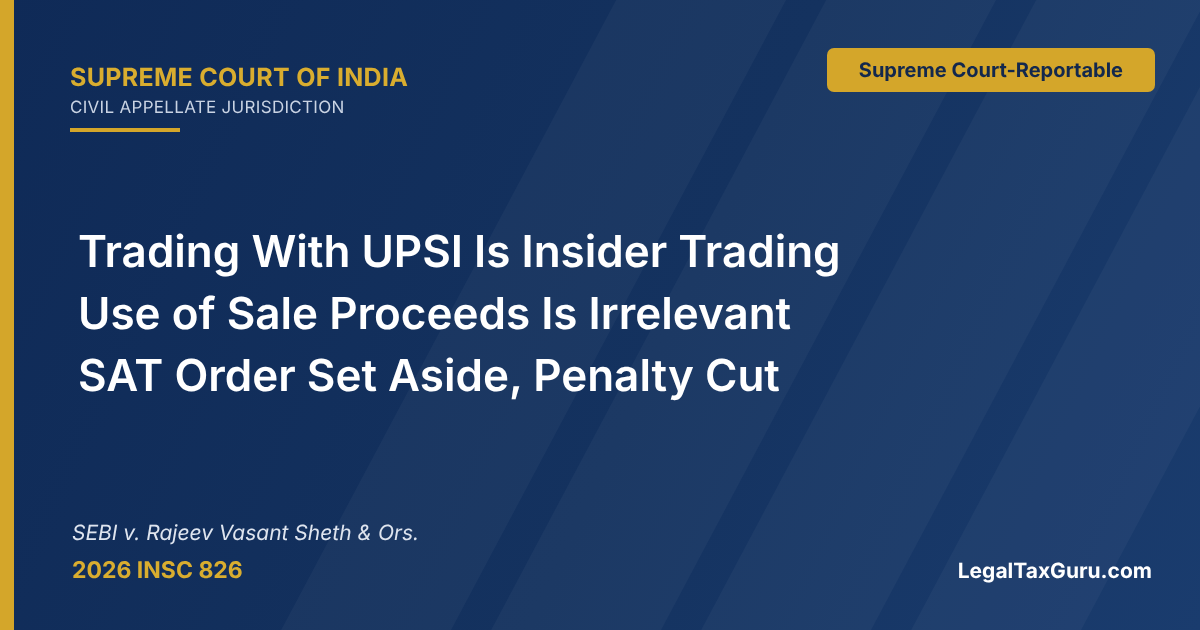
Quick Answer: Under the SEBI (Prohibition of Insider Trading) Regulations, 2015, once a person is shown to have traded while in possession of unpublished price sensitive information, the reasons for trading and the use made of the sale proceeds are irrelevant. The Supreme Court set aside the SAT order that had exonerated the Chairman and two promoters of Tara Jewels Limited, restored SEBI's disgorgement order, upheld the penalties, and reduced only the Section 15G penalty on the Chairman from Rs. 25 lakh to Rs. 10 lakh.
In Securities and Exchange Board of India v. Rajeev Vasant Sheth & Ors. (2026 INSC 826), the Supreme Court held that since the respondents admittedly sold large parts or all of their shareholding while in possession of UPSI, the note to Regulation 4(1) of the PIT Regulations, 2015 makes the purpose for which the proceeds were used irrelevant, and earning less or no profit is of no consequence (paras 9.7, 11). The defences in Regulation 4(1) are not exhaustive, but any further defence must be of the same and similar nature (para 13), and SEBI v. Abhijit Rajan, decided under the 1992 Regulations which had no such note, does not help the respondents (paras 14–15). A Bench of Justice Sanjay Karol and Justice Nongmeikapam Kotiswar Singh allowed SEBI's appeal (paras 16–20).
Status: SAT judgment dated 19.04.2022 in Appeal No. 536 of 2021 set aside; WTM's disgorgement order restored; penalties under Sections 15G and 15HB upheld, with the Section 15G penalty on Respondent No. 1 reduced to Rs. 10 lakh; appeal allowed (paras 1, 16–18, 20).
Headnote: Insider Trading and the Purpose of Sale Proceeds
Securities and Exchange Board of India Act, 1992 – Sections 11, 11B, 12A(d) and (e), 15G, 15HB, 15J and 15Z – SEBI (Prohibition of Insider Trading) Regulations, 2015 – Regulations 2, 3, 4(1) with Note and 9(1), Schedule B – Insider trading – Unpublished price sensitive information – Rebuttable presumption – Defences under proviso to Regulation 4(1) – Ejusdem generis – Legitimate corporate purpose – Disgorgement – Quantum of penalty.
Held: (i) The note at the end of Regulation 4(1) embeds a presumption that trades by a person in possession of UPSI are motivated by that information; the intentions behind the trades and the purposes to which the proceeds are applied are made irrelevant (paras 9, 9.7).
(ii) As the respondents admittedly possessed UPSI and sold large portions or the entirety of their holdings while in possession of it, they committed insider trading; less or no profit is of no consequence (para 11).
(iii) Ejusdem generis cannot be applied to the defences in Regulation 4(1), since the specific defences follow, rather than precede, the general word "including"; but the word "including" shows the six defences are not exhaustive, and any other defence must be of the same and similar nature (paras 12–13).
(iv) SEBI v. Abhijit Rajan arose under the 1992 PIT Regulations, whose Regulation 3B had no note barring consideration of where the proceeds were used; the same transactions under the 2015 Regulations could not have been considered on that footing (paras 14–15).
(v) SAT could not recognise a "legitimate corporate purpose" defence, drawn from Rakesh Agrawal v. SEBI under the 1992 Regulations, in view of the note to Regulation 4(1) (para 19).
(vi) The disgorgement of about Rs. 1.38 crore of loss avoided is justified by the Explanation to Section 11B and is restored; the Section 15HB penalty is upheld, but the Section 15G penalty on Respondent No. 1 is reduced from Rs. 25 lakh to Rs. 10 lakh (paras 16–18).
(paras 9–20)
Case Details: SEBI v. Rajeev Vasant Sheth (2026 INSC 826)
Final Outcome: Civil Appeal allowed; SAT judgment set aside; disgorgement restored; Section 15HB penalties upheld; Section 15G penalty on Respondent No. 1 reduced to Rs. 10 lakh, payable within three months if not already paid.
Case: Securities and Exchange Board of India v. Rajeev Vasant Sheth & Ors.
Neutral Citation: 2026 INSC 826
Case No.: Civil Appeal No. 4905 of 2022
Court: Supreme Court of India (Civil Appellate Jurisdiction) – Reportable
Date of Decision: 11 August 2026
Bench: Justice Sanjay Karol (author) and Justice Nongmeikapam Kotiswar Singh
Relevant Acts & Sections: Securities and Exchange Board of India Act, 1992 – Sections 11, 11B, 12A, 15G, 15HB, 15J, 15T and 15Z; SEBI (Prohibition of Insider Trading) Regulations, 2015 – Regulations 2, 3, 4(1) and 9(1), Schedule B; SEBI (Prohibition of Insider Trading) Regulations, 1992 – Regulation 3B
Impugned Order: Judgment dated 19.04.2022 of the Securities Appellate Tribunal, Mumbai in Appeal No. 536 of 2021, setting aside the WTM's order dated 24.05.2021 (para 1)
Source: Supreme Court of India
Key Holdings of the Supreme Court
- Trading while in possession of UPSI is enough to constitute insider trading; the purpose for which proceeds are used is an irrelevant consideration under the note to Regulation 4(1) (paras 9.7, 11).
- Making less or no profit from the trades does not matter (para 11).
- The defences in Regulation 4(1) are not exhaustive, but other defences must be of the same and similar nature (para 13).
- Abhijit Rajan is distinguishable because it was decided under the 1992 Regulations, which lacked the note in the 2015 Regulations (paras 14–15).
- SAT erred in recognising a legitimate corporate purpose defence (para 19).
- Disgorgement under Section 11B restored; Section 15HB penalty upheld; Section 15G penalty on the Chairman reduced to the minimum of Rs. 10 lakh (paras 16–18).
Brief Facts of the Case
Tara Jewels Limited (TJL), listed on BSE and NSE, was engaged in buying and selling jewellery. Respondent No. 1 was its Chairman and Managing Director, and Respondent Nos. 2 and 3, his daughters, were Promoters and Vice Presidents. TJL went into liquidation by an NCLT order dated 30.07.2019. Its net loss rose to Rs. 166.80 crore in the quarter ending September 2017, from Rs. 6.62 crore in the quarter ending June 2017, and net sales fell by about 69% (paras 2.1–2.2).
During the UPSI period from 02.10.2017 to 29.11.2017, Respondent No. 1 sold 30,93,948 shares (about 12.56% of the total shareholding) and a further 29,75,000 shares, while Respondent Nos. 2 and 3 sold their entire holdings of 1,14,440 shares each, avoiding a cumulative loss of about Rs. 1.38 crore. SEBI issued an impounding order-cum-show cause notice on 04.09.2020 (paras 2.3–2.4).
By order dated 24.05.2021, the WTM held all three guilty of insider trading, restrained them from the securities market (one year for Respondent No. 1, six months for the others), directed disgorgement with 12% interest, and imposed penalties under Section 15G (Rs. 25 lakh, Rs. 10 lakh and Rs. 10 lakh) and Section 15HB (Rs. 5 lakh, Rs. 1 lakh and Rs. 1 lakh) (para 3). SAT allowed their appeal, accepting that the sales were made because TJL risked being downgraded to a non-performing asset, which it treated as covered by the proviso to Regulation 4(1), and noting hardly any price difference on 29.11.2017 and 30.11.2017 (para 4). SEBI appealed under Section 15Z (paras 1, 5).
Issues Before the Supreme Court
- Whether the respondents, who sold shares while in possession of UPSI, could escape liability by showing that the proceeds were used for the company or that little or no gain was made (paras 10–11).
- Whether the defences in the proviso to Regulation 4(1) are exhaustive, and whether ejusdem generis applies to them (paras 12–13).
- Whether SEBI v. Abhijit Rajan, and SAT's recognition of a legitimate corporate purpose defence, could support the respondents (paras 14–15, 19).
- What directions on disgorgement and penalty should follow (paras 16–18).
Court's Findings and Reasoning
Statutory scheme (paras 6–9.7): The Court traced the prohibition in Section 12A, the functions under Section 11, the penalty under Section 15G, the factors in Section 15J and the disgorgement power in the Explanation to Section 11B, and then the definitions of "connected person", "insider" and UPSI in Regulation 2. Regulation 4 prohibits trading while in possession of UPSI and incorporates a rebuttable presumption that such trades are motivated by that information, with six circumstances in which the insider may prove innocence.
Possession and trading enough (para 11): It was not in dispute that the respondents possessed UPSI and sold large portions or all of their holdings while in possession of it. In view of the note to Regulation 4(1), the purpose for which the proceeds were employed was irrelevant, and less or no profit was of no consequence.
Nature of the defences (paras 12–13): Referring to P. Mohanraj v. Shah Bros. Ispat (P) Ltd., the Court explained that ejusdem generis applies to general words following specific words. Here the specific defences follow the general word "including", so the rule cannot apply; but that word shows the six defences are not exhaustive, and other defences must be of the same and similar nature.
Abhijit Rajan distinguished (paras 14–15): In Abhijit Rajan, shares were sold to fund a corporate debt restructuring package, and the transactions of 2013 were governed by the 1992 Regulations. Regulation 3B of those Regulations contained no note barring consideration of where the proceeds went, and the shares there were sold before a rise in price, not a fall. Had those transactions taken place after the 2015 Regulations, their purpose could not have been considered.
Legitimate corporate purpose (para 19): SAT appeared to recognise a legitimate corporate purpose defence, as interpreted in Rakesh Agrawal v. SEBI under the 1992 Regulations. That course was not open to it in view of the note to Regulation 4(1).
Disgorgement and penalty (paras 16–18): As the respondents engaged in insider trading and avoided about Rs. 1.38 crore in losses, the WTM's disgorgement direction could not be faulted under the Explanation to Section 11B and was restored. The penalty for breach of Clause 6 of the Minimum Standards for Code of Conduct in Schedule B read with Regulation 9(1) was justified. Taking a cumulative view of the facts, the Section 15G penalty of Rs. 25 lakh on Respondent No. 1 was excessive and was reduced to Rs. 10 lakh, the minimum imposed on Respondent Nos. 2 and 3.
Final Outcome and Directions
- Appeal allowed; SAT's judgment dated 19.04.2022 set aside (paras 1, 16).
- WTM's disgorgement order restored (para 16).
- Penalty under Section 15HB for breach of Clause 6 of Schedule B read with Regulation 9(1) upheld (para 17).
- Section 15G penalty on Respondent No. 1 reduced from Rs. 25 lakh to Rs. 10 lakh (para 18).
- The modified penalty to be paid within three months, if not already paid; pending applications disposed of (para 20).
Legal Principle Laid Down
Under the SEBI (Prohibition of Insider Trading) Regulations, 2015, once it is established that an insider traded while in possession of UPSI, the trades are presumed to be motivated by that information, and the reasons for trading or the purposes to which the proceeds are applied are irrelevant; the absence of profit is immaterial. The insider can escape only by establishing a circumstance in the proviso to Regulation 4(1) or a defence of the same and similar nature, and a legitimate corporate purpose defence drawn from the 1992 regime is not available (paras 9.7, 11, 13, 15, 19).
Precedents Relied Upon
- SEBI v. Abhijit Rajan, (2024) 11 SCC 645 – Distinguished – decided under the 1992 PIT Regulations, which lacked the note to Regulation 4(1). Discussed at paras 10, 14–15.
- P. Mohanraj v. Shah Bros. Ispat (P) Ltd., (2021) 6 SCC 258 – Referred to – principle of ejusdem generis. Discussed at para 12.
- Vikram Singh v. Union of India, (2015) 9 SCC 502 – Referred to – ejusdem generis, as quoted in P. Mohanraj. Discussed at para 12.
- Siddeshwari Cotton Mills (P) Ltd. v. Union of India, (1989) 2 SCC 458 – Referred to – rationale of ejusdem generis, as quoted in P. Mohanraj. Discussed at para 12.
- Rakesh Agrawal v. Securities and Exchange Board of India, 2003 SCC OnLine SAT 38 – Not followed – legitimate corporate purpose defence under the 1992 Regulations not available under the 2015 Regulations. Discussed at para 19.
Important Paragraphs of the Judgment
Verbatim extracts from the judgment. For the full text, refer to the judgment PDF below.
Para 9.7: "The intentions and the purposes to which the proceeds of the transactions are applied are thereby made irrelevant."
Para 11: "As such, in view of the note appended to Regulation 4 (1) reproduced supra, the purposes for which the proceeds are employed is an irrelevant consideration. The fact that the respondents had indulged in the trades at the relevant point in time is sufficient to conclude that they had conducted insider trading. In that view of the matter, less or no profit, is of no consequence."
Para 13: "What we can observe, though, is that the word including indicates the six defences provided are not meant to be exhaustive. What follows is that the other defences that may be covered would be of the same and similar nature as already provided therein."
Para 15: "In other words, there was no specific bar against the consideration of the issue of where the proceeds of such insider trading transactions are used."
Para 16: "In view of the explanation given in Section 11B of the SEBI Act reproduced supra, such order of the WTM cannot be faulted. The same is restored."
Para 19: "That, however, was not a course open for the SAT to take in the impugned judgment in view of the note appended in Regulation 4(1)."
Practical Impact of the Ruling
- For promoters and insiders: Selling while in possession of UPSI cannot be defended by showing the money went to the company or that no profit was made; only the Regulation 4(1) circumstances or similar defences help (paras 11, 13).
- For SEBI: Once possession of UPSI and trading are shown, the onus moves to the insider, and disgorgement of loss avoided is supported by the Explanation to Section 11B (paras 9.7, 16).
- For SAT: Precedents under the 1992 Regulations, including Abhijit Rajan and Rakesh Agrawal, must be read in light of the note in the 2015 Regulations (paras 15, 19).
- On penalty: The Supreme Court may still moderate the quantum of penalty on a cumulative view of the facts, as it did for the Chairman (para 18).
FAQs on Insider Trading Under the PIT Regulations, 2015
1. What did the Supreme Court decide in SEBI v. Rajeev Vasant Sheth?
It set aside SAT's order, held the respondents guilty of insider trading, restored disgorgement, upheld the penalties and reduced the Chairman's Section 15G penalty to Rs. 10 lakh (paras 11, 16–18).
2. Does it matter how an insider used the sale proceeds?
No. Under the note to Regulation 4(1), the reasons for trading and the purposes to which the proceeds are applied are irrelevant (paras 9.7, 11).
3. Are the defences in Regulation 4(1) exhaustive?
No. The word "including" shows they are not exhaustive, but any other defence must be of the same and similar nature (para 13).
4. Why did Abhijit Rajan not help the respondents?
It was decided under the 1992 Regulations, which had no note barring consideration of where the proceeds were used (paras 14–15).
5. Is a legitimate corporate purpose a defence to insider trading?
Not under the 2015 Regulations. SAT could not recognise it in view of the note to Regulation 4(1) (para 19).
Keywords: 2026 INSC 826, SEBI v. Rajeev Vasant Sheth, insider trading, Tara Jewels Limited, PIT Regulations 2015, Regulation 4(1) note, unpublished price sensitive information, UPSI, Section 12A SEBI Act, Section 15G, Section 15HB, Section 11B disgorgement, Abhijit Rajan, legitimate corporate purpose, Securities Appellate Tribunal, Justice Sanjay Karol, Justice Nongmeikapam Kotiswar Singh, Supreme Court judgment
Related on LegalTaxGuru
Download Judgment PDF – SEBI v. Rajeev Vasant Sheth
Source: Supreme Court of India (official website).