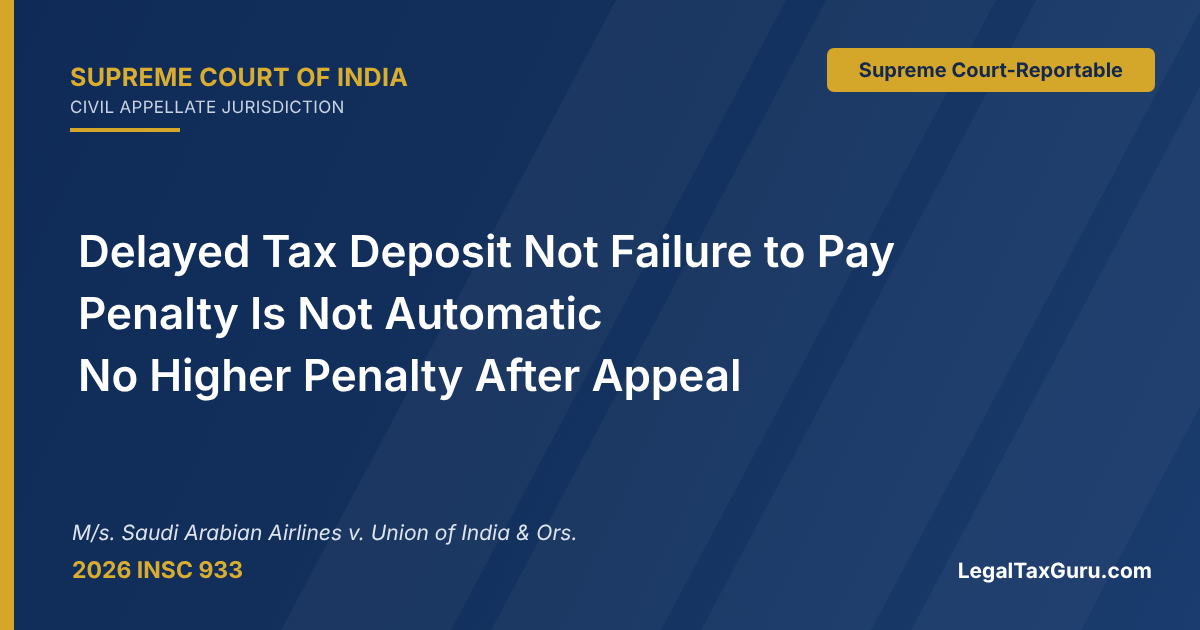
Quick Answer: Delayed deposit of Foreign Travel Tax (FTT) is not the same as failure to pay it. The Supreme Court held that the minimum penalty of one-fifth to three times the tax under Section 38(3) of the Finance Act, 1979 applies only to non-payment, while delayed deposit falls under Section 38(4). Penalty is not automatic even where a minimum is prescribed, and an appellant cannot be made worse off for filing an appeal. The penalty of Rs. 71,29,140 imposed on Saudi Arabian Airlines was set aside with refund at 9% interest.
In M/s. Saudi Arabian Airlines v. Union of India & Ors. (2026 INSC 933), the Supreme Court held that the expression "fails to pay the foreign travel tax" in Section 38(3) of the Finance Act, 1979 means non-payment and cannot be equated with delayed payment, which is governed by Section 38(4) read with Rules 4 and 9 of the Foreign Travel Tax Rules, 1979 (paras 35.1, 37.3, 40). A Bench of Justice J.B. Pardiwala and Justice Ujjal Bhuyan held that imposition of penalty under Section 38 is not automatic, that the authorities overlooked the power to condone delay under Rule 4, and that raising the penalty from Rs. 12,000 to Rs. 71,29,140 after remand offended the rule against reformatio in peius (paras 40, 46, 48, 50–54).
Status: Bombay High Court judgment dated 09.08.2010 in Writ Petition No. 3269 of 2004, revisional order dated 29.10.2004, order-in-appeal dated 09.01.2003 and de novo order-in-original dated 08.08.2001 set aside qua penalty for late deposit of FTT; refund with 9% interest ordered; appeal allowed (paras 55–56).
Headnote: Penalty for Delayed Deposit of Foreign Travel Tax
Finance Act, 1979 – Sections 35(2), 35A, 38(3), 38(4), 38(5) – Foreign Travel Tax Rules, 1979 – Rules 4, 9, 11, 12 – Foreign Travel Tax collected by airline – Delayed deposit into Government treasury – "Fails to pay" versus delayed payment – Penalty not automatic – Minimum penalty – Mens rea – Condonation of delay – Reformatio in peius – Enhancement of penalty on remand.
Held: (i) "Failure to pay" in Section 38(3) means non-payment of FTT to the credit of the Central Government; it cannot be equated with delay in making payment, and Section 38(3) does not cover delayed payment (para 35.1).
(ii) Delayed deposit of FTT is governed by Section 38(4) read with Rules 4 and 9 of the 1979 Rules; a deposit made after a show cause notice is non-payment, while a deposit made before it is delayed payment (paras 37–37.3).
(iii) The 30-day timelines under Rules 4 and 9 are flexible, as the Collector of Customs may allow a longer period on sufficient cause; if delay is condoned, no question of penalty arises (paras 37.4, 40).
(iv) Penalty under Section 38(2), (3) or (4) is not automatic despite the word "shall"; under Rule 12 the officer may decide not to impose penalty, and the range applies only once he decides to impose it (paras 39.1, 40).
(v) Exclusion of mens rea and automatic imposition of penalty are two different things; a prescribed minimum penalty does not make penalty automatic (para 46).
(vi) An appellant cannot be placed in a worse position by filing an appeal; enhancing the penalty from Rs. 12,000 to Rs. 71,29,140 on remand was a grave error (paras 50–54).
(paras 35–55)
Case Details: Saudi Arabian Airlines v. Union of India (2026 INSC 933)
Final Outcome: Appeal allowed; penalty for late deposit of FTT on 6 occasions set aside; amount paid towards the penalty to be refunded with 9% interest per annum within 3 months; bank guarantee discharged; no costs.
Case: M/s. Saudi Arabian Airlines v. Union of India & Ors.
Neutral Citation: 2026 INSC 933
Case No.: Civil Appeal No. 1052 of 2013
Court: Supreme Court of India (Civil Appellate Jurisdiction) – Reportable
Date of Decision: 1 September 2026
Bench: Justice J.B. Pardiwala and Justice Ujjal Bhuyan (author)
Relevant Acts & Sections: Finance Act, 1979 – Sections 35, 35A, 37, 38 (as amended by the Finance Act, 1994); Foreign Travel Tax Rules, 1979 – Rules 4, 7, 9, 11, 12; Customs Act, 1962 – Section 129 (revision)
Impugned Order: Judgment and order of the High Court of Judicature at Bombay dated 09.08.2010 in Writ Petition No. 3269 of 2004 (para 1)
Counsel: Mr. P.V. Dinesh, Senior Advocate, for the appellant; Mr. Arijit Prasad, Senior Advocate, for the respondents (paras 15, 16)
Source: Supreme Court of India (official website)
Key Holdings of the Supreme Court
- Section 38(3) of the Finance Act, 1979 applies to non-payment of FTT, not to delayed payment (para 35.1).
- Delayed deposit of FTT attracts Section 38(4) read with Rules 4 and 9 of the 1979 Rules, which carries a penalty of Rs. 500 to Rs. 50,000 (paras 37.1–37.3, 40).
- A deposit made after a show cause notice is non-payment; a deposit made before it is delayed payment (para 37.3).
- The Collector of Customs may condone delay under the provisos to Rules 4 and 9; once condoned, no penalty arises (para 37.4).
- Penalty under any sub-section of Section 38 is not automatic; the power to impose penalty includes the power not to impose it (paras 40, 46).
- An appellant cannot be worse off for filing an appeal; the enhanced penalty after remand could not stand (paras 51–54).
- The conflict between Section 38(3) and the Rs. 5,000 cap in Rule 11 was left open, as Section 38(3) did not apply (para 38).
Brief Facts of the Case
The appellant airline collected FTT from passengers travelling abroad and had to deposit it into the Government treasury within 30 days under Rule 4 of the 1979 Rules (paras 4–5). There were six instances of delayed deposit: delays of 1 to 11 days in five cases, where the demand drafts had been purchased before the due dates, and a delay of 63 days for December 1995 (paras 6, 47).
The appellant explained that the drafts could not be submitted in five cases because of security restrictions, and that in the 63-day case the employee responsible was on emergency leave (paras 47.1–47.2).
In the first order-in-original dated 14.06.1999, the penalty for the six late payments was Rs. 12,000. On the appellant's appeal, the matter was remanded, and the de novo order-in-original dated 08.08.2001 imposed a penalty of Rs. 71,29,140 under Section 38(3) for the same six cases (paras 9.1, 10, 11, 50).
The appellate authority upheld this on 09.01.2003, observing that the appellant's submissions "may be genuine" but penalty was attracted automatically; the revisional authority on 29.10.2004 took the same view on penalty (paras 12, 13.1, 47.3). The Bombay High Court dismissed the writ petition on 09.08.2010, holding that delayed payment equals failure to pay and that the remand was open-ended (paras 14–14.6).
Issues Before the Supreme Court
- Whether delayed deposit of FTT amounts to "failure to pay" attracting penalty under Section 38(3) of the Finance Act, 1979 (paras 15.4, 35).
- Whether imposition of penalty under Section 38 is automatic once the timeline is breached (paras 40, 46).
- Whether the penalty could be enhanced on remand from Rs. 12,000 to Rs. 71,29,140 (paras 50–51).
Court's Findings and Reasoning
Appellant's case (paras 15–15.9): Senior Counsel argued that Section 38(3) covers only absolute non-payment, that delay before a show cause notice is not failure to pay, that Section 38(4) and Rule 11 would govern in any case, and that interest under Section 35A already addressed delay; reliance was placed on US Technologies International.
Revenue's case (paras 16–16.9): Senior Counsel argued that "fails to pay" is of wide import, that Section 38(3) is a strict-liability clause requiring no mens rea, that delay is equivalent to non-payment in a fiscal statute, and that penalty proceedings are governed by Rule 12, not the limitation in Rule 7.
"Fails to pay" means non-payment (para 35.1): Reading "fails to pay the foreign travel tax" with "the amount of the tax not so paid", the Court held that Section 38(3) contemplates non-payment of FTT to the credit of the Central Government. In a fiscal statute, the Court cannot expand the expression to cover delayed payment.
Support from US Technologies (para 36): In US Technologies International, the Court had held that "fails to deduct" in Section 271-C of the Income Tax Act cannot be read as "failure to deposit" deducted TDS, and that belated remittance of TDS does not attract penalty under that section.
Delayed payment falls under Section 38(4) (paras 37–37.4): Section 38(4) must be read with Rules 4 and 9, which deal with delayed deposit of FTT and late returns. The 30-day timelines are flexible because the Collector of Customs may allow a longer period on sufficient cause, so the view that penalty is automatic on breach of the timeline is not correct.
Penalty is discretionary (paras 39–40, 46): Rule 12 requires a notice, a written representation and a hearing before penalty. The officer may decline to impose penalty; only if he decides to impose it does the range in Section 38(2), (3) or (4) apply. Relying on Hindustan Steel Ltd., the Court held that a prescribed minimum penalty does not make penalty automatic, and that exclusion of mens rea (R.S. Joshi, Gujarat Travancore Agency, J.K. Industries) is a different question.
Three errors below (para 48): The case fell under Section 38(4), not Section 38(3); the authorities overlooked the power to condone delay under Rule 4 even while accepting the appellant's explanations as possibly genuine; and they wrongly treated penalty as automatic. Penalty was therefore not imposable (para 49).
No reformatio in peius (paras 50–54): Referring to Jyoti Plastic Works (Bombay High Court), Jawal Neco and Nagarajan v. State of Tamil Nadu, the Court held that an appellant cannot be worse off than before filing an appeal, so the enhancement of penalty from Rs. 12,000 to Rs. 71,29,140 after remand was a grave error.
Final Outcome and Directions
- Penalty imposed for late deposit of FTT on six occasions set aside (para 55).
- High Court judgment dated 09.08.2010, revisional order dated 29.10.2004, order-in-appeal dated 09.01.2003 and de novo order-in-original dated 08.08.2001 quashed qua the penalty (para 55).
- Any amount paid towards the penalty to be refunded with interest at 9% per annum within 3 months; bank guarantee discharged (para 55).
- Appeal allowed with no order as to costs (para 56).
Legal Principle Laid Down
Under Section 38 of the Finance Act, 1979, "failure to pay" Foreign Travel Tax means non-payment and does not include delayed payment; delayed deposit is governed by Section 38(4) read with Rules 4 and 9 of the 1979 Rules. Imposition of penalty is not automatic merely because a timeline is breached or a minimum penalty is prescribed; the adjudicating officer has discretion after hearing under Rule 12, and delay may be condoned on sufficient cause. A litigant who appeals cannot be placed in a worse position than under the order appealed against.
Precedents Relied Upon
- US Technologies International Private Limited v. Commissioner of Income Tax, (2023) 8 SCC 24 – Relied upon – belated remittance of TDS does not attract penalty under Section 271-C. Discussed at para 36.
- Hindustan Steel Ltd. v. State of Orissa, (1972) 83 ITR 26 (three-Judge Bench) – Relied upon – penalty is discretionary even where a minimum is prescribed. Discussed at paras 42, 46.
- R.S. Joshi v. Ajit Mills Limited, (1977) 4 SCC 98 (seven-Judge Bench) – Considered – penalty may be cast as no-fault liability. Discussed at para 43.
- Gujarat Travancore Agency v. Commissioner of Income Tax, (1989) 3 SCC 52 – Considered – mens rea not required under Section 271(1)(a). Discussed at para 44.
- J.K. Industries Ltd. v. Chief Inspector of Factories and Boilers, (1996) 6 SCC 665 – Considered – strict statutory offences. Discussed at para 45.
- Jyoti Plastic Works Pvt. Ltd. v. Union of India, 2020 SCC OnLine Bom 2276 – Relied upon – no reformatio in peius. Discussed at para 52.
- Nagarajan v. State of Tamil Nadu, (2025) 8 SCC 331 – Relied upon – appellant cannot be worse off by appealing. Discussed at para 54.
- Jawal Neco Limited v. Commissioner of Customs, 2015 (322) E.L.T. 561 – Referred to. Discussed at para 53.
Important Paragraphs of the Judgment
Verbatim extracts from the judgment. For the full text, refer to the judgment PDF below.
Para 35.1: "We are clear in our mind that in the context of sub-section (3) of Section 38, failure to pay the FTT or non-payment of FTT is not to be equated with delayed payment of FTT."
Para 37.3: "Any deposit made after issuance of the show cause notice cannot clothe the default as an instance of delayed payment. It will be a case of non-payment. Conversely, any payment made prior to issuance of show cause notice would be construed to be a case of delayed payment."
Para 40: "For non-payment of FTT, sub-section (3) of Section 38 is attracted and for delay in deposit of payment of FTT, sub-section (4) of Section 38 would come into play."
Para 46: "Automatic imposition of penalty and exclusion of mens rea are two different things."
Para 46: "After all, the power to impose penalty includes power not to impose penalty."
Para 49: "Therefore, in the facts of the present case, we are of the view that penalty is not imposable insofar the appellant is concerned."
Practical Impact of the Ruling
- For airlines and collecting agents: A short delay in depositing tax already collected, made before any show cause notice, is not "failure to pay" and cannot attract the heavy minimum penalty under Section 38(3) (paras 35.1, 37.3).
- For customs and tax authorities: Authorities must consider condonation of delay on sufficient cause and must apply their mind under Rule 12 before imposing penalty; penalty is not a foregone conclusion (paras 37.4, 39.1, 40).
- For tax litigants generally: The ruling reinforces that a statutory minimum penalty does not make penalty automatic (para 46).
- For appellants: Filing an appeal cannot result in a higher penalty on remand than the order appealed against (paras 51–54).
- For tax practitioners: The reasoning follows US Technologies on belated TDS remittance and may be cited in other fiscal statutes using "fails to pay" (para 36).
FAQs on Penalty for Delayed Foreign Travel Tax
1. What did the Supreme Court decide in Saudi Arabian Airlines v. Union of India?
It set aside the penalty of Rs. 71,29,140 imposed on the airline for six delayed deposits of Foreign Travel Tax and ordered refund of any amount paid with 9% interest (paras 49, 55).
2. Is delayed payment of FTT the same as failure to pay under Section 38(3)?
No. Section 38(3) applies to non-payment; delayed deposit falls under Section 38(4) read with Rules 4 and 9 of the 1979 Rules (paras 35.1, 40).
3. When does a delayed deposit become non-payment?
If the tax is deposited only after a show cause notice is issued, it is treated as non-payment; a deposit made before the notice is a delayed payment (para 37.3).
4. Is penalty automatic once the deadline is missed?
No. The officer must follow the Rule 12 process and may decline to impose penalty; delay may also be condoned on sufficient cause under Rules 4 and 9 (paras 37.4, 40, 46).
5. Could the penalty be increased after the appellant's appeal led to a remand?
No. Applying the rule against reformatio in peius, the Court held that an appellant cannot be worse off for filing an appeal (paras 51–54).
Keywords: 2026 INSC 933, Saudi Arabian Airlines v. Union of India, Foreign Travel Tax, Section 38(3) Finance Act 1979, Section 38(4), delayed payment of tax, failure to pay, penalty not automatic, minimum penalty, Hindustan Steel, US Technologies, reformatio in peius, Justice Ujjal Bhuyan, Supreme Court reportable judgment
Related on LegalTaxGuru
Download Judgment PDF – Saudi Arabian Airlines v. Union of India
Judgment PDF: 2026 INSC 933 – M/s. Saudi Arabian Airlines v. Union of India & Ors. (Civil Appeal No. 1052 of 2013) – Download Judgment PDF
Source: Supreme Court of India (official website).