Quick Answer: An appeal to the Supreme Court under Section 62 of the IBC must be filed within 45 days, extendable by 15 days on sufficient cause, and if it is filed with defects, those defects must be cured within the 28 days allowed by the Supreme Court Rules, 2013. Once these windows close, the right to appeal is extinguished and re-filing delay cannot be condoned. The Supreme Court dismissed a liquidator's appeal re-filed after a further delay of 82 days as time-barred.
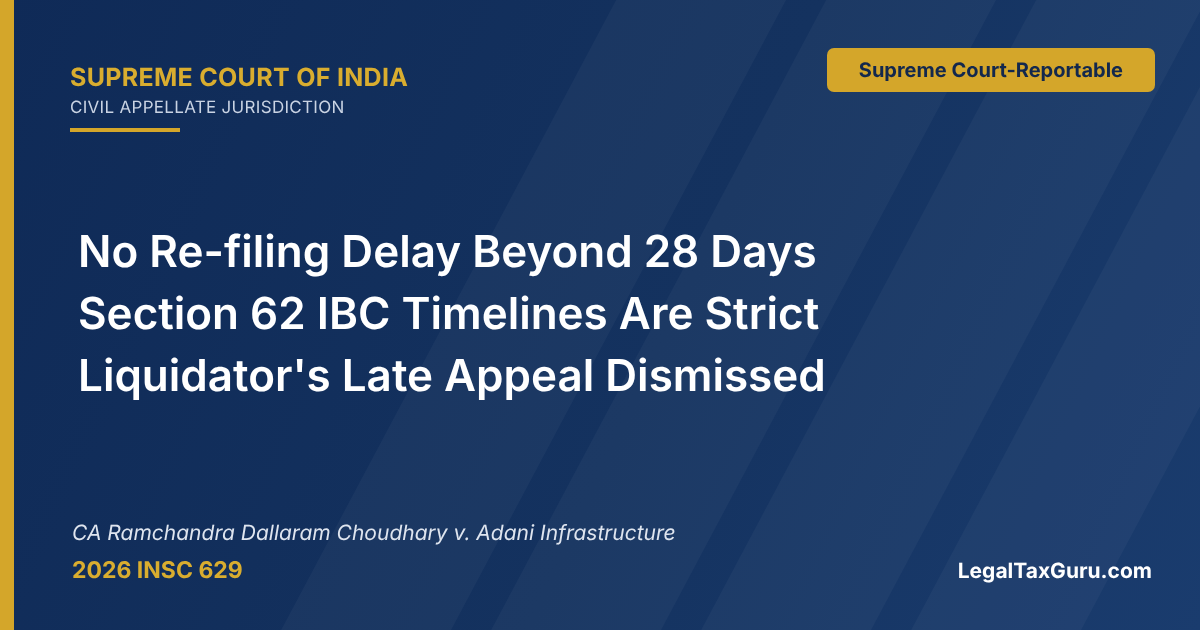
In CA Ramchandra Dallaram Choudhary v. Adani Infrastructure and Developers Private Limited (2026 INSC 629), the Supreme Court held that an appeal under Section 62 of the Insolvency and Bankruptcy Code, 2016 is regarded as instituted within time only if it is a defect-free appeal, and that no litigant can seek condonation of re-filing delay beyond the 28 days permitted by the Supreme Court Rules, 2013 after lodging a defective appeal (paras 15–17). The Rules, being subordinate legislation, cannot override the IBC, and the liquidator's status as a neutral officer does not justify relaxing the statutory timelines under Article 142 (paras 18–19). A Bench of Justice Dipankar Datta and Justice Satish Chandra Sharma dismissed the appeal as time-barred without examining the merits of the NCLAT's order (paras 2, 28).
Status: Appeal against the NCLAT judgment dated 08.12.2025 in Comp. App. (AT) (Ins) No. 2316 of 2024 dismissed as time-barred; applications for condonation of delay in filing and re-filing dismissed (paras 1, 28–29).
Headnote: Re-filing Delay in Section 62 IBC Appeals
Insolvency and Bankruptcy Code, 2016 – Section 62(1) and (2) – Appeal to Supreme Court – Limitation of 45 days and grace period of 15 days – Supreme Court Rules, 2013 – Order VIII Rule 6(3) and (4) – Curing of defects within 28 days – Condonation of re-filing delay – Defective appeal as a device to save limitation – Subordinate legislation cannot override statute – Article 142 – Liquidator.
Held: (i) The limitation scheme under the IBC is strict and time-bound; the outer limit for an appeal under Section 62 is 60 days, beyond which the appeal is barred and the Court's jurisdiction to condone delay ceases (paras 4–9).
(ii) An appeal under Section 62 is regarded as instituted within the prescribed period only if it is a defect-free appeal capable of being acted upon by the Registry; an appeal not so filed remains a defective appeal (para 15).
(iii) A litigant cannot file a defective appeal to save limitation and cure the defects at leisure; condonation of re-filing delay beyond 28 days after lodging a defective appeal is not permissible, and once the 60-day and 28-day windows close, the right to appeal stands extinguished (paras 16–17).
(iv) The Supreme Court Rules, 2013 are subordinate legislation and cannot override the IBC; the more lenient standard for re-filing delay applies to general laws, not to Section 62, which is a complete code in itself (para 18).
(v) The appellant being a liquidator acting for all stakeholders does not justify invoking Article 142 to dilute the statutory timelines, as the IBC sets no different threshold for such officers (para 19).
(vi) The earlier indulgence granted to the same appellant in the NCLAT appeal does not help; a litigant who has once secured indulgence on delay cannot assume similar discretion at the next appellate stage (paras 20–24).
(paras 4–28)
Case Details: CA Ramchandra Dallaram Choudhary v. Adani Infrastructure (2026 INSC 629)
Final Outcome: Appeal dismissed as time-barred; connected applications, including those for condonation of delay in filing and re-filing, dismissed.
Case: CA Ramchandra Dallaram Choudhary v. Adani Infrastructure and Developers Private Limited
Neutral Citation: 2026 INSC 629
Case No.: Civil Appeal No. ___ of 2026 (Diary No. 5988 of 2026)
Court: Supreme Court of India (Civil Appellate Jurisdiction) – Reportable
Date of Decision: 1 June 2026
Bench: Justice Dipankar Datta (author) and Justice Satish Chandra Sharma
Relevant Acts & Sections: Insolvency and Bankruptcy Code, 2016 – Sections 61 and 62; Supreme Court Rules, 2013 – Order VIII Rule 6(3) and (4); Constitution of India – Article 142
Impugned Order: Judgment and order dated 08.12.2025 of the National Company Law Appellate Tribunal, Principal Bench, New Delhi in Comp. App. (AT) (Ins) No. 2316 of 2024 (para 1)
Counsel: Mr. Fernandes, Senior Advocate, for the appellant-liquidator (paras 11–12)
Source: Supreme Court of India
Key Holdings of the Supreme Court
- Section 62 permits an appeal within 45 days plus a grace period of only 15 days on sufficient cause; beyond 60 days the Court cannot condone delay (paras 4, 25).
- To be treated as filed within time, a Section 62 appeal must be defect-free (para 15).
- Defects in a Section 62 appeal must be cured within 28 days of notification by the Registry; after that, there is no scope for curing defects and an application for re-filing delay does not arise (paras 17, 25).
- The Supreme Court Rules, 2013 cannot override the express provisions of the IBC (para 18).
- Article 142 will not be used to dilute IBC timelines merely because the appellant is a liquidator (para 19).
- The earlier decision condoning re-filing delay in the same parties' NCLAT appeal was confined to its peculiar facts and is no warrant for repeated indulgence (paras 22–24).
- In any case, sufficient cause was not shown for the delays in filing and re-filing (para 27).
Brief Facts of the Case
The appellant, the liquidator of a corporate debtor under liquidation, filed an appeal under Section 62 of the IBC against the NCLAT's judgment dated 08.12.2025 (para 1).
The appeal was presented on 29.01.2026, beyond the 45-day period under Section 62(1) but within the grace period under Section 62(2); the office reported a delay of 7 days, and an application for condonation was filed. The appeal was marked defective and, after the defects were cured, was re-filed after a further delay of 82 days, with a separate application for condonation of the re-filing delay (para 3).
The explanation for the re-filing delay was an internal oversight in the liquidator's office: an officer either believed the requisite details had already been conveyed or did not promptly relay them to the Advocate-on-Record, and has since left the position (para 21).
In an earlier round between the same parties, the NCLAT had refused to condone delay in re-filing the appeal under Section 61; the Supreme Court, by order dated 05.05.2025 in Civil Appeal No. 5106 of 2025, set that aside and remanded the matter for decision on merits, recording that the order was not to be treated as a precedent. The NCLAT then delivered the impugned order (paras 13, 20).
Issues Before the Supreme Court
- Whether, where a Section 62 appeal filed within 45 days or within the grace period is marked defective, the Court can condone delay in re-filing when the defects are not cured within 28 days (para 11).
- Whether the earlier condonation of re-filing delay in the same parties' NCLAT appeal assists the appellant (paras 13, 20–24).
Court's Findings and Reasoning
Appellant's case (paras 12–13): Senior Counsel argued that the liquidator is a neutral officer acting for all stakeholders, that the Court's power to condone re-filing delay of any length is not fettered if sufficient cause is shown, and that re-filing delay is treated differently from filing delay. Reliance was placed on the earlier decision between the same parties.
Strict timelines under the IBC (paras 4–9): Relying on Mobilox Innovations and Kalparaj Dharamshi, and on decisions under Section 61 such as National Spot Exchange, V. Nagarajan and Tata Steel, the Court reiterated that condonation beyond the statutory period is impermissible. In PEC Ltd. a delay of 21 days, and in Saturn Ventures a delay of two days, beyond the condonable period was not condoned.
Re-filing under the Supreme Court Rules (para 10): Order VIII Rule 6(3) and (4) earmark 28 days for curing defects; a litigant who misses this may re-file with an application for condonation, which is discretionary.
Defective appeal is no appeal in time (paras 15–17): A Section 62 appeal must be defect-free to count as instituted within time. Permitting a defective filing to save limitation, with defects cured at leisure, would defeat the object of the IBC. Once the 60-day window and the 28-day window close, the right to appeal stands extinguished.
Rules cannot override the IBC (para 18): The lighter standard for re-filing delay applies to general laws such as proceedings under the Codes of Civil and Criminal Procedure and constitutional remedies. Section 62 is a complete code, and the lis stands frozen once defects are not cured within 28 days.
No special treatment for a liquidator (para 19): The IBC does not mark a different threshold for officers like the appellant, and reading such words into the statute is impermissible.
Earlier decision distinguished (paras 20–24): The earlier order turned on the leniency shown to lawyers' lapses in re-filing and was expressly not a precedent. Here the delay was the litigant's own, and the appeal was beset by delay in both filing and re-filing. The discipline of limitation under the IBC does not countenance serial condonations across successive appellate stages.
No enquiry into cause needed; cause in any case insufficient (paras 26–27): Where the statute erects a jurisdictional bar, the adequacy of the cause shown makes no difference; even otherwise, sufficient cause was not shown.
Final Outcome and Directions
- The defective appeal dismissed as time-barred (para 28).
- Connected applications, including for condonation of delay in filing and re-filing, dismissed (paras 27, 29).
- The Court did not comment on the correctness of the NCLAT's impugned order (para 2).
Legal Principle Laid Down
An appeal under Section 62 of the IBC must be filed within 45 days, or within a further 15 days on sufficient cause, and if filed with defects, the defects must be cured within 28 days of their notification under the Supreme Court Rules, 2013. Delay beyond 60 days in filing, or beyond 28 days in re-filing a defective appeal, cannot be condoned; the right to appeal stands extinguished and no enquiry into sufficient cause arises. The Rules cannot override the IBC, and Article 142 will not be used to dilute these statutory timelines (paras 15–19, 25–26).
Precedents Relied Upon
- Mobilox Innovations (P) Ltd. v. Kirusa Software (P) Ltd., (2018) 1 SCC 353 – Relied upon – strict adherence to IBC timelines, including under Section 62. Discussed at para 5.
- Kalparaj Dharamshi v. Kotak Investment Advisors Limited, (2021) 10 SCC 401 – Relied upon – time-bound resolution is the essence of the IBC. Discussed at para 6.
- National Spot Exchange Ltd. v. Dunar Foods Ltd. (Resolution Professional), (2022) 11 SCC 761; V. Nagarajan v. SKS Ispat & Power Ltd., (2022) 2 SCC 244; Tata Steel Limited v. Raj Kumar Banerjee, (2025) 9 SCC 483 – Relied upon – condonation beyond the statutory period impermissible. Discussed at para 7.
- PEC Ltd. v. M/s Phulchand Exports Private Ltd., Civil Appeal (Diary) No. 37293 of 2022 – Relied upon – 21 days' delay beyond the condonable period; appeal dismissed. Discussed at para 8.
- Saturn Ventures and Advisors Pvt. Limited v. S. Gopalakrishnan, 2025 SCC OnLine SC 2484 – Relied upon – two days' delay not condoned under Section 62. Discussed at para 9.
- CA Ramchandra Dallaram Choudhary v. Adani Infrastructure & Developers (P) Ltd., 2025 SCC OnLine SC 1406 – Distinguished – re-filing delay before NCLAT condoned on peculiar facts. Discussed at paras 13, 20–24.
Important Paragraphs of the Judgment
Verbatim extracts from the judgment. For the full text, refer to the judgment PDF below.
Para 4: "Thus, the outer limit statutorily permissible is 60 (sixty) days, beyond which the appeal itself becomes barred and the Court’s jurisdiction to condone the delay ceases."
Para 15: "It is axiomatic that an appeal under Section 62 of the IBC to be regarded as having been instituted within the prescribed period of 45 (forty-five) days must be a defect-free appeal, which is capable of being acted upon by the Registry for being immediately placed before the appropriate Bench for consideration."
Para 17: "Consequently, no litigant can be permitted to subvert the statutory scheme by seeking condonation of re-filing delay beyond the period of 28 (twenty-eight) days after having initially lodged a defective appeal."
Para 18: "The SCR is the subordinate legislation in the field and whenever the IBC and the SCR clash, the latter cannot override the express provisions of the former."
Para 23: "A litigant who has once secured indulgence in relation to delay cannot legitimately proceed on the assumption that further defaults engendered at the next appellate stage would automatically attract a similar exercise of discretion."
Para 26: "Where the statute itself erects an insurmountable jurisdictional bar, no enquiry into the adequacy of the cause shown would alter the legal consequence that inexorably follows."
Practical Impact of the Ruling
- For IBC litigants and advocates: Filing a defective appeal within time does not save limitation; defects must be cured within 28 days, or the appeal is lost (paras 15–17, 25).
- For liquidators and resolution professionals: Their position as neutral officers earns no extra latitude on Section 62 timelines (para 19).
- For in-house and administrative teams: Internal communication lapses in relaying Registry defects to the Advocate-on-Record will not be accepted as a ground for condonation (paras 21, 27).
- For repeat litigants: Indulgence on delay at one stage does not carry over to the next appellate stage (paras 23–24).
FAQs on Re-filing Delay in IBC Appeals
1. What did the Supreme Court decide in CA Ramchandra Dallaram Choudhary v. Adani Infrastructure?
It dismissed the liquidator's Section 62 IBC appeal as time-barred, holding that re-filing delay beyond 28 days in a defective appeal cannot be condoned (paras 17, 28).
2. What is the limitation for an appeal to the Supreme Court under Section 62 of the IBC?
45 days, with a further 15 days if sufficient cause is shown, making 60 days the outer limit (paras 4, 25).
3. How long does an appellant have to cure defects in a Section 62 appeal?
28 days from notification of the defects by the Registry, under Order VIII Rule 6 of the Supreme Court Rules, 2013 (paras 10, 25).
4. Can the Supreme Court Rules allow a longer re-filing period for IBC appeals?
No. The Rules are subordinate legislation and cannot override the express provisions of the IBC (para 18).
5. Did the earlier condonation in the same dispute help the appellant?
No. That order was confined to its peculiar facts, was not to be treated as a precedent, and could not justify repeated indulgence (paras 20, 24).
Keywords: 2026 INSC 629, CA Ramchandra Dallaram Choudhary v. Adani Infrastructure, Section 62 IBC, re-filing delay, condonation of delay, defective appeal, Supreme Court Rules 2013, Order VIII Rule 6, IBC limitation, 45 days, 15 days grace period, 28 days, liquidator, Article 142, Justice Dipankar Datta, Justice Satish Chandra Sharma, Supreme Court judgment
Related on LegalTaxGuru
Download Judgment PDF – CA Ramchandra Dallaram Choudhary v. Adani Infrastructure
Source: Supreme Court of India (official website).