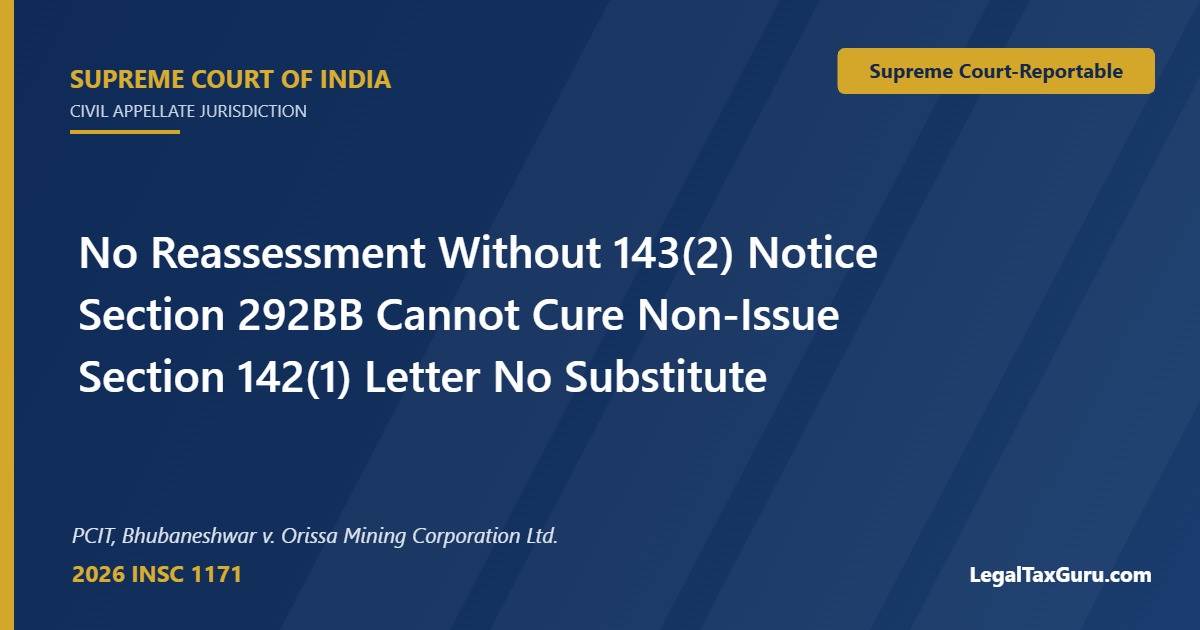
Quick Answer: A notice under Section 143(2) of the Income Tax Act, 1961 is mandatory before a reassessment under Section 147 is framed, even where the assessee asks that its original return be treated as the return in response to the Section 148 notice. Section 292BB does not save a notice that was never issued, and a Section 142(1) letter is no substitute. Reassessments framed without a Section 143(2) notice are vitiated, and the Revenue's appeals were dismissed.
In Principal Commissioner of Income Tax, Bhubaneshwar v. Orissa Mining Corporation Ltd. (2026 INSC 1171), the Supreme Court held that Section 292BB of the Income Tax Act, 1961 does not bar an assessee from objecting to the non-issuance of a notice under Section 143(2), merely because the assessee appeared and cooperated in the reassessment proceedings without objection (paras 15–16, 21, 23). A Bench of Justice Sanjay Kumar and Justice Sanjeev Sachdeva held that the Revenue must issue a Section 143(2) notice even where the assessee adopts its earlier return in response to a Section 148 notice, and that a letter under Section 142(1) issued during reassessment is not sufficient compliance (paras 18, 22–23). The Revenue's appeals against the High Court's decisions upholding the Income Tax Appellate Tribunal were dismissed (para 24).
Status: High Court's orders upholding the Income Tax Appellate Tribunal's decisions setting aside the reassessments affirmed; Revenue's appeals dismissed (paras 10, 23–24).
Headnote: Mandatory Section 143(2) Notice in Reassessment
Income Tax Act, 1961 – Section 147 – Section 148 – Reassessment – Section 143(2) – Mandatory notice – Section 143(3) – Section 142(1) – Section 292BB – Deemed service of notice – Non-issuance of notice not curable – Assessee adopting original return under Section 139 in response to Section 148 notice – Participation in proceedings – Jurisdiction of Assessing Officer.
Held: (i) Following Hotel Blue Moon, the omission to issue a notice under Section 143(2) is not a curable procedural irregularity; the notice is a sine qua non for reassessment under Section 147 (paras 12–13, 20).
(ii) Section 292BB creates a deeming fiction only as to service, timely service and proper service of a notice that the Revenue claims to have sent; it has no application where the Revenue admittedly never issued the notice (paras 15–16).
(iii) Mere participation of the assessee in the proceedings, without a Section 143(2) notice, does not confer jurisdiction on the Assessing Officer to frame an assessment under Section 143(3) (paras 17, 21).
(iv) An assessee may, in response to a Section 148 notice, state that its earlier return be treated as the return; doing so does not dispense with the Revenue's obligation to issue a Section 143(2) notice (para 18).
(v) A letter under Section 142(1) issued during reassessment does not satisfy the requirement of a Section 143(2) notice and cannot validate what is non est (para 22).
(paras 12–24)
Case Details: PCIT v. Orissa Mining Corporation Ltd. (2026 INSC 1171)
Final Outcome: Revenue's appeals dismissed; reassessments framed without a Section 143(2) notice held vitiated; ITAT's decisions, as affirmed by the High Court, upheld.
Case: Principal Commissioner of Income Tax, Bhubaneshwar v. Orissa Mining Corporation Ltd., with connected appeals (including the case of Bijoy Kishore Mohanty)
Neutral Citation: 2026 INSC 1171
Case No.: Civil Appeal No. ___ of 2026 (arising out of SLP (Civil) No. 14546 of 2023) with Civil Appeals arising out of SLP (Civil) Nos. 25931, 25932 and 25882 of 2026 and SLP (Civil) No. 3350 of 2024
Court: Supreme Court of India (Civil Appellate Jurisdiction) – Reportable
Date of Decision: 28 October 2026
Bench: Justice Sanjay Kumar and Justice Sanjeev Sachdeva (author)
Relevant Acts & Sections: Income Tax Act, 1961 – Sections 139, 142(1), 143(2), 143(3), 147, 148 and 292BB
Impugned Orders: Orders of the High Court upholding the decisions of the Income Tax Appellate Tribunal that set aside the reassessment orders for want of a Section 143(2) notice (assessment years 2008-09, 2010-11 and 2011-12 for Orissa Mining Corporation; 2009-10 and 2010-11 for Bijoy Kishore Mohanty) (paras 2, 9–10)
Source: Supreme Court of India (official website)
Key Holdings of the Supreme Court
- A notice under Section 143(2) is mandatory and a sine qua non for reassessment under Section 147 (para 13).
- Non-issuance of a Section 143(2) notice is not a mere procedural irregularity and is not curable (paras 12, 20).
- Section 292BB applies only to defects in service of a notice actually sent, not to a notice that was never issued (paras 15–16, 21).
- Participation in reassessment proceedings does not confer jurisdiction on the Assessing Officer in the absence of a Section 143(2) notice (para 17).
- An assessee adopting its original return in response to a Section 148 notice is still entitled to a Section 143(2) notice (paras 18, 23(ii)).
- A Section 142(1) letter during reassessment is not sufficient compliance with Section 143(2) (paras 22, 23(iii)).
Brief Facts of the Case
The assessees had filed their returns under Section 139, which were assessed under Section 143(3). The Revenue later reopened the assessments under Section 147 and issued notices under Section 148 (para 4).
Orissa Mining Corporation replied that its original return be treated as the return in response to the Section 148 notice; in Bijoy Kishore Mohanty's case, the same return was refiled. Admittedly, no notice under Section 143(2) was issued, and only notices under Section 142(1) seeking documents were sent during reassessment (paras 5–6).
The Commissioner of Income Tax (Appeals) rejected the assessees' objection on non-issuance of the Section 143(2) notice, holding that having participated after the Section 148 and Section 142(1) notices, they could not raise it at the appellate stage (paras 7–8).
The Income Tax Appellate Tribunal held the reassessments vitiated for want of a Section 143(2) notice and set them aside. The High Court rejected the Revenue's challenge and upheld the Tribunal (paras 9–10).
Issues Before the Supreme Court
- Whether Section 292BB precludes an assessee who appeared and cooperated in reassessment without objection from later objecting to the non-issuance of a Section 143(2) notice (para 3(i)).
- Whether an assessee who asks that its earlier Section 139 return be treated as the return under Section 148 need not be given a Section 143(2) notice (para 3(ii)).
- Whether a letter by the Assessing Officer during reassessment, asking the assessee to explain the grounds for reassessment, is sufficient compliance with Section 143(2) (para 3(iii)).
Court's Findings and Reasoning
Section 143(2) is mandatory (paras 11–13): Section 143(2) requires service of a notice asking the assessee to attend or produce evidence in support of the return. Relying on Hotel Blue Moon, the Court held that the notice is mandatory, gives the assessee an opportunity to produce evidence, and is a sine qua non for reassessment; without it, no further proceedings can be undertaken.
Revenue's reliance on Section 292BB (paras 14–16): The Revenue argued that the notice was not required and its absence was not fatal, relying on Section 292BB. The Court held that the deeming fiction in Section 292BB covers only objections that a notice was not served, not served in time, or served improperly, and comes into play only where the Revenue claims to have sent the notice. Where the Revenue admits no notice was sent, Section 292BB has no application.
Participation does not confer jurisdiction (paras 17, 21): Mere participation by the assessee does not confer jurisdiction on the Assessing Officer to assess under Section 143(3). Relying on Laxman Das Khandelwal, the Court held that Section 292BB cures infirmities in service of a notice, not its complete absence.
Adopting the original return (paras 18–19): In response to a Section 148 notice, an assessee may file a fresh return or state that its earlier return be treated as the return. Where it relies on the earlier return, the Revenue must still issue a Section 143(2) notice requiring evidence in support of it, since Section 143(3) assessment follows evidence produced pursuant to that notice.
Section 142(1) letter not a substitute (para 22): A letter under Section 142(1) during reassessment does not satisfy Section 143(2). A Section 143(2) notice is needed to commence the proceedings, and a later letter cannot cover the lacuna or validate what is non est.
Final Outcome and Directions
- No infirmity found in the view of the Income Tax Appellate Tribunal, as affirmed by the High Court (para 23).
- Question (i): Section 292BB does not preclude an objection to non-issuance of a Section 143(2) notice merely because the assessee appeared and cooperated without objection (para 23(i)).
- Question (ii): The Revenue must serve a Section 143(2) notice even if the assessee asks that its earlier return be treated as the return under Section 148 (para 23(ii)).
- Question (iii): A Section 142(1) letter during reassessment is not sufficient compliance with Section 143(2) (para 23(iii)).
- Appeals dismissed for want of merit (para 24).
Legal Principle Laid Down
A notice under Section 143(2) of the Income Tax Act, 1961 is a jurisdictional requirement for framing a reassessment under Section 147 read with Section 143(3), even where the assessee adopts its original return in response to a Section 148 notice. Its complete absence is not cured by Section 292BB, which deals only with defects in service of a notice actually issued, nor by the assessee's participation or by a letter under Section 142(1).
Precedents Relied Upon
- Assistant Commissioner of Income Tax v. Hotel Blue Moon, (2010) 3 SCC 259 – Relied upon – omission to issue a Section 143(2) notice is not a curable irregularity; notice is mandatory. Discussed at paras 12–13, 20.
- Commissioner of Income Tax v. Laxman Das Khandelwal, (2021) 18 SCC 691 – Relied upon – Section 292BB saves defective service of a notice but not its complete absence. Discussed at para 21.
Important Paragraphs of the Judgment
Verbatim extracts from the judgment. For the full text, refer to the judgment PDF below.
Para 13: "A notice under section 143(2) of the Act is sine qua non for a proceeding for reassessment under Section 147 of the Act. In the absence of a notice under Section 143(2) of the Act, no further proceedings can be undertaken by the Revenue."
Para 16: "Said deeming fiction cannot come into play where the Revenue has admittedly not even issued the notice."
Para 17: "Mere participation of the Assessee in the assessment proceedings, in the absence of a notice under Section 143(2) of the Act, does not confer jurisdiction on the Assessing Officer to frame an assessment under Section 143 (3) of the Act."
Para 20: "As held in Hotel Blue Moon (supra), the omission on the part of the Assessing Authority to issue a notice under Section 143(2) of the Act is not a mere procedural irregularity and is not curable."
Para 22: "A letter issued after commencing the proceedings would not cover up the lacuna in the proceedings and would not validate what is non est."
Practical Impact of the Ruling
- For assessees in reassessment: Non-issuance of a Section 143(2) notice can be raised even at the appellate stage, despite participation in the proceedings (paras 17, 23(i)).
- For assessees adopting their original return: Telling the Assessing Officer to treat the earlier return as the Section 148 return does not waive the Section 143(2) notice (para 18).
- For the Income Tax Department: A Section 143(2) notice must be issued before framing a reassessment; Section 142(1) letters cannot fill the gap (para 22).
- For tax practitioners: Section 292BB is a defence only against service-related objections where a notice was actually issued (paras 15–16).
FAQs on Section 143(2) Notice in Reassessment
1. What did the Supreme Court hold in PCIT v. Orissa Mining Corporation?
It held that reassessments framed without a notice under Section 143(2) are vitiated, and dismissed the Revenue's appeals (paras 20, 23–24).
2. Does Section 292BB save a reassessment where no Section 143(2) notice was issued?
No. Section 292BB deals only with defects in service of a notice actually sent; it does not apply where the Revenue admittedly never issued the notice (paras 15–16, 21).
3. Is a Section 143(2) notice needed if the assessee adopts its original return under Section 148?
Yes. The Revenue's obligation to issue the notice cannot be dispensed with in that situation (paras 18, 23(ii)).
4. Can a Section 142(1) letter replace a Section 143(2) notice?
No. A Section 142(1) letter during reassessment is not sufficient compliance and cannot validate what is non est (para 22).
5. Does the assessee's participation in reassessment cure the defect?
No. Participation does not confer jurisdiction on the Assessing Officer in the absence of a Section 143(2) notice (para 17).
Keywords: 2026 INSC 1171, PCIT v. Orissa Mining Corporation, Section 143(2) notice mandatory, Section 292BB Income Tax Act, reassessment Section 147, Section 148 notice, original return treated as return, Section 142(1) letter, Hotel Blue Moon, Laxman Das Khandelwal, Justice Sanjeev Sachdeva, Justice Sanjay Kumar, Supreme Court reportable judgment, income tax
Related on LegalTaxGuru
Download Judgment PDF – PCIT v. Orissa Mining Corporation Ltd.
Source: Supreme Court of India (official website).