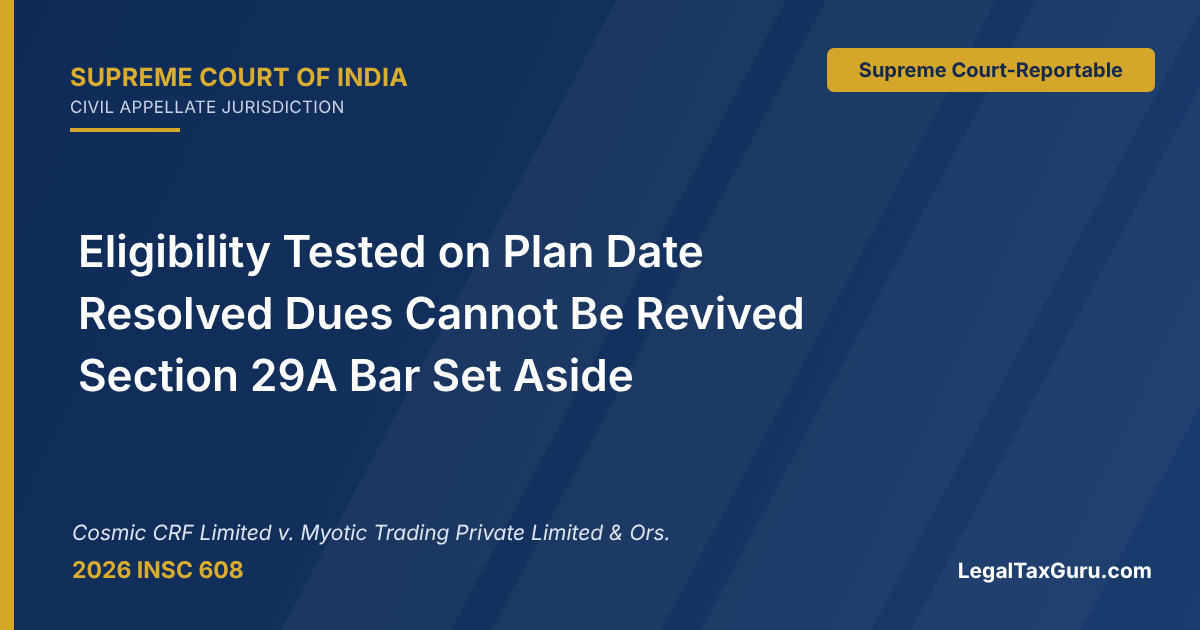
Quick Answer: Ineligibility under Section 29A(c) of the IBC is judged on the date the resolution plan is submitted. Where an NPA account of an earlier company was fully resolved under an approved plan years before, its extinguished dues cannot be revived to disqualify a resolution applicant or its connected person. The Supreme Court set aside two NCLAT orders that had held Cosmic CRF Limited ineligible, quashed the fresh Form-G and declared it eligible to participate in the CIRP.
In Cosmic CRF Limited v. Myotic Trading Private Limited & Ors. (2026 INSC 608), the Supreme Court held that the NCLAT's basis for declaring the appellant ineligible under Section 29A(c) was fallacious, because ineligibility is reckoned on the date of submission of the resolution plan, and on that date there were no dues in praesenti, Cosmic Ferro Alloys Ltd. (CFAL) having been fully resolved on 11.10.2018 (paras 31–41). As the connected person was not ineligible under Section 29A(c), there could be no disqualification under Section 29A(j) (paras 62–66). A Bench of Justice J.B. Pardiwala and Justice Ujjal Bhuyan allowed the appeals (para 68).
Status: NCLAT judgment dated 25.07.2025 in Company Appeal (AT) (Ins.) No. 859 of 2025 (to the extent challenged) and order dated 12.03.2026 in I.A. No. 4810 of 2025 set aside; fresh Form-G and consequential steps set aside; appellant declared eligible; appeals allowed (para 68).
Headnote: Section 29A(c) IBC Eligibility of Resolution Applicant
Insolvency and Bankruptcy Code, 2016 – Sections 29A(c), 29A(j), 31 and 62 – Ineligibility of resolution applicant – Relevant date is date of submission of resolution plan – NPA of another company resolved under approved plan – Extinguished dues not resurrected – First proviso to Section 29A(c) – Connected person – Familial relationship – Fresh Form-G set aside.
Held: (i) Ineligibility under Section 29A(c) has to be reckoned on the date of submission of the resolution plan; the words "at the time of submission of the resolution plan" were inserted with retrospective effect from 06.06.2018, and ArcelorMittal holds that the embargo applies in praesenti (paras 31–34).
(ii) Once a resolution plan is approved, all parties are bound by it and no dues remain under Section 31; such dues cannot be "resurrected" to gauge eligibility under Section 29A. CFAL stood fully resolved on 11.10.2018, six years before the appellant's plan dated 28.06.2024, so there were no dues in praesenti (paras 35–37, 52–53).
(iii) The appellant, incorporated on 21.12.2021, held no NPA on 28.06.2024, and its Managing Director was neither promoter nor in management or control of any NPA corporate debtor on that date; the appellant was eligible under Section 29A(c) (paras 38–41).
(iv) Following Swiss Ribbons and Eva Agro Feeds, a mere familial relationship does not render a person ineligible without actual connection with the business; there was no material that the Managing Director's father was involved in the appellant's management (paras 42–44).
(v) The first proviso to Section 29A(c), requiring payment of overdue amounts, did not apply, as no dues were outstanding; the later arm's length purchase of a CFAL unit and past employment as a marketing executive did not attract disqualification (paras 51–61).
(vi) Section 29A(j) is not a disqualification per se; once the connected person is eligible under Section 29A(c), there can be no disqualification under Section 29A(j) (paras 62–66).
(paras 31–68)
Case Details: Cosmic CRF Limited v. Myotic Trading (2026 INSC 608)
Final Outcome: Appeals allowed; both NCLAT orders and all consequent actions, including the fresh Form-G, set aside; appellant declared eligible to participate in the CIRP; its resolution plan to be processed in accordance with law (para 68).
Case: Cosmic CRF Limited v. Myotic Trading Private Limited & Ors.
Neutral Citation: 2026 INSC 608
Case No.: Civil Appeal Nos. 4266–4267 of 2026 with Civil Appeal No. 6684 of 2026
Court: Supreme Court of India (Civil Appellate Jurisdiction) – Reportable
Date of Decision: 14 May 2026
Bench: Justice J.B. Pardiwala and Justice Ujjal Bhuyan (Order; no named author)
Relevant Acts & Sections: Insolvency and Bankruptcy Code, 2016 – Sections 29A(c) (with first proviso), 29A(j), 31 and 62
Impugned Orders: NCLAT judgment dated 25.07.2025 in Company Appeal (AT) (Ins.) No. 859 of 2025, to the extent it held the appellant ineligible under Section 29A and directed a fresh Form-G; and NCLAT order dated 12.03.2026 dismissing I.A. No. 4810 of 2025 for recall (paras 2, 18, 20)
Source: Supreme Court of India
Key Holdings of the Supreme Court
- The relevant date for testing ineligibility under Section 29A(c) is the date of submission of the resolution plan, here 28.06.2024 (paras 31–33, 37).
- Dues of a company resolved under an approved plan stand extinguished under Section 31 and cannot be resurrected to disqualify an applicant (paras 36, 53).
- The first proviso to Section 29A(c) does not apply where nothing is overdue on the plan submission date; the NCLAT misread ArcelorMittal (paras 54–55).
- A familial relationship alone does not attract ineligibility without a connection with the business activity of the resolution applicant (paras 42–44).
- Section 29A(j) depends on a connected person being ineligible under clauses (a) to (i); with no Section 29A(c) bar, Section 29A(j) fails (paras 62, 65–66).
Brief Facts of the Case
The appeals arose from the CIRP of Amzen Transportation Industries Pvt. Ltd. The appellant, a prospective resolution applicant, submitted its resolution plan on 28.06.2024. The rival applicant was a consortium of Myotic and Fortune; after Fortune withdrew, Myotic alone failed the Rs. 100 crore minimum tangible net worth required by Form-G (paras 3–5, 19).
The RP and CoC first declared the appellant ineligible on 19.10.2024; the NCLT remanded the matter on 09.01.2025, and on 06.03.2025 the CoC by 100% voting declared the appellant eligible. Myotic challenged this, and the NCLT dismissed its application on 29.05.2025 for want of locus (paras 19, 24).
On 25.07.2025 the NCLAT upheld the finding on Myotic's locus but went on to hold the appellant ineligible under Section 29A and directed a fresh Form-G. On 04.08.2025 the Supreme Court permitted the appellant to point out factual errors to the NCLAT. The NCLAT heard the appellant's reply but, on 12.03.2026, dismissed the recall application and held it ineligible under Section 29A(c) and (j) (paras 9–18).
The NCLAT's reasoning rested on CFAL, a company declared NPA on 09.12.2016 and admitted into CIRP on 16.01.2018, in which the appellant's Managing Director held shares and his father was promoter; a third-party plan for CFAL was approved on 11.10.2018 (para 30). Before the Supreme Court, the CoC members, the RP and Myotic did not oppose the appellant's prayers (paras 24–29).
Issues Before the Supreme Court
- Whether the NCLAT erred in holding the appellant ineligible under Section 29A(c) of the IBC (paras 21, 30–31).
- Whether the first proviso to Section 29A(c) required the appellant to clear CFAL's past dues (paras 49–55).
- Whether the appellant was ineligible under Section 29A(j) on account of its connected person (paras 21, 62–66).
Court's Findings and Reasoning
Relevant date (paras 31–34): The Court held that the entire basis of the NCLAT's finding was fallacious. Section 29A(c) opens with "at the time of submission of resolution plan", and ArcelorMittal holds that the clause relates to NPAs and shortfalls currently owing on the plan submission date.
No dues in praesenti (paras 35–41): CFAL was fully resolved on 11.10.2018 and taken over by a new management. The appellant was incorporated only on 21.12.2021, held no NPA on 28.06.2024, and neither its Managing Director nor any connected person was in management or control of CFAL on that date.
Familial link not enough (paras 42–48): The Managing Director held only 0.09% in CFAL and was never a director or promoter; his father was the promoter. Relying on Swiss Ribbons and Eva Agro Feeds, the Court held that a mere familial relationship does not disqualify without actual involvement. The old shareholding was extinguished and control vested in the QVC Consortium, with which the appellant had no connection.
First proviso inapplicable (paras 49–55): As all dues stood extinguished under the approved plan, there was nothing to pay. The NCLAT misinterpreted ArcelorMittal, where the applicant held an NPA with overdue amounts on the submission date.
Other reasons rejected (paras 56–61): CFAL's own plan recorded that the Managing Director would have no influence over it, and he had resigned as marketing executive well before the plan submission. The purchase of CFAL's smaller unit for Rs. 49 crore, four years after the plan, was at arm's length between separate entities and drew no disqualification.
Section 29A(j) (paras 62–67): Section 29A(j) operates only where a connected person is ineligible under clauses (a) to (i). Since the Managing Director was not ineligible under Section 29A(c), the appellant suffered no ineligibility; holding otherwise would perpetually disqualify it from any CIRP. The appellant had also been declared successful resolution applicant in another CIRP.
Final Outcome and Directions
- Appeals allowed; NCLAT orders dated 25.07.2025 and 12.03.2026 set aside (para 68).
- All consequent actions taken under the impugned orders, including publication of fresh Form-G and consequential steps, set aside (para 68).
- Appellant declared eligible to participate in the CIRP of the corporate debtor (para 68).
- Its resolution plan proceedings, as considered by the CoC, to be further processed in accordance with law (para 68).
Legal Principle Laid Down
Ineligibility under Section 29A(c) of the IBC attaches at the time of submission of the resolution plan. Where an NPA account of another company has been resolved under an approved plan, its remaining dues stand extinguished under Section 31 and cannot be resurrected to disqualify a resolution applicant or its connected person, and the first proviso to Section 29A(c) has no application. A familial relationship alone does not attract ineligibility, and Section 29A(j) cannot operate unless a connected person is himself ineligible under clauses (a) to (i) (paras 31–36, 43, 53–55, 62, 65).
Precedents Relied Upon
- ArcelorMittal India Private Limited v. Satish Kumar Gupta, (2019) 2 SCC 1 – Relied upon and distinguished – ineligibility under Section 29A(c) attaches on submission of the plan; NCLAT misread it as the applicant there held an overdue NPA. Discussed at paras 33–34, 36, 54.
- Swiss Ribbons Private Limited v. Union of India, (2019) 4 SCC 17 – Relied upon – relatives and related parties are covered only if connected with the business activity of the resolution applicant. Discussed at para 43.
- Eva Agro Feeds (P) Ltd. v. Punjab National Bank, (2023) 10 SCC 189 – Followed – disqualification without substance where the related party had long ceased to be at the helm. Discussed at para 44.
Important Paragraphs of the Judgment
Verbatim extracts from the judgment. For the full text, refer to the judgment PDF below.
Para 31: "We are of the view that the entire basis for holding the appellant as ineligible under Section 29A(c) is fallacious as ineligibility under 29A(c) has to be reckoned on the date of submission of the Resolution Plan."
Para 36: "Since all remaining dues stand extinguished and the company operates on a clean slate, there is no question of such unpaid dues being ‘resurrected’ for the purposes of gauging eligibility in terms of Section 29A."
Para 38: "The appellant, which is a corporate entity, was not even born when CFAL stood fully resolved."
Para 55: "Thus, the first proviso to Section 29A(c) is not applicable at all to the facts of the present case."
Para 62: "Section 29A(j) is not a disqualification per se but only provides that the Resolution Applicant shall become ineligible if the connected person of the Resolution Applicant is held to be ineligible under Section 29A(a) to Section 29A(i) of IBC, 2016."
Para 65: "Once Aditya Vikram Birla is held to be eligible under section 29A(c), there can be no disqualification under section 29A(j)."
Practical Impact of the Ruling
- For resolution applicants: Eligibility under Section 29A(c) is tested on the plan submission date; a past NPA of another company resolved under an approved plan is no bar (paras 31, 37, 41).
- For promoters' family members: Shareholding or family ties in a resolved company do not disqualify without a present connection with the business (paras 42–47).
- For CoCs and RPs: Dues extinguished under Section 31 cannot be used to demand payment under the first proviso to Section 29A(c) (paras 53–55).
- For the NCLAT: A finding on Section 29A(j) cannot stand once the connected person's ineligibility under clauses (a) to (i) fails, given its drastic, perpetual consequences (paras 63, 65).
FAQs on Section 29A(c) IBC Ineligibility
1. What did the Supreme Court decide in Cosmic CRF Limited v. Myotic Trading?
It set aside the NCLAT orders holding Cosmic CRF ineligible under Section 29A(c) and (j), quashed the fresh Form-G and declared it eligible to participate in the CIRP (para 68).
2. On which date is ineligibility under Section 29A(c) judged?
On the date of submission of the resolution plan, following ArcelorMittal; here that date was 28.06.2024 (paras 31–34, 37).
3. Can dues of a company already resolved under an approved plan disqualify an applicant?
No. Once the plan is approved, remaining dues stand extinguished under Section 31 and cannot be resurrected to test eligibility (paras 36, 53).
4. Does a family relationship with a former promoter make an applicant ineligible?
Not by itself. Following Swiss Ribbons, the person must be connected with the business activity of the resolution applicant (paras 43–44).
5. When does Section 29A(j) apply?
Only when a connected person of the applicant is ineligible under Section 29A(a) to (i); it is not a disqualification per se (paras 62, 65).
Keywords: 2026 INSC 608, Cosmic CRF Limited v. Myotic Trading, Section 29A(c) IBC, Section 29A(j) IBC, resolution applicant eligibility, date of submission of resolution plan, connected person, first proviso Section 29A(c), Section 31 IBC, extinguished dues, ArcelorMittal, Swiss Ribbons, Eva Agro Feeds, fresh Form-G, NCLAT, CIRP, Justice J.B. Pardiwala, Justice Ujjal Bhuyan, Supreme Court judgment
Related on LegalTaxGuru
Download Judgment PDF – Cosmic CRF Limited v. Myotic Trading
Source: Supreme Court of India (official website).