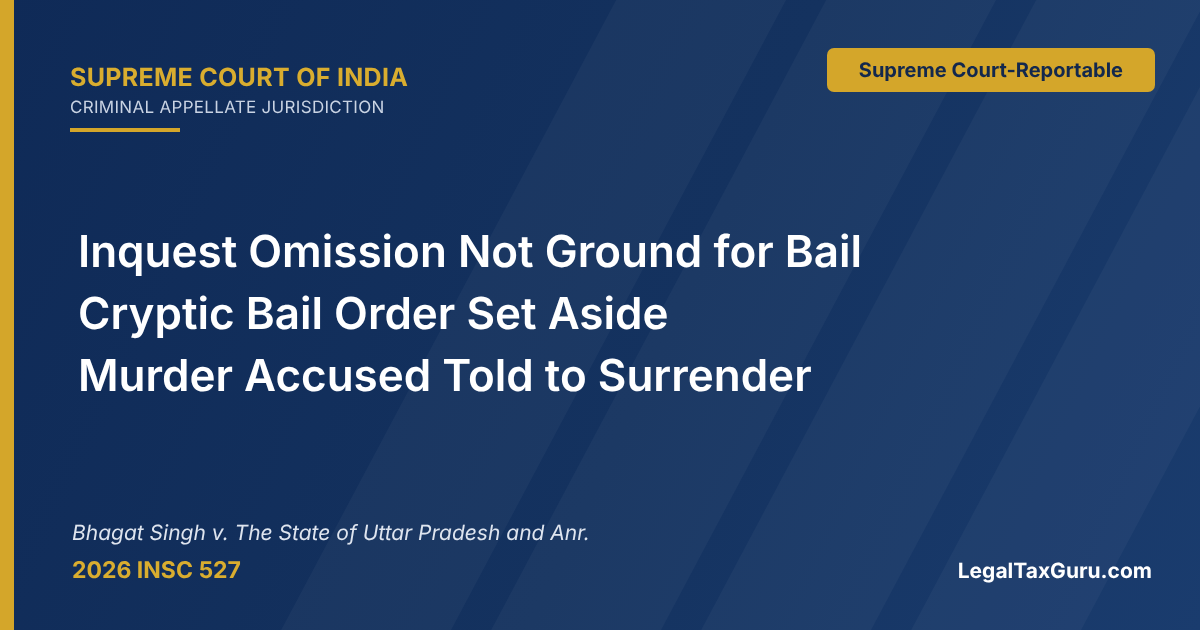
Quick Answer: The fact that the informant did not name the accused during inquest proceedings is not, by itself, a reason to doubt the accused's involvement or to grant bail in a murder case. The Supreme Court set aside an Allahabad High Court order granting bail to a murder accused, remanded the bail application for fresh consideration and directed the accused to surrender within one week.
In Bhagat Singh v. State of Uttar Pradesh & Anr. (2026 INSC 527), the Supreme Court held that an inquest under Section 174 CrPC (now Section 194 BNSS) is a limited enquiry into the apparent cause of death, so the absence of the accused's name in the inquest proceedings cannot by itself justify an adverse inference against the prosecution (paras 12–14). The High Court's bail order was cryptic, ignored the FIR naming the accused with a direct overt act, the post-mortem report, the recovery of the weapon and the witness statements, and did not follow settled bail principles for serious offences (paras 9–11, 15–16). A Bench of Justice Sanjay Karol and Justice Nongmeikapam Kotiswar Singh allowed the informant's appeal (paras 17–19).
Status: High Court order dated 22.01.2026 in Criminal Misc. Bail Application No. 2223 of 2026 set aside; bail application remanded to the High Court for fresh consideration; accused to surrender within one week; Criminal Appeal allowed (paras 17–19).
Headnote: Inquest Report Omission and Bail in Murder Cases
Bharatiya Nyaya Sanhita, 2023 – Sections 103(1), 352, 351(2) and 3(5) – Arms Act, 1959 – Sections 5, 25 and 27 – Code of Criminal Procedure, 1973 – Section 174 – Bharatiya Nagarik Suraksha Sanhita, 2023 – Sections 180 and 194 – Bail in murder case – Inquest proceedings – Accused not named by panch witnesses at inquest – Non-application of mind – Cryptic bail order – Remand for fresh consideration.
Held: (i) The High Court's order granting bail suffered from non-application of mind and was cryptic and bereft of substantial reasoning or analysis of the material particulars (para 9).
(ii) An inquiry under Section 174 CrPC, now Section 194 BNSS, is a preliminary enquiry of a limited character confined to ascertaining the apparent cause of death; it is not meant to record a detailed account of the incident or the names of the accused (paras 12–13).
(iii) Following Pedda Narayana v. State of A.P. and Amar Singh v. Balwinder Singh, the non-mentioning of the author of the crime in the inquest report cannot, by itself, be a reason to doubt the involvement of an accused who is subsequently named (paras 12–14).
(iv) The judicial discretion to grant bail, though wide, must be exercised in a judicious and reasoned manner by adverting to the settled parameters, particularly where the accusations are grave (para 14).
(v) Even if the omission at the inquest could be considered, it could not be viewed in isolation while ignoring the FIR, the chargesheet, the post-mortem report, the recovery of the weapon and the witness statements under Section 180 BNSS (para 15).
(vi) As the High Court failed to consider the material facts and assigned reasons not in consonance with settled bail principles in serious offences, its order was set aside and the matter remanded, with the accused to surrender meanwhile (paras 16–18).
(paras 9–18)
Case Details: Bhagat Singh v. State of Uttar Pradesh (2026 INSC 527)
Final Outcome: Criminal Appeal allowed; High Court's bail order set aside; bail application remanded for fresh consideration; accused directed to surrender within one week and remain in judicial custody until the High Court passes an appropriate order.
Case: Bhagat Singh v. The State of Uttar Pradesh and Anr.
Neutral Citation: 2026 INSC 527
Case No.: Criminal Appeal No. ___ of 2026 (arising out of SLP (Crl.) No. 4240 of 2026)
Court: Supreme Court of India (Criminal Appellate Jurisdiction) – Reportable
Date of Decision: 22 May 2026
Bench: Justice Sanjay Karol and Justice Nongmeikapam Kotiswar Singh (Order; no individual author named)
Relevant Acts & Sections: Bharatiya Nyaya Sanhita, 2023 – Sections 103(1), 352, 351(2) and 3(5); Arms Act, 1959 – Sections 5, 25 and 27; Code of Criminal Procedure, 1973 – Section 174; Bharatiya Nagarik Suraksha Sanhita, 2023 – Sections 180 and 194
Impugned Order: Order dated 22.01.2026 of the High Court of Judicature at Allahabad in Criminal Miscellaneous Bail Application No. 2223 of 2026, granting bail to Respondent No. 2 (paras 2, 7)
Source: Supreme Court of India
Key Holdings of the Supreme Court
- The impugned bail order was cryptic, unreasoned and suffered from non-application of mind (para 9).
- The scope of an inquest under Section 174 CrPC / Section 194 BNSS is limited to ascertaining the apparent cause of death; names of the accused need not be recorded in it (paras 12–13).
- Non-mentioning of the accused in the inquest report cannot by itself cast doubt on his involvement, and the High Court was not justified in drawing an adverse inference from it (para 14).
- Such an omission cannot be viewed in isolation while ignoring the other material collected during investigation that prima facie implicates the accused (para 15).
- Bail discretion must be exercised judiciously by applying settled parameters, especially in serious offences (paras 14, 16).
Brief Facts of the Case
The appellant, the nephew of the deceased and the informant, alleged that on 08.03.2025, while he and his uncle were going to their agricultural field, Respondent No. 2 and two co-accused emerged from concealment armed with country-made pistols and fired multiple shots at the deceased, causing his instantaneous death. The FIR was registered the same day after the inquest and post-mortem, under Sections 103(1), 352, 351(2) and 3(5) BNS and Sections 5, 25 and 27 of the Arms Act, and Respondent No. 2 was arrested on 09.03.2025 (paras 2–4).
On his disclosure statement, a country-made .315 bore pistol with a spent cartridge was recovered at his instance, and a chargesheet dated 29.05.2025 was filed. The Sessions Judge, Mathura rejected his bail application on 26.09.2025, considering the gravity of the offence, the post-mortem report and the recovery of the weapon (paras 5–6).
By the impugned order dated 22.01.2026, the High Court granted bail, observing that the informant and the brother of the deceased, who were panch witnesses, had made no allegation against Respondent No. 2 at the inquest stage. The informant appealed, contending that the order was cryptic and non-speaking (paras 7–8).
Issues Before the Supreme Court
- Whether the absence of allegations against the accused by panch witnesses during inquest proceedings justifies the grant of bail in a murder case (paras 12–14).
- Whether the High Court could ignore the other incriminating material collected during the investigation (para 15).
- Whether the impugned bail order was in consonance with the settled principles governing bail in serious offences (paras 9, 16).
Court's Findings and Reasoning
Cryptic order (para 9): The Court accepted the appellant's submission that the impugned order suffered from non-application of mind and lacked substantial reasoning or analysis of the material particulars.
Material against the accused (paras 10–11): Respondent No. 2 was specifically named in the FIR with a direct overt act of firing upon the deceased. The post-mortem report recorded ante-mortem firearm injuries with blackening and tattooing and death due to shock and haemorrhage from firearm injury. The alleged weapon was recovered at his instance, and the statements under Section 180 BNSS of the appellant, the wife and brother of the deceased and another witness prima facie supported the allegation.
Limited scope of inquest (paras 12–13): Relying on Pedda Narayana and Amar Singh, the Court explained that an inquest is a preliminary enquiry confined to ascertaining the apparent cause of death; details of how the deceased was assaulted, or by whom, are foreign to its scope.
No adverse inference (para 14): The non-mentioning of the author of the crime in the inquest report cannot, by itself, be a reason to doubt the involvement of an accused who is later named. The High Court was not justified in drawing an adverse inference merely because the informant and another panch witness made no allegation at the inquest stage.
Material cannot be brushed aside (paras 15–16): Even if the omission could be considered, it could not be viewed in isolation. The overt act in the FIR, the chargesheet, the corroborating post-mortem report, the weapon recovery and the witness statements required due consideration, and the High Court's reasons were not in consonance with settled bail principles in serious offences.
Final Outcome and Directions
- Impugned order dated 22.01.2026 in Criminal Misc. Bail Application No. 2223 of 2026 set aside (para 17).
- Matter remanded to the High Court for fresh consideration of the bail application of Respondent No. 2 in accordance with law (para 17).
- No opinion expressed on the merits; the High Court shall consider the matter independently (para 18).
- Respondent No. 2 to surrender within one week and remain in judicial custody until an appropriate order is passed on reconsideration (para 18).
- Appeal allowed; pending applications disposed of (para 19).
Legal Principle Laid Down
An inquest under Section 174 CrPC (Section 194 BNSS) is confined to ascertaining the apparent cause of death, so the absence of the accused's name or the omission of allegations by panch witnesses at the inquest stage cannot, by itself, justify doubting the accused's involvement or granting bail. A court deciding bail in a grave offence must weigh all the material collected in investigation and give reasons in line with settled bail parameters; a cryptic order that ignores such material is liable to be set aside (paras 12–16).
Precedents Relied Upon
- Pedda Narayana v. State of A.P., (1975) 4 SCC 153 – Relied upon – the object of Section 174 proceedings is only to ascertain the apparent cause of death; who assaulted the deceased is foreign to its scope. Discussed at para 12.
- Amar Singh v. Balwinder Singh, (2003) 2 SCC 518 – Relied upon – Section 174 does not require the manner of the incident or the names of the accused to be mentioned in the inquest report. Discussed at para 13.
Important Paragraphs of the Judgment
Verbatim extracts from the judgment. For the full text, refer to the judgment PDF below.
Para 9: "The impugned order, in our considered opinion, suffers from non-application of mind and is cryptic and bereft of substantial reasoning or analysis of the material particulars."
Para 14: "Thus, non-mentioning of the author of the crime or the person who had caused the death in the inquest report cannot, by itself, be a reason to doubt the involvement of the accused, who may be subsequently named."
Para 14: "The judicial discretion to grant bail, though undoubtedly wide, is nevertheless required to be exercised in a judicious and reasoned manner by adverting to the settled parameters governing the grant of bail, particularly where the accusations are grave in nature."
Para 15: "In our considered view, the aforesaid materials, which prima facie implicate Respondent No. 2, could not have been brushed aside solely on account of the alleged omission during the inquest proceedings."
Para 16: "the High Court, while enlarging Respondent No. 2 on bail, failed to take into consideration the material facts and circumstances of the case and assigned reasons which are not in consonance with the settled principles governing the grant of bail, especially, in serious offences."
Para 18: "Respondent No. 2 is directed to surrender within 1 week to the concerned jail authorities and shall remain in judicial custody till appropriate order is passed by the High Court on reconsideration of the bail application."
Practical Impact of the Ruling
- For accused persons: An argument that the accused was not named at the inquest stage will not, on its own, secure bail in a murder case (para 14).
- For informants and prosecutors: A bail order that ignores the FIR, post-mortem report, recovery and witness statements can be challenged as cryptic and unreasoned (paras 9, 15).
- For High Courts: Bail orders in grave offences must engage with the material collected in investigation and apply settled bail parameters (paras 14, 16).
- For investigating officers: The inquest report is meant to record the apparent cause of death, not a full account of the incident or the names of assailants (paras 12–13).
FAQs on Inquest Report Omission and Bail
1. What did the Supreme Court decide in Bhagat Singh v. State of Uttar Pradesh?
It set aside the Allahabad High Court's order granting bail to a murder accused, remanded the bail application for fresh consideration and directed the accused to surrender within one week (paras 17–18).
2. Must the names of the accused be mentioned in an inquest report?
No. An inquest under Section 174 CrPC, now Section 194 BNSS, is limited to ascertaining the apparent cause of death and does not require the names of the accused (paras 12–13).
3. Can bail be granted because the informant did not name the accused at the inquest?
Not on that ground alone. The omission cannot by itself cast doubt on the accused's involvement, and it cannot be viewed in isolation from the other evidence (paras 14–15).
4. What material did the High Court fail to consider?
The specific overt act in the FIR, the chargesheet, the post-mortem report, the recovery of the weapon at the accused's instance and the statements of witnesses under Section 180 BNSS (paras 10–11, 15).
5. Did the Supreme Court decide the bail application itself?
No. It expressed no opinion on the merits and sent the matter back to the High Court to decide the bail application afresh and independently (paras 17–18).
Keywords: 2026 INSC 527, Bhagat Singh v. State of Uttar Pradesh, bail in murder case, inquest report, Section 174 CrPC, Section 194 BNSS, Section 180 BNSS, Section 103 BNS, Arms Act, panch witness, bail set aside, cryptic bail order, non-application of mind, Pedda Narayana, Amar Singh v. Balwinder Singh, Justice Sanjay Karol, Justice Nongmeikapam Kotiswar Singh, Supreme Court judgment
Related on LegalTaxGuru
Download Judgment PDF – Bhagat Singh v. State of Uttar Pradesh
Source: Supreme Court of India (official website).